Dr. Cheskes - DOSE-VF RCT Final Results (11/15/2022)
Dr. Sheldon Cheskes presents final results from DOSE-VF, a four-year trial of 405 patients with refractory ventricular fibrillation. Double sequential defibrillation and vector-change pad positioning both improved survival to hospital discharge compared to standard care, though implementation challenges around device warranties and shock timing remain.
Questions this video answers
May 18, 2022
450 assessed; 405 enrolled
Patients had to receive a minimum of three successive shocks and remain in VF at the fourth rhythm analysis to be randomized
Survival to hospital discharge
ROSC (return of spontaneous circulation) and neurologically intact discharge (modified Rankin Scale ≤2)
Chapters
3, 3, 1. And then main equals will be 1, 5, 3, 3, 3. What I'm going to do is ask Sheldon to rejoin us in an hour, maybe like hit like a, like a noon hit here.
Okay.
So that.
Okay, perfect.
And I mean, the only comments I have to make is this is an amazing piece of work for a lot of reasons. It's clinical trials in.
Clinical trials in cardiac arrest are just really, they're just almost impossible to do because I think the work if all the other variables, whether it's ventilation or what's the word I'm looking for, ventilation, CPR quality, all that could be controlled for better. This, the results here would be even probably more robust if you have a really strong outcome here in any of these cardiac arrest studies. Because I've gotten to mistrust the, the ones that don't show any difference because of all those confounding variables. So this is very cool. Now one of the advantages you have here is you are dealing with ventricular defibrillation, which means that there are more cases are early on, they're witnessed, etc, that helps out a whole lot, help you achieve those goals, just like the ALP study did. And so I think that this is going to be, you know, it's going to be a game changer, I, I believe. But, you know, what do I know? Right. So we'll see.
Yeah.
How was that first? That okay.
Yeah, no, that, that. But it's interesting. How long do you think it'll take? I guess this would be one of my questions, you know, how long or if, if will the guidelines change formally because of this study? And that's, that's really the question because oftentimes, even though we've been doing this for a couple of years now, you find that the rest of the country won't change to it for years unless it's formally changed.
It will, it'll probably be done pretty rapidly, like 10 years from now. Okay, so we'll see.
So, hey, but I think it would change earlier. But that's the other thing is, remember, and I hope I'm not getting too.
Inappropriate here, but I just remember there was a comment by a certain person that said if it's good enough for the, for 60 million people, that's why the Eagles were just 60 million people we were covering. It's good enough for the President of the United States. So the point is, I think with enough, if you have enough people doing it, for example.
Then you got it for about a third of the US Population. That's A good factor.
Yep.
Hey, Paul. Okay, we got Shell on, so it's 1103. Michelle, we were just, we were just kind of talking about your study before you got on, so.
All right, so we said some good things about it, just so you know.
Thank you. Thank you, Paul. I'm so sorry for being late, guys. Really apologize.
No, we're blame Bill Gates. Don't worry.
I'm going to be sending you a link and I want you to see if you could do a reprise on this a little shorter but you know, in about an hour from now, if that's okay. All right. That's for the Eagles main Eagles group. Okay.
Yeah, no problem at all. I'm gonna my screen share, I guess, eh.
Yeah, yeah, do that.
What's that, a thing.
Canadian? I think so whatever. So.
Okay, so give me is 1-533. Whatever you want and I'll shut up for a while. Peter. See ya.
Awesome. Thanks, Paul. Shell, you want to, you want to go full screen with your, with your slides? That'd be good.
Is that it? Can you see it now?
I can see it, but we see the left column of the other slides. So just, just say, play.
Say from the beginning.
You're like, oh, you're in edit mode. So just the thing that says like it looks like a screen.
Yeah. Mine doesn't show me that. Okay, what do I show? Screen. What I do Screen.
Well, I'll tell you, I'll tell you what you do. Go, go to the. Where it says PowerPoint on top and say. It says view. Sorry. It says slideshow. You see where it says slideshow?
Yeah.
Now if you go to the left. Yeah, say from beginning. There you go.
You okay?
No, you got me now. You know what? We'll take it like it is because I, I don't want to delay it anymore. We. We see the slides, but we see your other slides too. It doesn't matter. We see it really well.
Okay.
That's all right. Yeah, exactly. So listen, we have a great, great show today and we've been waiting for this one for quite a while. And Shell Chesky is, you know, obviously we all know him very well. He's been on our webinar twice from Sunnybrook up there in Canada. And Shell underwent a huge undertaking.
For this particular study was published in the New England Journal. He presented at the AHA in Chicago last week. And he was kind enough to come and give us the hot off the press overview of it. So without any further ado, Shel, welcome back to the Florida EMS webinar my friend. Take it away.
Thank you so much, Peter. And thanks. I always love speaking to the Florida group. You guys have been very supportive throughout the trial, and it vet so many who request to speak. I'm really happy that the Florida one is one of the early ones. So going to be really nice today because I'm going to have a couple slides that we've never shown before for people, so I think they'll really enjoy it.
So.
Yeah. So, again, thanks for allowing me to present the dose VF cluster RCT following sort of my disclosure slides and my research funding slides. So certainly, we'd love to acknowledge all the co investigators. Many.
Yeah, I'm gonna stop you because your slides aren't changing for some reason.
Oh, man. They're changing.
I know, right? It's. There you go. Now it's changing.
Are you changing now?
Yep. Okay, whatever you just did there, keep doing that.
Okay, let's see.
Now. I can't find my slides here.
You know what? You unshared it, so share it again.
Yeah, but I don't have the slide deck up here, though. Okay, one sec. I gotta get this wrapped up again. Okay, Pete. Sorry, Matt.
Yeah, yeah, no, no worries.
Yeah.
This is teams, man. Okay.
Whatever. I got teams going. There's something.
Okay. Come on, baby. Can you see me?
Okay, here it comes. Okay, number. We see slide number one.
Have it now.
Yeah, but we still see slide number one.
Okay, I'm. But I'm on slide two.
Okay.
No, nothing.
Do me a favor. On. On your. On your PowerPoint, at the very top of the PowerPoint, like at the top bar, do you see it says slideshow?
Yep.
Like, above that, if you click on that, do you see it says setup show?
Yeah. Set up slideshow?
Yeah, yeah. If you click on that and then it says browse by an individual window. Click on that.
Yeah, yeah.
And I say. Okay.
Yeah.
Okay. And now say from the beginning. Yeah. Click there.
Yeah. Now you. Okay, there you go. All right. You're good. You're good.
Total insanity. Okay.
You've seen everything, Pete.
Yeah, yeah, we're good. Yeah, go right ahead.
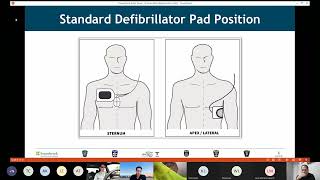
Okay. So. Yeah, yeah, just to the acknowledgments for sure, all the CO investigators, many were in Chicago, but for me, really, the 4,000 paramedics that we trained in the dose VFRCT, those are the real people I'd want to trace. I don't think I've ever had a study where the paramedics embrace the research as much as they did in dose vf. And really, if I had My choice. These guys would all be CO investigators in the study. Certainly. By way of background, many patients we know remain in VF after multiple defibrillation attempts. Double sequential vector change defibril have been proposed as alternative therapeutic strategies yet. Really? There's no high quality evidence to support or refute the use of either strategy for refractory vf. And currently under AHA ILCOR NERC guidelines, double sequential external defibrillation is currently not supported. The research question we wanted to answer were among adult patients presenting in refractory VF during that of hospital cardiac arrest, does double sequential or vector change defibrillation result in greater rates of survival and hospital discharge compared to standard defibrillation? The study itself was a three arm cluster randomized trial with crossover. It occurred in six participating EMS agencies in Ontario, Canada. The trial ran for just over four years inclusive of an internal pilot feasibility study that was previously published. The trial was paused for six months due to Covid in 2020 and the DSMB recommended halting the trial on May 18, 2022 due to Covid related operational challenges at the participating services. Survival hospital discharge was our primary outcome. Secondary outcomes were Ross VF termination and neurologically intact discharge with a modified Rankin scale less than or equal to 2. When we really designed this trial, we really wanted to focus both on the vector and on the energy. Because if either of these interventions work, we wanted to understand why it worked. Was it vector, was it energy, or was it perhaps a combination of the two? To be included in the trial, the patients had to present in VF or pulseless vt. They received standard ALS therapy if available, and we had to have a minimum of three successive shocks given and B in VF at the fourth rhythm analysis. So this is very, very important, very different from other studies. For patients to be included, they had to go vf, vfvf. Anything other than that was excluded from the trial. The pads for the first three shocks were always in the standard AL position. After three shocks, the patients were then randomized to one of three defibrillation strategies. The first one where the pads simply remained in the standard AL position as they were the first three shocks. The second randomization where the pads are removed from the L position, placed in the AP position, otherwise known as vector change defibrillation. And the third strategy involved bringing a second defibrillator, having the pads placed in the AP position and sequential shocking by two defibrillators, otherwise known as double sequential external defibrillation. Our paramedic training was really standardized Both ALS and BLS Maddox received standard in person training, both didactic video and simulated scenario on vector change and double sequential patent applications. All cases were reviewed by local PIs with feedback to the paramedics on both study compliance and protocol performance. And we found this is really key to further getting the buy in from the paramedics that they had this close relationship with the PIs. During the trial. All the patients were analyzed based on randomized treatment assignment or itt. General linear models with log link and by no means distribution accounted for clustering of the patients within each service and we adjusted for age, sex and bystander CPR. Outcomes were reported as adjusted risk ratios with 95% confidence intervals. Standard defibrillation as a reference. When we look at our CONSORT diagram, you'll see that we assessed 450 patients for eligibility, of which 405 were enrolled in the study. Nicely balanced between standard vector and double sequential as you'd expect from a cluster randomized trial. Remarkably, given the complexity of the trial, 80% of patients received the randomized allocated fibrillation strategy. When we look at the demographic characteristics, this is bad news for us males out there. 84% of males overall made up the dose VDF cohort. So this is much more common in males than females. A rate of bystander witness and bystander CPR were quite high as well as public location as the LOC for the cardiac arrest. One thing that was a real concern going into the study and because I'm such a. I'm quite anal about high quality CPR was could you do high quality CPR if you're randomized to vector change or double sequential? And what we see in this slide is regardless of the arm that the patients are randomized to, paramedics provide a guideline compliant high quality CPR throughout the trial, which is really remarkable given some of the challenges of the interventions. When we look at other characteristics, when we look at amount of drug given whether it's antiarrhythmic or epinephrine time, tantirythmic time, epinephrine time on scene, these are all very equally displayed between the three groups. You may see that the mean number of shocks to first Ross is very similar in all three arms. But remember, in vector and double sequential they required a minimum of three shocks to actually be enrolled in those arms. So it really was one or two intervention shocks that were used to get ROSC in those patients who got rosc. So these were patients who required a lot of these extra intervention shocks. If we look at our unadjusted outcomes, we see that survival to hospital discharge in the double sequential arm was 30.4%, 21.7% in the vector change arm and 13.3% in the standard arm. But really unadjusted doesn't mean much in a cluster randomized trial. When we look at the adjusted results we see that double sequential was superior to standard care for all primary and secondary outcomes of the study. Vector change was superior to standard defibrillation for VF termination and survival to hospital discharge, but not for neurologically intact survival.
First of all, this is really the first ever randomized trial exploring alternate defibrillation strategies for reform refractory F. As we noted, double sequential was superior to standard defibrillation for all primary and secondary outcomes while VF VC defibrillation was superior for VF termination and survival to hospital discharge. I think what's more important to note is we did a number of sensitivity analysis and double sequential found very consistent findings among multiple sensitivity analysis which we did not see in the vector change arm. The strength of a trial is cluster crossover. RCT designed high quality CPR regardless of the intervention group included patient important outcomes with almost complete outcome ascertainment. So it was very little missing data for primary outcomes. We couldn't blind the paramedics. Obviously tough to blind double sequential, but those assessing the outcomes in survival and neurologically intact survival were blinded to treatment allocation. We feel that the study has high generalizability because it occurred in both urban and rural settings. Both ALS and BLS paramedics use both Zol and Stryker defibrillators. And I think the importance for the defibrillator manufacturer is despite all the hurrah about defibrillator damage and the potential using our sequential technique of double sequential external defibrillation, no defibrillator was ever damaged during the trial. When we look at the implementations, clearly it's enrollment. So COVID 19 pandemic impacted participant enrollment and trial protocol resulting in early termination as recommended by the dsmb. I think when you think about that limitation you need to realize that many styles chopped completely during COVID 19. The paramedics actually did this trial for 18 months during COVID 19 and I can talk about the stop later on, but it really was quite amazing that they did that long during the pandemic. Early termination we all know has the potential to overestimate the effect size, but the findings particularly for DSED were consistent amongst multiple analysis protocol compliance 88%. You may think that's not Perfect. But really for real world study, we think it's excellent. And there was no collection of ED or in hospital care, certainly in time for our publication in New England. And we'll show you some other stuff here today. So I think when you see these results, the question is, what is really the biological plausibility of results? Why should vector or double sequential really work? And when you think of vector change, really, I think you need to visualize the position of the left ventricle. Left ventricle is really a poison posterior structure. And when you look at defibrillation using standard ALE pads, look what happens. And this diagram is fantastic. People talk about, well, you know, maybe the pads are in the wrong position. This is a very lateral pad. And what you can see with that is you miss 50% of the ventricle with this pad placement. Yet when you go to vector change, you actually pick up a greater proportion of the ventricle that was potentially missed by the standard alpad. We think that in double sequential, you get a more homogeneous distribution of current across the ventricle. But the other thing is, we saw a consistent 15 to 20% drop in impedance in the AP plane for vector change and the AP plane for double sequential, suggesting that both interventions are in fact applying a greater amount of current, which is really what's important during these two interventions. Some of the slides that I've never shown before are here. If you look at Mrs. Or modified ranking according to treatment allocation, what you'll see is that of Those who survive, 85% had a very, very good modified Rankin scale, a little bit lower in vector than double sequential and standard. And if you tease it out a bit more, look at the MRF scores for double sequential. How many had Mrs. Scores of 0, 1 or 2? So you can see that's where the big difference in the neurological intervention appears to be. One of the questions was, were people, perhaps in the arms, getting differential rates of angiography or pci? We did not have this in time for publication, but you'll see here that angiography was very, very consistent, consistent across the arms as well as a delivery pci. So it wasn't like one arm was getting more of this intervention than the other. This was very consistent amongst the group. What's very interesting is, look at a group, if you survived the hospital admission, those who had STEMI had high rates of angio, pci, correspondingly high rates of survival. But what's remarkable is, even if you had no evidence of STEMI on an ecg, you'd expect your Angio and PCI rates to be lower, but even they had a very high rate of survival. So I think that's important to take here. I think is a really incredible slide. Remember I mentioned that I said if the drugs were available from an ALS point of view. So here we had about 8% of the population with BLS care only. So no IV, no endotracheal tube, no antiarrhythmic, no epinephrine. And even in BLS care only the survival to hospital discharge was 50%. It makes me think, forget the drugs, just give me another defibrillator. So I think this is a really, really intriguing slide. In conclusion, double sequential was superior to standard defibrillation in this trial for all primary and secondary outcomes. Vector change was superior for VF termination and survival to hospital discharge. We feel that both strategies should be considered early in the management of patients in refractor vf. We also feel that the double sequential outcomes were much more consistent amongst multiple analysis. But vector change seems to be an alluring strategy in places with only a single defibrillator and rural the Ms. Agencies. We really thank the New England Journal for, for reviewing a very intense review of our paper and its publication. And yes, in Chicago I was a little under the weather as Peter mentioned, as my daughter got married the night before. So I flew out at six in the morning to get to Chicago and probably didn't give the talk quite as nicely as I hope I'm giving it today. So thanks so much everyone and happy to take any questions.
Wow, Shell, first of all, congrats on your daughter's wedding. Amazing. She looks amazing. I don't know about you, but she looks really good.
I know other people have some questions. I know other people have some questions. Exactly. I know that people have some questions. But the one I have for you is tell us about some of the challenges in running this trial. I mean, I know that it's a big, big trial, it's a big, big area. But like, just take us through some of the challenges in running a big trial like this.
Yeah, so I think the biggest challenge actually was just getting out of the gates. You remember in my slides I showed you that we use both Zole and Stryker defibrillators, but remember Stryker had a letter given to almost all their customers that if in fact they did DSD and damaged a defibrillator, they wouldn't honor the warranty. And that to me, even to this day, keeps anyone who's interested in dsdd, keeps them on the block right so we had to go to our chiefs and say, hey, we know about this letter. And they knew about the letter. They came to us and we said from our EPS experts. So we had Paul Doring, we said, using sequential techniques, we don't think that you can ever blow up a defibrilla doing that. And they agreed to take part in the trial, but that was a big piece or else we wouldn't even caught off the ground. The second thing is you run a trial and you think it's almost like an ivory tower, they're going to give three shocks and then the four shocks going to be an intervention shock. So people say, well, why did 50 people not get the randomization they're allocated to? Well, you know what, that's real life. And if there's paramedics on the call, we ran cardiac arrest in washrooms and toilets on, on buses. Sometimes you just can't get that the change in place on the fourth analysis. So patient would get a standard shock, they would terminate VF and then the patient wouldn't get the randomization because as soon as VF was terminated, that was the end of that randomization. So that's just real life in which paramedics practice. The last thing, and probably one of the more frustrating things was Covid, right? So Covid comes in. You know, we had to stop. Most people, as I said, stopped everything. But in Covid, what happened and the reason we had to halt the trial, we decided to on the basis of DSMB was at that point in time we had 75% of our workforce. Of that 75%, either that Covid or off with COVID the vast majority were sitting in emerged apartments with offload delay. So what happened was the key to this study is getting an intervention early. Paramedics were now showing up on scene after five fire shocks were given. That's unheard of in our system. You get one or two, never five. So in fact you couldn't give the intervention. So by that point, what you're actually comparing is standard to standard because it couldn't get the intervention shock. So it's very, very important for people to understand we stopped this trial not because of superiority, because we know the results, we stopped it because of feasibility. So I think that's really an important differentiation.
Very well said, Paul. Go ahead. I know you have to leave in a few minutes, but go ahead.
Yeah, so there's three points I wanted to make. One is to really congratulate you on this because it's almost impossible to do a clinical trial fortunately, you had a good subject. VF meant that you're getting relatively early with the patient. But there's so many confounding variables like the quality of CPR or like the ventilation. And you guys were keeping better track of that because of all those confounding variables. And the fact that you have your PIs out there with the medics is an important thing that people forget that it wasn't done very well during the rock. And so thank you so much for doing this. And it's a contribution. I mean, this in itself is just a victory, although a rare one on cardiac arrest trials. So that was number one. Number two is that what I wanted to point out is that.
I'm almost, you know, of the thing. They go even earlier, maybe even after a second shock, you know, to go right to this. And a lot of us are already putting the pads on the back, just coming in, especially if we're going to put out a Lucas or whatever. Just. And this helps support that. So thank you. But one thing I do want to say the. The term double sequential is a little bit. I got to put that in context when I first talked about that I was describing, because I had learned so much from all these physiologists that showed me about the VF and they had to deliver the shock within 20 milliseconds. Then they were showing that when you try to do it with two fingers at the same time, you're really not simultaneously doing it because there's such a small area. So I said, oh, so it's like a double sequential, whatever. And so when I go and talk about that at national meetings and it ended up being adopted, all I would ask is. I was going to say is if there is a way. Not that it's out on paper that way, but if there was a way to sort of change, the title of what we call this would be a little bit better. You know, like, for example, a duo vector or something like dual vector. You know, defibrillation would be a really good thing. By the way, years ago, Joe Barnado did these cool studies in the lab where he had 80 different ones on at the same time. You can get away with a lot less energy. And it worked out. But, you know, you're. Because everybody thinks that VF as being this sort of chaotic random, but there's really movement around the heart. And you pick that. You're more apt to pick things up this way. So I love the fact that you did the vector change alone. That was very cool. So thank you so much. Okay. I'm Paul Pepe and I approve this message.
Right. So. So, Paul, but that brings up a good point that maybe Shell can explain to everyone that you guys don't push the button at the same time in the paper you describe it. Can you. Can you take us through it real quick?
It's very important. I think that's a critical piece of this. So it's the difference between animal lab and real life. Okay. So many people, many of the naysayers of double sequential would tell you that you have to press the button within a very specific time frame, 75 to 125 milliseconds, for double sequential in the animal lab to be successful. So because you can't do that as a human, they can't be successful. But here we are a number of years later. We did it sequentially in our median time was 500 milliseconds. So what that tells you, you press button one, button two, as quick as you can. So 500 milliseconds, we've done the timing on this. This will come out as a secondary paper. But what it tells you is that in humans, this does not correlate to the same information we got from the animal model. In humans, 500 milliseconds seems to work. Whereas, again, the naysayers will say it's impossible. And as I said, here we are today. So it's two quick pushes, and it does not need to be simultaneous. The reason we didn't do simultaneous is there is a minuscule risk if you do it simultaneously of damaging the motherboard of the second defibrillator. Now, that's only been described to me in one case when or someone that synchronized cardioversion doing double sequential for pulseless vt. So that's the case that everyone talks about. But the risk, if you do sequential shocking, there's essentially zero risk to damaging the defibrillator.
That makes sense. Okay, how about we go to.
Okay, thank you so much.
Thanks, Shel, on that one. Let's go to Dr. Kim Landry from the panhandle. Go ahead, Kim.
Hey, Panhandler. Yeah. This has been so fascinating following your research for the past couple of years. And my question is, would there be any benefit to adding something like Esmolol to quell the electrical storm just ahead of the double sequential vector change?
Yeah.
So, Kim, that's a great question. And I'll tell you, when I came to Chicago, there was an individual giving a talk on Esmolol, and he was unable to see a benefit through Esmolol and the reason was, was 20% of the patients got double sequential. So sometimes when you do that, you're not really sure where is your benefit. Is it the drug? Is it the double sequential? And he mentioned we'll be seeing the results of dose VF shortly. And then I came and gave the talk. So I think esmo, I'm a fan of ESMOH in the, in the observational work. I'm not sure how it plays in, but I think ESMO has a role. Obviously it'll need to be likely a randomized trial that shows its benefit to actually put it into practice, but I am a fan of, and we've seen cases where both have been used and have been successful. Why that's the issue? Who knows? Is it double sequential or is it the ESMO wall?
Hey, Shel, one question I'll ask you this later so you can bring it up. Is that do you feel like you have to stick with the results of your study, like how you did your protocol, or would you move earlier to, you know, to an earlier shock, like after two or something like that? Right.
So here's the thing. You need to be careful about, about talking about doing it earlier. When you think about standard defibrillation, you need to look at survival rates after 1, 2 or 3 shocks. And survival rates after 1, 2 or 3 Shocks are actually much better than 4 to 10. So Holman and the group in Sweden, they showed your survival from shocks 1 to 3 is about 30%. 4 to 10, it's about 12%, which is bang on what we got. And after 10 shocks, you're about 4%. So if you say, I want to do this first, what you've got to show is that your survival is going to be better than 60%. I think that's a high bar to cross. And again, when you're talking about getting onto a patient's chest and doing cpr, doing double sequential runoff is a little bit trickier than just putting on the standard Al pad. So to me, I think standard Al defibrillation is probably okay. And those first three shocks after that, though, to me, all bets are off. I think there are better strategies now than, than doing standard Al defibrillation after that. So that's why I'm a bit reticent to say earlier unless I can prove moving double sequential makes that significant.
I just want to make sure we were thinking about that. And then. And the other thing is, though, I am definitely moving towards, especially if we're going to put somebody on A one of the machines or whatever is to move to that earlier. You know, get the pad on the back, you know, that kind of thing.
Yes.
Yeah, I think.
Are you opposed to. Are you opposed to AP first? The vector change first?
So. So it's interesting that you mentioned that because I. I learned this from you guys. Okay. I learned from the Florida group that they have people doing double sequential with the pads and AP first. And then it's easier to put on the AL pads after. I'm not opposed to it. It's just not what we did in the study. So I don't know if the results would be any different. But I'm big on choreography. I'm big on whatever is easiest for the paramedics. If that's easier, that's great. We do have video people. People seem to really flock to the videos in New England that we sent. Now we have video of how to do double sequential using mechanical CPR that we're going to release because I think a lot of people have that question. But again, that's with standard AL first. So we have a mechanism, a way to do it. And we're going to release those videos shortly because I think it's an area of big interest.
And then last, but not.
The Eagles meeting. Can you come on in a half an hour then?
Yeah, I. I have the link, Paul. I'll come on. And you wish me to give the same talk, Paul?
Yeah, sure. That'd be great. Okay, so thank you.
You're welcome.
Come on with the meeting right away and see what we do. I think if you good to get to know the group, it'll be good for you. All right. And I want to thank Mike Feldman and all the other folks that were just fantastic up in Toronto helping us with the show last week. So thank you so much. See you later. Take care.
You're welcome.
Thank you.
Let me bring in Dr. Mitch Mulfair from the west coast of Florida. Mitch, I know you had a question. And then we'll go to Paul's webinar.
Winter Parker. Hey, do you get any defibrillator manufacturers able to build a device for you?
Yeah, we haven't done that yet. I've had a lot of questions from the defibrillator manufacturers. I don't. I think we've. Listen to me. What would be perfect? What would be perfect would be a single defibrillator with four pads and perhaps the defibrillation shocks being able to be delivered exactly like in the animal model. Who knows? Maybe this is just the edge of the iceberg. Maybe we can even do better with optimized defibrillation. So I think you're going to likely see changes. What those are going to be, I have no idea. But I think people are always asking about this now, you know, will there be changes in defibrillator? I leave that to the manufacturers.
What about, what about an internal defibrillator probe? Basically an esophageal probe that defibrillates internally, essentially. Is that, would that be better because of the location or. That's hard to do in EMS anyway.
Yeah, to me, I don't have enough experience with that, so I wouldn't be able to comment.
Wow. Well, I'll tell you what, it's not often that you get folks in EMS who are publishing in the New England Journal and this was big and you put a lot of your life's work into it. The paper is very easy to read. I mean, very well written. All the data is there. Thanks for giving us some of the background inside baseball on the slides that you didn't show anybody else. We appreciate that and we look forward to hearing you back on the Pepe show. So we'll stop here and we'll all pop over to Pepe and Shel. Man, you're the best. Thank you so much for doing that.
Thank you, really. Thanks to the Florida group. You guys have been fantastic. I've always loved presenting to you folks. I think you're very progressive. You do some fantastic pre hospital work. I think you've always been supporters of double sequential. And I said this, I'll just give you one last word. People ask me, are the guidelines going to change, change now, do you know what I mean? And to me, to me, guideline, change is up to Ilcor, erc, all these other people. And to me, I've always been taught, do your best science and let that science speak for itself. In the area of double sequential, in my mind, there's no better science than what we've done. The other science is just not the quality of what we've done in this randomized trial. So for those people who've already been doing double sequential without the strong science, hey, you can feel like, hey, you know what? We knew this was, you know, we're seeing what we're seeing in our systems. It's now good to have some science to back us. So I think that's the important thing. I think I know during this trial we must add 75 to 100 agencies. Contact me about double sequential. And they were already doing it they wanted to know ways to do it better. So it's already out there. Regardless of what the guideline bodies say. People are already doing this. At least now there's a little better evidence for it.
And that's what I'm hoping that today's webinar and today's talk will accomplish here in the state of Florida is that we in Florida do things that the AHA probably won't agree with until 2032. We ought to we ought to have a body in EMS that has our own guidelines rather than waiting for the tablets to come down from the mountain of the ICU. Dr. So you helped us do that. And Shel, thank you so much.
Appreciate it.
Always a pleasure. Peter, thank you to everyone. I'll see you on the Eagles.
See you on the other side. Yeah.
Okay, bye.
Thank you, Angus. We appreciate that. And we'll pop on over someone. Stick around and we'll be on the Eagles in a minute.
More from Peter




Melissa Olen MSN, FPN-C, CCRN: Sudden Cardiac Arrest Training in Schools (Project ADAM) 4/25/25



Pediatric Hospital Readiness: How Teamwork & CPR Metrics Drive Better Outcomes



Chelsea Kadish, MD & Kyle Goodknight, EMT-P, RT: Pediatric CPAP in EMS (3/14/25)