Dr. Christain Villaincourt: Implementation of the Modified Canadian C-Spine Rule in EMS (4/11/2023)
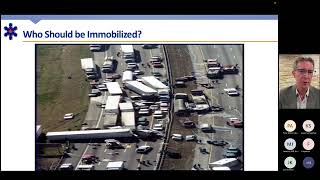
Dr. Christain Villaincourt (Univ. of Ottawa) presents evidence for implementing the Canadian C-Spine Rule in prehospital EMS to reduce routine use of backboards and cervical collars. He summarizes prior derivation/validation work, reports an Ottawa implementation study and a larger multicenter pragmatic stepped-wedge trial across 11 Ontario services that extended the rule to children (age ≥8) and used 30-day follow-up. Key findings: immobilization rates fell markedly (single-center to ~36%, multicenter eventually ~3% backboard use after provincial policy change), pain and discomfort decreased, diagnostic imaging and X-rays decreased, no new spinal cord injuries attributable to the strategy at 30 days, and a one-year cost saving of roughly CAD $1M across 11 centers. Training was brief (30-min video + 30-min in-class), eligibility/exclusion criteria emphasized (GCS 15, blunt trauma, exclude penetrating trauma and known prior spinal fusion), and older adults (≥65) remain a high-risk subgroup.
Questions this video answers
April 11, 2023 (YouTube webinar hosted by Peter Antevy).
About 1.3 million patients per year (Canada).
Less than 1% overall; roughly half of those have spinal cord injury (speaker's characterization).
About 50,000 patients studied with the rule; historically it missed two injuries across studies (speaker stated).
The cohort had 31 injuries total; 11 were described as clinically important (speaker's report).
Chapters
Yeah, no, I'm not. I'm proud I'm gonna be able to do that today. I'm sorry, Paul.
All right, good. Well, I'll just leave it on the agenda for next week. How's that? Can you think? Okay.
All right, I'll tell.
You're such a loser.
I know. I'm sorry. There's a lot going on down here.
I know. Is there anything we can do to support you? Please let me know. So. All right.
No, I'm good. Except if we haven't done a recent poll of what video devices people are using, I'd be interested.
What? What?
A video. A poll that we. Of what?
Of what video laryngoscope devices people are using.
Okay.
I'm just interested in what the. What the best stuff on the market is right now.
So, Peter, have you.
Well, you. Are you going to be on the Eagles? Can you remind me to ask that to the group?
Yeah, I'll be on it remotely through my phone, but I'll be on it.
Yeah.
All right. Just remind me. Yeah, we can do it. And we'll get to Jim and he. Maybe he could put something for us.
Yeah, I could just email Jim if that's easier.
Well, yeah, let me sort of filter it, too, to get some initial feedback.
Okay.
Because sometimes it's discussion and not just, you know, what's the word I'm looking for? And not just the survey. There's a lot of love when we ask the question because then we get a lot of cool insights. Like last week when we brought up this issue about identifying where the ODs are. That came out to be a really cool discussion that you launched. Okay. So.
Just. If you want to hold for a second, I'll make sure that Christian can get his thing up.
Yeah.
Can you. Can you see if you can go full screen on that? Christian?
Yeah. Are you seeing the slide without being full screen for now?
Yes.
Yeah, we see it.
See full screen.
Yep. Try and just advance one slide to see if that works, because sometimes. Okay, you're good. Perfect. Okay, awesome. You can go back one. All right. Perfect. Okay. All right, Paul and Angus, sorry about that. You guys got done what you need to get done?
Yeah, we're all set.
Okay. Thank you, guys. All righty, everybody. Welcome to another Tuesday. We are here.
It is April 11th. The Eagles and Seagulls CME codes are in the chat and really excited about today. We have Dr. Christian Villencourt, who hails from the University of Ottawa. He is a physician. He is a cardiac arrest researcher, but he's Also the lead investigator in the study that he'll be talking about today regarding a clinical decision rule assessing the need for spinal immobilization in low risk trauma patients. And obviously he's got a very long cv, many publications. I'm not going to go through all of that, but just hugely honored to have him. As soon as I emailed him, he emailed me right back and he says and he has a list of things that he would like to talk about. But we're going to try and focus on this paper today. Dr. Villancourt, thank you so much for joining us. If you want to make any further introductions, anything that I missed, but take it away. And thank you so much for coming on the program today.
Thank you so much, Peter. And thank you for you. Thanks to you for reaching out and thanks to everybody for joining. It's a real honor for me to be able meet with this group and tell us about, tell you about our work. So I may be speaking a little bit fast because I want to put a lot of things in and I want to leave time for answers at the end. But essentially let me just make sure it advances over here. Here we go. Just in addition to what was mentioned, I'm an emergency physician now in Ottawa. I'm also one of the associate medical director for the paramedics of Eastern Ontario. Before joining Ottawa, I was a doctor on the road in Montreal providing ALS care. So I don't believe that Montreal even to this date has advanced care paramedics. They have basic primary paramedics. And back in my days doctors were providing ALS care on the road. So always been passionate about pre hospital medicine to talk about C spine injuries very briefly. In Canada at least, we have 1.3 million such patients transported with backboards and C collar every day, every year. Sorry. To put things in perspective, the whole population of Canada fits in California. So I'm sure your problem is of a different magnitude. And if you look at stable trauma patients transported with the backboard and C collar, less than 1% of them actually have a cervical spine injury and half of that have a spinal cord injury. This is where the legal landscape might be slightly different between our countries. But a consensus of spine surgeons and trauma surgeons agree that the injuries on the screen we don't care about. So the Canadian C spine rule is meant to identify every cervical significant injury that requires stabilization or a collar or a halo or a surgery. But we don't care about spinal processes or small osteophytes or compression fractures of less than 25% those essentially you treat with painkillers and physio. So it's okay if we don't do diagnostic imaging on everybody. Meet the ancestor of the backboard. So back in the Napoleon wars, people were ripping off doors of buildings to essentially transport people. So this is what it is. The backboard is a transportation device, not an immobilization device. But we have so much fancier devices today. That doesn't mean that they're necessarily all helpful, except maybe for tabletop. We know as well that the majority of the damage is done at the time of the injury, not during transport. Suggestion that patients self extricating themselves is actually better than using all of our extrication devices. There's a growing number of papers and evidence showing that there's well documented impacts on patients and resources. What we currently do is simply not evidence based and people are often kept on these devices for way too long. You have here on the left the list of consequences to patients, but we also sometimes neglect the consequences on our healthcare system. And transporting people in board and collar is also often a source of back injury in paramedics as well. For example, there's been lots of studies done comparing transporting patients in their position of comfort, like in Malaysia compared to the US system with no changes in outcomes or spinal cord injuries. Has been a Cochrane review. And even in 2015 already the AHA and the Red Cross was recommending against the blanket statement of transporting everybody with a board and collar for first aid responders. Nonetheless, we have to determine who really needs to be transported with some kind of immobilization. I'm going to tell you briefly about the process of developing a decision aid or decision rule, such as the Canadian C Spine Rule. There's really four phases. The first one is a thorough review of literature to identify story elements and physical findings, elements that are associated with having a significant spinal cord injury. The next step is then you derive the rule. And I remember participating in this when we developed the rule in the ED in Ottawa and when we evaluated patient we had about 30 or 40 questions to answer. This is the derivation rule. When you don't really know which answers are which questions are most relevant and then you narrow it down to hopefully a more manageable list of questions and you redo the study. In a new population, you still X ray everybody, you still immobilize everybody, but then you see if the smaller number of questions can still identify all the injuries correctly. And you do all of this before implementing the actual suggestions from the rules where you can actually either not do an X ray or not transport the patient with immobilization. So the Canadian C Spine Rule followed all these steps. It was derived, validated and implemented first by emergency physicians and then by triage nurses to remove immobilization and not do any X rays when it was not necessary. But it would make so much more sense if we did not apply the immobilization devices to begin with. And that's the reason why we're together today is to talk about the implementation of the Canadian C span rule by paramedics, which was published in February in Annals.
Just to take a step back, it was actually difficult for us to do this study and to convince our ethics board that it was valuable to do this with our paramedics because what we knew in the pre hospital field at the time were mostly these five US studies using the NEXUS rules. They were all rather small and as you can see, all of them missed some injuries. So it was actually difficult to convince our decision makers to let us go ahead. But the Canadian C Spine Rule has now been studied in almost 50,000 patients and has only ever missed two injuries so far. So I hope I'll convince you that that's the rule to use.
We see the Canadian C Spine Rule as a series of three sifters. Simplistically, the first one being if there's any one dangerous mechanism, then you need immobilization, then we would do X rays in the hospital. If you don't have any of the dangerous mechanisms and you have at least one of the low risk criteria, such as you were ambulatory at the scene, for example, then you go through the third sifter which is can you rotate your neck 45 degrees left and right on your own? And if you can do all of this, you don't have a cervical spine injury. Now it sounds simple, but as you can see on the screen, there's many sub questions and no doubt that using this rule at first takes a little bit of investment. So we do have pocket cards that we've provided our paramedics to learn and sometimes they had to make reference to it in the field as well to make decisions when they were part of the study. Ultimately you remember all these things by heart and become second nature. So about the study that was recently published. This was the first time that the Canadian C Spine Rule was actually implemented with our paramedics. So they were allowed to actually transport patients without any immobilization when it was.
Relevant to do so. Just kudos to my team. We don't do ever any of these studies without paramedic partners. So we had study champions. So if there were any questions in the field, if some of my paramedic colleagues were a bit shy to contact me or my team for questions, they had some of their own colleagues that were part of the team that they could ask questions to. We had a data safety monitoring board as well and we were in partnership with our Ontario Ministry of Health. The goals of the study were many fold. Of course we wanted to evaluate the rule itself, but also the ability of the paramedics to follow the rule and also their comfort using it, not the least of which was whether or not this was going to ultimately have significant reduction in immobilization, the rule. The study was initially meant to be taking place over a three year period. It took us four and a half years to complete it. Perhaps important things to set in the beginning is that the rule only applies for what we call low risk normal patients. And we defined this by being essentially with normal blood pressure, normal pulse, normal gcs. That's not the kind of thing you want to do. If you have a very agitated drunk patient with a GCS of 13, you don't apply a rule to try to remove immobilization. It also excludes patients which are ineligible. So we do not include or evaluate penetrating trauma with the rule. If you have known cervical spine.
Injury from the past, if you already have a few fused vertebrae, or if you have enclosing spondylitis, obviously if you're already paralyzed, this is. These are not the patients that we evaluate with a rule like this to try to transport them without immobilization. Otherwise you apply the rule. When your local service or system would essentially ask you to consider the possibility of a cervical spine injury, you hit your thumb with a hammer, you don't use a C spine rule, but if you had a significant fall downstairs and there's a question that someone should be immobilized if you're about to apply demobilization, this is when you can consider can I use the C spine rule in this patient or not?
Training we trained all of our paramedics, not just the advanced care, the primary care paramedics as well. Training was not too involved. It included a 30 minute video to watch at home before an in class tutorial. Also 30 minute case based Q and A, a bit of a quiz as well. So not too, too involved.
We reviewed diagnostic imaging at all of our receiving hospitals. We used an admin database, we used referrals through our spinal service. There's only one in Ottawa. And we followed outcomes for 30 days to make sure we didn't miss any injuries. These are the usual statistics for patients that are eligible for being evaluated with a C spine rule, usually mid-40s. I wish I could say they're young and stupid males, but it's equally equal distribution between males and females. Majority of injuries are from motor vehicle collisions and falls. We did have 31 injuries in total. I told you that we're only concerned about the important cervical spine injuries. Those are the ones breaking the rim, the ring of bone stabilization around the spinal cord. And we had 11 of those. I did say that the Canadian C spine rule itself ever only missed two patients. Well, we. That was one of those in our study. This is very interesting because this was actually something that was caught on tape. It was during an assault. It was a store owner that was assaulted by a thief. He was punched in the face, lost consciousness, fell forward his chin onto a garbage can and essentially lost consciousness for a few minutes.
He had regained consciousness completely. I'm sorry, my phone's going in the background. He had regained consciousness completely at the time of the paramedic arrival. He passed the rule with flying colors. Emergency physicians looking after him in the emergency department originally had no suspicion of cervical spine injury and they only picked up a C1 fracture when they did the CT of his head because he had lost consciousness and he had been punched. So no spinal cord injury. That patient was left actually left with a hard collar with no other consequence. The paramedics were either comfortable or very comfortable following the C spine rule. And ultimately this led to a significant decrease in our need for transportation with backboard and C collar. So we only needed about 36% of our patients compared to usual practice to be transported with the backboard and the collar. This pretty much stops where the study that you're aware of that was public published in Annals, But I'm here to tell you as well that since then we've also completed a much larger study, multi center study. This time none of the papers have been submitted or published as peer reviewed, but most of them, except for two, have been already presented in abstract format and published in that way. So quite happy to tell you a little bit more about what we've been doing the last few years. This was a very large endeavor, 1.4 million dollar study, lots of partners, including this time patients and paramedics. So this was patient oriented. And as you can see here, we actually have a patient with lived experience and the paramedic as part of our study team as well, the objective of that trial was of course, to make sure that we could continue to decrease the need for immobilization, but also to look at the impact on pain and discomfort for patients transported with one strategy or the other. We also wanted to see if this was going to impact the use of diagnostic imaging in hospitals. And when you get x rays and CTs, you have radiation exposure and at least to cancer. We also wanted to look at skin pressure sores and also total time seen saved at the scene and also ed, length of stay and so on.
This was a pragmatic trial, meaning we were much less, we were much more hands off in terms of how scrutinizing we were of what was happening in the study trials. This was very much a real life experiment and the training was done by the paramedic services as well. We use something called a stepped wedge. This is something that our services prefer because it means that ultimately all the services can actually play with the rule. So in the first three months, everybody was evaluating all patients with the rule, but everybody kept being transported with cervical collar and backboard as per usual care. And at three month intervals people were actually allowed to start using the recommendations of the rules until such a point where everybody could use the rule. And they like that approach very much. These are the services involved. There were 11 across eastern Ontario. There was only two small differences. For the very first time ever, we were able actually to implement the Canadian C spine rule in the pediatric population, which is another thing I forgot to mention earlier. The C spine rules thus far was only applicable to people age 16 and above. And now we've actually implemented it in the population all the way down to the age of 8. The other difference as well, just to be in line with the in hospital studies and what is being used for in hospital, the same rule is a bit different. Injuries up to 48 hours is what we're using now as opposed to the study that we've published recently. If you had an injury more than four hours, you couldn't be evaluated by the C spine rule. We mentioned that the main scope of this project was pain and discomfort that was measured on the 10 point Likert scale. Because it was a pragmatic trial, we did not have the resources to look at every single diagnostic report, so we used a large admin database instead. So we had to redefine what we meant by clinically important injury. We used to be able to eliminate all the unimportant injuries and now we had to essentially look specifically for injuries where patients had received either Internal fixation, halo brace or rigid collar. Those are the injuries really that we care about not missing. I'm putting this flow diagram there to also give you a perspective of what proportion of all the patients you currently put on the backboard and C collar could even be evaluated with the Canadian C Spine Rule. For example, I don't know about you, but we transport all of our post arrest or WASC patients on a board and C collar for convenient purposes. But you can see on the right that among all the screen patients, some of them did not have a GCS of 15, some of them had missing eligibility criteria. So roughly speaking, of all the patients that you transport currently with a backboard and C collar, about half of those you could evaluate with the C spine rule. And among those 60%, you could probably transport without immobilization. Again, just regular stats from the study that is not published yet.
Again, motor vehicle collisions and falls most commonly. One thing that was pretty interesting as well is we did discover that in the intervention phase when some people did not need collar or backboard, they were also probably a bit more likely to refuse transport to hospital altogether. Which made us think that perhaps the only reason why some of those were transported to hospital was because the collar and backboard were applied. And we did have the expected 1% injury in our cohort. So that was pretty representative of real life in terms of safety data. There were five clinically important injuries that were transported without immobilization.
One of them, the equipment, did not fit, and you can argue they were immobilized but using pillows. In another case, the patient refused immobilization. So that's tough to blame the rule on this one. And in the other three cases, one occurred before the implementation of the implementation phase and two during the implementation phase. And it's essentially because paramedics did not follow their ministry criteria or did not follow the recommendations of the Canadian C Spine Rule. Nonetheless, these are patients with significant injuries transported without immobilization. None of them had a spinal cord injury. And the Canadian C Spine Rule rule would have identified them all if it was followed and still at 30 day follow up. No injuries resulting from this strategy. So if you look at immobilization rates, you would expect that in the control group the immobilization rate would be 100%. It wasn't. So I did say that this was a pragmatic trial. With the trial in Ottawa, if you did not immobilize someone appropriately, we sent you a letter asking you to justify why you failed to follow your clinical Medical directives. In this case, we just let real life experiments happen. So even in the control group, the mobilization rate was not 100%. And some paramedics were using their own experience and judgment, so to speak, to decide to kind of go against their medical directives as you go along in the blue phase, you see that the immobilization rate, this is when they were allowed to actually implement no immobilization following the C spine rule, it kind of decreased to the expected 30 to 40% rate. And then the Ministry of Health in Ontario threw a curveball at us in three months before the end of the study, rolled out their spinal motion restriction, which essentially allowed our paramedics to transport most patients with or without a C collar according to our study, but essentially without immobilization on the backboard. So our backboard immobilization rate by the end of our study fell down to about 3%. So we took this opportunity to prolong the study a little bit and study this group as well. So what does this mean is the majority of patients in Ontario now are transported top right in a position of comfort, sometimes semi sitting on a soft cush, not on the backboard, with or without a cervical collar, according to what the recommendation would be from the Canadian C spine rule. So in the end, these are our immobilization rates. So in blue you see the immobilization rate from the much larger multicenter study, pragmatic experiment, real life experiment, not surprisingly, the immobilization rate decreased a lot. Certainly not unexpectedly, pain and discomfort decreased also very significantly. We saw no pressure sores. We read everywhere in the literature that, you know, backboards cause pressure sores. We did not see any. It did decrease significantly. Diagnostic imaging, if you're a volunteer, you immobilize yourself on a backboard long enough, you'll have back pain in your upper thoracic lumber area. That will make a physician think that you have an injury even if you don't and lead to X rays. So we were able to decrease X rays. Unfortunately, time at scene and time in the ED that didn't change. But it's probably more a reflection of our crowding. We have a few pre specified analyses as well. We were interested to compare the scoop device to the full board with the hypothesis that the slit in the, in the scoop device would actually make pain and discomfort less. But we did not find any difference between the scoop and the hardboard. Really. Pediatric population, thankfully, these injuries are rare. We did not have any significant injuries. The paramedics were quite Happy applying the rule even in the pediatric population. So were the patients and their parents. And we were able to successfully decrease significantly the amount of immobilization in the pediatric population. We looked at inequities, we did find that we looked at inequities by age, by sex, by language barrier. And there's a few details that I don't have time to go into too much today. But not surprisingly, once again, if there's a language barrier, you will not benefit from this. Essentially, when we couldn't communicate well with patients, they were transported more likely with a cervical collar and backboard, even perhaps if they didn't need to. And similarly in the hospital when we can't communicate, unfortunately most often we do more tests and X rays. We did look at the impact of our Ministry of Health spinal motion restriction. Transporting patients, as you see here, bottom right, does not cause spinal cord injuries, increases patients comfort satisfaction tremendously and is certainly appears to be a safe thing to do. And lastly, we did do a cost analysis. Not myself personally, we had a team of cost analytic experts doing this. And just to put things in perspective for you, just among the 11 centers who participated in that one year study, taking into account the equipment, the diesel of the truck running longer, also the visits at their friendly doctors in the next 30 days after injuries, X rays and so on, they saved $1 million in that year. So imagine if we were to do this province wide and for more than one year.
I guess we can discuss before opening for questions, the last study I told you about, this was a very large real life study, certainly a reflection of what it might look like if you were to implement this in centers other than Ottawa. It's a relatively easy strategy to implement in terms of teaching to the paramedics. We had many measures of direct patient benefit, not just system benefit, although we did not find any time savings from doing this, but massive massive cost savings. We also so far have not still have no spinal cord injury from using this strategy of transporting in a position of comfort. Additional impacts. This is certainly gathering some attention. These studies have been presented at three plenaries at scientific meetings. The Annals paper that you're aware of was selected for article of the month in February in the US the pediatric patient paper had a not paper. The abstract got a pediatric national award. The cost analysis we're about to present in May. So really this is data that has not been presented ever before. It did win the Choosing Wisely award as well. And certainly we can say that and now I can also. I'm happy to announce that the Canadian C spine rule was most recently evaluated by the medical advisory committee of our Ministry of Health and will now be implemented province wide in Ontario. So this is now going to be what all paramedics in Ontario are going to be doing before the end of the year. So I think, in conclusion.
I think this is where we need to go next. I think that there's now ample evidence that.
Putting everybody on the board using a cervical collar is certainly not warranted for the great majority of patients. It's a safe thing to do even when you miss the odd few certain there's no long term consequences that we're aware of that in your context would lead to successful lawsuits and things like this. But then again, I work and live in Canada, so who knows? I want to thank our study team and everybody who's been involved in all of these projects over the years. And I want to thank you for taking the time to listen to me today. And I think it leaves us just a few more minutes for any questions that I'm quite willing and hopefully able to entertain.
Wow, that was an incredible presentation. Years of work all summed up in 27 minutes. It's just the amount of work that you did, your team did, is just incredible. So thank you, Dr. Pepe, I know you're about to head off to your webinar and so are we, but I would love to hear your comments on Dr. Valencourt's presentation.
Just the first question is, what's the conversion rate from US dollars to Canadian dollars? Okay, that's number one. Number two, one thing that always bothered me, and this is why it's good to have the data that they're out of 50,000 people. There are no people that we miss is that there are people who, for example, at the car wreck, they actually may have total, you know, they know where they are, they're oriented, they look like they have good metal stats, but their adrenaline is so you pump it around so much and they're excited and upset that they're usually going, I'm fine, I'm fine, I'm fine. And those are the people that always have bothered me over the years, you know, when I'm out there, because I don't, you know, because they're not, they do have capacity, but, you know, you know, the main things have not said it, you know, how people always ache hours later, you know, after their muscles or whatever, you know that. So I've always worried about that, but that's why this is kind of reassuring. And so on in general. So really appreciate all your work. I. I'm not sure what else to say. Although the main thing still is not necessarily use a color. Sometimes we think is more harmful than putting it on if it's not done right. Okay. So the main thing is just to keep people immobile like we do with kids. Right. Which is really kind of cool.
Doctor Pepe, great comment, but I wanted to kind of bring somebody else in who's going to, I think, take it a step further. So, Dr. Caldwell, I mentioned you at the beginning. I know you jumped on right in the middle, but. Chris Caldwell, who heads up the San Francisco General, the Zuckerberg Hospital. Chris, what are your thoughts on this topic?
Thanks.
Hi, everybody, and sorry I was late. I'm up in the Northern California coast at the Sea Ranch on vacation here, but couldn't miss this presentation. So thank you. Thank you for including me. No, I mean, I love it. I think anything we can do to get away from the immobilization issues is fantastic. And I think we've known for a long, long time that we can safely do that in a lot of different ways. And I love that this is moving us forward to where ultimately I hope we get, which is a much more rational approach to mobilization that goes well beyond that. I think the one thing I would just ask is because.
I think implied in all of this is still that the board and collar is the standard of care. And I really do question that. I don't believe anybody's ever shown that it provides any sort of reasonable protection. I do think we've gotten some good evidence that it causes some harm. And so I think this is yet really important. And I really appreciate the work you've done, because this is how we have to do it, is to move forward. But I also want to kind of emphasize that since that immobilization practice, and it sounds like you've gotten rid of the black backboard, which I think there's plenty of evidence to do, and that's great. But I think the C collars are next. And what I would hope is that we weigh in our decisions as we are using decision rules like what you're talking about. We weigh in the fact that there is harm in putting these collars on, particularly when we have awake, older patients that are telling us it's, this is where I'm comfortable and this is where I'm not. And a lot of our mobilization practices make them uncomfortable. To me, that's very clear harm with no benefit. And so I just. I want to keep reminding Us that we have to weigh risks and benefits of everything we do in the field and in the emergency department. And this is a procedure that has risks and I would question if there are any benefits. And so love that we're moving in the right direction, but also want to throw out there that I'm not sure that C collar with or without the backboard is actually the standard of care, or should it be?
I would argue even that a C collar without the backboard does very little to clearly stabilize your cervical spine. So if you do have a significant injury, what you really need is a halo or fixation surgery. Sometimes a Miami collar will do the job for the non surgical injuries. But the collars we use in the field, I often put one on and I can still do full range of motion in them.
I call it window dressing.
Right. So Chris, that's really your point, right?
Yeah, yeah.
It's a torture device. The window dressing is a nice way to put it. I would call it a torture device. It's uncomfortable and again, as we know, sometimes actually puts a unstable cervical injury at risk, at added risk. So no, thank you for the work on this. And hopefully this will be yet another tool that our paramedics can use to decide not to put our patients through this torture.
So this is basically you're saying we're going to boil the frog slowly. We can use.
The Canadian ceasepine rule to turn the heat up a little bit more. Right.
Chris.
One thing I want to say very briefly. It's the tables have turned really in the middle of all this work. Whereas we could not. We were turned down for funding once or twice. The reviews we got was why bother? Just transport them quickly with board and collars. Let the doctors make the decision if the patients are sick or not. And they didn't quite get how bad of a problem this was and how expensive it was. And even our own ethics board were sharing these thoughts. And then before the end of our study, all of a sudden we couldn't get rid of those things fast enough.
So.
Interesting. Dr. Daya has a question. Dr. Dyer, you want to come on and clarify your question regarding the age element.
Hey Christian, thanks a lot for your presentation. It was outstanding. So the quick question is that with the Canadian C spine rules, the biggest issue has been age over 65. And the ones we miss, as you know, and we're most worried about are the older patients. Right?
Yes.
They're also accounting for most of our ground level falls today. And they're the ones that I think are the hardest for us to assess because they often have other medical issues like dementia and other things that make it really difficult to address. And I know it's hard to ease this out, but that's what was missed in Michigan. And so I'm wondering how you're handling this in Canada.
So this is a most relevant question because our paramedics were initially, and some of my colleagues and triage nurses were very dismissive of the old people falling from their own height. And we've even tried in the past to get rid of the age criteria for some inequity issues and social comfort issues. As it turns out, it's one of the most predictive element of the Canadian C spine rule. If you look at the 12 injuries we had in the study, about half of those were people over the age of 65 falling from their own height, not down the flight of stairs. This is how they hurt their neck. I still have today nurses coming to me in the middle of an EG shift asking me if I can clear someone on the Runway so they can go to the waiting room because the paramedics put a C collar on them. My first response usually is, I train those paramedics. If they put a collar on, I'm not going to remove it. And it's usually old folks, thankfully not on the backboard anymore, but with a collar on at least to remind us we need to do some X rays on those. And even just this past week a colleague of mines picked up, you know, I think it was a 73 year old women came on their own.
Had a fall from their own height and she had a significant injury that needed to be referred to her spine services for fixation. So this is a bang on comment. This is a group of people that will unfortunately grow exponentially in demographics in the next 10 years. There will be twice as many people above the age of 65 in the next 10 years as we do have now. And they unfortunately are brittle and their necks can be certainly significantly injured with what appears to be a minimal injury. So we just have to be super careful with these folks. And the age over 65 might seem like an overkill, but it's half of the significant injuries we see and often from very minimal mechanisms of injuries. One gentleman was rolling his father with Parkinson's in a wheelchair and the front two wheels cut in a crack in the sidewalk. He wheelbarrowed him over, had an actual load and broke his neck.
Wow, that's incredible. This is a great discussion. Wow, great question, Dr. Daya, last question. And we'll move to Dr. Pepe's webinar. But Larry McCarthy says, is the paramedic tutorial available online? Do we have that? Do you have that available to.
Yeah.
People want to change your protocol.
Yeah, thank you. So the answer to that quickly is it's not. And we literally just had.
This approach approved province wide. I would, I want to say in the last month. And they're just, just now looking at our training material which we're sharing with the province of Ontario. But of course it's, there's some study related information within it, things that are not relevant to be able to share with, you know, broadly. But this is something that we're looking to do in the future. So right now we're, we're revising the teaching material such that it no longer includes some study elements. And I have to say, province wide, they're only going to move forward with the adult population because the pediatric cohort has not been published yet. And so we have to remove this from the training material. So I, I'm not quite able to share what we have right now because it would be misleading perhaps in terms and moving perhaps a little too fast. But thank you for the suggestion and certainly we had thought to share it with our own province or state, so to speak. But.
We'Re not going to study this anymore. And I'm quite happy to ultimately move the training online. You still can't do this on your own without the proper channel authorizations. So I just want to make sure that paramedics don't start to, to do this in jurisdictions where they're still expected to transport all their patients with full immobilization.
You have a group on this call who are actively changing their protocols as you're speaking. I know in Florida, delegated practice state, we can change many, many things and I think this would be a welcome change. So Dr. Valencourt, thank you so much again for gracing us with your presence and your incredible research. We really thank you so much for everything. Appreciate.
Thank you. And apology to Dr. Pepe for going a little long.
I'll let him know. But.
More from Peter




Melissa Olen MSN, FPN-C, CCRN: Sudden Cardiac Arrest Training in Schools (Project ADAM) 4/25/25



Pediatric Hospital Readiness: How Teamwork & CPR Metrics Drive Better Outcomes



Chelsea Kadish, MD & Kyle Goodknight, EMT-P, RT: Pediatric CPAP in EMS (3/14/25)