Dr. Clemency & Susie Burnett, MS, EMT-P: Witnessed Cardiac Arrest (11/22/2022)
Brian Clemency and Susie Burnett analyzed 27 EMS-witnessed cardiac arrests in Florida, interviewing 29 paramedics and EMTs within 72 hours. They found 26 of 27 cases had warning signs beforehand, but crews often didn't recognize them as dangerous. Environmental factors, crew dynamics, and individual judgment all shaped how providers responded.
Questions this video answers
February 1 to July 31, 2021.
45 arrests identified.
27 cases included.
29 clinicians interviewed: 23 paramedics, 5 advanced EMTs, and 1 EMT.
26 of the 27 included cases had at least one prodrome.
Chapters
David, would you mind pressing the record button? There you go. Thank you so much.
And if it's okay with you, both Brian and Susie, we're going to be recording this and we put it up on our YouTube channel for everybody to see afterwards. And we, you know, we appreciate you guys doing that. I see we have a nice quorum developing here of some great people. So let's get started. So, as everyone knows, every, every week I try to bring to the program EMS related topics. We're just incredible researchers. And so what I do is I comb the literature and I basically reach out to the authors of these studies. And almost to my surprise, we just get some great responses from some great people. So today is no different. We have both Susie Burnett and Brian Clemency from New York and their article titled In Pre Hospital Emergency Care that was titled A Qualitative Analysis of the Experiences of EMS Clinicians in Recognizing Treating Witness Cardiac Arrests. I just really loved how they just focused on that one part of the pie and fascinating article and I'm really looking forward to the discussion today. So, Susie and Brian, welcome to the program and typically how it works, just so you know, because we have a hard stop at 11:30 for Dr. Pepe's webinar. We usually go 20, 25 minutes with a 5 to 10 minute Q& A. So I'll turn the microphone over to you guys and thank you for joining us in the Florida EMS webinar. Take it away.
Yeah, thanks so much for.
Hey, Peter. Peter, did you get the CME up?
Oh, you know what, Paul, thank you so much. I'll put the CME in the chat in a minute here. And.
Yeah, so I appreciate the reminder, Paul. Thank you.
Yeah, it's great to see a lot of familiar faces that we know like Dr. Pepe and Dr. Cromer. And thanks for those of you who we don't yet know. Great to see you all. My name is Brian Clemency. I'm a professor of emergency medicine and EMS Medical director in Buffalo. Susie Burnett is a paramedic and a PhD candidate in health communications. And we work together with some other authors from the Buffalo area on this paper. Next slide, Suzy. So EMS witnessed cardiac arrest has been a subset of out of hospital cardiac arrest. That's been of real interest to me over the years. We know this is a phenotype where there's obviously decreased downtime because the Ms. Is already there and we know there's an increased chance of survival. But yet still, this is still an important chunk of mortality and perhaps avoidable mortality in some instances. And so we've been really interested in how EMS providers can anticipate and respond to cases of EMS witnessed out of hospital cardiac arrest. We have for a number of years tried to tackle this from primarily a quantitative perspective, looking at PCRs, looking at important data points and run reports. And we found over time that a quantitative approach to this only really told half the story. You should put the next slide up, Susie, please. These are some of the data points that we thought about in the past. We thought about presenting rhythms, demographic differences in patients, location differences, pre arrival interventions and pre arrest interventions. We've looked at patient outcomes and prodromal symptoms. Right. Prodrome refers to what happens before potential warning signs associated with something bad happening. This quantitative approach really did not answer all the questions that we had and didn't always give us the right direction for what to do next. We found that in order to really tackle this question in a holistic way, we needed to go to the providers and ask them questions that were beyond what is typically put in your narrative. We need to ask them about their thought process, about their barriers and challenges. And again, all these things are not things we typically encourage people to document in their pcr. These are the what went wrong, what could have gone different, stuff that we really, really need to better understand in order to move the needle next slide. And so to do this, we needed a system of structured interviews. We needed a system where we asked, shortly after an EMS witness cardiac arrest, we asked our providers what happened, what did they learn, what could be different? And that's what we did. And so Susie's going to talk about the study in a little more detail.
As we set the study up, we looked at other implementation science and other behavior change models and chose to use the Consolidated Framework for Implementation Research, or cfir, which is a way that we can organize all of the constructs associated with implementing or changing or recognizing the need for some sort of intervention. And so this model looks at the characteristics of the intervention itself, things like what science supports that intervention or the process. So how is it actually conducted? What is it that people can do to make it work? We were really interested in those human factors. And so we looked at the outer setting, which is the environment or the context or the patients, the inner setting, which is the networking or the communication between the people who have to do the intervention and the individual characteristics. So what is it about the human that makes the human do what they do? Again, we were so interested in just those human factors. That's why we needed to go talk to the humans.
To do this, members of the study team looked for any cases of EMS witnessed cardiac arrest. We checked the database at least twice daily to make sure that we didn't miss any. Once we figured out where the cases were, we contacted the person who wrote the chart and the other members of the crew to see if they were willing to speak with us for an interview. Most of the interviews were conducted by zoom, and they lasted about an hour, Although some were a little bit longer, some were a little bit shorter, but on average, an hour.
We chose to use semi structured interviews, which means that we were able to ask questions, but also follow up or ask for clarification to make sure that we had a true understanding of what happened on that case.
We were looking for things having to do with timing. So the duration of time that the clinician was with the patient before they arrested, or the timing of the interventions, or the timing of the moves to the stretcher or to the ambulance or toward the hospital once loaded. What happened in the environment? Were there other people present? Were they helpful? Was it a house? Was it a public space? We wanted to know about the patient. Of course, the demographic information was helpful, but what else was it about the patient that made it easier or more difficult to. To work with them? And then, really importantly, we wanted to know how the people who worked on these cases felt, the experience went. Were there things that they would like to do again next time? Are there things that they might want to change about what happened if presented with the same or similar opportunity?
As we went forward, we were able to.
Determine if the people that we talked to had determined if there was a prodrome present. Was there something about the patient that was potentially predictive of them going into cardiac arrest? Was there a gastrointestinal complaint, like nausea or vomiting? Was there a cardiac complaint like persistent or transient chest pain? Was there shortness of breath or a feeling of chest discomfort or loss of consciousness of some sort? If yes, there was a peri arrest prodrome, we consider that case to be predictable. If there wasn't anything present, we would consider that to be unpredictable. If, in the predictable cases, the crew members reported that they had a feeling the patient was going to arrest, or they knew for a fact the patient was going to arrest, we considered that to be an anticipated arrest, and if they didn't, it was unanticipated.
Again, as we were thinking about the human factors in the process of both recognizing and treating the patients who devolved into cardiac arrest, we looked at the outer setting, which we equated to the environmental elements, and then we looked at the human interactions for the intersetting. So what happened between the crew members and then what was the person feeling at the time? And those were the individual characteristics that we called the intrapersonal elements.
So in our study collection period, from February 1st to July 31st of 2021, which, if you know the upstate western New York area, that gives us a lot of seasons from which to choose, we had 45 EMS witnessed cardiac arrests. From those 45 arrests that occurred, 27 cases were included in the study. 29 of the clinicians who were on those 27 cases were willing to be interviewed by us. And that included 23 paramedics, five advanced EMTs, and one EMT.
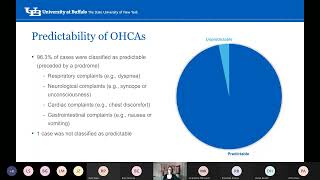
When it came to predictability of the cardiac arrest, 26 out of the 27 cases did have at least one prodrome present prior to the patient's condition devolving into cardiac arrest.
One case was classified as unpredictable, and that person had no complaints, signs, or symptoms of anything that would trigger someone to think that they might go into cardiac arrest while with the EMS crew.
Interestingly, of the ones that had the prodromes present when there were cardiac or gastrointestinal sorts of complaints, the crews did not anticipate that the patients would devolve to cardiac arrest. Those were cases that could have been and from our participants equated to something that they see every day, like an opiate overdose or a person who was infarcting, but they didn't think that they were that sick that they would eventually arrest. As we spoke to people, they told us about their mindset, and as all the thoughts were going through their mind, they thought, yes, I've seen this sort of thing before. But more often than not, these patients don't get a lot of sicker while they're with us, and they certainly don't go into cardiac arrest.
This is just one way that we organized some of our data. These were the cases that were not anticipated to go into cardiac arrest. And so we looked at the different variables here. Who was present, what were their initial complaints, what sorts of prodromes were present, and how long was the crew with the patient before they arrested? I digested some of this for us to make it a little bit easier than reading this big chart. And what we found was when patients were anticipated to go into cardiac arrest, they did so earlier than those who were not anticipated.
When patients were anticipated to go into cardiac arrest, that event occurred while the crew was still on scene with them. The average age of the patient that was anticipated to go into cardiac arrest was younger than those who were not anticipated. And when the cases of anticipated arrest were happening, what we also saw in association with was there were other first responders on site seen.
Not just the predictability and anticipation of these arrests, but there were other components that factored into someone's ability to recognize and treat those cardiac arrests. And here are some of them. So we looked at the environment and so which factors were helpful in recognizing and treating arrest? Things like privacy or. Or supportive or few, if any bystanders. Things like having an easier extrication from the residents or the building than something with a spiral staircase or having to go upstairs. There were also cases of barriers that people reported to us, like when patient size was larger or they were stuck in a place that was difficult for crew members to manipulate. That was more difficult for some of these scenes. They were scenes of violence, and that's what prompted the call to 911. And those scenes were seen as difficult to manage. The crew elements had to do with the interpersonal interactions. When people had worked together before, even if it wasn't on a cardiac arrest, maybe it was on a traumatic case or somebody who was super sick. They felt like the cardiac arrest was easier to recognize and subsequently manage. When they hadn't worked with people or people had fewer experiences either together or in total, that was more difficult. That was a barrier. Additionally, when there was a different sense of urgency about the patient's case and the management, that was more difficult. That was considered a constraining factor.
Intrapersonal elements had to do with the human themselves. And so people reported when they had lower stress because they had information about the case, either from dispatch or from other responders on scene. They felt that that was easier to manage once they were on the case. Maybe it was because they had a mental rehearsal with their partner or they were able to choreograph based on the dispatch, information on what someone would do when the other person was doing another intervention. When they didn't have information or they felt stressed about going to the case. Like going to an unfamiliar territory or being pulled from the hospital without fully completing the thoughts from the last call. That was more difficult for them to recognize the patient devolved into cardiac arrest and then subsequently manage it.
Thanks, Susie. This data from the study has been extremely helpful to me as a medical director. Because now as I read pcrs, I'm trying to fill in the gaps and thinking about what kinds of scenarios are going on in the background that are not documented in the pcr. I don't get to go on as many calls as I once did when I was a firefighter, EMT or even an EMS fellow. And so I think this study has been really helpful for me as I think about not just how we respond to these cases, but also how we evaluate them and look at them. A real important thing in the study design was as we followed people after an EMS witnessed cardiac arrest, we were asking them specifically about what happened in that index cardiac arrest that had just occurred. This is different than other qualitative research we've done in the past where we don't tie it to a particular call and we ask people, tell us about your experience with cardiac arrest management or tell us about your experience with a particular kind of pre hospital emergency. In those there's often a lot of recall bias to a strange case or a normal case, or a case that went very well or a case that went very poorly. And we found one of the ways to minimize that bias was to do what we did, which is look for a particular kind of case and then immediately talk to the crews and ask them to talk to us about that case and that case only. And we think that got us better data. Some of the limitations were we reviewed cases for only one agency and so there may be different approaches in different agencies. We had a 72 hour window for interviews. If after 72 hours we could not complete the interview with our providers, then that case was lost. And that 72 hour window probably is double edged sword, right? If you came out to 71 hours your memory of the, of the case was probably starting to wane. But at the same time we also missed out probably on some great cases that we would have been able to interview after 72 hours. And so there's some pros and cons to the that approach and obviously other cases and other experiences between the index case and the interview or experiences that occurred prior to the index case may have changed the provider's view of the particular call. Next slide.
I think some of our take home messages in this case were that there often are prodromes or signs that can alert us to the potential of an EMS witness cardiac arrest. Obviously this study design does not give us any hints into which EMS cardiac arrests were seen as possible by the providers and had an intervention which prevented that arrest from happening. The only thing better than having a survival from an EMS witness cardiac arrest is to never have an EMS witness cardiac arrest at all. This data does not include those features. This study has given us ideas about how to Better do QA Qi how to better train and talk about EMS witnessed cardiac arrest both in terms of simulations and specific education about some of the prodromes that occur. Finally, I want to say I think one of the real pleasures of working for this agency and being part of this study is, is that we have really tried to create a supportive environment where people feel comfortable talking about these cases. You could imagine potentially having an air of shame or criticism around EMS Witness cardiac arrest. Oh my goodness, they were alive when you got there. Then they stopped being alive. And we have worked really, really hard to foster an environment where people feel comfortable talking about these cases, both in a research and a quality improvement setting. Because that's really the only way we're going to get better, whether it's in the hospital or outside the hospital. If we don't talk about cases that don't go the way we want them to, whether it be because something we did, something we didn't do, or something that was going to happen no matter what we did, if we don't talk about these cases, we're not going to get better. And having a culture we're comfortable talking about them, I think is super, super important. Next slide.
And so we have nine minutes left before we get the hook from Dr. Pepe and Dr. Entebbe and so we'll open up to any questions.
Awesome. I tell you what, your timing was impeccable. Your ability to work with Microsoft Teams is better than anyone we've ever seen. So snowstorms aren't affecting you guys, clearly.
Amazing, amazing overview of your paper and we really appreciate the contribution to the literature. I'm fascinated personally by qualitative studies.
Because I think that you learn so much that's really not reported from just a pcr.
When I'm looking at that slide you had with the enabling factors and the constraining factors, you immediately recognize how complex and complicated a response could be.
Because there's so many different variables that impact not just recognition of cardiac arrest, but then the performance of CPR in the correct manner.
You had mentioned it Brian already. But beyond this modifying your CQI process.
What will you do to implement or how would you recommend that we modify when we have, let's say the new recruit class coming in and we have 30, 40, you know, kids who are just starting with us.
What are some of the, of the, of the modifications and training that could be done? The low hanging fruit, in your opinion, with respect to these external factors and these crew elements and the environmental factors that we could modify in training?
Today. Yeah. We talk a lot about that initial assessment of the patient and the decision to lift the patient off the floor from the location you find them. Right. It's super easy in a moment of panic or stress to immediately try to run out to the ambulance. Right. And when you've got somebody who's got a looming systolic blood pressure of 60 and they're in a flat position and you put them in a stair chair, what have you just done to their cerebral protection pressure? You put it into the toilet.
Right.
And so we've talked a lot about how do we take an extra minute or two and assess a patient before we start heading out to the hospital. We have found that one of the most potentially challenging interventions and potentially dangerous interventions is taking patients down the stairway. Right. As we, not because we drop them, but because there's that moment where we're not able to watch them as closely as we were able to. Maybe we're, like I said, raising their head above their heart. We find that taking a minute with this data in mind and we also have a previous quantitative paper where we take a look at vital sign abnormalities as a predictor of out of hospital cardiac arrest. Taking a second analyzing your patient and saying what's the probability they're going to arrest in the next three minutes as we head out to the ambulance and should we perform some interventions now to prevent that on scene? We five, six, seven years ago did what lots of agency did, which is a real focus on working cardiac arrests on scene rather than rushing them to the hospital. Now I think many, most agencies are really good at that. Now the next challenge though is working that peri arresting patient and maximizing them before we start run out to the ambulance. And I don't think throughout the country, EMS agencies and EMS providers, EMS education have caught up with that phenotype quite yet. And I think that's our challenge from this paper.
That is a beautiful takeaway. I love that. Suzy, did you want to add on to that? Because I mean for me that is the take home point at least, at least from this paper for me. But Suzy, did you want to comment as well?
I think one of the things we do other than understanding what people are feeling is helping them to understand what they're feeling. And some of that came through this work. So this was a venue in which people could talk about the case. It was low stress, low stakes. Brian didn't know who participated, which was another feature of this. He wanted to be left out of it. And with them knowing that he wasn't going to know who they were. They were able to really talk through things and sort of make plans for their future. One of the other things I think that we can implement here is not just.
Put the ideas into people's heads, but put it into practice. It becomes more challenging to do training when there's 81 inches of snow to tackle. But that is a reality in western New York and in some other communities as well. And so maybe the training session this afternoon should be, hey, let's go to a house where the driveway hasn't been plowed. Let's try to navigate this situation because that is real. That is a real thing that happens. Mannequins can be put in all sorts of different precarious locations. Their sizes don't necessarily change all the time, but. But getting people to understand what happens, understand how they feel, something happens, and then getting them to navigate some of these challenges just sort of exercises their brains in different ways than we may traditionally.
See, it's funny, I actually put this, as you're saying that into the same bucket as the hypotensive septic patient who's at a nursing home, who's only five minutes away from the hospital. And the thought process is, we'll just bring them to the hospital and let them do it. And you're just creating the opportunity for more morbidity and mortality. And the same thing happening with these patients who are kind of pre arrest. You know, they don't look well, you know, they're about to die. But instead of saying, hey, let's stop, take those extra couple minutes, beef up their blood pressure, give them some fluids, X, Y or Z, you just say, hey, let me just rush you, lift them up. The physiology works against you. And now you're on a stairwell with a dedication. Right. I'm wondering if Dr. Pepe, you want to jump in here.
With respect to that? I just find that fascinating. The physiology of the extrication. Is Dr. Pepe still on? Let's see. There you are.
Yeah, I'm on for at least a second.
Yeah, for one second. Just there. Everybody else has called me, but what's the specific question for me, though? Physiology?
Yeah, I find it fascinating that Brian was mentioning that when. When the patients were being extricated and sat up, that's when typically went into arrest down the stairwell in a stair chair, that type of thing.
Yeah, yeah.
Movement.
I mean, it is it really. You have to go back to the individual cases, but there are people who, for example, are having a brady cardia, so they can't pump the hill, whatever they're pumping. They can't pump up upright, you know, as well. Or there are people who are hypovolemic or whatever. So I think that there are a lot of things like that, and there are things like where there are vagal kind of, you know, things that will happen to people, you know, people who have a rest on toilet seats, for example. Right. So there's all those things. It's multifactorial, and you can't.
Yeah.
I can't give you a answer like it's this or that when this happens. It's just that you got to be real careful about it when it does, you know, when you are doing that extrication, know that they're unstable until they're stable. Right, right.
But it's. This concept of perioresque positioning is. Is. Is fascinating. And from a standpoint, if you're the medic and, you know, your patient doesn't look well in the. In the supine position, then maybe you shouldn't lift them up until you really make sure that you're. That they're physiologically okay to be moved. Right. I think that's really a big point for me. Okay. Yeah.
You're saying that. Yeah. Yeah, I think you're right on that. I think that's probably what I've always practiced all along, anyways. Yeah. To try to avoid that as much as possible. On the other hand, I don't also necessarily put their head downward either. So that becomes a little bit of a tough positioning. But to keep them. No, but I'm saying it just really depends upon the case. And I'd have to see the case to give you an instruction about that, Peter. Okay.
All right, let me bring in. Thanks, Paul. Let me bring in Joseph Zalka. And you want to unmute and ask your question by voice.
I gotta be going to the other side here. I'll make sure everybody gets.
See you later.
Okay.
Bye. Bye.
Hey, guys.
Bye.
Bye.
Go ahead.
Nice presentation. Thank you. Do you guys implement a peer hot wash or a debrief after these events?
We do. We do not do them for all calls. I would love to do that, but I think that is this research in many ways serve that purpose. But I would love in the future to have a system where we're able to do these reviews automatically. If you have that in your system, that's fantastic.
I would say, just anecdotally, I do that in Palm beach county for the pediatric arrests. And I find it so valuable because of the individual Little. Not just kind of external factors and environmental factors, but we learn about equipment failures and that type of thing. So I know it's hard to do in a big system where you're, you know, in Palm beach county, we're doing 60 arrests a month, so that's not practical, but maybe even some percentage of. Right. Would be helpful. Awesome. Let's see. David. Oh, David had the same exact question. All right, well, we're at the bottom of the hour, so Brian and Susie, thank you so much. Let me give you guys the last word, last take home point, before we switch over to Dr. Pepe.
I think I would just say that there's lots of great opportunities to look at things through a qualitative lens. PEC is publishing more papers on the qualitative thing, and I think hopefully the next decade of EMS research, we're going to be asking more of these questions that we can't answer with ones and zeros and fixed text fields and PCRs.
Susie, this work could not have happened without the generosity of all of the people who were willing to share their experiences. And my gratitude is never ending for all the people who participated or wish they could participate or spread the word about what we were doing. And it just is another testament to how incredible EMS folks are and how generous they are and how much they want to improve their. The science to improve patient care.
Awesome. And that's how we feel about you. I'm always in awe of the people who spend years of their lives putting out these types of papers. That's why we love to have you all on, because I think that this information is important, and I think it's going to impact all of our training. I think we can take this information and integrate it very quickly.
Into our training. So we're very thankful for you for that. I'll send you guys a recording once it's done. You're more than welcome to stick around. And we're going to move over to Dr. Pepe. And last but not least, let me say Lou Steinberg. Lou, why don't you unmute and say this? Go ahead, because I'd love to hear your comments.
All right. Can you hear me okay?
Yes.
Okay, good. So I'm always amazed how many providers take the attitude we're only five minutes away from the hospital, when in reality is how far are we away from the care that we could be giving? Now we get to a hospital, South Florida, in season. We're waiting on the hall for bed. We finally get into bed. We're waiting for a nurse to do an assessment. We're waiting then for a doctor doing the assessment. We're then waiting for orders, then for the nurse to carry out the orders. Many cases, we're talking a long period of time when we could be stabilizing before we ever leave the scene.
I think more and more with whole blood, with fingers, with ultrasound, with push pressure.
We are there. And I think that beauty of our field.
So.
All right there. Thank you all, and let's stick around and take us over to Dr. Pepe. Thanks, everybody.
Thanks, Peter.
Happy Thanksgiving, guys.
Thank you. You, too.
More from Peter




Melissa Olen MSN, FPN-C, CCRN: Sudden Cardiac Arrest Training in Schools (Project ADAM) 4/25/25



Pediatric Hospital Readiness: How Teamwork & CPR Metrics Drive Better Outcomes



Chelsea Kadish, MD & Kyle Goodknight, EMT-P, RT: Pediatric CPAP in EMS (3/14/25)