Dr. Dan Davis - Airway Management in TBI (11/29/22)
Dr. Dan Davis reviews airway management in traumatic brain injury, starting with a San Diego paramedic trial that found routine early intubation increased mortality. He outlines a framework targeting three physiologic domains: oxygenation, perfusion, and ventilation, with specific thresholds like SpO2 >93% for preoxygenation and ETCO2 ≈25 mmHg as a critical perfusion marker.
Questions this video answers
15338
Chapters
Three eight.
Awesome. Okay. Yeah, make sure we got it all. Thank you, Angus, for getting us started there and.
Let me get things together, so. All right. Can you guys hear me okay?
Yes. And Peter.
I just said CME today is 15338.
Okay, you know what? And I'll put that in the chat here in a minute once Dan gets started. Thank you for that. All right, so welcome everybody. It's 11:02 and really excited about this, this particular topic and certainly our guest speaker. Many of you know or have heard of Dan Davis. I've gotten to know Dan over the years and really have followed his work, specifically in resuscitation. He's done just incredible work, not just in ems, but in hospitals with cqi, looking at data, looking at outcomes, and he's really well published in the field. What caught my eye was something that Dan wrote. It was an op ed, an editorial commentary that was about a pre hospital emergency care publication that recently came out. And it's something that I'm really intrigued about and I'm really big believer in, which is should we just intubate every patient with TBI just because their GCS is less than 8? And I did post a commentary for everyone to read.
On the FAEMSMD site, but there's nothing better than hearing it from Dan himself. So, Dan, I'm going to pass you the mic and thank you so much for joining us today.
Yeah, well, thank you so much for having me. I'm going to share my screen here.
And do you now see my slides?
Yeah, we do. Perfect.
Yep.
Thanks, Dan.
Well, thank you again. Thank you for having me. As I went through.
My lecture and then re read your email and it said 20 minutes and 10 for questions, I actually was going to invoke Paul Pepe, who suddenly appeared on my screen. So he's sort of like a genie in a bottle here. But his rate of slides per minute has always been twice as fast as the rest of us, which probably reflects his neuronal speed as well. But it was funny to see him because I was actually going to reference him as my motivation for refusing to let go of any of my slides. But what I'd like to do is kind of lead you through a path that I've taken as an EMS medical director in trying to solve a problem. And.
I've spent most of my career in San Diego. More recently, I've started working in Montana. So here's.
A video I took a couple months back. Doesn't look quite that sunny and warm anymore, but I figured since this was Florida based. I would have to explain what those big lumps of dirt are in the background. Those are called mountains.
And so I'm excited to kind of begin a new chapter with some of my medical direction and research. But I want to take it way back to when I was still in residency and the triumvirate of Peter Rosen, who really kind of defined the field of emergency medicine. David Hoyt, who was the head of trauma in the United States and is now the head of all surgery, and then Larry Marshall, who was really seen as the preeminent neurosurgeon interested in brain injury for some reason, handed me all of the data for the San Diego paramedic RSI trial. And this was back sometime around the turn of the millennium, and then got published a couple years later when the assumption was that every patient with traumatic coma and GCS8 intubate was, of course, the rhyme.
Needed to be intubated. And we were really looking at all the missed opportunities where paramedics were taking patients directly to the hospital and we were missing out on 15, 20 minutes of time that they could have been intubated. This study was powered for a 10% improvement in mortality, and it ended up being exactly a 10% difference in mortality, but in the wrong direction. In fact, for a while, I was convinced that our statistician got the zeros and ones mixed up, that there's no way that suddenly intubating more patients with head injury was going to increase mortality. We were psychologically prepared for the possibility that it didn't work, but certainly not for the idea that it could be harmful.
I spent the next 10 to 15 years trying to figure it out. I went back to the original assumptions. Where did GCS 8 intubate come from? And turned out there wasn't a lot of stress. Strong evidence, in fact, if you really trace it back, it comes from the ob GYN literature with women who suffered postpartum hemorrhage and drifted into coma and were prone to aspiration. Very different than what we were seeing in the field. But there wasn't a lot of data. So I went back and called the trauma registry in San Diego, which was one of the first in the world, and we had tens of thousands of patients. And it turned out that no matter how I sliced and diced it, that early intubation was always associated with an increase in mortality or a decrease in survival. But yet my three mentors were telling me the opposite. And so it really set me on a path. And the Air Medical Agency in California Was my testing ground for a lot of interesting things. Now we divide the world into three basic physiologic elements. Perfusion, oxygenation, and ventilation. And I'll kind of jump to the end here and then go backwards and trace how I got here. But what I found was that there were opportunities to improve care in each of those three areas. And what I've come to sort of realize, or at least my strong bias at this point, is that we haven't yet seen whether early intubation is helpful or harmful. There's some tantalizing data saying that it is helpful, and I'll show you some of that in a bit, but that this procedure is so fraught with potential error that if you don't do everything perfectly, you will wipe away the potential benefit and, and you will actually potentially cause harm. And so with regard to oxygenation, our baseline intubation success in our helicopter program was only about 84% before we started this program. Two thirds of the time there was a desaturation, oftentimes into dangerous levels and sometimes producing cardiac arrest. With regard to perfusion, we've started recognizing the interrelationship between what we do to improve oxygenation or ventilation and how it affects perfusion.
A lot of that actually came from the early work of guys like Paul Pepe, who was presenting similar data at the same conference where I presented our paramedic RSI study at the trauma meeting. But we found that many of the arrests were related to patients who are hypotense, that they often collapsed in the wake of their RSI medications. So we'll talk a little bit about that. And once they arrested, survival was not particularly good. Even these witnessed arrests had a survival to hospital admission, which is roughly double what you'd expect to see coming out the other end of only 8%. And then ventilation, which is really where I made a lot of my.
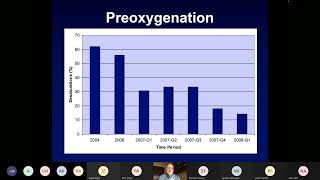
Gains in knowledge. Turned out that we routinely hyperventilate and that causes particular problems to the brain, as well as increasing intrathoracic pressure and lowering cardiac output, Especially with the fast rates that we see all over EMS and emergency medicine for that matter. So if there's a take home slide, it's slide number two or three or whatever this is, that these are really the opportunities. And I want to try and show you that these are solvable with simple interventions that mostly focus on education. So let's start with oxygenation. We were one of the first groups to start using simulation when the simulators were really kind of a brand new thing. But it required that we come up with some kind of an algorithm that I'll show you and then more recently a checklist to make sure that we've covered all the bases prior to the initial attempt. Pre oxygenation wasn't necessarily an automatic thing in those days. This is temporary. 10, 15 years ago, and the thought was if your patient had a full stomach, that pushing air into their lungs was going to push air into their stomach too, and cause regurgitation, make it more difficult to intubate, et cetera. So we tried to intubate without having to positive pressure ventilate as part of our pre oxygenation strategy and essentially just using non rebreathers as best we could. I think more recently with the COVID pandemic, we've seen even the use of things like high flow oxygen via nasal cannula and then coming up with different ways of picking the patients that GCS8 intubate is too simple and that we can try and anticipate which patients might give us some problems using some new mnemonics that I'll share with you in a second. Here was the first publication about using simulation. And I think most of you kind of accept that that's just part of it. But this was sort of a revolutionary thing in those days, expensive because we were renting out an anesthesia suite with an anesthesiologist. So we had to quickly learn how to do it ourselves to avoid paying someone else's salary. We found that the crews all found it helpful. The most experienced ones found the very specific technical skills like cricothyrotomy or use of a bougie helpful. The new hires were more interested in just the general cognitive approach. But everyone found something. This is ultimately what we produced as our algorithm. Now it's got a lot of interesting features that we're still kind of going back and questioning, and I'll show you some of those things in a second. But it follows a lot of the other difficult airway algorithms in that the top line is about trying to get him intubated on the first attempt without its saturation. The middle line is then using attempts number two, three or more to get them intubated again without allowing them to desaturate. And then the bottom line, really looking at a crash airway, either a very rapid attempt for endotracheal intubation, or moving on to an alternative like a surgical airway or a supraglottic device. And this algorithm has really been the centerpiece of our approach to airway management. Early on, we showed that There was a very rapid acceleration in desaturation once the patient's oxygen saturation crossed below 93%, which we should have been able to predict just by looking at the hemoglobin.
Oxygen dissociation curve. But it was nice to be able to show it in actual patients. It created a very clear line in the sand that all of our pre oxygenation attempts were geared towards trying to get the oxygen saturation above 93%. And to make that point, we would stick it on the edge of El capitan Again, a 3,000 foot cliff that rises above the floor of Yosemite Valley, to make a point that when you desaturate, you really do kind of fall off a cliff in that things accelerate below that 93%. In fact, we found that the desaturation rate, if you could drive the sat above that was only 6% versus 100% if you tried to intubate at 93% or below. But a third of the patients were being intubated in that danger zone because of the fear of positive pressure ventilation. And so we made it okay to do positive pressure ventilation. We did it in two different ways, synchronized with the patient's breathing before they get their RSI meds, and then a different approach once the patient is paralyzed, using longer inspiratory times to try and simulate what you might do with a ventilator in a patient with ards. But doing this for all patients who required pre oxygenation. We saw, once we started this training, which we called advanced Airway Resuscitation Training, or aart, we saw a very rapid decrease in the desaturation rate per downloaded oximeter devices. The desaturation rate after the first four or five years was actually lower than what's been reported in the emergency department. Although you won't be able to read this. More recently, we've challenged the New England Journal of Medicine article that said we should just positive pressure everybody who's undergoing emergency rsi, suggesting, per our data, that if a patient is already above that critical threshold, all you're doing is increasing the aspiration risk by inflating the stomach. So if they're above 93%, leave well enough alone. But if they're below that, then it's a huge mistake to not try and positive pressure ventilate in order to improve their oxygen saturation that you're basically guaranteeing desaturation and in some cases even arrest.
We created a difficult airway predictive tool. This would essentially replace lemon, which was really meant for outpatient anesthesia. This is called Heaven. And it really relies on a combination of physical features that you can identify even before you give the meds, like extremes of size, blood, vomit, fluid in the airway, and then physiologic features like existing hypoxemia or suspicion of anemia, which lowers your oxygen carrying capacity. We were able to show that the more of those criteria present, the less likely you are to be successful, especially looking at first attempt and first attempt without a desaturation. And so we added that into the algorithm and more recently have even used the presence of certain criteria to suggest we should be doing direct laryngoscopy versus video. I think we've seen a major shift in the last 10 years where everybody is using video laryngoscopy, but it takes a little bit longer. It takes longer to pass the tube indirectly, and it takes longer to place.
To set up and give that first breath. And so when speed is of the essence, like a patient who's hypoxic or anemic, we still advocate the use of direct laryngoscopy. And we found that that actually predicts higher first attempt success and first attempt success without desaturation. And to help kind of stimulate some of this stuff in the heat of the moment, we developed a card that's handed to the ground providers or whoever is there on scene to go through, just like the aviation checklist, to make sure that we've got everything in place so that we don't make a simple mistake like not having working suction, like oxygen, not being connected to a tank, et cetera, over a period of two or three years, that we implemented this across air methods, which is one of the larger air medical.
Companies in the United States, we saw intubation success rates overall, first attempt, first attempt, that the saturation exceed those of anesthesiologists even doing things in the operating room for elective surgery.
Given Peter's involvement with pediatrics, we crunched some data looking at pediatric intubations and found that whether we're comparing to PEDs, ICU attendings, the NEAR database, which is an emergency medicine one, or even pediatric emergency physicians, that our crews routinely exceed their standards with either first attempt or first attempt without an adverse event, which is mostly desaturations. By applying some of these principles, some of which required us to do original research, we were able to make the procedure much safer and then hopefully reduce the likelihood that we're causing harm. And if we look then at the clinical outcomes, particularly in traumatic brain injury, that same graph I showed you before, where everyone seemed to be doing worse with early intubation. Suddenly, you compare the air medical crews to either patients intubated by ground providers or even emergency physicians, and their survival rate is routinely about twice as high to perform the procedure in the field. And in fact, the intubation success rates are higher than those reported in emergency medicine. And so when I get pushback from my colleagues in the ED saying, why did your crews stay on scene and do this procedure in the field when they could have done it in the more protected climbs of the emergency department, I asked them, why don't they call our crews to come do their intubations? Because our success rates are higher than theirs, which doesn't always go over well, but at least makes the point. And using some interesting computer algorithms, we can show that the vast majority of trauma patients either live when they're supposed to, that big set of lines in the middle, or die when they're supposed to the ones just to the left. But when you look at the heroic saves way out to the left where they should have died and they didn't, or way to the right where they should have lived and they didn't, you can see that the air medical crews generally are more likely to be involved in the heroic saves. And these are ways that we can try and validate this approach. And here's even one where the computer can kind of predict which patients are going to benefit the most from air medical intubation. And basically, the sicker the patient, the more likely they are to benefit, probably because of some of those physiologic disruptions that increase the likelihood of things like desaturation or cardiac arrest. And that's a good transition to the perfusion side of things. The idea that a lot of what we do with regard to airway management has an effect on perfusion. The key take homes are going to be using end tidal CO2 not only as a tube confirmation, but as a perfusion sensor, especially with patients in shock. We'll talk briefly about different RSI medications and then some more about preparation before rsi, specifically push dose pressors. And then I'll get into a little bit of how we interface between ventilation and perfusion. What we found is that patients who arrest in the back of a helicopter do it quickly. They kind of bounce around at a critical threshold of just above 80 systolic, and once they penetrate that floor, they very rapidly deteriorate into cardiac arrest in a matter of four or five minutes. So that's going to have some implications with how we approach these patients now. End tidal if you're not used to using it as a perfusion indicator, is actually a much better early indicator of a patient sliding towards cardiac arrest that those Same patients, about 100 of them, who deteriorated into cardiac arrest from the previous screen. You can see those same patients end tidal CO2 values here, which start out surprisingly normal just 45 minutes before arrest and then gently decrease to a critical threshold of about 25. So if there's one thing you remember, an end tidal CO2 of 25 is kind of a critical threshold. It's what we aim for in cardiac arrest with regard to compressions that potentially indicates a return of circulation. And it also is the gateway into cardiac arrest for patients in shock. Right there we've shown that in air medical patients, the blood pressure and the end Tidal CO2 parallel each other perfectly. But we already have blood pressure. So what's the advantage? Well, end tidal CO2 is continuous, it's not invasive, so you don't need that ART line. But some more recent data suggests that you're going to see changes in end tidal CO2 even before you see changes in mean arterial pressure. That that might be the first indication not only of a descent into cardiac arrest, but even that your resuscitative efforts are working, that you'll see the end tidal CO2 change up to five minutes sooner than an improvement in mean arterial pressure.
With regard to the choice of induction agents or specifically sedatives in this case, when I was still a resident, we looked at the idea that Versed, which was the standard at that time and had replaced some of the barbiturates, maybe should have a cap of 5 milligrams. And we compared our crews in the north who didn't have a cap and would give an average of about 0.1 per kilo to the crews in the south who were giving an average of about 0.05 per kilo and showed that the likelihood of critical hypotension went up more than threefold. More recently, we've seen a shift not from barbiturates to versed, but I would say from automata to ketamine. In all of emergency medicine. This reflects a two or three year period where our crews who were given the choice but were taught that ketamine might have better hemodynamic profile than etomidate. You saw them using it more and more, and still I would say that's our most likely agent in a patient who's hypotense. Now, when we looked at the likelihood of a cardiac arrest, it was much higher in the patients who were given ketamine. But again, those were the patients that the crews thought were most likely to be in some form of shock or hemodynamic embarrassment. We ended up looking at the incidence of cardiac arrest over the period of time that I just showed you, and it really didn't change much. So. And since then, we've seen similar kinds of patterns in emergency medicine that maybe ketamine isn't the answer. And so we just published on what we called the Viper study, and that basically stood for vasopressor intravenous push to enhance resuscitation, giving either vasopressin to trauma patients because it has some nice brain injury characteristics and it seems to stop bleeding below the diaphragm, or phenylephrine, which was really what was being used most often by anesthesiologists for non trauma patients. And looking at whether that it corrected hypotension, how often they then went right back to being hypotense, did they ever go too far, which in a trauma patient going to be becoming hypertense could be an issue. And what our arrest rates looked at, the bottom line is that in their respective patient populations, both agents were very effective and very safe. They almost always corrected. Very few of them got rebound hypertension. And most encouragingly, the likelihood of cardiac arrest dropped quite a bit when we started using these patients.
More from Peter




Melissa Olen MSN, FPN-C, CCRN: Sudden Cardiac Arrest Training in Schools (Project ADAM) 4/25/25



Pediatric Hospital Readiness: How Teamwork & CPR Metrics Drive Better Outcomes



Chelsea Kadish, MD & Kyle Goodknight, EMT-P, RT: Pediatric CPAP in EMS (3/14/25)