Dr. David Miramontes - Opioid Treatment (5/3/2022)
Dr. David Miramontes describes San Antonio's EMS program that treats opioid addiction in the field using buprenorphine induction. Paramedics start patients at 16 mg, titrate to 24-32 mg, and bridge them into ongoing treatment. The program also distributes naloxone and runs harm-reduction services, though regulatory questions remain about whether paramedics are administering or prescribing.
Chapters
Get shit done kind of people. And he, he kind of does things that his systems that all of us are, many of us are envious of. And this today's topic is one of those things where they're providing.
Medication assisted treatment from ems, right. And they have a just a really robust MIH program. And one of his fellows, Joseph Martin is the one who's going to be talking about some data they've collected on that. So let's see if we can bring in David or Joe to the call. David, Joe, can you unmute yourselves and see if you're there?
Still not hearing you guys.
Let me see. I'm texting you. David. Can't hear you.
Sure that's not an old age problem with you? Ah, okay. There you go. All right.
God, I had to get jump out of a meeting. I'm sorry.
I can share my slides. Just a second and I'll just do it.
Okay, thank you. We got the man himself.
Yeah.
How do I share screen on this.
Right next to the mic button, there's an up arrow. It says share. Click on that and then click on window.
There you go. Perfect. Yeah. Click on, click on play, you should be fine.
Okay, good.
So I'll do a quick overview of opioid program we have at San Antonio.
So of course it takes a team. Here's my team. I have no financial conflicts. So what we have is a very different approach to mih. These are all the service lines. I got more than that actually now. And two of our service lines is the targeted opiate response to TTOR and MAT mat. Both are state funded. It's federal dollars to state to local grant. And then we negotiated as a rack to do this throughout the county.
So we all know that overdose deaths are going up, especially after the pandemic. A lot of folks came out of treatment unfortunately and they're not doing so great. Plus a lot of our narcotic programs shut down during COVID We got a lot of folks lost in our area. We have a really increased overdose because the cartels are damn smart. And they're now mixing fentanyl in with our method. So most meth users they use for a couple days and they crash. Well now they have to use every single day. They have to buy every single day because otherwise they get dope sick from the fentanyl. They got them hooked on fentanyl even though they're meth heads. So as we know, the opioids affect the brain, right? With the normal opioid receptor and then the brain on opioids have an exaggerated response to this dopamine reward center. And so when that's not there, they get what we call dopesick or in withdrawals, which is really not life threatening. But they wish they were dead when they're going through that withdrawal program. Right.
We know that the sobriety method of detox and keep them abstinent with Narcotics Anonymous is not all that effective. So abstinence at one year is pretty low and the mortality rate is pretty high. But if you keep them on methadone or buprenorphine maintenance, their mortality is low and their absence rate is high because we substitute a better drug for the crappy drugs they're using from the street with a consistent dose. And we also allow.
To get their lives together, both economically, psychosocially, mentally, and they actually get into healthcare treatment as well. So also the buprenorphine as we know also is an agonist antagonist. So what it does is it prevents overdose because it has a ceiling up back. Buprenorphine is extremely safe and the harm reduction effect of buprenorphine is a big deal. So we have a couple. This vocabulary teacher is our narcan program. More narcanplease.com that's actually our website actually for replacement of Narcan. And then we have the mobile integrated healthcare program that we use for our mat. So we know the opioid response continuum is prevention, treatment and recovery. We're actually in the the treatment side where we do says treatment in the office. We treat at the patient's home using that. And we do a lot of prevention and arm reduction with an R grant program referring these people into peer counselors and into our drug treatment centers. So surprisingly, the biggest thing for success in recovery is not the treatment part, but actually it's the support, the wraparound services and housing actually. So you can't focus on your addiction if you don't have a safe place to live. You're not getting food and you don't have access to health care. So it really is an all inclusive wraparound process that you have to do to get them to a safe place so that they can actually address their addiction. So what I'm going to skip through that. What do we do? So we are contracts all stipulate for all of our MIH contracts that if we're gonna do a program, you gotta pay for it. And we actually insist that all of our units have everything that's on a regular ambulance. So initially our funder said, oh, you just need a blood pressure cuff and a computer and you'll be fine. And we said, nope, you gotta have everything because we're going into harm's way. And if we, the patient gets sick or their family is sick, or we walk in and there's a bunch of overdose folks, we need everything we need to do. So our contracts, we actually stipulate that you buy the normal equipment that's on an ambulance and then we use these crappy little Ford vehicles because they're cheap.
More. Narcanplease.com so ttor the goal is to prevent overdose and to treat the continuum of opioid services. It's more of a triage process. So what we do is we identify everyone who's in the CAD from the previous couple days that have had an opioid related call and we go out and try and find them. We prevent disease or overdose, decrease the 911 resources for repeat calls. And there's a community benefit of getting people in treatment or off narcs. And that lowers HIV and hepatitis C transmission. Crime reduction. Some of our people are stealing, pimping, dealing.
Prostituting 100 to $200 a day to, to support their habit. So by decreasing their dependence on the drug, we're lowering crime in the community. And then we give them access to primary health care and cancer screenings because before they never even were in a clinic. Right. And then a lot of times we can get these people back to work or school to better their lives because they don't have to worry about their addiction. They can worry about making themselves better. So we have a pretty big team.
We have two staffers in the office that do scheduling and all that stuff. And we, when we target these, it's all overtime. So we offer overtime both to the fire and EMS division. They're trained. We have two ttor medics a day and two mat medics a day. And most recently, to get more bang for a buck, it's a medic in an EMT. We do use some of our fire EMTs in the program to try to give our paramedics a break because we couldn't get them scheduled.
And then we always have two people always that way we have someone who's taking care of the patient, someone's doing the paperwork, and being the radio person or the safety guy. We use an app to find our patients. We use first watch. So every morning we run the report and we reach out to find the folks that were evaluated in the days before. And we go out and try and find these folks wherever they're at.
And we Actually, when we do need to link them into resources, we use our Signify Community. That's a computer system that links our various providers and also provides transparent.
Benchmarking about how well we're doing. And we use this for data collection and generating reports. We use this throughout our NIH programs in the community, whether it be high volume utilizers, psychiatric intensive care, our core program, which is our mental health program, whatever we use, we use this to benchmark and connect the patients to the community food bank, project men for dme, whatever they need.
And this is an example of the software we use. This was funded by the South Texas Crisis Collaborative, which is part of our rac. And that's a whole other topic. But we have a whole bunch of harm reduction models for mental health, substance abuse, domestic violence, you name it. We have a program that's using this process to get through the day.
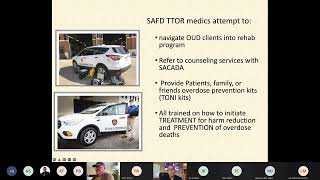
Our medics try to navigate them into programs. We can get them into peer counseling with our drug addiction agency, Sakata. We give everybody Tony kits, patient, family, friends, fellow shooters. Tony kit. I'll show you in a minute what it is. And then we teach them how to use treatment for harm reduction.
Tony Kitts. We have state funded as the Narcan Nasal. It has contact information how to get more instructions. Gloves, a bearer device to do cpr, Fentanyl test strips and which is kind of useless nowadays because everything we have has fentanyl in it and then addiction assistance brochures. So everything you need to take care of an overdose and then get them into recovery if they want to get in recovery.
We got some results. We're seeing a bunch of people, which is great.
And with outcomes. Most of the time we're a lot of unable to contact and that's because those runs are on a street or bus shelter or whatever. And we can't track the patient or their cell phones off or they just don't answer the door, which is a very common aspect. So we use a fire department model for ttor. A lot of times we'll knock on a door, they won't answer. They'll be, you know, we'll see people peeking out the window through the people or whatever. But we leave a card and then we take off. And about eight times out of 10, by the time we were down the block, they call on us, hey, I don't want to meet at the house. I'll meet you at the carry out in the corner. Because I don't want my family to know that we're talking right? Or we thought you were Cops. I could see your firemen. We'll be glad to meet you. I'll meet you in five minutes. Let me get some clothes on. Right. So we do not use a cop model. The firefighters in our area are a trusted member of the community and they know that we're not going to rat them out.
The mat team we have is similar equipment, only they have a lockbox with buprenorphine in it. And the goal is to relieve the symptoms, to bridge them into our program. And our program, it's grant funded. We navigate them into New Seasons, one of our contract outpatient providers. And they get 90 days treatment free of cost while we try and get them on insurance or get them squared around. And that can be renewed up to 180 days depending on their progress.
So our goal is we do a basic physical assessment, vitals or cow score, which is clinical opiate, which are also score. And we're looking for score around eight. Okay. Do they have nozivomic diarrhea? If so, we treat them and we have to make sure the last heroin use is less than 24 hours or greater than 24 hours rather and that they're in mild to moderate withdrawal. Or the heroin, heroin in three days or I'm sorry, methadone in three days. So heroin greater than 24 hours, methadone greater than three days. And then our treatment plan is we. So we do things a little differently than other folks. We actually pre med folks. So we give them a big slugazofran Benadryl for anxiety and for the cramps, Imodium if they have diarrhea and a gram of Tylenol. And then after they've taken those pills, then we put the buprenorphine strips in and we do the pills first. That way they can drink and then the buprenorphine because can't eat or drink for 30 minutes after you use a strip because it has to absorb through the bucca mucosa. If they're less than 24 hours. We do use clonidine. We found this to be pretty effective. So we give them 0.2 mg orally. We watch them while we're getting all the paperwork together. And then I didn't say this on a recorded line, but we actually leave a dose. In Texas we're not supposed to dispense, but on the down low we leave one on the counter or we forget to give one to pick it up and we leave it on the counter for them to use later on that night. And then they navigate the next Morning into the treatment center.
At 5am Why 5am I have no freaking clue. But that's when all the treatment programs want our patients in. And then we provide a taxi voucher for them to do that. So exclusion criteria for it. Chronic pain. If they're toe to stone to participate. Benzos are a concern, you know, because the additive effects, if they're known pregnancy, we can start them and then we can navigate them into a maternal fetal. We have connections for that. There is no risk of the Narcan being in the suboxone. But as a sign of caution, most facilities don't use straight up buprenorphine without the suboxone in it or without the narcan in it to prevent any fetal issues. We don't do people with severe cirrhosis.
Dialysis or failure because they're so hard to dose. And if they're unstable, they have any other medical issues, then of course we don't do induction.
The GAL score, you guys probably know what this is. So our guys use a paper form and then they log it in the epcr. The inner rater reliability is pretty good. I usually ask them, okay, give me cows 8. Okay, what are their biggest scores? Are they having nausea, vomidiarrhea? Because that affects what pre meds we give them. And then we just go from there. We look for approval of three to five points on their COW score with meds.
So we know they work in the brain really well. And buprenorphine is really good because the kappa effect actually helps as an antidepressant as compared to native opioids. And they actually start feeling better in the first week of treatment. And the nice thing about buprenorphine is that it had agonist antagonist effect. So I don't have to worry about them overdosing the next 24 to 40 hours because all their receptors are snagged by buprenorphine. We don't do naltrexone, obviously, because you have to be off meds for a very significant amount of time before we inject them. So we just use buprenorphine. And of course we don't use methadone because the vets said we can't use methadone and methadone is kind of tricky anyway. So buprenorphine is our safest option for induction. And this is what we use. We use buprenorphine strips. Actually, Suboxone brand has Narcan in to prevent diversion. They're like the Listerine strips and we just put them in their buccal surface and this surprisingly, they work very, very well and very, very quickly.
We already talked about that. So the nice part about buprenorphine is the ceiling effect. You really can't overdose. So we start at 16 and do 24-32mg. This is contrary to the ASEP guidelines where they want to go low and slow. We think that's actually stupid. And we don't do that. We start midpoint and go high. So like when I work in the er, we're supposed to do eight, wait about an hour, give them another eight, wait an hour. It's stupid. So we do what's kind of street medicine and it seems to work out better. And again, remembering that buprenorphine is an agonist for the.
Kappa receptor, which works as a functional antidepressant, which really helps a lot with their recovery. So contacts, we're seeing a bunch of people. We don't do a lot of Suboxone because they usually have used recently, but we can at least get them referred into treatment and, and then a lot of times we'll see them in the morning and by afternoon they're calling us back because they're dope sick. Can offer them at least clonidine and other meds to get them through until the next day. The goal is to, is to keep them from not using so we can get them into treatment the next day. If we don't use Suboxone.
And then COW scores dramatically drop. This is from our some data that we did on a poster just recently. And you can see their COW scores rapidly go down and stay down. You say, well, what do you treating them that long for? Well, if you, you know, usually it's one day and they go into treatment. But if we catch them on a Friday evening, we've got to babysit them Saturday and Sunday with doses because the opioid treatment center only index Monday through Friday. So we may treat people for three to five days depending on the holiday status. And this we, most of the time when we go back, their CAL scores are 3 or 4 and they do very well with repeat dosing.
So these are some results.
We've had two episodes of precipitated withdrawals and both of them, the patients were idiots and lied to us. And the minute they got sick we figured it out and they said, yeah, yeah, yeah, I just used like eight hours ago. So and the treatment for that is actually more drug. So we actually gave them a bolus of 16 on top of the 16 plus we started lying on them and gave them fluids IV Zofran and Benadryl got them better. None of them had to be transported. We just had to stay on scene for a while. And nobody has overdosed or needed Narcan during that treatment that we know of. So pretty safe, very effective. And even if they go into precipitated withdrawals, you can manage them without having to transport to the hospital.
And that's kind of the quick and dirty overview if you need more questions. So I'm going to be real honest with you. We're not sure that this is legal. So I contacted the DEA a long time ago and they couldn't, they wouldn't answer my questions right. They said, well, we don't know. No one's ever done this before. The reason why we can do it in Texas is because we're a delegated practice state. So my paramedics are actually me. So they're treating as a physician. We do not prescribe, we only administer Suboxone and we never leave a dose of Suboxone. Now we'll leave Clonidine because.
That'S not controlled. So we don't prescribe, we don't dispense, we only administer. And that's under licensed position. Every Suboxone administration has to be staffed with a physician. So me and CJ are X waivered and then we have a fellow that's ex waivered who's actually addiction trained. And so between the three of us, we can get that quickly. The reason why we did this is nobody in our area was doing hospital based or at the time of need induction. So just recently our university hospital started a Suboxone ER program. But we've been doing this for two years before that. So very successful, low risk, a lot of legwork. But thank God we're grant funded for this because I don't think operationally we could have done otherwise funding.
So that's the down and dirty of it. Who's got questions?
Yeah. Yeah. So amazing presentation again. How you do what you do is just incredible. But I wanted to bring someone on the call here who has been leading a charge for us in the state. He's a mentor of mine, Ken Shepky. So Ken, you want to come in and talk about your experiences and perhaps something from the state that could be done?
Yeah. Thanks, Dave. Fantastic presentation as always. Appreciate it. We do something similar in Palm Beach County. That's how we actually started our addiction stabilization. We started as a program like this and then we morphed into having.
More from Peter




Melissa Olen MSN, FPN-C, CCRN: Sudden Cardiac Arrest Training in Schools (Project ADAM) 4/25/25



Pediatric Hospital Readiness: How Teamwork & CPR Metrics Drive Better Outcomes



Chelsea Kadish, MD & Kyle Goodknight, EMT-P, RT: Pediatric CPAP in EMS (3/14/25)