Dr Dunne - Stroke Detection (6/28/2022)
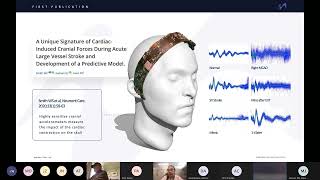
Dr. Robert Dunne presents an experimental headband that detects large vessel occlusion strokes before patients reach the hospital. A Michigan trial has enrolled 223 people so far with a 96% consent rate. The device showed 92.6% accuracy in prior hospital testing.
Questions this video answers
92.6% accuracy and 2.9% false negative rate.
>96% consent-through rate.
223 enrollments.
West Michigan: May 10; Detroit: May 30.
11% total LVOs.
Chapters
Hey, Peter.
Angus, back from vacay. Nice. Here we go. Looking relaxed.
Where were you?
The Smoky Mountains, up in eastern Tennessee.
Nice.
Nice.
All right. All right.
Let's see here.
Yeah, why don't you try to do the share thing and see if this can get that rolling?
All right, so.
Yeah, perfect. You want to just press play? Let's see if we. If we get a full screen.
Oh, boy. Let's see. I can't see what you're seeing, though, some reason.
Can you go.
Can you go down? Are you seeing a full screen on your screen?
So how about now?
There you go. Yeah, that's good.
That's good. Okay, perfect.
Okay, so let's.
Let's talk about this. I've got two things I want to show you.
Okay, hold on. Before you start, I got to give you an intro. Come on, you're like a special guest.
Okay.
And, and, and I'll start and I'll let Paul finish. But.
So welcome everybody to 1101. We are recording and many of us are coming from different parts of the world, which is good. I see some people on from different parts of the country, which is great. And just so you know, Rob, we have people in listening from city of Miami who are super interested in potentially joining the study. So, you know, you have some people excited about what you're going to talk about. But for everyone's knowledge, those who don't know, Dr. Dunn, he's an associate professor, the Department of Emergency Medicine at Wayne State University in Detroit. Of course. He's the fellowship director for the EMS fellowship. He's been talking about this device since last year. We're all super excited about it. Those of us who care and love the topic of stroke are really interested in this. But, Paul, I was hoping maybe you could talk about a special award that, that Rob got this year. And then we'll let Rob start after you're done.
Oh, yeah, sure. So let me turn this around. See me better. Yeah. So, first of all, Rob is just one of my favorite people. Literally, not only on the Doctor and because he came in and took a city that really was in really poor shape for decades and really did a good job despite all the odds against him for a lot of sociological, political, and whatever reasons, you know, socioeconomic reasons, has done a fantastic job there with a just incredible heart. He's one of the most generous and one of the most just delightful human beings I know and just really smart at his job and just get stuff done. They recognize that in the city this past year and not just the medical director for ems, you know, in the fire department, but for multiple city agencies, which stayed through Covid because he was doing such a good job, you know, no good deed goes unpunished. And I won't list them all. But needless to say, but what I'm getting at is this past year, the Eagles, the municipal metropolitan EMS medical directors, awarded him what we call internally our highest award because it's a reflection about the person we emulate the most in terms of being a medical director. And he won the Michael K. Kopas award this past year. And we're just really.
It was just perfect for him. It just. He's great and well deserving. And so here's gonna. You're gonna find out for yourself a good example of why I'm saying that. And I'm sorry to get too long winded, but I feel to some extent actually trivializing incredible career by this short introduction. So. All right, well, thanks a lot, Ben.
Thanks, Paul. All right, Rob, take it away.
All right, thanks, Paul, for a big build up there. All right, so let's talk about stroke. Right. We all work in systems generally where we see a fair amount of stroke. I certainly know something about your demographics and I heard Peter's presentations. He also mentioned there was the folks from Miami. I want to give them a shout out. And we need to have a separate conversation about where you're going after safety pad, because we haven't figured that out yet either. But we have participated in a number of different stroke trials. Our EMS system was actually integral to the original NINDS trial. I was a resident at the time, and I spent my time training our EMS personnel to do an NIH stroke scale because that's how we did the inclusion criteria during NINDS back in the 90s. And you know, we've all gone through a lot of different things since then. Right. And what we've done is we've seen that that move from thrombolytics into thrombectomy and better outcomes for the people who have some of the worst strokes and identifying the lvo. And I'm aware of some of the work that's gone on in your area, really refining some of the scales and having some very active.
Interventionalists who support what's going on in EMS to get the patients to the best care in the fastest time. So we had been looking at some other options, some non scale type options, and we do a lot of technology research. We have kind of a technology incubator at our university that works closely with the medical School and actually one of our own emergency medicine docs, Jim Paxton, who some of you may know, I think he ran the ASEP Scientific.
Forum this year, the research forum. And he had been very involved in some of this technology to try and identify early on a large vessel occlusion using some technology. So, you know, we all know we want to get some of this identified. We want to get identified, right? You know, maybe a little over triage is fine, but we don't want a ton of over triage, especially since it may mean patients moving a long distance for little or no benefit. So originally.
You can see this device and when we break off, I'll show you, I've got both devices here, which is, which is handy. This was our prototype device. These are still experimental devices. This was used to in a fixed operation at hospital triage to determine large vessel occlusion and large vessel stroke to develop some predictive modeling. It uses incredibly sensitive accelerometers to detect the flow of blood in your brain from various different points on your skull as a headband. And of course what really makes it work is the processing that is going on behind the scenes to interpret that data. Right. These are very small signals. So getting rid of noise, figuring out what it means and interpreting it. So a lot of that kind of derivation set happened before we got into our trial. This trial from Smith 2020 was done at a stroke center where they were really looking at how well this device worked. And at the time, this device interfaced with an iPhone where you put in some questions and then it gave you some probability of large vessel occlusion and had a capability of doing some mapping. It's no secret that company that makes the device is located in Cupertino with those who will not be named. And then we had these results from that. So this is your, this stroke device is the first column on here.
Showing this. This red line is the false negative, the blue is the accuracy. So you know, you've got accuracy over here, you've got false negative over here. So don't, don't get hung up on it. So it was 92.6% accurate with a 2.9% false negative rate, which gives you a false negative rate a little higher than, you know, a race of greater than or equal to five, but a little more accuracy as well. There are ongoing fixed trials on this to continue to refine this as the technology has gotten better. But they were interested in the proof of concept about whether this could actually work in the pre hospital environment where there's A lot of vibration and noise. And obviously we all know it's a lot different than sitting in an exam room or a triage room. Even as chaotic as your triage area may be, it's not the same as the ambulance, and particularly for something that's trying to sense very small signals. So working with Dr. Paxton at our site, they reached out to us in Detroit to do a clinical trial. And I want to talk briefly about the clinical trial and I'm going to jump to a little more updated slide deck, the way clinical trials work. In ems. In our state, we have these things called medical control authorities, which were the state basically drew a map and if your patients came from that map, the hospitals had to get together and they had to create a board that had to write protocols, had to give all the drugs to EMS and not charge them, had to set up quality improvement, was responsible for all the EMS data. And really this giant unfunded mandate that has some pluses and some minuses, of course, like all of our EMS systems. But when they did that, they also created a portion of the state law covering pre hospital research, which in many ways has helped us to facilitate pre hospital research in Michigan, which is something that we've all been pretty enthusiastic about with kind of the blessing of the state. So it's a multi step process, of course. Course, the first thing we had to do was, you know, come up with a research protocol. We ran that through our Wayne State IRB and we had to create an EMS protocol, the EMS protocol that goes with the research and that initial IRB approval is what goes to the state. And then the state blesses that as what's called a study protocol. And then all of the agencies within your geography can then can then participate in the trial. And that trial was basically to put the stroke headband on anybody who had positive signs of stroke or significant altered mental status. And the left side of this slide is the protocol, which I'm also happy to share. So you suspect it. You open the app, you put the headset on, and then you transport the destination hospital. We then consent the patient to have their data included. This was fine with our IRB because this is a minimal risk device. It just is a headband that passively sits on your head. It only has to sit there for about a minute and then you can choose whether or not you want your data included in the trial. And our consent through rate has been, you know, over 96%. We've had a couple people that, that did refuse. And then we have had a Couple people that we could, that had.
Other things going on that prevented them from consenting and we had no next of kin. And of course, as many of you are familiar with, we had some patients who just walked out of the emergency department before any other workup was done, despite their, you know, their high concern for stroke. So nothing I could really do about those folks. And that kind of sets the stage here. Let me move to this other set of slides and then we can do some Q and A and I can show you some hands on.
So can you see the new, a different slide now?
Yes, perfect, Perfect.
Okay, so let's just jump ahead. That's, that's where we left off.
That was the old device. We, we moved to a new device about five, six weeks ago. This is much closer to a production looking device and I'll, I'll hold it up, but I want to show you a couple of things on it. You don't see the exposed electronics. You know, patients kind of like it when it looks a little better, as do the medics. And then it has a, doesn't use an iPhone anymore. It has a built in screen with some navigation buttons on it that does the, that does the work. So for us, for this trial, we're, we're blinded to the, to the LVO determination. Right. That, that is, you know, this is truly the validation of the concept that we're going to take the clinical data and adjudicate that and, and then the data from the headband and those. We have an independent review board that's, that's adjudicated, that's putting that data together to say does the prediction from the device match what we're really seeing in our, in our patients? We've got a bunch of different agencies now involved, including some Bay area agencies in California, West Michigan based out of Kalamazoo and our Detroit regional area, both public and private agencies involved. We had, this was, as of.
A week ago, we had 223 enrollments in this phase of the trial. We launched the new platform May 10th in West Michigan and May 30th in Detroit. We had interim data analysis. So the interim data analysis says yes, we're good to continue and we're good to expand the trial. Basically making it sound like without knowing what the actual unblinded data analysis is, that it seems to have an accuracy that looked similar to what was in the hospital data. And we had 11% total LVOs. So that means we had enough like true positives in our actual clinical data to probably be pretty meaningful. And this really gets us to where we are today. You can see this enrollment. This is going to basically get us through this first phase. And then our goal is to get at least 400 subjects in, in the next phase using just the new device.
More from Peter




Melissa Olen MSN, FPN-C, CCRN: Sudden Cardiac Arrest Training in Schools (Project ADAM) 4/25/25



Pediatric Hospital Readiness: How Teamwork & CPR Metrics Drive Better Outcomes



Chelsea Kadish, MD & Kyle Goodknight, EMT-P, RT: Pediatric CPAP in EMS (3/14/25)