Dr. John Aho: Capnospot (1/10/2023)
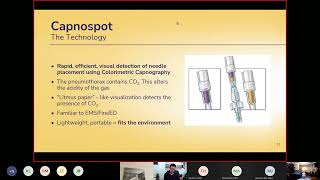
Dr. John Aho discusses Capnospot, a device that uses a colorimetric CO2 sensor to improve needle decompression for tension pneumothorax. The sensor confirms proper needle placement by detecting exhaled carbon dioxide, making the procedure more accurate in emergency settings.
Chapters
Totally fine. By all means.
All right, Cool. Alrighty.
All right. Appreciate that, Angus, for getting that started. All right, so let's go ahead and get started. Welcome, everybody. It's our Tuesday, 3pm, not no longer 11am and I think slowly but surely people will kind of get their calendars fixed up and all that type of thing.
Thing.
But we're here, it's 2023 and looking forward to the NMSP conference. Fire Rescue east is also coming up. So we got a lot of, a lot of meetings coming up. But excited about today's presenter. So Today we have Dr. John Aho, who's a trauma surgeon formerly with Mayo Clinic and saw a problem and sought to find an answer and fix it. And. Oh, Angus, would you want to say something?
Okay, nevermind.
Nope, sorry.
That's okay. And actually how we got to today is my fire chief, Julie Downey from Davey Fire Rescue. She emailed me and she's like, have you seen this? And I said, I have not. And I looked into it, sent out an email to John, he responded right away. And we've asked him for some samples and so forth, and we're gonna see if we can evaluate it. But essentially this is a way to detect whether your chest tube or your needle is in the right place. And John, interestingly, and maybe we'll talk about it afterwards, but one of the abstracts that's gonna be presented at the national association of EMS Physicians in a few weeks from now is about misplaced needles in chests. So I thought you was really like that. So without any further ado, John, thanks for coming. If you want to make any further introductions, please do and take it away.
Well, thank you for the opportunity. I'm Dr. John Aho. I'll start off with a story about how this whole company and concept and basically how we got to now to today is our second year general surgery residents at Mayo. What we would do is, you know, if you're the first person there before everybody gets there and you think that there's a tension pneumothorax, you and whoever's there do the appropriate thing, you know, consistent with ATLS. And while the team's getting rounded up, etc. And we had a patient that said we had very strong suspicion of tension pneumothorax and isolated one side young guy trauma penetrating to the chest and he was having a very bad time breathing and, you know, didn't have any breath sounds on that side, had dubious tracheal deviation. So we did, you know, what they told us in medical School and when we were interns and everybody tells you to do, we did a needle decompression and we used, you know, the appropriate at that point in time, 5 centimeter long angio catheter, 16 or an 18, I don't remember. But they, they told tell you in medical school. Second intercostal space, mid clavicular line. And then if you do it correctly, you're going to hear a gush of air. And we put the needle in expecting to hear a gush of air. And me and my buddy, neither of us heard it. We looked at each other and said, well, shoot, what do we do now? Well, the guidelines would say at that point in time, do another one and then do a chest tube. So that's what we did. We didn't hear gush Averon the second time. Eventually that patient needed an operation on that chest and we saw needle holes from where our needles went in and we said, well, why didn't we hear that gush of air? What's the issue there? And that's sort of how we came up with this company and this idea was why is this not working the way that they told us it was going to work?
I don't need to really tell this audience very much about tension pneumothorax, but some basic facts that are really underappreciated. It does have a fatality rate of 100% if it's not treated immediately. And everybody asks me, well, what does immediately really mean and is it an hour? It maybe takes, depending on the level of trauma that you have some period of time to build up, but once they have it, you have on the order of minutes, if not seconds to correct this. And it is responsible still consistently today, depending on exactly how you look at what data and who you're pulling it from, responsible for 30% of preventable trauma mortalities, the other two thirds that are preventable, typically being bleeding. The civilian incidence of this condition after trauma is really unclear. You can go back and look at all the papers in the literature and it's estimated about 5%. But when you really dig back to where those citations are coming from, that number is essentially made up. Fortunately, it seems to be made up based on at least on contemporary data published in September by the Group in Pittsburgh, to be about right. So they looked at needles and people that needed subsequent chest tubes who didn't get needles. Their incidence in their population, a large population based study was about 0.5%, but they were under utilizing needles by about 9x. So that actually ends up being pretty comparable to what the estimate was. About 1 in 20 trauma patients have the condition and then the DOD it's responsible as of the most recent war, 3 to 4% of all combat mortalities. And so it's not a trivial condition and it's not a straightforward condition to treat in the field. And the other thing that that September study showed was that prehospital decompression does reduce mortality by about a quarter and that's a 24 hour all cause mortality. They can't attribute it directly to needles. But looking at the 24 hour mortality, those who got needles versus those who did not get needles that needed a chest tube for a chest decompression had significantly improved mortality rates in the standard of care. It fails pretty often. And this is actually a picture from a TCCC publication. And you can see a variety of different things that are wrong with this picture. But I'd like to highlight that there's about six needles sticking out of this guy's chest. And the issue is, well, when you do the procedure, how do you know it worked correctly? And it's a gush of air is the gold standard that we're still using in 2022. And people attribute other reasons for needle decompression failure rates. But I'd like to really, as my thesis for this talk, really point out that that's a subjective standard and it's not really appropriate for the location that this is being practiced.
Other people have looked at, well, why is this rate so high, including us? Well, it's a needle chest mismatch. The needle is too short for the chest or the chest is too thick or too too thick for the length of the needle. Or other training issues as highlighted in this picture, there's a couple of them that are put in the wrong spot. But the failure rate, even after addressing all of these issues, going from 5 to 8 cm going up in the girth of the catheter, changing anatomic placement locations hasn't really moved the needle, pun intended on that failure rate whatsoever. This is from our data that we published looking at clinical effectiveness of 5 centimeters versus 8 centimeter needles. And we measured using CT on patients who underwent subsequent CT evaluation based on their chest wall thickness at their decompression location. And the red ones on the left, this is with 5 centimeter needles on the left, you can see that there's a lot of needles that are quote unquote ineffective or needles that should reach that using a 5 centimeter needle that are effective. It's Just there's no, it's completely nonsense to say that it's a needle chest mismatch when you have people reporting effective and ineffective outcomes there. Similarly, with an 8 centimeter needle, they had a tension pneumothorax. They got decompressed with an 8 centimeter needle. Their chest wall thickness was only 5 centimeters thick. Why didn't that actually work? And sort of going back to, well, it's a placement location problem. There's really not that much difference. If you're using a 5 or an 8 centimeter needle between the 4th and 5th anterior axillary mid axillary line or the midclavicular line, it's a little bit thinner there for sure. And it's a little bit more standard anatomy that you can teach somebody fairly rapidly for that fourth or fifth anterior axillary line. If you're using a 5 centimeter needle, you should be reaching almost most of the time. And if you're using an 8 centimeter needle, you should be reaching almost all of the time. And so we did all of this research and all of these studies figuring out how can we what's the problem here? Is it actually a problem with needle chest mismatch or whatever you want to call that, or is it really an actual issue of we don't have a way to know that the procedure was actually successful in the field. And this happens all across the US when you talk to different emergency medicine physicians, paramedics, firefighters. There's an ambiguity to doing this procedure. There's the fog of war when you're decompressing somebody's chest in the field that leads to an indeterminate outcome. That audible gush of error is very, very short lived if it's even audible in the conditions that you're practicing this procedure. And that was sort of our problem when we did that chest decompression in the trauma bay was we didn't really know if it worked or not. It ended up that on operation that we did reach the chest with that needle, there's a little puncture wound on the inside there. But we had no idea if our needles that we're putting in were failed or successes. So if you don't know if it worked and you think it works about half the time, the tendency is, oh, I'm going to put another needle in, I'm going to put another needle in, I'm going to put another needle in. When in the field, that's really the only tool that you have. And vast majority of paramedic and Fire locales that are or regions. They're not doing chest tubes in the field in the United States, they're not doing finger thors and they have needles and that's what's in the toolbox. So what we need to do is look, look at what's, what's the actual root cause of these problems. And fundamentally the pre hospital environment and the emergency room are loud. They are loud compared to a needle. That noise that is actually quite quiet. And I'd be very curious at the end of this talk to go around the room and see, you know, in terms of the number of needles that you put in, what percentage of them do you actually.
Excuse me, do you actually think you heard a gush of air versus were actually successful and it had responses and vital signs. And based on, you know, I don't want to taint the data here on my informal survey at the end, but it's not very many people hear this when they're doing the procedure. So the fundamental problem isn't actually whether the needles are reaching or not and is we don't know at the time of procedure if they've reached the chest or not and into the pleural space because the outcome of the procedure is based on a gush of air.
So what if we can interrupt this pre hospital hamster wheel that, that people have a tendency to get on when they're doing needle decompression and instead could replace it with an objective metric that's a non auditory based metric. And we had come kick the can around on this and it wasn't a flash of insight. It was refined iterations and trying to discover what the root causes of this problem were. And keep in mind that when you have a tension pneumothorax, that air actually leaked from the lung. It's like air you breathe out. And that's why it's building up. It's building up there over time. It's leaking from the lung and it's filling that space and eventually it's under pressure. We already have a tool for that. That's colorimetric capnography, colorimetric indicator paper, colorimet ph paper, the same stuff you use for endotracheal tubes. And that basically detects CO2 in the relevant range. That's in the pneumothorax. We said, okay, well does this really fit? Is this something we can engineer a device around? Is this appropriate for the field? Ends up that, yeah, it's lightweight, it's portable, it's small, it's Inexpensive. It's already familiar to practitioners in the pre hospital and early hospital space that color changes. You're in as in it's the color of urine, you're good. Right. So there's not much additional education here that has to happen for the pre hospital providers.
So this is the cheapest paper probably ever published in chest. So basically what we did was we did, we took novice and expert operators, those who had done needle decompression, those who were familiar with the procedure, and those who had been trained on basically the basics like a mannequin, but had never actually done the procedure in the real world. And we asked them do the procedure on a pneumothorax that we generate. So we took, we injured the pig's lungs, didn't insufflate CO2, didn't artificially gas this in any way and let the pig develop tension pneumothorax by vital signs, and then asked the provider practitioner to do a chest decompression using a needle, using the standard of care, gush of air and then using our color based CO2 sensor.
And I'll just play this video here real quick. Pay attention to this upper right hand corner here. It's purple right now. Operator pulls the plunger out, thing turns yellow. And so the interesting thing here that happens too is the decompression of the gas along this needle. This, this device here that actually reverses that color change occurs before vital sign changes occur to that vital signs change over the course of a minute or so. This changes on the order of about three to five seconds. And then so we did a receiver operating curve analysis. The other thing I didn't mention before is we knew whether or not they got the needle into the correct location in the chest or not. We had a thoracoscope in there looking up at the chest wall where they were doing this. So we knew what ground truth was whether or not they got the needle into the location. And interestingly, the standard of care, whether you were an expert or a novice, you were basically doing a little bit better than guessing when you put the needle in. And this is in a semi quiet animal research lab operating room. And keep in mind the needle girths, the gauges have gone up over time. And if you think about that for a second, if you have a very, very big straw and you have a stream of air going through it, it's going to get quieter as the needle gauge goes up. And so over time, I think what has happened is as we've increased these needle gauges We've actually quieted that signal down. We've made it so that it's harder to detect if you're actually successful with the procedure or not. And so this device, this technology basically removes that ambiguity and it makes it so that, you know, at least in the animals, it seems to work better than the standard of care and arguably perfectly. So it really does provide that binary yes or no, removing that operator subjectivity. It's durable. It persists for a period of time on the order of a minute. If you were to clog off the needle, that color change persists for about a minute. However, if the needle gets clogged up, it does shift color back the other way and let you know that that needle is no longer patent, it's no longer decompressing. Designed by myself and several colleagues at Mayo, and basically we, we did that compelling animal data that I just showed you, but I'm also going to show you a little bit of our, of our human data, too. We have cornfield trauma, we have tractor trauma at Mayo and Rochester. So almost all of these patients, all of these patients were blunt trauma patients. And a lot of them were in the situation of agonal blunt arrests. So at our, in our facility at that point in time, they all got bilateral needles just as rule outs during transport, which is an important negative control. And then the patients that had autopsies we did look at to see whether or not they had evidence of that needle reaching or not. So in patients who had tension pneumothorax, it turned color the way it did in the animals. And in patients with blunt agonal, which is basically the negative control, they did not have any color change. And then, so that's all well and good, that's all in a research lab, you know, internal, at the world famous Mayo Clinic. How do we get this out to the rest of the community so that we can actually have a device that's usable by clinicians? That's basically what I've spent the past year doing fundraising around this device. We have enough money to get this to FDA clearance. We submitted our FDA paperwork back in December. So right now we're just waiting on FDA clearance for this. We've had prior discussions with the FDA around what they want to see for that documentation. And we took care of it and have it all together. And it's planned to be commercialized here probably in the next several months. I'd say probably you're looking at April for an FDA clearance, but we're looking for feedback. We're looking for Comments? Is this something you'd use? Is there something you change about it? What do you all think? But first I'd just like to have some, tell me some war stories about, you know.
Have you had a time where you got the needle in but you weren't sure you got it in? Tell me about that. Like what's that practice like in your communities?
See, Dr. Pepe, do you want to, want to jump in? I know you have to hop off in a few minutes. You want to make some comments?
Yeah, the first thing is like it's really great that you brought this up because everything they teach you that you're supposed to see, like tracheal shift, I probably have seen probably hundreds of petroneumothoraxes of my career. I've unfortunately been practicing for about 45 years, but I never really saw a tracheal shift that I can't even think of, you know, and so I didn't bother looking for it, let alone the air cup. Now the, the issue is, is that I agree with you is that once you keep poking holes in there, you got even more risk for hitting something else that could be thing to hit. And so, so I think this is a thought and it's been good. I've always used long needles gone very slowly and. But yeah, you don't get the gush. Yeah, it's, it's. That's good for TV thought. You know, we can use it for that. So. But you very. You get that sometimes if I'm chest tube and you will get that sometimes, but not what you do with the needle. Right.
So yeah, that's a great comment, Paul. And I think that, I think many of us have experienced the same thing, which is, and I think John, you mentioned it very well that it's kind of very dubious and it's unclear oftentimes.
We had someone on our webinar a few months ago who developed a device to help people get the right spot. But what you're saying is that even if you have the right spot, you may not even be in to begin with, which is another, another big issue.
Yeah, the Sam Thoraci would be the one that that's typically used for that. So there it's a three dimensional problem. And as your colleague mentioned earlier, you can get this the two dimensional problem pretty good. That's something you can train based on surface anatomy. That's just a question of explaining how long the clavicle is and going lateral to the nipple and finally the sternal angle of Louis or you know, going wherever you're putting it, that's a two dimensional problem. When you're talking about depth now you're talking about a three dimensional problem. And with the 8 centimeter long recommended catheters that are typically recommended now for ATLS and some of these other guidelines, that's a, that is a long. There's a reason they call it a spear. It's huge and not appropriate for every patient. You have a small skinny person, 5 centimeter will do just fine. But it's a question of getting it to the correct depth so that it functions, so that you can temporize it and move on to other therapy. The issue, what's going on right now is in that picture with the gentleman that had six needles coming out, half of those needles were about halfway out and they probably weren't deep enough. Some of them were too medial. You do more pokes, you're going to hit something you don't want to. You have wasted time on your trauma resuscitation, wasted time during transport, wasted ambiguity, questionable legal issues of not getting the device in the correct location. Whereas with something like this, you could do it once and get it done correctly. Move on to your next thing in your ATLS algorithm and remove that ambiguity. Because even the most experienced people that I've talked to in this space, they say it's a coin flip every time they're doing it and they. You're not. This gush of air that they teach in medical school with a 10 gauge catheter, fat chance, pun also intended on that one.
Yeah, Peter, we're just talking about trauma cases here. There are other medical cases which we have to come across. That complicates even further, particularly if it's a, you know, a pink puffer or whatever. But also I think it brings up. What you both brought up is a great point. Point is that everybody thinks of the air rising and it's up there at the top, or squeeze it. These things, the pockets show up in weird places, especially if there's blood in there as well at the same time. So I think there's a combination of things that we need to be looking at here. But I think it's great discussion because we just brought this up about how to last week about how to manage people with post traumatic circulatory arrest, as I call it, because they're not quite yet in cardiac arrest, but they're getting there. And so I think this is timely and it just really, I like it. I'm very intrigued. So it sounds really good, John. Thank you. I love the tractor people, because. Yeah, not enough people know about that. That's difficult situations. Yeah.
I have a quick logistical question, John, which is, does this device, it kind of hangs off the side, if you will, is that the mechanism?
So it uses a standard Luer lock fitting. So that, and we did that purposefully. We could have bundled it with a certain manufact manufacturer or another manufacturer. We said that's not the right way to go for this from a business case for a variety of reasons. It's going to limit the rate of adoption. So we put a standard Luer lock fitting on there. If one wanted to put it on a pigtail catheter, they could. If one wanted to adapt it for a chest tube, they could. If one wanted to use it on an ars, a spear, an H and H, a pneumo dart, doesn't matter. They can, they can connect it in whatever scenario they want for whatever chest decompression that they're doing is clinically appropriate.
Sorry, who's that? Who is that you know about? How can we get sampled who's ak, See who that was?
Yeah, no, so we, we have, we have Dr. Nir Hus, who's a good friend of mine, he's a trauma surgeon at Delray and St. Mary's and he, he's super excited about this. I'm not sure, I think, John, you sent him his way, right?
Yeah, I did. I sent some over to them. If you have some interest in looking at them partnering in some way, potentially doing a study like that's. That's part of what we're trying to do right now. Now is outreach time where we basically are trying to figure out. Because changing clinical practice on a procedure that's 50 years old is difficult. So the talking to people who understand this problem, who understand. Because I can talk to the paramedics, they get it right away. They like, I show it to them, I stick it in a balloon. They say, oh, it's just like the endotracheal tube stuff that we already use. Yeah, it's the exact same thing. Exact same color change. And very minimal additional education is required in a lot of EMS locations. They don't even need to change protocol. Right. Because it doesn't alter that gush of air. It's an adjunct. So they can use it in that way in the pre hospital space. But there's. We're looking for partners and that doesn't just mean financial partners looking for people to. How do we, how do we change practice here? I've been able to Adjust that practice with some of our data for going from a 5 to an 8 centimeter. That's mostly my fault. In our group's fault. The.
Alternative anatomic location, that's also partially our group's fault.
But we really want to deal with this issue because it's one third of preventable deaths. It's so stupid. And all you have to do is get a medical grade straw into the right spot and you've at least temporized that.
Only because we only have three minutes left. What I would propose is that, you know, we have large systems here. You have a lot of people on the phone here who are medical directors, EMS leaders, state people, people from all over the country. And we would be happy to kind of roll this into what we do. Obviously it would take a little bit of time to gather the right numbers, but I think putting a protocol together. Dr. Pepe is the research guru. Go ahead, Paul.
Yeah, yeah. So just want to know. The AK was Abdel Curry. So he's over in France. So we.
Okay.
Well, I'll try to get the information for Peter, but we ought to present this with Maine Eagles next week. Hey, how are you? We ought to bring him. Come on. It's too late today. I got too many things going on today. But have him come on next week because that's really a good follow up to last week's discussion.
Right, okay, perfect, perfect.
In France, I assume, right? In the dispatch center. He popped up there. Chris. Yeah. Oh, you can't talk center. That's why. Okay, so you just want to let you know we'll get you plugged in with him as well because he has. He's a big leader in the year in the European domestic committee having been the president of one of their key organizations. So that'll be a Good.
Awesome.
Well, listen.
6,01 and I'm switching over to Eagles. Okay, see you later.
We'll see over in a minute.
Thank you.
Well. Well, first of all, I wanted to thank Chief Downey for. For bringing this to my. My attention and to our attention.
When I first saw this, I'm like, this is brilliant. We should be having it just real quick because I know a lot of people on the call are probably wondering, what do you expect the cost to be, John, when it comes out to market? Per. Per device?
That's an excellent question. So the. The MSRP, that is the suggested retail price is on a $25 unit basis. So. And then people are like, oh, that's too much. That's too little. It's Actually right in the middle, based on what we looked at. So the average number of chest decompressions that patients across the US Are getting is somewhere around four. So each of these needles, the spear is a great example. Spear costs $40 per unit. The TY tech or the H and H or the pneumo dart cost are around 20, $25 a unit. And then if you go simpler than that, you're looking at $9 per unit MSRP. Now, that's whatever your facility contracts is fine. But.
On the average, if we save one needle per per patient out of that four, we broke even on economic costs for the value assessment committee type stuff. So not only are we doing the right thing for things for patients, you have confidence in the people that are in the field that are doing it. And they call back and they say, yeah, it turned yellow. And then you can say, there's no arguing with it turning yellow. Same thing for the endotracheal tube. Shift over to that practice for the field intubation stuff too. Right. So it's $25 per unit. They're probably going to be bulk order discounts through distributors and things like that. But it's about the cost of a needle and it definitely saves additional needles. And more importantly, it saves trauma time and screwing around in the ambulance, which, you know, trying to figure out if a needle is functional or not. And troubleshoot that in an ambulance. That's not a situation you want to be in.
Awesome. Fair. Very fair. Thank you so much. All right, well, listen, thank you so much. We've recorded it. I'm sure this will get a lot of views. Dr. Pepe has invited you to next week where he'll ask you to do like a 3 minute to 5 minute version of this presentation.
Yeah, sure.
To another audience. You're welcome to stick around if you want. I see you put your information in the chat. Thanks for doing that. And again, thanks, Chief Downey.
So.
All right, everyone, stick around. We appreciate you, John and I'll be in touch with you on email.
The opportunity and happy to try to make it better.
Awesome. All right, guys, thank you so much. All right, everyone, stick around if you want to stick around.
More from Peter




Melissa Olen MSN, FPN-C, CCRN: Sudden Cardiac Arrest Training in Schools (Project ADAM) 4/25/25



Pediatric Hospital Readiness: How Teamwork & CPR Metrics Drive Better Outcomes



Chelsea Kadish, MD & Kyle Goodknight, EMT-P, RT: Pediatric CPAP in EMS (3/14/25)