Dr. Josh Gaither - EPIC TBI (8/23/2022)
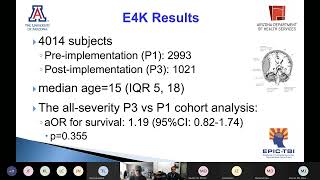
Dr. Josh Gaither presents the EPIC TBI study, a 5-year NIH-funded project that trained 11,000 EMS providers across Arizona on three simple guidelines: avoid hypoxia, hypotension, and hyperventilation. The full cohort showed no survival benefit, but severe TBI patients treated per guidelines had roughly double the survival rate, and severely injured children had five times better survival. Key findings: aim for 100% oxygen saturation, keep CO2 around 40 mmHg, and treat low blood pressure aggressively because cumulative hypotension predicts mortality.
Questions this video answers
Five-year study; funded by the NIH with subsequent DoD support for subanalyses.
About 21,000 adults total: ~15,000 before implementation and ~6,000 after.
Approximately 3,000 children before and 1,000 after implementation (median age 15).
Target ETCO2 around 40 mmHg with an instructed range of 35–45 mmHg.
Aim for a pulse oximeter reading of 100% (give supplemental O2 to reach 100%).
Chapters
To have Josh Gaither on. So Professor Gaither, who's been there, professor of emergency medicine for quite a while now, you've been at the University of Arizona, Tucson, I think, for at least a decade, if not, and done fantastic work there, is now our eagle there, so to speak, our medical director for Tucson Fire Department. And what's kind of even cool also is that he's honored us by becoming the chair of the program committee nationally for naemsp, National Association EMS Physicians. So it's been great to have him at the help because it's just great to have a person knows what he's doing now. They've been involved in a study on tbi, as you'll see coming up here today, for the last, I think over a decade, if I remember correctly, or maybe five years, I can't remember what it was, but it's a pretty long period of time in which you guys were looking at TBI and come up with a bunch of different observations from that that you want to share with us. And it's all really important and I think it's all really relevant because we're all sort of going like this nowadays. Right. So this will be helpful to add some more data to the base, so to speak. So with that, let's welcome to the stage, so to speak, Dr. Josh Gaither. Okay, thanks a lot, Josh. Thank you for being here with us today.
Yeah, absolutely. Thanks, Paul, for the introduction. Thank you all for having me. Can everyone see my screen? Paul, you got that?
Yeah, I just see the jg. There he is. Epic traumatic brain injury. There you go.
Perfect. All right, so I'm going to roll through this. Feel free. I'm not as fluent with teams as I am with zoom, so feel free. Just pipe up if you got a question. Don't hesitate to interrupt me. This is going to be quick, down and dirty. What you need to know kind of about epic.
I think we've talked a lot about this. Here's what we're going to do. I'm going to give five minutes kind of the nutshell of epic. It's the refresher if any of you have kind of heard some of our talks before. And then really what I wanted to focus on for today is kind of the top five things you should know about TBI that we've learned from EPIC that they didn't teach you in medical school. And then of course, we'll wrap up with some questions at the end. So what was EPIC? Is EPIC? So EPIC was a five year study funded by the NIH and then subsequently funded by the DoD to do some sub analysis. And we're going to primarily focus on those sub analysis today. And we're about halfway through the planned sub analysis work. Of course, this is not my project, so to speak. This is a team's project. You can see that projects led by Dan Spate, Ben Barbaro and a whole group of very talented researchers make this possible.
So like I said, the refresher on EPIC here. So the objective was to evaluate the impact of implementing the TBI guidelines, the evidence based guidelines across the state of Arizona, and Arizona is not nearly as big as Florida, but we're not small either. There's 130 EMS agencies, we train 93% of them and that's over 11,000 EMS providers. So this is a pretty big initiative. And that training occurred over about a one year period. So you can more or less think about this as two years before, a year of training and a year after. And two years after.
What was the training? This is stuff you guys already know, right? Avoid hypoxia, avoid hypotension and avoid hyperventilation, right? This, this was purposely made simple. This is not rocket scientists. We told people, hey, avoid the H bombs, hypoxia, hypotension and hyperventilation. That's what we care about, right? One of the, I think reasons that this was successful was that it was simple, easy to remember. This was the study design, pre kind of implementation that was excluded and then a post period. So P1 compared to P3 was really kind of what we looked at for this study. So here's how the numbers looked. We had about 21,000 adults enrolled, 15,000 before, 6,000 after. And here's the results of the main study. And this is not good, right? There's no difference. This made no difference in care, right? Survival to admission. We had slightly better survival to hospital admission, but those people that did make it to the hospital didn't survive to discharge. You can see there an adjusted odds ratio of 1.06 with a P value of 0.4. No significant improvement in all patients enrolled in this study. Now if this was the finding, obviously I wouldn't be talking about anything today. This would be quite a boring talk. It'd be a yawn. Move on, please.
But when we really look at it, and you know this from your clinical practice, there's patients across the TBI spectrum, patients with moderate tbi. These are really the ones that may have a skull fracture without an associated intracranial bleeding, mild to moderate injury. There's the severe TBI group. These are patients with a subdural and epidural, maybe some scattered subarachnoid that don't require operative intervention. They don't require any type of interventricular intervention, but they do have some severe head injury. And then of course there's the critical patients with severe head injury. The majority of patients do fall into that severe head injury category, 70%. And actually our injury severity increased across our study time period. So we had more patients in P3 in that group.
Paul, I can see you talking, but I can't hear you talking.
Just to get back today.
I think we keep losing you.
Your audio is still cutting in and out. Maybe it's me.
It's not.
I think I just keep getting cut out, that's all. All right, so then just quickly, I wonder if you go back to the. Well, you don't have to go back, but just when you had that thing that was called moderate, where would that be? Sort of in the Glasgow Coma scale range, would the severe or the critical, I should say be under 8 and.
The severe ones be a little bit higher than that, like 9, 10, 11s or something?
So super frustrating. And we're going to get to this at the end. There is no association between our initial pre hospital GCS and these categories is really difficult. Of course if you have a GCS of 15, much less likely to have critical injury. But if you have a GCS of 15, it doesn't rule out critical injury which is really part of the crux of the problem for all of us who do this in the field day to day. Thanks.
Sorry to interrupt you but I hope you understand why I was asking that.
Absolutely very important question. Thank you for bringing it up. And this is really why we care. Here is the adjusted odds of survival if you got treated with the evidence based guidelines for those with severe tbi and of course a twofold increase in survival. And among those patients intubated a threefold increase in survival after implementing these guidelines. So let's take a similar look at the kids. So these are children under the age of 18, 3000 before 1000 after median age 15 and again same thing in the full population, no improvement in survival. However, when you look at that severely injured population, there is a significant improvement, a five fold increase in survival among that population of children. So really impactful. The bottom line for EPIC and EPIC for children is that evidence based guideline implementation really does help in the subset of patients with severe head injury. And I think probably most of you. That comes to no surprise, as you've heard that, and hopefully that's fairly straightforward. What I really wanted to spend the next 10 minutes doing is diving into this. The five things that we haven't talked about as much about Epic that you should know. So the first one is airway. I have to give the disclosure EPIC did not compare, right. Bag valve mass to endotracheal intubation. This is not an airway study. We did compare outcomes among patients with bag valve mask ventilation before to outcomes after. Here's what you need to know when we interpret this data.
The training we implemented really focused on two things. One, we said the airway isn't the solution to this patient, giving them oxygen is. And as a result of that, we had a dramatic increase in the rate of bag valve mask ventilation after and a decrease in the rate of intubation. Right. So focus on oxygenation over airway. And two, if you do put in that supraglottic, whether it's a king combi igel, you name it. Right. Or intubation, preventing hyperventilation, keeping that CO2 at the goal range. And here's what we found. All right. If you had a severe head injury and you had positive pressure ventilation, this is really bag valve mask ventilation. The adjusted odds of survival after implementation the guidelines was 7.5. And in the subsets, whether you had an eye gel or endotracheal intubation, similar improvement. Although these findings bordered on statistical significance, obviously a smaller subset. Right. So here's the take home. From my view, it's not how you manage the airway. Right. This fist fight over bagging, supraglottic endotracheal, it's about how you ensure oxygenation and normalize ventilation. This is really key. And a key component of our training was keeping your end tidal CO2 at 40. And we gave them a range 35 to 45. Right. But setting that goal is incredibly important. All right, take home number two. Hypoxia and hypotension are toxins to the brain. And really for a lot of us who are fire based EMS medical directors or providers, this is kind of intuitive. We think about the LD50 when you walk into a toxic environment, a hazmat scene. It's the same thing for hypoxia and hypotension. Hypoxia is a toxin to the brain, hypotension is a toxin to the brain. And the dose that a patient is exposed to really does affect their outcome. So this took me a long time to get my head wrapped around. But this is the dose of hypotension and it's the same for hypoxia. I'm not gonna put the hypoxia ones up there. Right, this is a timeline. This is your pre hospital course. Right. These are mostly flight cases, obviously longer. Oops, normal blood pressure to start out, it falls below 90. And this is your dose of hypotension here, which starts. It goes for about 30 minutes. Right? Same thing here. This is a 60 minute prehospital interval patient, persistently hypotensive. You can see the dose is 550 and 570. Right. The striking thing about this finding is that for every increase in dose of 50, you have a 14% increase in mortality rate. So let's make that simple. If the dose goes from 50 to 100, your chances of death increase by 14%. So really what we have to do for our providers is change the mindset. This is a toxin. We need to limit the exposure to that toxin as much as we can. All right, point number three, hypotension is likely not a systolic of 90. This is the graph of mortality compared to blood pressure. And you can see there's a nice trough that bottoms out between 120 and 200. Lowest mortality in patients with head injury occurs when your blood pressure is normal to high. When we really focus down on that side of the line that we care about, the 40 to 120, you can see an almost linear relationship with mortality decreasing right up to a systolic blood pressure of 120. In patients with head injury. 90 is probably a random number. If 90 was truly a threshold, we would have expected to see this plateau off here. And we didn't find that. All right, finding number four, oxygen is probably not a bad thing. And I don't know how many of you have taught the National Registry NCCP curriculum. Right in there they really drill into the concept of in stimi, we want to maintain an oxygen saturation of 94. And we have really perpetuated that kind of physiology, that pathophysiologic understanding of injury to head injury. But again, we don't see that if oxygen was toxic, we would expect at 94 for this morbidity line to plateau out. We don't. We see decreasing mortality all the way through an O2 sat of 100%. I really think this is probably the most surprising and probably most clinically impactful change that we've come up with so far, which is that maybe oxygen needs to be a little higher in these patients with head injury.
Can I ask you one more question there? Of course. Is this a oxygen that you're measuring by pulse oximeter in the field or under what period of time is that when you're coming up with that level? What does that mean? Yeah.
So that's your lowest pulse oximeter in the field. So most recorded O2 sat in the field.
Yep.
So for our system, we've changed to this. We want our providers to just give enough oxygen to keep the SAT at 100%. So if they're at 95, we give them two liters and put them up to 100. Just enough to get there. Not everybody needs a non rebreather, but just enough to get there. And this is the last one I'll leave you with, which is skills deteriorate for TBI care just like they do for everything else we do. This is. I apologize, the graph's a little distorted. I don't know why. Early in our post cohort versus late. This is the first 18 months after care compared to the last 18 months after training for EPIC. And you can see in those patients with severe head injury, initially. Oops, sorry. Initially a 2.4 injury odds of survival compared to a 1.6 later, we saw a real deterioration in our improvement in outcomes. And that was certainly associated with poorer compliance with the TBI guidelines. So I want to leave it with this and then I'll open it up to your guys. Questions? Quality improvement in your system for head injury is critically important. Here's the things that we have decided to benchmark in our system. Having done this for the last decade, all of our medics, we want the patient's O2 sat to be 100% or they should be giving supplemental oxygen. Right. Everyone in our system with a severe head injury, and we define that as a GCS of 14, who has trauma gets an 18 gauge IV. And everyone with a blood pressure of less than 110 gets a fluid bolus. And we've really chosen this because we want to avoid that toxic effect of hypotension. We want to stop that blood pressure from drifting down after a head injury. These are the benchmarks that we show our folks to help kind of keep them on task. And you can see this is a really hard thing to do. Right. Our goal is to have 90% of patients at that O2 sat. We almost get there. Getting an 18 gauge in people is tough. And ironically, getting that fluid bolus in is the hardest thing to do. And this is probably a little unique to my system as it's an urban system with about a five minute transport time. But what I really pound in is that for our patients, a 10 minute transport while the patient's hypotension. Hypotensive really does affect their outcome. We have to optimize oxygenation and we have to optimize their blood pressure while we're transporting them or before they're being transported. This is really a shift from that load and go mentality to a. We are going to use 10 minutes. We call it the Platinum 10, the 10 minute pause to optimize care before we get into the truck and start our path towards the trauma center. So with that, of course we have a whole bunch of partners, huge thanks to them. I don't want to underscore at all the work of all of our EMS providers in Arizona. So I will shut up now and see if you guys have any questions.
Okay, Thanks a lot, Josh. As usual, that was a fantastic. You just presented it really well. It was very, yeah. Very cogent and did a fantastic. And you touched on the big points as far as I was concerned. So let me then if I'll open. I want other people have the questions, but maybe I should open up with my usual devil's advocate approach, that kind of thing. Right. So first of all that. Absolutely what you're saying is, you know, the first thing is it's how you use the tools. If that's something's good or bad, it's how you use it, when you use it and all those kinds of things. And so this is a very complex set of circumstances. And I'm so glad you're thinking that way. Absolutely agree with the H's. Right. There's no question about that. What's interesting is that they interact a lot. And the other thing is that this is an observational study, didn't do a propensity control analysis or a clinical trial. So let me point out one thing that we have to all recognize, which is that the whole issue about the blood pressure being low may actually be an indication about a severity of the injury. Okay. So the low blood pressure is really a surrogate variable for.
The seriousness of the injury that you do. So that has to be kept in mind. And one of the reasons why I'm bringing this up is that I agree with you, you got to maintain a much better blood pressure than usual with a head injury if it's isolated. What I do have concerns with, and I'm not sure exactly what to tell you what to do at this point in time is that there is some concern about internal bleeding. And, you know, and like Sue Stern's work has been fantastic in this area where it did make tbi, at least in the laboratory, worse if you started raising the blood pressure up in the people who were bleeding because it blew off soft clots and all that kind of stuff before it performed fibrous clots. So I don't know the answer yet, but I'm just going to say that that's something we need to continue to research and think about. Okay, that's it. So. So that's my first Devil's Advocate thing. And as you go forward with that, number two, and I have four things, unfortunately, that I was going to throw at you, but I'll bring it down to three. How's that on the carbon dioxide thing where you said hyperventilation defined as having a 40 end tidal CO2. Right. One of the things that I think is that we've actually looked at that in the laboratory. It's not the CO2 so much as the positive pressure of ventilation. And then again, the end tile CO2 may be a surrogate variable for how often your positive pressure ventilation is going in there and knocking out cardiac output. And there are people who are overzealously ventilating. And it's not so much the CO2 as much as it's the positive pressure going in there. So just wanted to throw that out at you as probably what's going on in that particular situation. And then finally, what's really interesting about the oxygenation levels is that there are two things that will cause that oxygenation level to go down in the tissues. Right. And one is you could be oxygenating very well in the lungs, et cetera. But the two things that could be affecting is one, blood oxygenation itself, and then two is perfusion. And the perfusion could be affected by the overzealous ventilation or the, you know, or whatever it may be under those circumstances. So the point is, is that it's not as easy as just oxygen level, you know, but I agree with you 100%. Put on the highest level of oxygen you can. The things that determine oxygen levels are usually the amount of lung inflation. So securing a good airway, as you're saying, getting a good lung inflation, it's just not giving too many breaths to those patients under those circumstances. So that's my, you know, 50 cents. I think with inflation it's up to 75% now, but, you know, whatever. So Anyway, so it's just good stuff for you guys to be thinking about as you, as you progress on with this kind of thing. And this is great work. Thank you for all that and again, a great presentation. Let me toss it out to everybody else. Anybody else have any comments to make about this or want to throw in their two cents with that or. I'm sorry, 75%.
Hey, I have a question. Yeah, who's this? This is Kim Landry. How you doing? Hey Kim, how are you? Good to see you. Start up in the panhandle.
I'm wondering if there's been any relationship or there's been any other things that can be done to reduce the intracranial pressure, such as maybe elevating the head of the traumatic brain injured patient to somewhat reduced her intracranial pressure, which takes the burden off of elevating the blood pressure to maintain cerebral perfusion pressure.
Yeah, absolutely. Great question. We of course did not look at that in this study. But it goes back to the same thing that Paul was talking about. We care about cerebral perfusion pressure, which of course is dependent on blood pressure. Right. And your intracranial pressure as well as your central venous pressure essentially. Right. So you elevate the head of the bed. There is of course that theoretical benefit, I think in after having looked at this for a while in the inter facility transport realm, a lot of our very rural hospitals flying a patient to a central trauma center, that's entirely possible and doable. In our urban EMS systems where our transport time's five minutes, it's quite difficult to facilitate. But yeah, I think you're absolutely right. There's the potential for that and it's really important. Let me also add, while I have a minute, two things. One, I see mo ask a question about how accurate are O2 sats? Our oxygen saturation data is incredibly good. Our blood pressure data not as good. I trust our data on quality, especially normal O2 sats a lot better Then the follow up is. I also wanted to share my screen just for a minute here to show a comment on what Paul talked about.
Which I know you can see all of my slides here, but these in this top kind of right hand corner you see that we use smart bags as part of this study, which is really important and I. I didn't mention it. Paul highlighted it. Positive pressure ventilation can be very harmful. Reducing that or increasing the pre. The preload. Right, sorry. Increasing the intrathoracic pressure and decreasing your afterload. So using a smart bag I think was a big part of this study that does frequently go unrecognized. So thank you both for the questions and comments.
The interesting thing about the smart bag is that I gotta see them and see what they do. But they may not give an adequate enough lung inflation, which is what you need for better oxygenation, Although it does reduce how fast people are doing it. So I'd have to know a little bit more about the bag, but it probably works from that point of view. To go back to Kim's thing about raising the head, there is some consideration. Is it a spinal injury? Because we can't ruin off that point in time. And are you bending your neck up? Would you. It'd probably better to put it more in a straight level like with the head and sort of reverse trim Delenberg thing with the, you know, the head and thorax up. But the other issue that I think is that the main thing is we found in our studies when we were doing head up CPR was that we had to have a good mean arterial pressure. So that's why it's a very difficult thing. If you don't have a good enough pressure, then may not do that. Okay. To get it uphill. That's it. But Kim's right on. And absolutely. We may want to tag on the fourth H, which is head up. Right.
So. All right, great. Any other questions?
This is Todd Husty in Seminole. I gave a talk to a number of trauma centers through HCA on this subject because of everything that I've been learning from you all. And thank you very much. And it was brought up by one of the trauma surgeons at a big hospital said, so how much fluids would you limit it to? Are you going to limit the fluids or not? And it really goes back to. So we kind of had a discussion at that morning. And a liter boluses and not to exceed a liter. And in 10 minute transports you're probably not going to get there. 20 minute transports, you might get closer then 30 minute transports you certainly. So we're going to try to. We're going to institute this but probably make sure we understand the bolus concepts and make sure that we don't over overshoot the Runway. By the way, my. The other doctor, Todd Husty is a trauma surgeon in Jacksonville and he's sort of a Nazi about. About crystalloids. And he's even kind of relented on. Yes, some crystalloids. But how much. How much is too much?
Yeah, I think you're right on. We kind of start with 500 as our threshold. I'd really like to see people starting to get blood at that 500. And like I said, it's system dependent. Right.
Yeah. And Todd, one resolution that might be to this in the future is that the crystallite kind of disrupts the glycocalyx. So then you get leaky stuff. And all the troubles we got into from fluids, that's one of the reasons why they're so adamant against it. It's not so much. Well, there is the issue about hydraulically raising the pressure, which is good, but if you blow off soft clots, et cetera. But if we give blood in there, that's less apt to cause problems for so in the future. And maybe the whole blood is what we do to sustain it and make it better. If we're worried that there is a risk here for internal bleeding somewhere that we can't control. So it's a thought.
I can't wait for freeze dried whole blood. That'd be great.
Yeah. Right. At McDonald's. Right. Okay, good. All right. Any other questions though? This has been great, by the way. So we're gonna. You wanna do a. If you could come back, you wanna do a repeat for it in about a half an hour, 45 minutes. That job works for me.
I'm gonna be on the next one at a little after nine. So.
Yeah. And then I'll give you. I'll do the same, you know, devil's advocate, if that's okay. Right. So are you okay with everything I said, by the way?
Of course, yeah.
Okay, good. All right, fantastic. Yeah. I wanna not embarrass it or anything like that. I just wanted. That's why I said it's more of a devil's advocate because we don't know the answer. And that's why it's been fantastic. But what's doing. I'm totally agreeing with all your conclusions there with the sort of the caveats that we were talking about. And so I think this is fantastic. So thank you for all the good work you're doing out there. Okay?
Absolutely. Thank you guys for inviting me. Really fun talk.
All right, I'm going to. You got to go to another meeting. I'm going to switch over to Eagles. Everybody else, thank you so much for everything. We'll see you next week. Peter is going to be back. He's on a plane coming back from Paris right now. And so we'll see. Thank you so much everybody else for being on here today. And of course, Angus. You know, what can I say? Angus, you have any quick announcements? You have to make?
No, not particularly. Just everybody hopefully has the state meetings.
On their calendars for a couple weeks from now. September 13th, 14th, I believe.
And the CME code for today for the Florida meeting is 1528-515285. And I will put it in the chat right now.
I'm usually the CME Nazi, so thank you for doing that for me. I guess.
All right, we'll try to switch over.
I'll see you a little while. Bye. Bye.
More from Peter




Melissa Olen MSN, FPN-C, CCRN: Sudden Cardiac Arrest Training in Schools (Project ADAM) 4/25/25



Pediatric Hospital Readiness: How Teamwork & CPR Metrics Drive Better Outcomes



Chelsea Kadish, MD & Kyle Goodknight, EMT-P, RT: Pediatric CPAP in EMS (3/14/25)