Dr. Kajal Jain: DSI vs. RSI in Trauma (2/16/24)
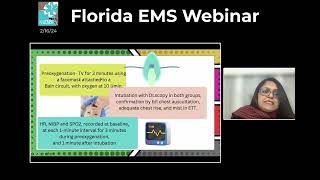
Webinar (Feb 16, 2024) where Dr. Kajal Jain (Postgraduate Institute of Medical Education and Research, Chandigarh, India) presents a randomized trial comparing delayed sequence intubation (DSI using ketamine) versus rapid sequence intubation (RSI) in adult trauma patients requiring endotracheal intubation. Key trial details: 236 randomized, 200 analyzed; primary outcome was peri-intubation hypoxia (SpO2 <93% from preoxygenation to 1 minute post-intubation). Results reported: peri-intubation hypoxia 8% with DSI vs 35% with RSI; first-pass success 83% (DSI) vs 69% (RSI). Study limitations include normal-airway patients only, lack of end-tidal CO2 monitoring in triage, use of direct laryngoscopy, and trainees performing intubations.
Chapters
Welcome everybody. It is Friday, February 16th. We have another great episode here in store for you on the Florida EMS webinar. Obviously this is from the Florida chapter, the namsp, which is alive and strong and very active and we're really grateful for that. Each and every week we bring you incredible speakers, authors from around the country and really around the world. So this week is no different. We have Dr. Kajal Jain, who's a very accomplished physician. She's a professor of anesthesia and critical care in the northern part of India. She'll orient you shortly to the to exactly where she's located.
I connected with her on Twitter. She just released a paper not too long ago on a topic that I love and I think more people need to hear about. It started with Scott Weingart and Jeff Jarvis talking about DSI over rsi. This is another great study that goes along to that topic. Dr. Jain, thank you so much for joining us today. Please make any further introduction and then you can go ahead and share your screen and take it away.
Thank you so much. I'm extremely delighted to be with you all today and all the way from India. And if you like, if you just let me share my screen, I will briefly show you from where I am. Can I share my screen now?
Yeah, it's all, it's all yours.
Yeah, yeah. So as I've been already introduced, I'm Dr. Kajal Jain and I am from Postgraduate Institute of Medical Education and Research. And just to show you from where I have come briefly, this is Chandigarh and it is in the north of India, quite high up. It's a very well planned city and you can see that. And it's been planned by a French architect, Lee Kabuzi. And this below figure, it just shows you, shows you one heritage park over here which has been made out of waste materials. And this is a hallmark of Chandigarh. Whenever you visit Chandigarh, this is a must go and see place. This is called Naked Chance Rock Garden. So and this is my institute where I work. This is a tertiary care center and it's a big academic center which caters to the whole of northern India. And this building which you can see is the exclusive standalone trauma center which is approximately 200 bedded with 5 theaters and 14 bedded ICU running around the clock. All facilities which cater to level one trauma center happen here. So with this I would come to our topic of today. And as we all know that endotracheal intubation is a very high risk procedure which is when Performed in emergency situations, critical cares or pre hospital setting. And it's very much different from the ones which we do in our operating rooms. And we know the reasons why. This has been elegantly studied in this intube study in JAMA 2021 where they showed many peri intubation adverse event out of which to relevance to me was this severe hypoxia which with an incidence of 9.3%. And this stands to a lot of importance in the setting of trauma patients where severe hypoxia leads to secondary damage and then adverse outcomes. So how do we approach these patients who are at risk of hypoxia, hypertension and cardiac arrest? We all know the, the approaches are very simple. Additional one which we are taught in the operating room is that you oxygenate the patient and then put a induction agent, continue with oxygenation. When the patient is getting further, you know, induced, then you go ahead with paralysis and then you intubate. But when we talk about rapid sequence induction, this is mostly done when you want to prevent the aspiration risk. Here you break it down, you like pre oxygenate the patient and then you co administer the sedation with paralysis and then you intubate. We are all aware of it, just to revise it. I am saying all this again. And when we talk about delayed sequence intubation this has been particularly useful in those patients who are agitated, they are thrashing around and they rip off the MO mask. Basically you fail to oxygenate them in emergency situation then how do you take control of this? So it was. It was opined that if you sedate these patients with a dissociative dose of ketamine they become calm and then you can oxygenate them. And if the patient requires tube you can go ahead with paralysis in and in certain situations it was also found that there was the patient became, you know, better with respiration and did not require intubation. So those patients were awakened and you know, the. The situation was averted, the intubation was averted. So basically it was thought that this, this delayed sequence intubation is actually a step ahead. It's a pro sedation for the procedure of pre oxygenation by giving a lower dose of ketamine and dissociating the patient from the environment. So this was elegantly studied by Dr. Scott Vad, which really intrigued me because I read his article which was published in 2011 in which he talked about pre oxygenation, reoxygenation and delayed sequence intubation in emergency department. He basically had this background in mind that the goal of preoxygenation is to provide us with a safe buffer time before desaturation during an emergency intubation. However, some patients are unable to achieve adequate saturations by conventional means. And here therefore they're at risk of desaturation during apnea and laryngoscopy. So he, he opined that in such patients if you administer ketamine in a low dose as a slow IV push then patient becomes dissociated. Then you can place a non rebreather mask or N and once the patient has reached a saturation which is in the safe zone that is more than 95%, then you can allow them to breathe for another three minutes and administer a paralytic agent, leave the mask in place till paralytic agent has taken its full effect and then intubate. So this was very interesting because this gave, you know, a higher first pass success rate without hypoxia. So at the end of it I, Dr. Wingard suggested that these techniques like NIV as pre oxygenation technique or ventilator in emergency as a better backwell mask device and breaking the sequence of RSI using the concept of delayed sequence intubation may make PERI intubation periods safer. So for this he did one observational study which I read long time back in which he questioned whether DSI is a safe and effective alternative to RSI in patients who cannot be adequately pre oxygenated. And he from his reports which were which was enrolling 64 patients in multicenter trial, they found that in altered mental status if you do dissociation with ketamine it allows preoxygenation with non rebreather mass and NI PPV and therefore his the primary outcome that is a difference in oxygen saturation after maximal attempts at preoxygenation before DSI is done compared with saturations just before intubations showed a benefit. So the benefits you can see in this graph, these blue dots actually indicate the oxygen levels before dsi. Sorry, these are the after DSI and these are the ones on. I'm saying the wrong thing. These are the ones before DSI and these are the ones after dsi. So he used a mean dose of ketamine which was quite low, 1.4mg per kg in maximum number of patients. And these the indications of intubations were primarily the same as we see in emergency settings. But more important is to note that this the saturations increase from a mean of 89.9% before delayed sequence intubation. To 98.88% afterwards with an increase of 8.9% so with a big confidence interval of 6.4% to 10.9%. However, the drawbacks of this study were that this was an observational trial and I felt that in in trauma patients with altered mental status and those who are obtained the use of NIPV would not be possible. For these two reasons I I got the idea, need some more evidence and maybe I can also plan a study in my center which is a high volume center where a lot of trauma patients come and we have to do daily six to eight intubations for these critically injured. So this trial was published in anesthesia analgesia in May 2023 with this citation and we enrolled adult trauma patients who came to a trauma emergency and required definitive air with endotal intubation and they were random to receive either the traditional RSI or DSI using ketamine and exclusion criteria included patients with anticipated difficult airway, extensive burns, those who were actively vomiting or there were crash intubations or patient had had a cardiac arrest or unanticipated difficult airway encountered during the study. So as I've already said that we in the in the RSI group we did the traditional pre oxygenation and drug admin administration as I'd already alluded to before, but we use main circuit for oxygenation at 10 liters per minute and we use direct laryngoscopy in both the groups and confirmation of intubation was done by bilateral chest auscultation or chest rise and missed in the endotracheal tube. We observed heart rate NIBP saturations at baseline and then at each minute interval for 3 minutes during pre oxygenation and 1 minute following intubation. So our primary outcome was that we observed incidence of per intubation hypoxia that is saturation of less than 93% anytime from preoxygenation until 1 minute after intubation. Also along with this as secondary outcomes, we observed the Cormac Lehan grading first pass success rate at intubation, airway injuries and use of adjuncts like bougie or oropharyngal airways. So we calculated the sample size looking at the incidence of PERI intubation hypoxia which is reported to be around 57% in trauma patients and assuming a 20% absolute reduction in the incidence of PERI intubation hypoxia in the DSI compared to RSI. We required 967 patients for each group so this is the CONSORT statement in which we have seen that some intubations were done out of hospital and in trauma tried. Some intubations were done by the emergency residents. So we had 236 which were randomized for RSI or DSI and the total analysis was done for 200 patients as we excluded 12 patients in DSI and 24 in RSI for the unanticipated difficult intubation after randomization. So as the results showed that the baseline saturations were low for both the groups. However, at one minute we saw in DSI group the saturations were significantly more than RSI group and so were they at 2 and 3 minutes and at 1 minute after intubation they were comparable. So the overall incidence of peri intubation hypoxia was 8% in DSI group, whereas in RSI it was higher, that is 35%.
So this is the box and whisker plot showing the same thing. The baseline saturations, the blue one is DSI group, whereas the red one, the orange one is rsi. And you can see how the DSI group is faring well with the oxygen saturation at at 1, 2 and 3 minutes and then 1 minute post intubation.
For the secondary outcomes, we also observed that the first pass success rates were better in DSI group than in RSI group is 83 versus 69%. Whereas the CL grading and airway injuries and use of airway adjuncts were comparable in both the groups. So however, this study had certain limitations. Like the study was conducted on patients with structurally normal airways and due to the low resources in my country, we are not able to measure entidal oxygen or entidal carbon dioxide. We used clinical methods to determine our intubation, to check our intubation in the trachea and intubating anesthesiologist were in the second year of training because that is the typical way our hospital goes. It's always a second year training resident who does the periphery intubation calls. But they have had certain significant experience in the operating room of our operating these patients. And another thing which we can add is that at that point of time in 2019 in our emergency triage, we did not have the use of of video laryngoscope. So all the intubations were done using direct laryngoscope. So at the conclusion I would say that delayed sequence intubation significantly decreases per intubation hypoxia compared to rapid sequence intubation. But whether we will be able to Use it in future. It stands the test of time. And some more data maybe. And with this I will thank my authors. This is the.
This is Dr. Pankaj Kumar. And this is Dr. Anodeep Jafra, Dr. Hanish Thakur, and then myself. You are already seeing. So thank you very much.
Questions?
Yes, yes, thank you so much. Amazing presentation, Great timing. I see one of your co authors. Yeah, yeah. You could stop to share. Yep.
One of your co authors is there. Oh, go ahead, Paul. You want to make a comment. Well, I just want to know what.
Kind of bird that is.
That's great. No, good job. Thank you very much, but I'll let you go. And then you're introducing a co author there. Yeah, I see Dr. Pankaj Kumar is on. Thank you for joining us as well. You wanna, you wanna make any comments before we get to the questions?
Pankaj, you can just.
You can switch on your video and say hello and you can tell your. He is the resident who has intubated all the patients. He's the. He's the person who has done all the intubations. So Apanka, do you want to share any, any experience of yours while you were in the trash?
Hello everyone.
Did you enjoy your thesis?
Yeah, definitely.
It was a great experience to be.
Doing that thesis under the elite guidance of yours. And now I really thankful for everyone to having me here with you. Excellent. Well, we. We appreciate it. Clearly you're getting great mentorship. That was a very well done study and looking forward to some of the questions. And I'll start, which is you talked about the Weingart paper, which was all the way back in 2011, another one in 2014. Jeff Jarvis published several years ago too, specifically in EMS. Now you have a publication. It's very clear that DSI is safer and more effective than RSI. Why is it that most of the US. The US, you know, both EMS and hospital, and maybe you can describe if anyone else is doing DSI in India. Why is it that people are having a hard time converting over to DSI if it's that good?
Yeah, because I feel rapid sequence induction has been the gold standard over many, many years and people are not very knowledgeable about delayed sequence intubation. I myself, although the papers are very old, the first paper came in 2011, then 2014 and then Dr. Jarvis, he published in 2015, but I, I read them in 2019. So like, we are very, you know, way behind in reading the literature because not much work has been done on it. But now since it's coming up, some of my colleagues in another institute which is also of national importance in Delhi, they have in emergency medicine, they have started doing it in their center. So and we have also started conducting like more studies using delayed sequence intubation in anticipated difficult airways now. And I think if we have more data then it will become more convincing once we have more meta analysis and systematic reviews to suggest that yes, per intubation, hypoxia is decreased using this technique, especially in trauma settings where patients are agitated, they are having so much of pain because they are traumatized, they have fracture femur, they are fracture ribs. And ketamine helps a lot in alleviating that pain, which propofol doesn't do. So I think it will have some role to play in future for sure if you have more data.
Awesome. And as we're waiting for other questions, I have a little curveball to throw you. We've been doing DSI at my agencies since 2019 very successfully. And what I added into the protocol was the ability to in certain cases not use a paralytic. For example, the severe asthmatic, if you take away their negative pressure, their respiratory drive, they end up having a peri. Intubation cardiac arrest. And we're planning on publishing our data. But do you have any experience with giving the ketamine and either aborting the intubation altogether or not utilizing the paralytic? You know, in, in any patient moving, moving past the ketamine. Any comments on those two items?
Definitely. We do avoid paralytics in certain groups. But for this patient, since the protocol, this study, the protocol dictated that we use it, we used it. But otherwise in my center there are patients who are uptrended significantly, say they have got a very low GCs. They are like just about 4 GCs or 5 GCs in, in those cases, my resins do avoid using paralytics. They do it with simple ketamine or propofol also. But they don't use delayed sequence in those cases because they are not very used to it. And I do give a class before they start their periphery posting that they should use this technique. But definitely we do it without paralysis also.
And, and I know, and I'm going to bring in Dr. Lee in a minute. I know that there are people who are against that just to kind of be very open about that, Dr. Jarvis being one of them, saying that there's more complications as it relates to a ketamine only intubation. So thank you for that. Let me bring in the one and only Dr. Wayne Lee. Wayne, go ahead.
Hi, Dr. Jain. Very, very nice study. I appreciate it. I don't think this has much to do with the study, but I was curious. I didn't understand why you weren't able to use end tidal CO2.
In, in our hospital. The emergency triage has the facility for monitoring only ecg, NIBP and pulse oximetry. It's not upgraded to use carbon entidal carbon dioxide in trauma triage. In our ICUs and operation theaters, we are fully equipped, but somehow in. And the monitoring is slightly, you know, not up to the mark in triage.
Interesting. That's a great question. So even the, there are, there are the end tidal CO2s that are portable. You could just, you could just put them in line into the ET tube. Even, even those are not available. Interesting.
No, they are available, but there is, you know, the. We are graduating. You know, if I tell you how raw we were a couple of years back and I have done another study in 2016 when I found out that most of the intubations were being done using, you know, injudiciously benzodiazepines. I'm 1520. Because there were so many airway complications once patients were coming to us in theater or in ICUs. So from there on I started doing my series of studies and then I started putting the monitors over there because we are, we are not very well set, well, gelled system. System of, you know, deceiving patients in our hospitals. We are still, you know, we are working ahead on those lines.
Excellent.
So maybe in the next purchase grant we will get those entitled carbon dioxide. Because now I am very strongly going ahead, you know, with the, with the administration that I want those entitled carbon dioxide monitors as well. So I'm sure we'll get them.
Great. Well, your leadership sounds like it's making a lot of impact, so thank you. Let me bring in Dr. Tom DiBernardo. I'm calling you Dr. Chief Tom D. Renardo. I know that you're working very hard at the state with biospatial. Many of us have.
Seen our data. Would you mind coming on real quick and letting at least the Florida people know what the bispatial fare 19 measures.
Chief.
The lecture was just so on point as we released the state plan measures Fair Airway Measure 19. All is available to all EMS agencies in Florida. That monitors the peri intubation period for oxygenation, proper oxygenation, so you don't cause the desaturation pre and post intubation within 5 minutes. I like your graduated Scale. So I think our five minutes is, is even more liberal. But I'm okay with that. Now that I saw your data there, I felt pretty good about that. But I just want the folks to know to study the peri innovation period in Florida. Making sure that you prepare the patient before your innovation so you don't crash them is fair airway 19 and that we need to do a lot of work on that measure in some areas. So it's a good measure to use. And feel free to call me and I'll help you crafted on your screen.
I can't wait to to log on to Biospatial to see our data. You know we put a lot of work into it, Tom and I appreciate the fact that you've given us these dashboards so thank you for that. And if anyone in Florida wants to know how to get onto Biospatial, we've done a few tutorials but either hit me up or hit Tom up for a password. You need to hit Tom up. Let's bring in Dr. Marv Wayne. Dr. Wayne, you want to make your comments?
Well, I tried to make it in the, in the chat but a couple of important points here. Number one, the process of intubating an asthmatic should be taught as a last resort, not a first resort. It's the fastest way to kill an asthmatic or somebody with profound lung disease copd they get the tube and they often go down the tube. So we use a progression of care for our sick asthmatics of which the third or fourth step, however you wish to look at it, is ketamine. The ketamine in most cases allows us to then adequately ventilate and oxygenate. Remember we had a two stage process here especially with asthmatics. We get area in very easily. It's getting it out that's the problem. And we don't have to go on to the process of putting plastic in the airway. And I think if you take that approach and you get to that point of disaster as I call it, we really think you must put the tube in. You've at least done an excellent job of delayed sequence and maximizing the.
Oxygenation because the minute you stop and give the paralytic that little bit of oxygenation you've got is going to disappear. And then as I said, most of the time you don't need that. The other thing that we've started doing more is using a CPAP on our asthmatics after we give them ketamine and other patients in whom we're pre oxygenating as Again, a staged process. Now, we're very fortunate in America. We know we have video laryngoscopy for we've been doing it for 18 years. We've got all kinds of monitors, you know, whistles and bells. But I have done work in Asia and other third world nations. I hate to use that term, low resource nations. I like that term. And I think we all are spoiled. And your work definitely shows us that you can do excellent work in nations that have limited resources. So thank you for bringing this up today.
Excellent, excellent. Thank you, Marvin. So my question here for the group is here, we mentioned it and Dr. Jain very nicely laid it out for us that this has been around since 2011.
What will be the tipping point? What is it going to take for people to actually change their practice? Is it going to be looking at their data, for example, what Biospatial Fair 19 is going to do? Is it going to take a larger rct?
I think that the EMS community is much further ahead in the US than in the hospital community. Whenever I bring up. And I actually gave a talk on DSI to some hospital folks, a big group, 200 people, and it was almost like I had three eyeballs and four heads. They couldn't believe that I was even daring, daring to change this concept from RSI to DSI. So, Dr. Jain, I'll throw it over to you to give us a final comment about what your thoughts are on that. Again, thank you for joining us and we really appreciated all the work that you've done and you had a great presentation.
Thank you so much for your kind words. And I again feel that we should think about using ketamine first. For those patients who are agitated, who are thrashing around because we lose so much time in putting back their masks and then ventilating them and then causing, you know, aspiration, vomiting and aspiration, I think it'll be a great idea to start using dissociative dose of ketamine. And maybe we can work further ahead on defining the doses and you and seeing how good they fare in different comorbidities, like you're talking about asthma. Similarly, in difficult airways, say we have soiled airways or we have a burnt airway, whether these are going to be useful in those situations. Also, because what we have studied is in normal airways, I think we should study it further because we did not find any adverse event in those 200 patients and another 200, which I have studied, but I'm yet to, you know, screen that data once again. So I'm finding it Useful.
Excellent. Very wise words. And again, we really thank you so much for joining us. This will. This talk will be on YouTube. I believe this is. This may be the 150th talk we've had. We've had incredible speakers next week and the week after. We have some great speakers lined up as well. So please send out the email to your friends and join us every single week. Please stick around and join the Eagles webinar, which is about to get started. Dr. Pepe runs the International Consortium, Medical director. You can click on the zoom link and pop on over. And Dr. Pepe, we will see you in about 30 seconds. I'll stick around and we'll see you on the other side, my friend. 11:30. Perfect timing. That's like a half a minute, so. Okay.
Bye. Bye. You got it. And Kelly, the activity code is right above you. CME is. Is 19369. And then for Eagles, it's 19368. And again, if you have any questions, let me know. Good to see everybody. Dr. Jain, that was awesome.
Thank you.
Thank you so much. Thank you.
Please, please join us. I know it's late, but feel free to join us every week. And when you have your other papers come out, please let me know. We'll have you right back on.
Thank you. Thank you so much. And I'll invite you all to India for our meetings. It would be good.
The city looks beautiful and so it's my dream. It's a bucket list thing for me to come, so I would love to do that.
We look forward to. Thank you.
Thank you. Thank you, Dr. Kumar. Nice to meet you too. Thank you so much. All right, so everyone can join. Thank you. Thank you. Everybody can join using the link in the chat. So open up your chat, everybody. Look in the link. It says link to join Eagle's Webinar. And everyone can just. If you click on that link, it'll take you right over to Dr. Pepe's webinar and we'll see you guys on the other side. If anyone's having any issues, just let me know.
More from Peter




Melissa Olen MSN, FPN-C, CCRN: Sudden Cardiac Arrest Training in Schools (Project ADAM) 4/25/25



Pediatric Hospital Readiness: How Teamwork & CPR Metrics Drive Better Outcomes



Chelsea Kadish, MD & Kyle Goodknight, EMT-P, RT: Pediatric CPAP in EMS (3/14/25)