Dr. Louis Fornage: Pre-hospital treatment of AFib w/RVR Florida (2/9/24)
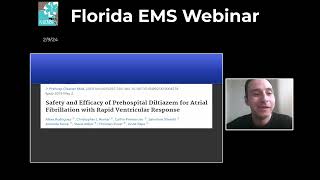
Webinar (Feb 9, 2024) led by Peter Antevy with Dr. Louis Fornage reviewing pre-hospital management of atrial fibrillation with rapid ventricular response (AFib w/RVR). Fornage summarizes historical small prehospital studies (early 2000s through 2010s), then presents an ESO-consortium retrospective analysis drawn from a large EMS database (~initial pool ~5 million calls, narrowed to AFib w/RVR cases). Key findings: prehospital interventions (predominantly diltiazem) were associated with earlier rate control (target HR <110) with a substantial effect (NNT ≈5), no significant increase in persistent hypotension, bradycardia, or cardiac arrest in propensity-matched comparisons, higher ED discharge rates and lower mortality in treated patients (associative, not causal). Limitations: retrospective design, exclusion of patients with concurrent trauma/sepsis, limited hospital outcome linkage (~25% charts available), and need for prospective/RCT data; emphasizes importance of protocols, education, and QA/QI.
Chapters
Welcome Everybody. It is February 9th on a Friday 11am and we have another great session scheduled here today on the Florida EMS webinar. This is the NAMSP webinar for the Florida chapter. And as you know all of our recordings are on YouTube on the floor. Just type in Florida NAMSP. I think Dr. Florence will be maybe number 150 which is pretty incredible. It all started during COVID thanks to Dr. Pepe and here we are. You do get CME if you would like it. So you can go and cloud CME is what we use. If you want instructions on how to do that, you can let me know and we'll get that. We'll get that done. I'm going to try something before I introduce our speaker. I'm going to launch a quiz.
And a poll and let's see if you guys go ahead and just click on.
Does your EMS system carry any of the following medications for afib?
Lewis, as we, as we go and we can see what we have here. So far 50 have participated. So it looks like 82% is the winner for a calcium channel blocker, 59% with MEO or DID or at least the anti rhythmic category and beta blockers 24% 6%. Only one person say none of the above. As many of you know, what I do for these webinars is I scour the literature, I search on Twitter. Whenever I find something of interest, I send an email to the author. And I think that almost everybody has responded as a yes and which is pretty incredible. That's why we love ems, love the Internet. So today is no different. We have an amazing speaker. He's an assistant professor of Emergency medicine at Baylor College of Medicine. He is EM and EMS board certified and he wrote an incredible paper that he'll be discussing today. So Dr. Fornage, thank you for joining us. You can make any further introduction and I'll let you take it away.
Yeah. Thank you all so much for the opportunity and that was perfect. I'll just go ahead for the interest of time. Just go ahead and get, get started.
So I.
Came across this opportunity to focus on this topic a few years ago during one of the ESO research symposiums. But it really had been a question that asked myself for quite a while.
Let's see, see if I can get. There we go.
So I'd actually start kind of thinking of the interesting diversity of ways of managing folks who are in patients who were in AFIB with RVR for quite a while. I started off as an AMT.
In the Houston area Had volunteered and worked for various fairly progressive services in the area and had noticed a variety of different approaches to these patients. This continued when I did residency in North Carolina.
And further during my fellowship in Missouri. Missouri was really where I was exposed to having a lot of different services. Basically say, well, you know, if they're minimally symptomatic, even if their heart rate's in the 130s, while they're relatively stable, we don't really need to do a whole lot. We'll just take them to the hospital and let them take care of it.
At that point in time, I was starting to think of.
Who'S doing the right thing for the patients. And even looking at the literature from the ER itself, there seemed to not be a one consensus approach. There was obviously a lot of different ways to skin this cat. But I felt like that that situation had bled over into, into ems and that's why we had so much variability in treatment.
Furthermore, I think that going forward, this was a good opportunity.
And a relevant topic to look at when the opportunity presented itself. Because as we know, atrial fibrillation and its complications, like having a rapid ventricular rate.
Is basically a condition that does increase in frequency with age. And we know that our population is aging. So even though the total call volume of AFIB of patients presenting in AFIB with RBR is comparatively small, maybe 1% of all EMS runs.
Certainly something that's not going away and is increasing over time. And what was actually interesting about those two papers that I put up on the screen is that they actually also noted the same thing, that there was actually a fairly wide practice variation between emergency room physicians once patients were brought to the er, and hospitalists and cardiologists as well as well too.
So the first paper that we ran across during the writing of this, of this publication is this one that was published back in the early 2000s. And just for a little bit more context, I really felt like this.
Webinar would be a good opportunity to review the literature because there's really, frankly not a whole lot that's been presented specific to the pre hospital setting. So.
For, for this paper, it was a fairly small.
Service that they were getting data from about 5,000 runs per year. And what they came to the conclusion was that their AFIB with RVR or rapid AFIB was such a small percentage in terms of their call volume that in most of the situations that were presented to their paramedics, basically, quote, unquote, supportive care was all those needed. And they didn't really they never had to use DILT or electrical cardioversion.
And so as a result there really wasn't need to be that aggressive pre hospitally with management of AFib with RVR.
In 2001, 2002. So around the same period of time Dr. Henry Wang came out and published one of his own papers which was interesting because it really was overall even up until up until now one of the few studies that we have available for pre hospital management that actually offered a comparison, a control comparison to between DILT and control patients. And they had about 40 patients that they looked at and the primary outcome here was they were looking at overall efficacy so decrease decreasing the patient's heart rate with administration of dilt. And they also commented on the fact that they were able to do so safely without any significant.
Adverse events such as hypotension, requiring any form of intervention, cardiac arrest, cardiac arrest, intubation subsequent to the administration of diltiazem. So as a conclusion they basically say that diltiazem was a viable medication to use in the field for patients presenting presenting an AFIB with rvr.
Subsequent to that, the next major publication on this topic was again Same Time Frame 2002 by Dr. Slovis and his and his group. And this is a passage I wanted to highlight that they were fairly.
Generous or.
Broad in their recommendations of basically saying that well you know, it's at the discretion of the medical director who with their pre hospital team knows their population the best and they can choose to do what they feel is most appropriate. But certainly saying that you know, if the patient's clinically stable and no intervention is felt to be needed, that's okay. But that also having pre hospital intervention is certainly also something that that is runtime to 2016 where the some of the folks out of Seattle published a chapter in this publication of atrial fibrillation management in essentially settings that I thought was really interesting but at you know, that point of contact and they're also starting to mention that.
They were surmising that earlier access to care would hopefully improve patient centered outcomes down the road. But at this point in time we still had no studies that were able to link that prehospital intervention to that final clinical outcome.
And in between those two time periods there are two other papers I want to highlight. This was the first one in.
20 2011, excuse me. And this is where we're starting to see a larger population being looked at with regards to any possible safety and efficacy issues related to the use of STILTIZE them specifically for AFIB with RVR in the pre hospital setting. And what I'd like to emphasize here is that it ended up essentially looking at 278 patients. Only two of them were hypotensive on their review subsequent review.
A third of them actually were able to control the heart, the patient's heart rate to less than 100 beats per minute. And at least two thirds of those patients had at least a 20% reduction in the heart rate by the time that they were, by the time they arrived to the ER.
And similarly out of Orlando. This paper came out most recently where I think the takeaway was that in a system that provided close.
Or initial education and close monitoring essentially QAQI of the paramedics administration of agents like diltize them, they were able to decrease the likelihood in the rate of adverse events. I believe that they reported.
As high as 18% risk of essentially complications or problems during.
Protocol deviation.
Situations where deltasm was administered versus only 8% of adverse effects.
When the protocols were successfully followed. So I think that the highlight of.
This paper was that again under close supervision qaqi, there's a way to limit any possible.
Any possible risk associated with administration of some of these medications. Pre Oprah AFIB with RPR.
And as we moved over time, I'd mentioned initially there had been quite a few publications saying, well, we don't have a consensus on how to manage AFIB with rvr. Different providers choose to do different things. Well now as we move over time, the American College of Cardiology has come out with stronger recommendations of how to treat and what medications should be used in different situations. In the emergency room, we've had some of our colleagues also kind of summarize and try to be more concise with some of these recommendations. So for services that don't have these protocols in place, there's certainly more resources to help with establishing these protocols nowadays as well too.
So this leads us to the paper that are that our group, that our group wanted to look at and write about, basically building on the body of literature that existed. But again, when we look at the population size of these studies, they were usually in the few hundreds at most, usually a handful, 40, 30, 40 patients initially for some of these studies. So this is where really where that research consortium through ESO was really helpful.
Because of the fact that it gave us access to that larger database of initially a volume of about 5 million calls. And obviously we narrowed it down to the calls that we were interested in looking at. So first and foremost we wanted to basically Reinforce if at all possible, if the data showed it, the safety profile of treating AFIB with RVR in the field, regardless of how the paramedics chose to do so or regardless of how the protocols were established, and also reinforcing the fact that this was a safe intervention to do, and so to do so, as had been done in prior studies, we chose to look at whether or not pre hospital rate control had been achieved in the first part, in the first place. From an efficacy standpoint and from a safety profile, we looked at episodes of bradycardia, hypotension and cardiac arrest specifically.
One thing I do want to point out is we felt that a more patient centered and more clinically relevant endpoint for hypotension and bradycardia were episodes of what we would deem persistent hypotension and persistent bradycardia. So having more than one reading, because I would surmise that most folks here in attendance probably wouldn't necessarily change automatically what we're doing for the patient would just one abnormal reading. We probably base our changes in therapies based on a trend or again a significant pattern. So based on that, when we're looking at episodes of persistence, of non transient bradycardia, non transient hypotension, there's actually no significant difference between our propensity match treated and untreated patients that we were looking at. And same thing for cardiac arrest as well too.
And from an efficacy standpoint, I would like to emphasize that there was a pretty significant.
Effect that was seen here with regards to getting pre hospital rate control.
The only caveat I will point out there here is we based our goal of a heart rate of less than 110, which is a little bit different than prior papers. That was just based off of the fact that that's a goal that's highlighted in a lot of the more recent guideline recommendations for AFIB treatment. Initial AFIB with RVR treatment versus the initial papers a lot of time used either a cutoff of less than 100 beats per minute or reduction of 20%. But regardless, the effect size is pretty large. With a number to treat that's also pretty impressive of 5. Again, things like aspirin and chest pain that I think we all regard as being a pretty well established.
Metric for us to look at prehospitally. We certainly don't have a number to treat that's as robust as this. So that was certainly an interesting finding when we were looking at this data.
Another goal that we had when we set off writing this paper More importantly, was really trying to go ahead and link patients final outcomes as best we could and not just stop at when the patient was handed over to the providers in the er. Here in terms of the data that we're able to extrapolate from that exchange and I want to bring yalls attentions to two in particular the discharge to home. So patients who were transported to the er, there was a higher likelihood of those who had received some form of intervention by EMS to be able to be discharged back home and not be admitted if they had received that pre hospital therapy. And there was also a decrease in mortality as well too associated with those interventions. Now again, obviously taking this information with a grain of salt, there's a lot that goes into the treatment of those of these patients and this is certainly not.
A causational link that we're applying, but it's certainly an interesting relationship that we, that we found during this, during this publication. And then the last thing I want to highlight as well too in that we did in this paper is that a lot of the feedback that we had gotten when we had initially talked about publishing this and presenting this at NAEMSP in the first place last year, a little bit over a year ago, was that there was a lot of concern about inappropriate administration and how that might affect, affect the data. And so we tried to, as best we could, again make sure that we were looking at what are the effects of appropriate, of administration of these medications or these therapies in the appropriate setting. So certainly there are larger issues at play that need to be addressed from an operational and clinical standpoint if we're giving dual ties them to a patient who's in AFIB with RVR in a trauma setting or if they're septic. And that was not something that we had the bandwidth to address during this paper. So we did exclude these patients again regardless of if they received therapy or no therapy, if they had AFIB and another concurrent either medical or a condition or a traumatic condition as well too. And you can see that those were excluded based on.
Graph that's on the screen. Now.
Some of the main points that I want to highlight that we again kept in mind and try to do our best with was again this is retrospective review. So a lot of the quality of the evidence that we brought forward was subsequent to our best attempts at providing a robust matching.
Protocol. And so here's the exhaustive list. I won't read through it, but here are all the things that we tried to factor in so that we had as good of a match population as possible.
And so in summary, what we were able to see was that crosspoint intervention of.
Patients in AFIB with RBR was associated with earlier rate control, which I would argue is really.
Was, which is very helpful for our patients just because this is what's going to happen regardless in the ER once these patients are admitted, if they have to be admitted. So why not try to get the ball rolling on that as soon as possible.
We were able to see a trend towards increased ED discharges when patients received pre hospital intervention for their fib with rvr, noted decreased mortality and as I pointed out, really no significant increase rate. Increased rate of adverse events as well too.
One thing that I wanted to point out is that we also were curious to see if, if we were able to treat these patients sooner from a system standpoint, would there be an argument to say, you know, we should really continue to look at this as trying to encourage these protocol changes prehospitally because it'll allow us to, to have shorter length of stays in the ER and in the hospital. Again, try to get people out sooner and again to leverage that going forward. In our conversations, we didn't see a significant change in length of stays between these two groups. One of the thoughts that we had while we were discussing this was that once you show up with AFIB with RVR and the decision's made to hospitalize someone, there's a lot more that goes into it before you can be cleared to go back home. You know, we see them having to sometimes get repeat echoes and have other folks get consulted as well too. And so that may be independent of of the timeline of when that rate control actually is complete. So maybe that's why we're not seeing as direct of a relationship between that pre hospital intervention and those secondary outcomes.
And then just another thing I wanted to point out as well too, and I appreciate you doing that quiz up front. Dr. Antevi was to be fair, we called it, we named our paper as pre hospital interventions to encompass really everything that is available to prehospital providers with regards to managing AFIB with rvr. So that includes diltiazem as a very common option, but beta blockers, certain antiarrhythmics as well too, such as DIG and amiodarone cardioversion as well too. But when we looked at our data, we were well over 80% of the time a therapy was used. It ended up being diltiazem about 5% of the time, if I remember correctly, we were.
Providers were using metoprolol and only 2% of patients had gotten cardioversion. A thought that we had was to try to go back and look at specifically, you know, just the patients who received diltiazem to see if those other medications and other therapies had any effect. I think if I remember correctly, we ended up doing that on a somewhat formal basis and the overall trends that I noted earlier really were held.
Held for the vast majority.
And then just to finish off real quick, some of the next steps that we also kind of brainstormed about and were thinking about is it'd be interesting to see if our outcome results and associations continue to hold when more data is plugged in from the hospitals into these various health data exchange portals. We only had about 25% of all patients that we had charts, that we had charts available for have actual outcome data. But this is something that is in flux and again is getting more and more, we're getting more and more data back from the participating hospitals. So it'd be interesting to just make sure that these results continue to hold with 50%, 75% of these patients having outcome information on. As always, it'd be wonderful if we could have something more perspective and something along the lines of an RCT obviously would be great. But I would venture to say that, and we hope that the, the result of having this publication out there is to continue to encourage maybe some, some of the services that may be a little bit more on the fence to consider looking into these protocols.
Just because of our larger sample size and allowing to hopefully get us a little bit more confident in the fact that these are safe and reasonable interventions to do. And I want to just finish off on one last point. You know, over the past few years we've had pretty significant changes in.
Some of the things that our pre hospital providers are capable of doing, such as basically rsi. Making sure that that has been safe, rolled out safely really has been a result of buying a lot of equipment, for example, for certain services, getting video laryngoscopy, investing a lot of time in both initial education and qaqi. Same thing for services that are rolling out blood products as well too. There's a large investment up front in terms of all the relationships that need to be built for.
There's an equipment cost associated with it as well too, and obviously qaqi. And again, there's certainly risks associated with both of these interventions. I feel like with the information that we were able to see here, I would argue that these are treating AFIB with RVR in the field is probably not any more risky. We're developing more and more robust QAQI programs throughout the country. We have.
More from Peter




Melissa Olen MSN, FPN-C, CCRN: Sudden Cardiac Arrest Training in Schools (Project ADAM) 4/25/25



Pediatric Hospital Readiness: How Teamwork & CPR Metrics Drive Better Outcomes



Chelsea Kadish, MD & Kyle Goodknight, EMT-P, RT: Pediatric CPAP in EMS (3/14/25)