Dr. Marc Eckstein: Tele911 Update (2/7/2023)
Dr. Marc Eckstein presents Tele911, a Los Angeles program pairing paramedics with remote emergency physicians to handle low-acuity 911 calls without transport. After a year, it safely manages cases like cough, minor chest pain, and anxiety while reducing ambulance trips and ED crowding.
Chapters
There we go.
Thank you. Thank you, Angus. Okay. All right. So welcome everybody. We're getting a nice, nice quorum here. It's Tuesday afternoon at 3:00pm There he is. Smokey Joe. I was gonna, I was gonna guess.
What else, but it just wanted to do something of. Just off color, you know, that kind of thing. Right.
I was. I was. I was. I was guessing just in time, but you got me this time. Thank you, Joe.
We're still waiting for people. Did you get the transcription today about what our CME is for today? No.
Can you tell it to me and I'll throw it in the chat right now?
Sure, as soon as I find it. And if you don't mind, like to say a couple words about our speaker today that I found out about early this morning. So. Which is kind of cool.
It's all you two hat. Because I just won the bet.
Yeah, yeah, that's from my Asia tour.
I said, Paul, I said it's you two stones or the police. So.
Yeah, yeah, exactly. I could switch over. I have Steely Dan as well, so. I'm sorry, I shouldn't be clowning around. Let me see if I can find the.
Thing for it today. I have to print it out anyway. So. Eagles, where is it? Huh? Updated. Here we go. Zoom. All right, so today's thing for The Seagulls is 1-732-217-322. It'll go on to be 7323 for the full meeting at 3:30.
Okay, so. So the, the. The afternoon one is 17323.
Yeah. Same sequence. Yes.
Okay, it's up. All right, awesome. Thank you, Paul. Okay. All right, so let's get started. Welcome everybody. It's three o' clock in the Eastern time here in South Florida today we have a very special guest. Many of you know Dr. Mark Eckstein, former EMS medical director out in Los Angeles. And he's been doing it for quite a long time and he came on our webinar. Mark, how long ago was it that you came on our webinar? Probably it was less than a year.
Ago, it seems maybe a year ago. It's been a while.
Yeah, it's been. It's been a minute. And I know you have a lot of great updates to give us and I know a lot of agencies in Florida are. Are ramping up with Tele 91 1. But before you get started, Paul, you said you wanted to make a couple of comments and then we'll let Mark take it away.
Yeah, I've actually known Mark for literally several decades.
So first of all, and actually I first didn't meet him, but I was supposed to meet him in 1992. He'll explain sometime later on why he hates me forever. But the. But I got to know about his background. I think before we get into this. First of all, Mark started off as a, as a New York City paramedic way back in the 80s, et cetera and eventually went into medical school, did well, ended up in La la land in LA and gradually went his way up through the ladder, so to speak, as their medical director over many years ended up becoming their bureau chief, actually part of the fire service that was the bureau chief there for a long period of time. His experiences and post traumatic circulatory arrest, his experiences and disasters have been enormous. But mostly importantly, he was on the streets, always there responding, got a great family and all that. And also he was a person that went to 911 and he was part of the rescue teams that went in there later on he said an incredible experience and a credible career. And about a year ago, because he thought it was the right thing to do, especially after Covid, he got into this program to try to help offload emergency departments and more importantly do the most appropriate thing for the patients and not always ucall u haul and I've been really impressed with it and I'll make a comment later. I just wanted to say that Mark's an extraordinary person. We're just really glad to him. And by the way, I should mention Mark, I think you were the first, first full professor at university, I think Southern California, if I remember. Is that right in the Keck School of Medicine. Am I right in saying that?
Yeah, well, you're embarrassing me, but yes, but that is correct.
That's correct. Thank you. Now I've left two minutes for your talk, so get on with it.
How much did that, how much did that cost you? It was like he bought me a cup of coffee one time and.
No, that. That bought you. I'm going to buy an Irish coffee after that one. But Paul, thank you so much. And yeah, Paul actually was my mentor and dear friend and colleague now and Peter and a lot of people on the call. Thanks for inviting me. I'm going to share screen for a moment. I'm not going to do death by PowerPoint, I promise but I do want to give everyone kind of an update of where we are and.
Just kind of open up the Q and A. So as Peter mentioned and Paul mentioned why we get into Tele911 everyone really has the same pain points now in EMS ED. Overcrowding, the paramedics are burned out, running low acuity calls. And as Paul mentioned, the UCALL we haul phenomenon really hasn't changed really since, since EMS started over 50 years ago. And then on the flip side, at least I found in my tenure in LA and I'm, I was.
Mark, can I interrupt you for a second? One thing I should say also is that one of our problems right now is this wall time or ambulance parking. And you were the one that first wrote the article about how to handle that stuff way back in. So this is like been near and dear to you and I'm sorry to interrupt you but it just like people have to know you've been on top of this for a long time. And I just think it's. You have your finger on the pulse is what I'm getting at. So thank you so much. I mean you've had it on there for years as you've just mentioned.
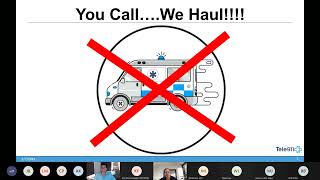
So thanks Paul, I appreciate that. Yeah, well, initially we did a, wrote up a retrospective study looking at wall time in LA. We were losing the equivalent of three to four ambulances. So we had you know, 96 plus hours cumulative per day with wall time. Obviously that would ebb and flow during COVID and seasonal influenza. Paramedics were carrying wall kits with them. I mean it was just horrific. And then a high percentage of patients that for whom they were babysitting on the wall were not were stable. And then the paramedics would miss critical calls which obviously compromised lives and were huge morale killer for the paramedics. Then on the flip side we saw because the medics wanted to avoid wall time often for the right reasons, they wanted to become available. They kind of started pushing the envelope to leave patients at home and not transport them. And we unfortunately, I'm sure as everybody else on this call has dealt with, we had some really bad outcomes and catastrophic outcomes with some non transports because the paramedics did want to transport. They knew if they transported the AB out of service for many hours. And some of these were really tragic. And then on the flip side, patients who need to go to the hospital, the medics are trying to convince, they often refuse. And we know a lot of those tend to be middle aged older males. You know, we're all stubborn, the wives call, the kids call. You know, I think all of our medics, a lot of us have seen Even in the ED, you know, the 65 year old male, he's pale, cold, diaphoretic with tombstones on the 12 lead. And he says it's just an ingestion on not being admitted or in the field. I'm not going to the hospital. And it's a horrible feeling because you can't convince them over the phone. So we'll talk about that really briefly. So we're really just really talking about paradigm shift in EMS. And it's interesting I actually put this up on LinkedIn with an X over ucall we haul and it kind of went viral. Got almost 60,000 hits on this. So it really struck a nerve that we need to stop the ucall we haul phenomenon. Our telemedicine policies that we have with our EMS partners are really straightforward and when to consult telemedicine. And the biggest bucket really is the medics think the patient's stable, doesn't need to go to the ED by ambulance. They contact one of our board certified state licensed emergency physicians, years experience in EMS. I think the epiphany I had now that we're one year operational with Tele911 with multiple agencies is that almost all the patients who call 911 with very few exceptions really are not calling because they want an ambulance ride to the er. They're really calling because they want their problem solved. And that statement supported by the fact that of almost 2000 consults and the paramedics call requesting a treatment in place, there's only about one handful, about five or so patients still insisted on ambulance transport after our physicians recommended treatment in place, meaning they were comfortable to be reassured. The emergency physician walks them through what their impression was send a necessary prescriptions and then that next day follow up by a patient care coordinator is so important a to make sure the patient who wasn't transported is safe and if it was a high risk refusal who we couldn't convince to go. That's our highest priority for next day follow up. Basically do a comprehensive needs assessment. Why does patient call 911 and link them to primary care and local social services. And this is really low hanging fruit. And our patient care coordinators have been successful about 85% of the time convincing patients to go to the ED which is really.
Quite remarkable. Why they call connect them to primary care. Some of the most common.
EMS transports that we see day in day out that have led to ED overcrowding and wall time that we're routinely converting to treatment in place. Not surprisingly, cough, fever, congestion, flu symptoms. I think the trick here is because we have experienced emergency physicians doing the consult, we're able to Tease out those patients who may need to go. Maybe they're getting septic, they have comorbidities that may tip them over.
They have pneumonia that requires inpatient care. We'll look at a 12 lead, but we're keeping patients at home even at all ages. We've even had patients in their 90s with flu symptoms. Even a positive COVID test, a home COVID test that we're able to keep at home. Plus or minus Tamiflu, plus or minus Paxlovid, plus or minus a Z pak, again with the next day follow up. We know transporting elderly patients to the ED unnecessarily is really a horrific experience for them. And again ties up our paramedics near syncope, palpitations, headaches, back pain. It's amazing how many patients with chronic hypertension run out of their medications, have some headache or they monitor their home, blood pressure, their kit alarms, they call 911. Gastroenteritis, UTIs, a lot of low risk chest pains. As we risk stratify like we do in the ed, we'll do a perc score, we'll do a heart score. Look at the 12 lead risk stratify. To keep these patients at home, tons of patients call 911 for anxiety. This was actually one of the most common provider impressions in my experience in la where we had catastrophic outcomes. I think the difference here is having the emergency physicians work with the medics on scene to risk stratify and then determine how these patients need to be medicated and send in prescriptions to really treat patients in crisis and make sure the anxiety is not something that suggests underlying serious pathology. Febrile seizures, we know that's terrifying, particularly for first time parents or first time the parent has an infant with a new onset seizure. And if the kid is well appearing back to baseline, the vaccinations are up to date. We're routinely keeping these kids at home, known as Maddox and Copders, with no significant comorbidities who turn around after we do an eb. Some of the paramedics pick like.
More from Peter




Melissa Olen MSN, FPN-C, CCRN: Sudden Cardiac Arrest Training in Schools (Project ADAM) 4/25/25



Pediatric Hospital Readiness: How Teamwork & CPR Metrics Drive Better Outcomes



Chelsea Kadish, MD & Kyle Goodknight, EMT-P, RT: Pediatric CPAP in EMS (3/14/25)