Dr. Mark Brady: SafeBVM (2/21/2023)
Mark Brady discusses SafeBVM, a device that prevents over-ventilation during bag valve mask breathing. The webinar covers how it works, real-world use in emergency medicine, and upcoming research with Peter Antevy, Art Slutsky, and Paul Pepe.
Chapters
So over to you, Art, and you could introduce the rest of the team, etc. That'd be great.
Super.
All right. Okay. And I see that David has started the transcription, so we are recording. So welcome everybody. It is just about three o'.
Clock.
It's another Tuesday, Florida EMS webinar where, as you know, we bring in incredible speakers who have published on something that they've done.
This month of February. We're kind of attributing it all towards, you know, really good products that we've seen out of the conferences that have some publication behind it. And I've known these guys who are the creators of this device ever since they were, they had like a little clay model of it. I'm joking, it was, it was more than a clay model. But I gotta give them credit, coming from Georgia Tech and trying to make a difference in the world. And now they've clearly developed a team. Holly Stewart and many others. So really proud of these folks. Can't wait to see the data. So without any further ado, they brought their own moderator, Art Slutsky. So, Art, let me pass it over to you and then introduce your team. And at the bottom of the hour we're going to close it up. So just please be mindful of that timeframe and take it away. Thanks for coming on, Peter.
Thanks very much. We're really excited to be here. You know, we're going to be talking about bvm, which as we all know is used sort of daily. Seems like the very simple thing to do. But it turns out as again, all we all know that it's, it's not so easy how to do it in a quality way. So the topic today is really how do we make it safer? How do we make BVM safer? So I'm moderating this. My name is Art Slutsky. I'll give you my conflict of interest in a second. There's Mark Brady. He's going to do the majority of the presentation of 17 minutes and we hope to have 10 minutes at the end for questions. Obviously, feel free to jump in, put up your hand, whatever to ask questions. So listen carefully to Mark.
Next slide please. Mark. I'm a consultant and part time chief scientific officer for a company called SafeBM, a small company that started that has, I think a pretty cool device to help limit flows and therefore pressures during bag valve mass ventilation. Next slide. So just tell you very briefly about myself. I'm a professor of medicine, surgery and biomedical engineering. I'm at the University of Toronto. I was a previous Director of the respiratory division at this university, as well as previous director of a division of critical care medicine. So I'm more of an intensivist. I'm not a hospitalist, although I was involved with a number of NIH trials. I'm also an intensivist and a scientist. And my major research interest is mechanical ventilation, ventilator induced lung injury. And that's why my interest in this device, in this whole area, how do we limit the complications due to ventilation? So that's really all I'm going to say. I'm going to leave the cool stuff to Mark. Mark Brady's going to introduce himself in the first couple of slides. And I hope you find this interesting. Some exciting stuff.
Take it away, Mark.
Before Mark takes off. Art, you may remember me, my name is Paul Pepe.
Of course I remember you, Paul. Oh, my God. Haven't seen you in ages. Great to see you, Paul. Paul did some great stuff in the ICU before he got into the. You know, I'm sure you all heard of auto peep. This is the originator, one of the originators of that. So, anyway, great to see you, Paul.
Yeah. Sorry to interrupt you, but I just wanted to say hi. And then. Everybody get the CME code for today.
Yeah. Put in the chat 17328 and then 17329.
Rock away, Mark. Thanks a lot.
So, Peter, we get an extra minute at the end because of Paul's interruption, right?
100%. You got it.
Okay, Mark.
Hey, afternoon, everybody. My name's Mark. I'm an assistant professor of emergency medicine. I'm an emergency doc by training up in Providence, now Providence, Rhode Island. I'm also Navy reservist and spend a lot of time with the. With the Navy. I don't own any of this company. Speaking as an individual now, on behalf of the Department of Defense, we did get two NIH grants related to this device. We've been using it to do studies on the device. But I don't own or I don't do any consulting for SAFE evm. That's me. My background. I'm an emergency doc by training, but I did an NIH fellowship doing research in tuberculosis. I'm a Navy reservist. Went to New York City for the COVID response. Was the chief operating officer of the COVID Hospital in Memphis when that was a thing. I've worked kind of all around the world in a lot of places without mechanical ventilation or readily accessible mechanical ventilation. Cambodia, Liberia, place in South America, South Africa. And I used to do Some writing for the Discovery Health Channel back when that was.
Did spend eight years in Memphis at the fourth busiest trauma center in the country, the Elvis Presley trauma center. The reason I went down to Memphis was to start help start a residency program down there. Because training is I think the biggest way to make a difference as an individual.
We made our own little challenge coins here and have a family history of work with EMS and fire. This is my brother, he's on North Providence Fire. This is had people on the Rhode island fire for about 100 years in my family. And that's my nephew Aidan who will hopefully be carrying on that tradition. Let's start with the problems with the bag valve mask. And.
The main issue of the bag valve mask system is it's unregulated. The design doesn't have any regulation in it. You've got a pop up valve that's not really regulation. And what it's so easy to do, especially when you're in the field is over ventilate. And that can lead to complications when you over. If you push too much air in too high a pressure you can insulate the stomach, you can fill the stomach with air and it later comes up, they aspirate. It causes lots of problems. If you're over ventilating you increase the intrathoracic pressure. So when you're trying to do CPR you're not getting enough venous return and that can lead to poor outcomes. With CPR you can of course if you squeeze the main resuscitator back too hard, you can blow out the lungs and that can happen below the threshold of the pop off valve and then you can of course have under ventilation issues. So the main problem with the bag valve mask system is it's unregulated by design. Initially started doing some research based not at all with any kind of device or anything but just on EMS providers ventilation patterns. Back before COVID in 2019 one of my residents was interested in doing some research on this stuff. Went to EMS World then 2020. EMS Today had 199 just medics that were just walking by and we had them ventilate a simulated lung for 90 seconds. Just squeeze this bag like you would do with the bag valve mask. And we just watched to see kind of what they did and it looked kind of like this. Just hey, just squeeze this bag just like you would when you're using a bvm. And we just saw what they did. We measured the peak pressures that they generate and the tidal volumes.
These are the things we set with a mechanical ventilator, but also the things that can cause all the complications of over ventilation. And we measured the outcomes on the x axis here. Going left to right, we have individual providers. And on the y axis on this top graph, we have the peak inspiratory pressure. How much pressure are you generating? Anything above that bright red line is enough pressure to insufflate the stomach. So about 22 centimeters of water. So a lot of those little green dots are above that line. So a lot of the breaths being delivered are high enough that if you were using bag valve mask, you'd be at risk of insufflating the stomach. We also looked at tidal volume on the bottom, and we told people to bag about a regular sized male, which would be about 500 milliliters, which is where this blue line is on the bottom. And you can see that some people are giving very, very high volumes, more than double what's recommended. Again, that layer's gotta go somewhere. So it might go into the stomach and it might induce lung injury. So just not even looking at a device or anything, we're seeing like just 200 random EMS providers.
Over ventilation is an issue. And then we just thought it'd be interesting to look at, say, hey, are there any other variables that would affect this? The gender of the provider, Are they using one hand versus two hands? How big are their hands? Just some things we thought might be interesting to look at when you're actually using the device and their confidence and years of experience. Maybe, you know, maybe this is a newbie issue. And we found just three other variables were associated. The 1 versus 2 hand was the most important thing. If you use two hands, you're probably over ventilating. If you're using most people that use the two hand technique, although, you know, theoretically you don't need to squeeze all the way. Most people are.
Over ventilating with two hands. Also, people who are more confident tended to over ventilate more, and people with more experience tended to over ventilate more. The years of experience was statistically significant, but clinically not really relevant. The biggest thing is one versus two hands. Just thought that was kind of interesting.
And we took these big scatter plots and just kind of different thresholds. And I'll point out the things in the table. I know it's a lot at once. So one, the percent of all breaths delivered that are over a 22 centimeter red line was about 60%. So 60% of breaths are delivered at too high a pressure.
When you look at pressures above 60cm of water, which is where we know you can pop a lung, you can get a pneumothorax. About 9% of providers provide at least one breath above that threshold, which is, you know, it's a lot. Under ventilation, also a problem. About 14% of breaths were under, you know, the pressure and pressure of 10cm of water. Our volume of 420ml, where we consider that to be under ventilation. So a lot of breaths are also under ventilated. And this all comes down again, it's a manual system, it's not regulated. The biggest thing is the bottom of this chart. Only 2% of providers were consistently perfect. Perfect in terms of being delivering every breath within the right pressure range and the right volume range. Only 2% means 98%.
Of us using this device had at least one breath delivered. Outside of that, most of the breaths delivered. The problem was over ventilation, although under ventilation was also observed.
So basically over ventilation is a big challenge. And we published this in Pre Hospital Emergency Care.
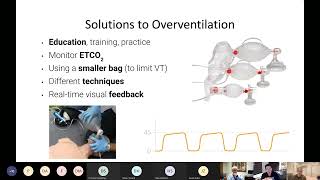
The solutions to over ventilation. I've got a bunch. Education, training, practice is something that a lot of people are trained on and they never necessarily have continuing training. And one of the challenges to it is there's no feedback in the system when you're doing training with a manual resuscitator bag. Just told how to do it and somebody might say, hey, that looks like too much or too little. But there's not any. There's not necessarily any training that everybody goes through that gives you feedback. You could in the field monitor your end Tidal CO2, which is great because it's real time. You can see how you're doing with your breaths based on your end title, which is great. There have been some people proposing to use a smaller bag to limit the tidal volume. You could do different techniques, use one hand versus two hand. And people teach all different ways of gripping bag and looking for real time visual feedback, just seeing chest rise and stuff like that. So there are some solutions.
And so we just done this study and I was over in Rota, Spain at the naval hospital at the time and we were hearing some of our ships were having these people with.
This virus from China on it.
And weren't really sure which direction that was gonna go. And then a few months later, on the right side of this, this is the civic center where I grew up going to the circus and seeing Barnum and Bailey turned into a big old Covid hospital. They were just getting ready for Comic Con. And that's where a few months later, I'D found myself. So.
Between Spain and going into the COVID Hospital, one of my residents had met the Safe BVM folks at a conference. Again, I don't own Safe BVM or anything. And I knew about the device and I was like, well, I've been in a lot of places where we don't have.
Enough ventilators. So it would be a solution to running out of ventilators. And there's this little device thing, it basically just connects to the manner resuscitator bag. You just basically snap it on the bottom there and if you squeeze too hard, it'll stop you from squeezing too hard too fast. It's a mechanical flow rate limiter. So if you squeeze nice and slowly, it works fine. If you squeeze too hard, it just basically stops. And it's a one way, one way thing, just goes on one way. It's kind of, it's kind of, kind of dummy proof and it makes it obviously like intuitively a lot safer for using the Mantle resuscitator bag. Basically if your flow is greater than 55 liters per minute, the little valve will occlude the outflow and stop you from doing that, which is safer for patients. So before I went to New York City quickly had a buddy, had a hotel down in Memphis, asked if I could use it to, to do a study. And just looking at medics and medical students. I was like down in Peru we only had five ventilators at the hospital. Sixth ventilator was a med student. I was like, if we run out of ventilators, we're just gonna have med students vetting people. No biggie, but I think this device would really help. So we just basically got them. And for 12 hours a day, for a week we were just having.
My local medics in Memphis and med students and nurses, anybody I could grab just ventilating for two, one hour sessions at a time and, and saw how they performed just like this with little metronome, just had them go for an hour at a time. Likewise, pressure's on the top, tidal volumes on the bottom. We're going to have the red dots and green dots mean two different things. The red dots are the bag without the device and the green dots are with the device. So you can see the green dots. And again we get that red line showing that the pressure threshold above which you get gastric insufflation.
The green dots and we have the individuals on the x axis so they're their own controls. When you're using the device. The green dots Are more of them are below the red line, below the peak pressure threshold than without it. And sometimes you can see these red dots go really, really high. Some people are really, really going off the reservation there. Likewise with tidal volumes. We see the tidal volumes are much, much closer to what they should be. The blue line there with the device. And when you look at an individual, you can see that they kind of self correct with this individual that circled there without the device. The red dots, they were really, really high pressures. And with the device the pressures were much more in line. And we saw that trend kind of throughout. We also published this in the British medical journal Innovation Journal. Just because it was something we wanted to get out really quickly and thought it was a good enough idea that they took it. It's pretty good journal. Just the feasibility of manual ventilation, replacing mechanical ventilation with this device and really seemed to help and everything was significant.
Okay. And then got a little grant to do some. Do some training videos for providers because everything really.
Is provider dependent. So one of the things with this device is like any device, it's just as good as the person that's using it or any weapon system. If you're in the military, it's just as good as whoever's operating it. So got a little grant to make some training videos. Went down to Chattanooga to the PBS studio where I knew some folks there. We made some training videos which I'll put a link at the end because I think they look kind of cool even if you're not using the device. The just train people on how important it is to use the mantle resuscitator bag correctly. So I'll put on a QR code at the last slide. And I went up to my brother's fire department up in North Providence, Rhode island and then just wanted to do usability study seeing can people figure this out pretty quickly and do it much better with the device. And they could watch three minutes of videos and then you're kind of good to go. People got it. It's pretty intuitive.
On the chart here on the left. And we studied there, you know, we studied how the firefighters performed on the left. We've got the peak inspiratory pressure on the Y axis and that's what to pay attention to, the Y axis. And the chart on the left is without the device. And those red dots are when you're going above the threshold. When you're going above here we're using 20cm of water. You can see about half the dots are above that. Whereas with the device on the Right. None of them are like, I mean, two dots are above the threshold. And so we did find, just after watching a video for two minutes, just messing around with the device for a few minutes. People get it, it's intuitive. It only goes on the manual resuscitator bag. One way, if you squeeze too hard, it stops you from squeezing too hard. It kind of slows you down a little bit and very impressively, kind of keeps people from overinflating. This graph's, I think, the most complicated one.
And on the Y axis, again, going up and down, we've got the proportion of breaths greater than the threshold on the x axis. And I'll explain what that means. So right here where this red arrow is.
Got a vertical line at 20 centimeters of water.
And on the y axis, we're at 36.5% means that 36.5% of breaths with people without using the bag. The blue line is without the bag, there was a positive pressure greater than 20 centimeters of water. So we. Without the device, 36.5% of people.
Of breaths were delivered above the threshold, whereas with the device, the orange line here.
I think is 0.3% of breaths. So this is just showing that the device really helps, and it reduced breaths over the pressure threshold by 36% just using this device. Just really a few minutes of training. We saw a similar effect with title volume. The title volumes weren't as high, and they're both statistically significant.
And the little thing in the bottom left is we presented the EMSP conference in Tampa just back in January, a few weeks ago.
You're muted. Is Mark muted?
Yeah. You know what? I also lost your audio, Mark. I thought that was my computer, but it wasn't.
Somebody muted him.
Yeah.
Mark.
Okay, there you go.
I'm back. Okay. I don't know what happened there. Sorry. Okay.
So one reason you're using the Mannary tested bag is somebody's having trouble breathing. One reason they might be having trouble breathing is they might have.
Like, ARDs or pneumonia or something states where Acute Respiratory Distress syndrome states where you've got decreased compliance of the lungs. And these are just some X rays just showing some lungs that are full of fluid. And they're less compliant, they're less pliable. It takes more pressure to get them to get the same amount of volume in. And there's just some curves showing that you've got the chest wall. Of course, the chest wall is rigid, too. You're going to have issues with compliance. You're going to need to press hard to get the same volume in. And there are different states of pathology that'll change your lung compliance. And so while I was doing that study in Memphis at the hotel, I just had people also we changed the compliance on the simulated lung and, and saw if the device still works. So this I'm still trying to get published.
Again on the Y axis, peak inspiratory pressures, the pressures that we want to avoid getting too high. And the top graph will be normal compliance. The bottom graph decrease compliance.
And the X axis is the provider. So basically the red dots are the bag and the green dots are with the, with the device on. And again you can see that with the device on, we're closer to the pressure thresholds that we want. Closer to that, like 20 centimeters of water. Even with decreased compliance. We see that both with the normal compliance graph on the top and decreased compliance on the bottom.
And we saw that with tidal volume as well. I'm not going to go through it, but basically it was similar with tidal volume. The tidal volumes were better even in states of decreased compliance where you got to push harder to get the same amount of air into the lungs.
Here we've got this other graph just basically showing the same thing. I don't think I'll get into the details, but basically shows with decreased compliance.
The device is still safer than without it in terms of pressure and with tidal volumes.
And so basically over inflation is an issue. Just to summarize things, I thought it was kind of interesting that years of experience and confidence were inversely correlated with how good people performed. At least in our study we did with the 200 EMS providers. And SOTIR, I think is a potential solution to prevent overinflation and also works in states of decreased compliance.
And there's our presentations and publications so far. And then here are the QR codes. If people are on their phones, you can take out your phone. You can just scan. The one on the left is some training videos we made for the EMS and fire folks. And on the right are a bunch of FAQs because a lot of people have questions about this device. And I got a few minutes for questions.
Mark, thanks a lot. We're a little tiny bit over time, but I think we still have time for questions. By the way, I don't know how you do the questions here, Peter. Either people jump in or whatever. If there's questions afterwards, this group is willing to get together with anybody to discuss any of the issues. So I just email, I guess Mark, because he's got his email up there. Happy to address things afterwards as well so everything doesn't have to get done now. Don't worry. So any questions out there?
Yeah. So normally what happens is that we have people in the crowd will just kind of give the raised hand signal.
And so I'll go first and I'll wait for my esteemed colleagues to come in next. Just one comment that I wanted to iterate and only because I have a son who's colorblind, is that Dr. Kim Landry, who clearly can't see red or green either. He had a good comment in the chat. You probably saw that about making your colors on your graphs different. So, Kim, we feel you, man.
That was a great suggestion.
Now, Paul is like you, Dr. Slutsky. He is like our resident expert physiologist. And I know he'll have a comment. My question for you is, you know, this data on this virtual lung looks great. Do you have data or do you have real world use on real patients? And I think that that's because, as you guys know, in the EMS world, people want to know. Yes. And I'm so happy you guys have this data. And when I met the guys years ago, I said, you guys got to have some data. Where are you with real world data with this device.
Mark?
So that was the other grant we got. We got a phase two with the department of Anesthesia. We're gonna be doing. We're doing up in province. We're recruiting this year. So we're getting some. Some real world device. The way Art can speak some more to this, the way that the device is kind of approved and it's approved by the fda, is that it's kind of like. It's like a splint. You say a splint keeps somebody from bending their wrist. And again, this is more. I'm not one of the company people. The device just does what it says it does. It's a mechanical flow rate limiting thing. You just show that it does exactly what it says it does intuitively. By limiting the flow, you're decreasing the pressures.
And so the FDA approved. Approved it for use for decreasing gastric insufflation. Getting the human data takes a while, and depending on where you stand.
We'Re.
Working on getting it and applying for more grants to get real world data. But we're starting to recruit for the anesthesia study in Providence.
So, Mark, regardless of the actual data, do you have actual real use? I mean, do you have use of it out there in the world? And I think that, you know, most people in EMS first we'll look to see if there's data and we say yes, there's data. Then we ask who else is using it. Right. That's like one of the big things. And so I think that that would be an important thing. And the other, other question is, this may be a stupid question. Why, why hasn't anyone done this before? It seems like such as, such an easy concept to understand. It's a brilliant idea. How come it took two smart people from Georgia Tech to develop this? When we have brilliant people on this call, how could that be?
I'll maybe answer the second one first. My understanding is the two guys, and it's really just two guys in a garage. Prath, Mesh and Haris, they were at the University of Georgia doing their master's thesis and they just listened to EMS folks. They were doing a ride along and were like, hey, what would be helpful for you guys? And they're like, you know what one of the things is, you know, kind of a lot of times, you know, insulate the stomach and then they get to the ER and then they barf and aspirates. That's a problem. I'll defer to Art about like the history of other, other attempts, attempts at this. I know there, there have been some, but my understanding is the guys, they just listened to the EMS folks and it was a, it was a demand signal thing.
Yeah, or Art and I would like to hear Art and Paul. I mean, you guys are, you know, the legends here. How could it be that 2023 is when this device comes out?
You know, I think, well, it'd be interesting to hear what Paul has to say. I would think that, you know, people thought initially of sort of pop off valves as a sort of the solution. In other words, wait till you get to a certain pressure, then just pop off completely. And when that happened, I guess people weren't, you know, you got to think out of the box. So I would think that's potentially the reason because people have thought about it. It's a pretty cool idea to think about limiting flow, not just pressure per se. Especially when you think of patients with stiff lungs, for example, because a pop up valve, you got stiff lungs, pop up valve is going to keep popping off. So Paul, what are your thoughts on that? Why this hadn't been done before?
Well, I got a couple questions for you. One is.
We can catch up on this later on, but I just wanted to see how. The other thing I have to ask you, can you tell them what these are?
It's hard for Me to see on this tiny screen.
Mark, go ahead and unshare your screen for a second and maybe. Maybe.
Yeah, you got peep valves.
You got it. See? No, get that. Okay, so those are ones that originally ones I used years ago. Okay. So laboratory. One of the problems I have so far. And we'll have to do this offline. Maybe Art will talk, but this. The dynamic airway pressure, are you looking at. In other words, pressures as well.
Are you measuring.
Hey, Paul, your microphone is coming in and out. I don't. We're hearing you in bits and pieces. I'm not sure why.
Yeah, I think there's something.
Paul always talks.
No, but there's something else in the deep background.
This is better.
Okay, well, yeah, so a couple things. One is, is that there seems to be a focus on peak airway pressure, which could be affected by. So I don't know what disease process we're going after here is a patient with asthma that we have to support. A drowning patient or cardiac arrest patient is that they're all different in how you should approach them. And also I'm interested in. Are you looking at plateau pressures? Because by the time you get down to the alveoli, the pressures could be zilch, you know, like a P5, anything we have. Our patients are often under inflated. I like the idea of how you, you know, control the way things are going in. So you prevent them. Depend a lot. But. So I think it's very complicated. I think we're gonna have to have a little offline conversation about this.
So I can address a couple things. We should talk offline for sure, Paul, But I think the idea here is you're limiting flow and you want to. They're measuring pressure at the airway opening. And the idea here, you're right, that's not what affects the alveoli in terms of ventilator's lung injury, but it certainly is what affects, you know, a gastroesophageal sphincter. So that's. So that's where it decreases that breathe there. Exactly. And so the key here is that it's flow limited. It is quite a bit different conceptually.
The other thing that in our CPR cases, if anything, inflate and what happens, we prevent transpulmonary blood flow, especially as they're continuing to compress. So one of the things we really need to make sure. This whole thing about ventilating. I love that you guys said over ventilating because that's really, you know, in preventing the, you know, lowering Meaning your thoracic pressure. There are little tricks of the trade to do that. And I think that, you know, just saying that we're giving too large a tidal volume may not be appropriate in the case of a cardiac arrest versus, say, an asthma patient or a COPD patient. So I think there's a lot more to the discussion. I think it's not fair to the other people here to get into it.
Let me make one other point, because it gets out of what you're talking about as well. And that is what's cool about this device. And Paul knows me. I'm more of an academic, although I'm doing some consulting for a safe bpm. The idea here is that the idea is not to just do the squeezing as slow as possible because you don't need a device. You could just go like this. The issue is you try to do it as high as possible until you trigger the device, and then you get a feel for what is the maximum you can do without causing injury. And that's sort of a bit of the training. And that's, I think, sort of the key to make sure not only that you don't over ventilate, but you don't under ventilate as well. And the data show that the tidal volume looks about the same with this device, but you stop the over pressurization if you like.
I've got to run another meeting right now, but I gotta switch over. But the 4,000 numbers, that's still your mobile.
Yeah, give me a call today, next days.
Okay, Thanks a lot. Hey, thank you, everybody. I'll, I'll get back, maybe even, you know, work on this a little bit for everybody. Okay, thank you so much. Bye bye.
All right. All right. Awesome. That was, that was fantastic. Well, we appreciate that, Mark and Art and the entire team. You know, it says a lot when you develop something and then you go out and you actually do the work, you do the publication, and then, you know, all of us on the call, I know no one's raising their hand. And what that typically means is everyone's like this. This is like a kind of a simple concept that all of us get. Many of us manage many thousands and some of us hundreds of thousands of patients every year. And we all know that the BVM could be the most dangerous piece of equipment in the room. So we appreciate what you guys are doing. We know it's not an easy road to get something into market. When the BVM is, since 1956, whenever it was first developed, we get that. But we appreciate you guys doing the work. We would invite you guys to stay on. But let me give Art, Let me give you and Mark the last word, and you guys can take us away.
So my only last word is, you know, we're available. There might be lots of other questions. Just not enough time. So you've. You had Mark's email address or maybe if they didn't copy that down. Peter, if they email you, they can email us, and we'll be happy to get on a call or zoom or whatever to sort of go into a little more detail because it really was not sufficient time. Great. Thanks, Mark. Mark, any last words?
No, thanks. Thanks for having me. I always love talking with the EMS community. Thanks.
Yeah, that was cool.
Can't hear you, Peter.
Yeah, yeah, sorry. Yeah, I was gonna say this is something that we definitely need. It's a skill that we use every single day. So.
We'Re big fans. We're gonna keep following. But is this actively available? If someone on the call says, I want to get those. Are these available today or what? What's the story there?
Yes, they are. They're FDA approved now. And I can't tell you exactly how to get it, but if you.
I know Holly is who I probably. I could probably contact Holly.
She can tell you how to. How to get hold of.
All right. And I will forward that to our group as well if they're interested. You guys are more than welcome to stay on and come see Paul's show that starts right now. I'm going to be live streaming that through here, so if you wanted. If everyone just can hang on a second, I'm going to restream that now. But thank you guys so much for coming on today. Really appreciate it.
Thanks for the invitation, Peter. Really appreciate it.
Nice to meet you. Take care, guys.
More from Peter




Melissa Olen MSN, FPN-C, CCRN: Sudden Cardiac Arrest Training in Schools (Project ADAM) 4/25/25



Pediatric Hospital Readiness: How Teamwork & CPR Metrics Drive Better Outcomes



Chelsea Kadish, MD & Kyle Goodknight, EMT-P, RT: Pediatric CPAP in EMS (3/14/25)