Dr. Mark Piehl - Fluids in Trauma (7/26/22)
Dr. Mark Piehl discusses fluid resuscitation in trauma, arguing modest crystalloid doses are safe when blood isn't immediately available, but blood products and higher blood pressure targets matter most. For traumatic brain injury, aiming for systolic BP of 125-130 mmHg reduces mortality; for other hemorrhage, permissive hypotension around 80-90 mmHg works until surgery.
Chapters
Obviously hemorrhage is an important topic for us in the hospital and in ems. A lot of deaths per year, most occurring in within minutes pre hospital. We can make a difference as pre hospital providers and ED docs resuscitating people early. We know from emerging data that earlier blood in the field probably saves lives. There's still some controversy about that, but we all intuitively believe that it does and that earlier whole blood in particular reduces mortality and total need for subsequent blood products. Some of those data are coming out of Memorial Hermit in Texas and one thing I want to focus on is that hypotension and trauma, particularly tbi, is something we should.
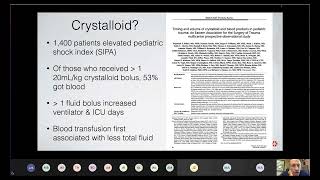
Vigorously avoid because it increases mortality. And I think that message gets lost in the no fluids for trauma ever debate. So how should we treat hemorrhagic shock? Obviously whole blood is what people have lost. We should be giving O negative or O positive whole blood to our bleeding trauma patients if we have it. If we don't, in the ed, we try to do a balanced ratio transfusion if we're not in a hospital that has whole blood immediately available, meaning platelets, plasma and RBCs in equal proportions. If not that, then plasma or PRBCs alone, and if not that, fluids. Interestingly, the the TCCC guidelines most recently updated have left off crystalloid as even an option for resuscitation based on some data I'm going to show you, however, elsewhere in the TCCC guidelines, when you get to traumatic brain injury, fluid is allowed. And so how does one know whether you're to resuscitate with fluid or not for a given patient if you don't have access to blood? You will see everywhere in the literature and on Twitter and in a variety of publications the idea that we should, as good clinicians, never give a drop of pasta, water or crystalloid to a bleeding patient because it can worsen coagulopathy, acidosis and hypothermia. And in general that's true. From the days that I trained and was told by the surgeons in the ED to give surgical doses of fluid to my child patients in the volume of many, many liters, we did do that. The question is, in early moments of resuscitation, do we really harm or can we provide benefit by giving some fluid to a trauma, a bleeding trauma patient, and still avoid the bad things that we want to avoid hypothermia, coagulopathy and acidosis? I think the answer is yes and we'll show you some data on that. Remember the atls, which runs probably several years behind the literature still recommends warm crystalloid as the initial resuscitation product for adults with hemorrhage or 20 per kilo of fluid per kids. Before we start with blood and part of the idea that we also want to adhere to is the idea of permissive hypotension, meaning we don't want to over resuscitate with whatever product we use, particularly in non compressible torso hemorrhage where we can't tamponade that bleeding unless we're a surgeon in the or and therefore we don't want to over resuscitate with blood or fluid. So the idea of permissive hypotension is resuscitate until systolic is somewhere around 80 to 90 initially and then add 250 to 500 mil bolts as a fluid blood plasma to keep their systolic in a livable range around 80 or 90. By the way, kids probably need at least 80 plus twice their age. Remember, hypotension in a kid is 70 plus twice the age. Try to get to 80 plus twice the age in our traumatic resuscitations. But with TBI, patients probably need a lot higher blood pressure. So how do we balance this idea of permissive hypotension if we're worried in a multisystem trauma patient they may have a brain injury? So I guess the answer that we're going to come to is give enough to correct the hypotension to a given level. We'll talk about that, improve their perfusion, and remember always that we should resuscitate before we intubate. Hypotension is a big risk factor, if not the main risk factor for peri intubation, cardiac arrest, particularly in trauma patients. So where did some of this come from? The famous Dr. Pepe is one of the authors of this landmark article 1994 out of Texas, where they looked at immediate EMS versus delayed resuscitation with fluids for trauma patients. Interestingly, these trauma patients were all men who were either shot or stabbed in the chest or the abdomen and presented with a systolic under 90. And they were randomized to get lactated ringers to treat their hypotension in the field versus nothing until they got to the or. And so you can see that the immediate resuscitation patients got 870mils of LR Pre Hospital and another liter and a half for almost two and a half whole liters before they went to the or. The delayed resuscitation Patients who got nothing but KBO fluids got very little in the field and about 280 mils in the ED in the trauma bay, and they had slightly lower mortality. And this article continues to be cited today as a reason for not giving any crystalloid ever to any trauma patient. And we need to learn the invaluable lessons from this study, which were they got a lot of fluid and those who did did worse. But there is zero TBI in this article. So their injury to OR arrival time was 75 minutes. No patient received that I can tell blood products before arriving to the OR. And their intraoperative crystalloid volume was massive, almost 7 liters. So absolutely yes, these patients got a delusional coagulopathy intraoperative. And remember that none of the patients had a tbi. So this was an over resuscitation probably in the days that blood wasn't given immediately in the field or maybe even in the ed. And they were probably overzealous, I'm guessing, with some of the surgical resuscitation with fluids in the, in the or. And note that these super high mortalities, which we would probably expect today to be lower for the same patient, regardless of whether they got fluid in the field or not. Is there any evidence that crystalloids do or do not harm? And interestingly, it's a pediatric study that's the largest one to date that I know of. Peter, you can probably point out others, but the Eastern association of Trauma looked at this registry of trauma patients with kids with a high shock index, almost 1500 kids, and looked at those who got crystalloid first.
Or not in the trauma bay. And of those who received more than 20 per kilo of crystalloids, so probably the equivalent of about half a liter to a liter in an adult, half of those ended up getting blood. And they showed that over one fluid bolus, beyond that first one increased ventilator and ICU days, there was no change in mortality, there was no change in other markers of outcome. But blood transfusion first was associated with less total fluid. Just as we pointed out before, whole blood first is better, but there did not appear to be harm in the patients other than a longer day in the ICU for receiving crystalloid as their first resuscitation fluid as long as they got the proper intervention subsequently. So this is actually some safety data on the initial 20 per kilo of crystalloid being valid in our resuscitation. Interestingly, half the patients who got their initial crystal oversusitation went on to need no blood. So no, presumably no coagulopathy. Delusional coagulopathy was created here. Quick word on the recent refill trial out of the uk. You've probably heard a lot about this. Now they randomized pre hospital trauma patients with hypotension to crystalloid versus packed cells and actually showed no difference in outcome. And their conclusion was maybe blood isn't helpful to us in pre hospital trauma care. I think interestingly, there's a lot to learn from this study. But interestingly one of the problems with it was they had a super long, I think almost 90 minute pre hospital time. So these patients were probably under resuscitated with whatever they got before getting to definitive care. They had a lot of TBI in their patient population. So those patients are probably under resuscitated and in a way it may actually show that crystalloid is no worse than blood in these patients. So it's a, it's a fascinating study that may also lean us toward the safety of actually a modest dose of saline or LR as we're preparing to get the patient resuscitated with blood. So.
Let'S get into why we should probably be paying more attention to hypotension and maybe using fluid if all we have in our ambulance or initially in our ED is fluid. And that's the EPIC TBI trial.
Out of Arizona, Dan Spate. And they looked at ways to prevent subsequent brain injury in trauma patients with TBI in the field. And they were focused on avoiding hypoxemia, hypocapnia and hypotension. And they used saline boluses. They didn't have blood to address hypotension under 90 and they would continue to give volume, keeping the blood pressure over 90 if possible.
In these trauma patients.
In kids they did the same thing, 20 per kilo and then repeated doses of 10 per kilo to keep their blood pressure over 70 plus twice their age. Every minute of hypotension worsened their risk of death. Not just neurologic poor outcome, but death. This study that Peter sent to me recently was just published. They did a secondary analysis and looked at what was the blood pressure threshold in these patients, what was the optimal threshold for pressure in patients with TBI and multi system trauma and it showed to be 125 to 130. So the idea that 90 is the acceptable threshold is probably something we need to revise. And then we're stuck in this dilemma of saying, okay, I've heard that I should give no crystalloid to a trauma patient. Yet this patient has an altered mental status, may have a tbi. What blood pressure should we target? And I think that remains a mystery. Peter, I'm open to your thoughts here, but it may be worth thinking about 110 at least as the new 90. And there's some data in geriatric trauma and from the EPIC TBI trial that at least 110 as a systolic threshold in resuscitation of trauma patients is valuable, perhaps even if they have non compressible torso trauma.
Remembering that single episode and increased duration of hypotension dramatically increases mortality. And they showed that every 10 point drop below 120 increased mortality by 20%. Pretty dramatic stuff.
Remember also in pediatric trauma that hypotension is the single biggest risk factor for death. So once again, should we be getting crystalloid to our pediatric trauma patients before hospital? Yes, if it's a modest dose and it's titrated to effect to a given blood pressure threshold 70 to 80 plus twice their age or a minimum of 90 to 110, I think is a very reasonable goal. So.
Lastly, just also remember that post intubation or peri intubation hypertension in trauma patients is exceedingly common and.
Associated with high mortality. And there again, do we resuscitate before we intubate and then with what product? And I believe that in cases where blood products are not immediately available, this is another situation where we may have to give a modest dose of crystalloid fairly rapidly to correct hypotension before placing an invasive airway. So I think we should be adopting a circulation first strategy in our trauma resuscitations. Ideally, every agency would have whole blood accessible for every patient. That's not going to happen anytime soon or ever. And therefore we need a thoughtful approach to the proper resuscitation of trauma patients with hypertension, particularly if you have tbi. And I believe that we need to be thoughtful about using crystalloid in the right cases. Not too much. What's too much? I don't know, maybe up to a literature liter and a half like they used in the EPIC TBI trial and then no more.
Systolic resuscitation. So Peter, I'll stop there and take some questions from you or some debate from the audience and love your thoughts.
More from Peter




Melissa Olen MSN, FPN-C, CCRN: Sudden Cardiac Arrest Training in Schools (Project ADAM) 4/25/25



Pediatric Hospital Readiness: How Teamwork & CPR Metrics Drive Better Outcomes



Chelsea Kadish, MD & Kyle Goodknight, EMT-P, RT: Pediatric CPAP in EMS (3/14/25)