Dr. Marshall Frank: Improving Trauma Destinations for Injured Patients (8/16/24)
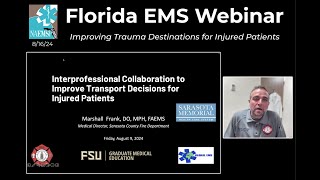
Dr. Marshall Frank presents a protocol allowing EMS to bypass state criteria and transport injured patients directly to the county trauma center. In Sarasota, where 38% of residents are over 65, the change cut inter-facility transfers of severe patients from 20 to 11 in one year, reducing delays and costs.
Questions this video answers
An article published in GEMS (published in April; referenced by presenter).
38%.
63 years old.
Pre: 20 transfers; Post: 11 transfers (one-year pre/post comparison).
Falls >12 ft (adults) or >6 ft (children); head injury on anticoagulation/antiplatelet therapy; death of an occupant in same passenger compartment; prolonged extrication; major intrusion; rollover; motor vehicle crash/pedestrian struck; blunt trauma with distended/tender abdomen; tourniquet use; and consideration of anticoagulant/antiplatelet/beta-blocker medication as modifiers and paramedic judgment.
Chapters
Morning, everyone. So, you know, as we know in the, in the pre hospital setting, one of the most important things we can do for trauma patients is make sure that these patients get to definitive care in an expeditious manner. And there's a number of studies out there that demonstrate that triaging patients appropriately, particularly severely injured patients, improves their outcomes. And so today we're going to be talking about a protocol that was implemented to improve trauma triage in the pre hospital setting with Dr. Marshall Frank, who is the medical director of the Sarasota County Fire Department, as well as Bayflight 2 in Florida and an assistant professor at the Florida State University College of Medicine. Thank you very much for joining us today, Dr. Frank. And the floor is yours.
All right, thanks, Tanner. Thanks for. Thanks to you and to Peter for asking me to talk. So we basically I'm going to. What I'm going to be talking about is as a CQI project that we did and subsequently changed protocol and wrote an article and had it published in GEMS back in April. And basically the title of the article that was published is Interprofessional Collaboration to Improve Trauma. To Improve Transport Decisions for Injured Patients. And the goal was. Let me see if I can advance my slides. Here it is. You can search it in gems. And that's a picture of our trauma center in Sarasota. And that's our EMS physician response vehicle that we're very proud of. But we do have a trauma center in Sarasota. It's the only trauma center in the county. And I'll talk about our. I think I have a slide that talks about our volumes and so forth, but we definitely talk about the age of our, of our patients here in Sarasota. And again, the project was a quality improvement project that we utilized a pre and post design with data that we collected retrospectively from the trauma registry. And we identified a problem. And the problem was that when I took over as the medical director and 2017 or so, the problem we identified was that we were taking patients who didn't meet state of Florida trauma alert criteria. And for those of you who aren't from Florida that are on the call in a couple of slides, I'll go over the state of Florida trauma scorecard. But what we were seeing was that people who didn't meet these specific criteria but were injured, they were just taken to non trauma centers because that's how the state sort of asks us to do it and that's how our protocols were. So in other words, if they didn't meet the trauma alert criteria, we would take them to any small community hospital in our county. And we identified that problem and we were identifying that there were increasing numbers of inter facility transfers for injured trauma patients to the trauma center from these non trauma center community based hospitals. And the concern was is that the literature shows that transport of these patients to an appropriate level of care impacts their outcomes, particularly if they're transferred to a lower level of care and then they have to be transported. And that's a couple of papers that.
Show support of that concept. And I don't even think we need to study that. That just makes perfect sense. So we were seeing an increasing number of patients who are traumatized and being sent to non trauma centers just because they didn't meet the trauma alert criteria, which I'll go over. And so Voskins and his colleagues found that more than 20% of elderly patients with severe injuries, and they report that as an injury severity score of over 15. Over 20% of these patients with severe injuries were not taken to a trauma center. And what we'll see in a second is that these elderly patients do quite poorly if they're not taken and taken, taken to and taken care of in a trauma center when they're injured.
So, and then here's just more evidence from.
Within the national guideline of field triage. And what this showed was that under triage is highest in older adults and.
Then half of them with serious injuries were treated at non trauma centers. So what we're doing is taking older folks who we know do better in trauma centers when they're injured. And we're taking over half the time we're taking them to non trauma centers. So that's a real issue, I think nationally based on what this national guideline shows. And we are certainly seeing that as a real issue locally just because they weren't meeting this trauma scorecard alert criteria.
So what we wanted to do was identify significant injured, significant injury within the elderly population. And we know that sometimes this is more difficult based on, you know, whatever other medical problems they have, whether they're on anticoagulation medicines or beta blockers and so forth. So this paper also shows that it's more difficult to identify severely injured patients on one second. Sorry.
So moving on, Sarasota, we do have a level two trauma center.
38% of our general population is over 65. So not insignificant. And in our trauma center, the average trauma Alert patient is 63 years old. And I have to be honest, I don't know what that average is nationally, if anybody knows Maybe throw it in the chat or, or, you know, feel free to speak up if you're not. If you're able to unmute. But that to me seems like a pretty high, high average of, of trauma alert patients that are, that are, you know, that are getting up there in age. Not that that's an old age, but it seems like I would think nationally the, the average would be under that.
It's absolutely a higher. Yeah, it's definitely a higher number nationally. You have to reinforce what you're saying.
You're absolutely right. But if you come to Sarasota, you'll see a lot of, you know, older people, which is nice. Yeah.
Including Mick Jagger, right?
Yeah, he's down here. There's a couple of famous people that like to come down here.
So what we wanted to do was identify injured patients who are at the higher risk of moderate to severe injury that would benefit from direct transport to the trauma center. Not too difficult. And our ultimate goal was to reduce the incidence of transport to a lower level of care, which subsequently required inter facility transfer to a higher level of care. So what we did was develop.
A non trauma alert transport consideration. We call it trauma center transport consideration or tctc. And this is it. So, and again, these are patients who are not meeting state of Florida.
Trauma alert criteria. And again, for those of you who are not in Florida, what the state of Florida does is, is identifies a scorecard of how we identify trauma alert. And the EMS medical directors have to use that as a baseline, but you're able to go beyond that. And that's what I, we're sort of doing here with our TCTC or trauma center transport criteria. And you can read through, Includes falls over 12ft for adults and over 6ft for kids.
Head injury on an anticoagulation medicine or antiplatelet medicine, death of an occupant in the same passenger compartment, prolonged extrication, major intrusion, rollover, motor vehicle crash, pedestrian struck, blunt trauma with a distended abdomen or tender abdomen. And then if they're having to use a tourniquet.
And so that's one of the criteria. And the other is traumatic injury, one of our blue criteria, which I'll go over if you're not familiar with them and taking an anticoagulation medicine, an antiplatelet medicine or a beta blocker. And they're also just like the state, just like the state allows us to do, you can use paramedic judgment. So that's our TCTC criteria. And again, the idea is just to get these patients to the Right place. What, what ended up happening with our protocol is that we were notifying the trauma center of our TCTC coming in, and then they were actually activating an internal trauma alert, which was not the intention at all. The intention is simply to get the patient to the, to the right place that, you know, for example, if they, if they're anticoagulated and they have an intracranial hemorrhage that requires hematoma evacuation, you know, all. None of the hospitals in our county, with the exception of the trauma center, can do that. So I don't care. I didn't care if the patient was sitting in the hallway in the trauma center. You know, as long as they were at the right place. That's, that was the goal on my, on my. And. But the hospital ended up making it an internal trauma alert for, you know, for these patients. So like I said before, here's the Florida criteria. I'll give you a second to look through that. I think most of you are from Florida that are on the call, but if you're not from Florida, you're not familiar. These are our trauma alert criteria. Any single red criteria is a trauma alert. And then you have to have a two blue criteria to be a trauma alert.
And then what we did was just to simplify the TCTC and then we added it at the bottom of our trauma alert.
Criteria so they can still use judgment, but then they, they are able to take by consideration these patients to the trauma center even if they don't meet trauma alert criteria. The most frequently used one here is fall with a close head injury on anticoagulation medicines. We see that very, very frequently.
So in our population, we identified.
A severely injured patient with an injury severity score of over 15. And then we discussed that these patients with a moderate score were categorized as injury severity score of 10 to 15.
And again, the primary outcome of the quality improvement project was to decrease the incidence of inter facility transfers, effectively decreasing the time to trauma care, whether that's blood or operative management or what have you. And here's what we saw. So in a time period we did a year pre and post, we saw a decrease of just about half of patients who had an injury severity score of greater than 10 that were requiring inter facility transfer. So pre you can see on the left was 20 and then post it was 11 or so. Okay, so decrease in the inter facility transfer. And then also we looked at how injured these patients were. So the pre TCTC, 64% of these patients had an ISS of over 15. So severely injured and then post TCTC we were transferring fewer percentage of patients that were severely injured. So we're identifying more severely injured patients that don't meet trauma alert criteria. In the post TCTC implementation, people who were moderately injured. So an ISS of 10 to 15 pre we were seeing inter facility transfer of about 36% and then post about 41 or 42%. So we're able to identify more severely injured patients and take them to the appropriate hospital at the same time decreasing the amount of patients that were transferring that were injured moderately or severely. So utilization of these protocols we determined tailored to trends identified in the local communities. We predicted this and we proved this can help reduce delays in access to appropriate level of trauma care, particularly in the elderly trauma trauma patient population who we know do better in trauma centers. So I, you know, this is not something we invented for. Sure. This is something I'm sure a lot of your agencies have probably called something different. But the idea is again just to get these patients to the right place at the right time and not delaying and causing increased money to be spent from inter facility transfers and and improving care and outcomes. So that's what I have. Regarding that, I would love to have an open discussion if anybody's interested in discussing.
Yeah.
What is the reason.
That a trauma patient would not be taken to the trauma center that does not meet trauma alert criteria? I mean, is it a request from the trauma centers to not overload them with these type patients? Is it the patient's request to go to a non trauma center or the paramedics discretion to go to the closer facility and not have to transport to the trauma center? I'm just kind of curious because in my mind it should be logical that you've got a particularly elderly patient that's involved in an accident. And even though they don't meet trauma alert criteria, it would seem intuitive that you take this to a trauma center. And I'm just curious if you were able to identify what was the reason not to take that patient to the trauma center.
Well, in our area I think. Well, I think the answer is that it's multifactorial.
One big one in our area from a system that I don't operate as a medical director, is that it's a small city with limited resources that's far away from the trauma center and they don't want to be going out of service for an hour and a half with a patient that you know by state criteria doesn't need to go to a trauma center. That's one reason. And Then I think there's just discretion like you said.
And protocol, you know, so implementing, implementing a protocol that allows this to happen and have the paramedic discretion without having to call a trauma alert. I think all three of those things are influenced in that.
Yeah. I often intervene when I hear the.
It's absolutely all the above that we see across the country. So I'm sorry to interrupt you there, Kim.
Go ahead. Yeah, I was just saying I often hear, you know, a medic attempting to divert or transport to a non trauma center with a patient that, you know, it's a significant accident even though the patient's not injured per se, based on the report they're receiving. But I just, you know, try to divert them to the trauma center right off the bat to just. That's where they need to be. That's. They get a much more detailed trauma exam at this facility to rule out anything that may be subtle. So, yeah, I think it's a, it's a, if you can influence the, the crews to, you know, just, if it's trauma, go to a trauma center period. And, and that, that'll kind of help this a lot.
There's a couple of hands up. David, do you have something?
Yeah, if you can let me share for a second. I'm gonna first congratulate you because San Antonio ripped off your red, blue stuff.
20 something years ago. But we've taken a very different twist to this. So let me. And we took your process and your thought in this red, blue idea about sick, kind of sick, not sick type thing. Let me see. Can I share?
Yeah, share. And this.
You're sharing type of person you're on. It's coming up.
All right, so what we did is very similar to what you guys have. Instead of having a separate. It's a trauma, but it's not a trauma. We did this red, blue criteria, but we said. So the reds, those are all standard, right? That's acs, the blue. We made this. But you notice we have pediatric, adult and geriatric. Also we have. In the blue, we can say if you have two blue, you can go to a level three or a level one. But look what we did. See this age over 65 on B8 in the geriatric section. By adding that in there, that wasn't a mistake. You only need one blue for geriatrics. And that shoves you into a level three or level one trauma center. This. I'm going to tell you that you are 100% right. This geriatric conundrum, it took me, four years to get this column built in strap. And let me tell you, I fought with some hospitals about this because the level four trauma centers, the community hospitals, wanted all those hip patients. But I'm going to warn you, a lot of those patients that fall and have a hip fracture, they have a second fracture, they have ribs, they have a neck fracture, a transverse process fracture, they have a head bleed that's brewing. And so they belong in a, in a trauma center of some kind that has good quality assurance and oversight. And that's a level three or above, in my opinion. And that's what we did. So congratulations, Florida. We ripped off your idea, but we just twisted it a little bit. Instead of having the TCTC thing, we made the blue criteria a lot more accessible and we use this as our way to go to a lower level drama.
So that was a great transition, by.
The way, because Candace, who represents the.
Hospital as a trauma director there, had her hand up. You want to go over to her real quick?
Sure. So just my question was, you know, fantastic to add that in there. And our county, we created similar criteria, the CDC gray criteria, but we made it a level 2 trauma alert. So it does allow EMS to bypass other non trauma centers to be at the trauma center in case of injury. So same thing. My question is, in the data that you collected.
Did you collect how much additional transport time it added? Because to your point, you said people questioned, well, we're having to drive much farther out of our catchment area, so what additional time is that taking us out of service? What other issues is that bringing? Did you collect any of that data to just kind of validate this is still the right thing to do?
No, in this project, we didn't. That's just not what we were looking for because it wasn't going to influence my decision in terms of protocol. I just knew these patients, you know, we just knew these patients needed to get to the trauma center. Whether that took the unit out of service for an extra hour, that, you know, you know, that wasn't of concern to me. So we didn't look at that. Okay.
And just. And obviously, every area in Florida can be completely different. There's a lot of urban, suburban and a lot of very rural and not much in between. And unfortunately, in Florida, we don't have the luxury of having level threes and fours. So, you know, those are just all acute care hospitals.
Absolutely. And you know, and like I said, I took over in 2017, and not long before that, we didn't have a trauma center in the County. And our protocol was to fly every trauma alert out of, you know, fly them out of the county into to the trauma center. So you're issuing a trauma alert at that point in time was not, you know, it was non. It was. It was quite consequential, you know, that we had to take it. Now we're taking a helicopter out of service and, you know, putting the patient in the helicopter. So it wasn't just, you know, it was a. It was a more difficult decision to make at the time.
Yeah. And just for everyone's awareness, the state of Florida trauma standards are from 2010, which is really, you know, the early 2000s American College of Surgeons criteria. So it's very old. We're looking actually, as we revamp the trauma standards versus the state of Florida to also add additional criteria like the CDC grade criteria or having alternate levels of activation. So this is perfect. This falls into a lot of our needs. And the trauma centers do encourage having those, you know, high index of suspicion, I guess you would call it, criteria, because it's better to be at the trauma center, get that evaluation and go home, even if it's a longer transport than all of these transfers in. So we appreciate that, and that's truly where we're moving in a lot of the counties. So thank you.
And Marshall, this is Fitzpatrick over here in Orange County. Question for you. When it comes to the dynamics between hospital systems, the hospital systems that you had there that don't have a trauma center and the ones that do.
What.
Was the pushback or feeling with this expanded transport directly to the trauma center?
Good question. And I have a story about that. I'm out in the field all day on Fridays and going on calls. And right when we implemented this on a Friday, we took a patient to a non trauma center, and I was introduced to one of the charge nurses or something, and she says, oh, you're the Dr. Frank who's stealing all of our patients. And so that was. That was my first introduction to people not liking this process.
There was, you know, more official sort of emails that went out indicating a distaste for this. But in my opinion, we're doing what's right for the patient. And there are patients until they get to the hospital. And so I, you know, just like a lot of other things with what we do, it's, you know, people don't like what we do, but I think they've gotten used to it by now. Did.
Did you have your trauma center help, I guess, get the message out or be on your side? When it comes to messaging or you know, talking about the fact that these patients were having high rates of morbidity mortality and you're basically trying to do the right thing for the patient not respective to necessarily the center that you're at.
I didn't just again, because I was going to do it regardless.
The optics of it. I didn't ask them to get involved, but I mean we have a very good collaborative relationship with them. One of the team members from the trauma center was on this paper with us, so we have a great collaboration effort with them, but I just didn't feel that that was necessary. Awesome.
And you currently work at that trauma center, correct?
Yeah. Yeah.
So that, that also is one of the difficulties that you had to deal with.
Yep. The optics of it wasn't. Wasn't the best, but I mean, I don't want to work at the other places.
Awesome. Thank you for the answer.
Just one more as, as people are considering doing this, if you, if your county does have a lot of, you know, EMS agencies having to call back because inter facility takes too long. So now you're getting 911 to those acute care hospitals to go to the trauma center for the trauma transfers to decrease that. I think the trauma centers would encourage some sort of alert criteria because to your point, you know, you're just bringing them to the trauma center and they can wait somewhere in the hospital. But when those hospitals are really busy, they still may underappreciate that injury because they if, if depending on their triage process, may miss it as well. So having that official alert criteria or letting them know, hey, elderly falls on anticoagulation, it doesn't hurt to just call the trauma team together, do that initial eval and then that way we know, upgrade we need or and blood or hey, regular eval, let's get them, you know, treated and moving. So in our trauma center, we appreciate that it's an alert. The same team shows up the difference between a level one Florida criteria and this criteria that you have is just not opening the, or not opening the blood immediately. But we at least have those resources and it expedites the imaging in the lab. So we can recognize especially your elderly on anticoagulants. You have improved access to CT to just get them moving and find real injury sooner.
Caleb Hudak also had a comment that was posted in the chat. So I know this was kind of implemented as a bundle, but were there any specific criteria that correlated with a high injury severity score?
You know, specific criteria that maybe other people would want to implement in terms of kind of all the different mechanism based criteria that you included. Any standouts?
I would say the most common one was fall on anticoagulation medicine, head injury on anticoagulation medicine.
In your future rendition, will you also do elderly fall with potential hip fracture on or fall falls with anticoagulant possible hip fracture?
It's something we've considered, you know, and like Dave said, it's not, you know, always an isolated injury. And so would these people do better at a trauma center? Probably, yes. Do they get, you know, operated on faster? In our trauma center, the trauma surgeons or the trauma team admits all hip fractures because what we found is that they get operated on faster. They don't sit on the floor. So in terms of playing nice in the sandbox with the other hospitals, I think I would have to get like a bodyguard of some sort if I did that. But no, that would be, that is not. It is, you know, something to consider.
Nashley, the American College of Surgeons trauma centers used to exclude hip fractures, but now it's a very clear, very large part of the population that they own because we do do make sure to optimize getting care, Getting surgery within 24 hours or less and are seeing significant improvements in care.
So I think that's analogous to another protocol we have for open fractures and pediatrics. So we don't have, our trauma center is not pediatrics and we operate on kids for bone fractures. But the orthopedic, the orthopedic trauma surgeons were very concerned that a kid's going to have an isolated open fracture of some sort, which is high mechanism of injury, and then will miss, you know, something else, a liver or spleen or something. And they'll be sitting on a pediatric ward, you know, with no access to a pediatric surgeon and, you know, and so forth. So we don't take open fractures to our, you know, that don't meet trauma alert criteria. We don't take open fractures to the trauma center here. We take them to a pediatric trauma center even if they don't meet tromble or criteria.
All right. If nothing else, thank you very much for presenting today, Dr. Frank. A lot of great discussion. I've posted in the, in the chat, the link to Dr. Pepe's webinar that'll be coming up next.
All right, thanks for asking me to present. I appreciate it.
Yeah, thank you. Have a good weekend, everyone.
More from Peter




Melissa Olen MSN, FPN-C, CCRN: Sudden Cardiac Arrest Training in Schools (Project ADAM) 4/25/25



Pediatric Hospital Readiness: How Teamwork & CPR Metrics Drive Better Outcomes



Chelsea Kadish, MD & Kyle Goodknight, EMT-P, RT: Pediatric CPAP in EMS (3/14/25)