Dr. Mausz, Dr. Donnelly & Mandy Johnston: Violence Against Paramedics (5/30/23)
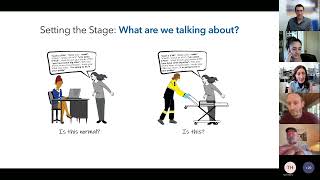
Elizabeth Donnelly, Mandy Johnston, and Justin Mausz describe the EVAP program in Ontario, Canada, which tackled violence against paramedics. A staff survey found 98% had experienced violence in their career; 40% documented incidents. The program created incident reporting forms, zero-tolerance policies, spit hoods, and a public awareness campaign.
Chapters
So hopefully you'll see some of it in Austin.
Okay, excellent. Just as a gentle reminder that at the bottom of the hour, we have to go to Dr. Pepe's call. So we'll have everyone just keep an eye on that time. Sometimes we go a couple minutes over, but we try to be cautious at that time.
We're planning for about 20 minutes to allow for questions.
Mandy.
Mandy's here.
Oh, where's Mandy?
Let's see.
The fabulous lady.
Let's see Mandy. Are you. Can we see you yet, Mandy? Or not? How do you know she's here? I don't see her.
No, she's here.
You know what? I can. I can see you guys.
I can see you. Oh, there you are.
Okay, perfect. Good.
You have been discovered.
That's leaving. Because technology is not my favorite thing.
In the world, so especially Microsoft Teams, we all hate it.
And we only use it because the. The next meeting is a zoom call. And so Dr. Jameson is kind enough to stream this team's call onto the Zoom call. Because you cannot do two zoom calls at once, apparently. So.
That'S how we have it. And are we waiting for Justin, or is it just you?
Both.
He was gonna pop in, I think, just if there was any sort of specific questions about the analysis. The analysis. Because he did.
He took lead on that. But.
Okay, perfect.
We can.
For sure.
We don't. I don't. We have to wait on him.
Okay, excellent. All righty. And then the last thing I'm gonna do is I'm gonna get. So we do give some CME for today, and I'm gonna. I'm gonna pop that on the thing real quick.
Let's see here. Cme.
I got it right here. I will post that in the chat.
For everybody to see.
Alrighty, so we are good. And I see that we are recording. Thank you, Angus. Oh, good. Awesome. All right. And are you guys okay with this being recorded? We put it up on our YouTube channel. We get a lot more views. Are you good with that?
Absolutely.
All right. Excellent. All right, so let's get started. It's three o'.
Clock.
Welcome, everybody. It is Tuesday, May 30th, 3:00pm this is a Florida EMS webinar. We have now over, I believe, 110 talks by incredible presenters. This has been probably one of the most fun roles that I've. That I've adopted is finding this incredible people out there on the Internet who have been so kind with their time and their information to come and pop in remotely and provide us with a recent publication or more than one publication that they're working on. And today is no different in that we have an incredible group of folks from Canada. Again, we've had a few of our Canadian colleagues come on very important topic that we have discussed a number of times on this webinar, which is violence against paramedics. It's obviously it's a serious health problem. There is not just physical harm, but the psychological harm. And, you know, a lot of times our organizations just say this is just part of the job. However, we have a group of people today who will prove that to be incorrect, and it will show us what they're doing about it. So without any further ado, today we have on the program Dr. Elizabeth Donnelly, Dr. Justin Mows, and more. Mandy, are you also a PhD doctorate?
No, I am a paramedic.
Okay. So which is great paramedic Mandy Johnson. So if I can, I'll turn it over to you guys and I'll turn over you guys to make some further introductions. Tell us who you are, where you're from, and then we cannot wait to hear the talk. So take it away. Thanks for joining us.
Perfect. Mandy, do you want to open up the slides while I start saying hello? Hi there. My name is Elizabeth Donnelly. I am just delighted to be here as a representative of the.
Violence Against Paramedics Research Group. And I'm going to talk a little bit about this program that we're all supporting in different ways. I want to just acknowledge first off that this isn't a pure research presentation. This is honestly a workforce health initiative that was developed by paramedics for paramedics. And so there's research attached to it, and we're going to bring that forward. But mostly I wanted you to hear from Mandy and hear about this incredible work she's done, and then we'll talk about what we know because of her work toward the tail end. So thank you so much for your time and your attention, and I'll let Mandy introduce herself as well.
Hi, everybody. So my name is Mandy Johnston. I'm an advanced care paramedic, and I'm a paramedic superintendent in the Region of Penal, which is Mississauga, Brampton and Caledon, about 1.5 million people that live just west of Toronto. I began leading the External Violence Against Paramedic work group when I was a frontline paramedic about four and a half years ago now. And it's developed quite a lot as a program since. And because of that, we have been able to collect a lot of data that Justin and Elizabeth analyzed to prevent future violence. So I'm really happy to be here to talk to you guys about it. It is probably my favorite topic.
Justin, did you want to go?
Hi, I'm Justin. I'm excited to be here as well. I'm a clinician scientist with the Regent Appeals Paramedic Services in Ontario, Canada Region. Appeal, like Mandy said, is just to the left of Toronto and Ontario, sort of in the middle of the country. This is really great work. Super excited to be sharing with it you with it today. Looking forward to a good discussion.
Can everybody see the slides? Okay. Are they full size and. Yeah. Okay. Perfect.
Yep.
That's good.
Awesome. All right. So like you already said, Peter, we are talking about violence in paramedicine. I have been a paramedic for 18 years, like I said, and I haven't experienced. I've experienced a lot of. A lot of violence. Well, as a paramedic on the road, I'd say the worst incident, my partner was strangled. Another, my partner and I were being chased when police arrived, seen and pulled their guns. We thought we were going to watch a shooting happen in front of us. But those weren't the incidents that were actually what started the external violence against paramedic work group. So when you look at the screen here and you look at the things that are said to this office worker, be it a teacher, somebody who's an accountant, whomever, a lawyer, this is a quote, this is something that a patient said to a paramedic while on offload delay. And is it normal for these things to be said to anybody in any other profession? And if it's not, which we know it's not, then why is it normal for those things to be said? Or why is it acceptable for those things to be said to a paramedic? And this was the question that I posed at our Ontario association of Chief conference last fall and the initial question and conversation that I had with my superintendent five years ago when evap began.
So evap started as myself, one voice who explicitly spoke up and told my superintendent that it is not an expected or tolerated part of the profession to experience violence at work. There are laws in place that require an employer deal with violence. If my partner at home was assaulting me, verbally abusing me in any way, and my employer suspected that they legally have an obligation to speak up and do something about it. So when I'm treated that way at work, why is it that I'm told to let something roll off my back, shake it off, or just move on because they would never tell me that in my personal life. And so it was that conversation that I had with the superintendent that led to the development of the External Violence Against Paramedic workgroup. I, having worked here for a long time, being a large service, have a lot of friends who you'll see on the left who are all paramedics. They are most of them married to each other. My husband's also a paramedic in that picture. So I work every single day with people that I love and I care about. Now as a Superintendent, I have 800 coworkers, but 30 who I'm responsible for on any given day. And I don't want any of the people that I love that I care about or that I'm responsible for to experience any verbal abuse, sexual harassment or physical assault while they're at work. So my one voice became 196 voices because when I spoke up to the employer, I said that while this was something that bothered me, I didn't know how other paramedics in Peel Region felt about it. So when we surveyed our staff, we had about a 33% response rate and 196 people replied to the survey. When I got those survey results, I immediately contacted Justin to help with the data analysis because the experiences that paramedics talked about and the emotions or the impact that they had had because of those experiences, not just at work, but their personal lives were so powerful and so upsetting that we had to do something very meaningful with the information that they had given us. So Justin and I came up with six recommendations based on that initial study and research that we did in Peel Region. And we presented to our leadership team our chief, Peter Dundas, who's retiring today. He took me to Peel Regional Council. That picture on the right and those six recommendations that Justin and I had made, I presented to so that we had their support in implementing every single one of them. So my one voice speaking up became 196. And those 196 voices you'll see resulted in a lot of change.
One of the things that we learned in our initial study is that violence experienced by paramedics was widespread. So it was enacted in many forms, be it verbal abuse through through to physical assault. It happened so frequently in the course of a paramedic's career that they thought that it was too chronic to report. It happens too frequently. Who has the time to report all of these incidents? And so if the violence is happening in so many forms and so frequently, paramedics would deem it as being unpreventable. Also, people who they stated were enacting the violence were people who were under the influence, often of drugs or alcohol. And so they deemed that this was an unpreventable experience.
There's often no consequences for the perpetrators of violence. People spoke about police excusing or not charging the people who had assaulted them. And so being that violence is so widespread, the fact that paramedics believe it's unpreventable and there was no consequence for the perpetrator, violence just became a normal and expected part of the job that has existed in our profession for 40 plus years. If something is part of the job, we don't typically document the normal things that happen day to day. Paramedics were not documenting. There was no purposeful place for them to document. They didn't see the point and they didn't believe it would create anything meaningful. There would be no change. So what's the point? And I can't tell you how many times when Justin and I were analyzing those first results or that first survey or study we read nothing will change what's the point.
And that's it part of the job. So we were not the only people to learn that paramedics experience violence and that it goes under unreported. A previous study to us in Canada, done in both Ontario and Nova Scotia, surveyed about 1600 paramedics. It was found that in that past year, 75 paramedics had experienced violence, but 81% had never reported.
In Peel, we had asked paramedics about violent encounters over the course of the career. So 98% had said that they experienced an incident of violence and only 40% said that they had documented a incident of violence in the career.
So what's the problem with not reporting? If paramedics aren't reporting violence, we can't provide them with the support that they deserve. We can't provide them with psychological support. We're not tracking a known cause of psychological injury in the paramedics workplace. And without any data, the employer cannot do anything to mitigate future incidents of violence because they don't understand the circumstance, the context under which it applies. And, and without knowing that, there's nothing that you can do to address it in the future or stop it.
So everybody is faced with a dilemma. Reporting violence is very important if we want to change an organizational culture of tolerance or part of the job. But in order for a paramedic to deem reporting as worth it, the employer has to demonstrate that the, the organization's culture is going to change.
So in Peel, we developed a pretty comprehensive strategy to address the violence that paramedics experience.
We wanted to make clear to them that it is not an acceptable or tolerated part of the job. And with every single new.
Initiative that we launched, we would constantly communicate to paramedics and remind them that it was because of their reporting to us that 196 voices that we were now able to give them zero tolerance signs in the ambulance like they asked for. We launched a public awareness campaign that was a paid social media campaign. A few years back we developed a harassing client letter process in which we actually send harassing client letters to people who perpetrate violence numerous times, which we track through external violence incident reports. We created a zero tolerance for violence from the public policy.
We pointed out to our regional employer that their policy resulted in call 911 and so it just was not really applicable to our circumstance and our work environment. We gave paramedics spit hoods and soft restraints which are to this day one of the most appreciated and most cost effective things that we did. We started a collaboration with Peel Regional Police which is quite extensive and has been very beneficial. I won't go into detail, but if any of you want to ask me questions about it later, I'm happy to share. We've been advocating for legislative changes at a federal level. So we have been working with our regional partners and council and we've been writing letters or championing bills, one that's currently in Parliament, to make assaults against paramedics and frontline workers an aggravated circumstance when it comes to sentencing. And most importantly, while I did not understand it was the most important thing that we would do when we started four years ago, we developed the External Violence Incident Report. And as an organization and for paramedics, it is probably the most important tool that we developed and what will mitigate the majority of violence in the future.
When we built the External Violence Incident Report, we addressed every single cultural barrier to reporting. So paramedics said that it would take too much time and be cumbersome to report every incident. And we made sure that it was filled with checkboxes and dropdowns. We only provided one free text section so that it was quick for them to complete. We made sure that it had multi functions so they're only doing one document instead of many. So it counts as the Paramedics Ministry of Health Incident Report. It is our hazard flag for flagging repeat offenders of violence and their households. It tracks the paramedics cumulative exposure so if they make A workplace injury claim due to multiple incidents or even a singular incident of violence. We are able to search their name, go back and in their report we can actually write every single date and the type of violence they were exposed to. It is information for the employer to actually address, track violence, address trends, find trends, and then prevent future violence. And in that way, hidden. It's actually been really effective and it's data for research which Justin and Elizabeth worked very, very hard on. So we did all of these things and created one form to carry or pull a lot of weight, but be very superintendent and very paramedic friendly to support the culture of change.
So we started from a place where paramedics believed that violence was unpreventable. So I want to tell you a story and really great example of how we were able to leverage multiple parts of the EVAP program that we created and reporting in the external violence incident report to actually address family or two brothers who were incredibly high risk to paramedics.
So over a three month period from September to December, I started receiving complaints from superintendents and from paramedics about twin brothers who were incredibly threatening, verbally abusive, but posed really high risk to paramedics as they were constantly threatening physical violence. They had even managed to trap paramedics in a room while pushing police out and held them contained in that space for a while until police could break in. It was really upsetting to paramedics. They were very fearful. They said many of them, having worked 20 years, had never experienced anything like this in their lives or in their career. So what we did is we looked at our EPCR so our patient documentation over a three month period and we found that we had been called to the this address 30 times.
Those 30 calls resulted in 11 external violence incident reports. And 24 paramedics were involved in those 11 external violence incident reports. So that documented for us a trend of behavior that needed to be addressed. With that information, we went to the region's legal and privacy teams. Privacy gave us the right to post pictures in our stations because this person was calling from addresses not their own since they learned their address was flagged. We worked with legal to send harassing client letters to two members of the family, which proved to be highly effective. We worked with our risk and audit team, audit team because the people were routinely complaining about paramedics and were also lodging complaints with the Ministry of Health. So Based on these 11 documented incidents, we were actually able to stop the investigations, even the investigations at the Ministry of Health level.
And we collaborated with Peel Regional Police. So we actually worked with them to change the way that they respond to the call, the way that their dispatch and our dispatch communicated and tiered police, paramedics, superintendents and surgeons to the call. And they agreed to lay charges. Those charges were laid about a year and a half ago. Since that date when the harassing client letters were received and the charges were laid, we have never had one more external violence incident report completed and our call volume dropped significantly. So there was an instantaneous response to those letters that we sent and our collaboration with police as well as the charges. It wasn't just a good outcome for us because the patient was diverted through mental health court. And what that meant was his charges were held for a two year period and he's now receiving mandatory mental health training or mental health courses, treatment, medications and getting the help he needs. And so it was really a positive story for paramedics, for police services, and for the patient and the family themselves.
That is not the only incident. We've had some recently. And I think it's really important to know that violence is a very. Addressing violence is very common, complicated, and in order to properly address it, it really requires collaboration of multiple departments, like I said, and utilizing different aspects of the program to address the situation at risk, whatever it might be.
So we started at a place that we only own, only one paramedic speaking up about the violence they experienced. That was me. My voice became 196 paramedics. And then to date, as of a week or two ago, the last time I looked, we have over 1100 external violence incident reports completed. We surveyed Peel paramedics recently because we wanted to do a program evaluation. And one of the paramedics said, I understand the value of reporting to support change within the profession, even if not impacted myself. I file reports to keep my coworkers safe. I see the efforts of the service to address violence and appreciate them. Reporting is me doing my part. Overwhelmingly, when I speak to paramedics and I do incident debriefs with them following violent encounters or high risk encounters, they speak to their gratitude for the program. They speak openly about their experience and most importantly, how it actually impacted them in a psychological way. And they're willing to contribute or want their experience to contribute to the continuous growth or development of the program. And so that's why these over 1100 reports that we have now and the 900 or so that Justin and Elizabeth analyzed are very important because they are actual data and information that we've never had previously in this profession that can drive process, policy, training, and actual future change.
Okay, so I think this is where I came in. I had met Justin a while back and he was telling me about this initiative that Peel Region was undertaking. And I, being a researcher, got super excited because everything that's been done up till now is sort of retrospective. Like, how often has this happened to you in the last six months, in the last year, in your lifetime? And everyone's memory gets a little fuzzy over time. And so the fact that we had point of event reporting is really novel and really, really powerful. And it allowed us to ask questions that really haven't ever been asked before. So we've developed this program.
More from Peter




Melissa Olen MSN, FPN-C, CCRN: Sudden Cardiac Arrest Training in Schools (Project ADAM) 4/25/25



Pediatric Hospital Readiness: How Teamwork & CPR Metrics Drive Better Outcomes



Chelsea Kadish, MD & Kyle Goodknight, EMT-P, RT: Pediatric CPAP in EMS (3/14/25)