Dr. Moses Washington: ECMO CPR (3/14/2023)
Dr. Moses Washington explains extracorporeal CPR for cardiac arrest that doesn't respond to standard resuscitation. The goal is to get patients on ECMO within 30 minutes of low-flow time. His program has treated about 35 cases with roughly 40% survival and good neurologic outcomes in out-of-hospital arrests.
Questions this video answers
Out-of-hospital cardiac arrest ~12%; in-hospital ~25% (speaker's citation).
No-flow: time from arrest until CPR initiation. Low-flow: period receiving chest compressions without ROSC.
Aim for ECMO initiation within 30 minutes from arrest (best neurologic and cardiac recovery).
Witnessed arrest with bystander CPR; initial rhythm VF/VT (PE patients/selected PEA included); no-flow <2 minutes; age ≤70 with low-flow <30 minutes (or age ≤40 with low-flow <60 minutes); patient functionally independent; team agreement required.
Asystole as initial rhythm; septic shock as cause; traumatic arrest; known poor baseline neurologic function; unknown downtime.
Chapters
All right, perfect.
So as I was saying, as you guys are aware, with conventional cpr, despite what we try to do with advances over the past, at this point, 50 years after the inventors of CPR and then the introduction of AEDs, the survivability is only 12% for out of hospital cardiac arrest. So in hospital, a little bit better, about 25%. And that really just deals with time and time getting to the patient. Most of the time the arrests are witnessed and there is less no flow and low flow time. And I'll go into that a little bit more in the next couple of slides. So what is ecpr? So it's actually rapidly implementing a mechanical circulatory support device during cpr or putting a patient's on ecmo, which is a cardiopulmonary bypass. It provides heart and lung support and it essentially supports the blood, the body by improving oxygenation, improving the removal of carbon dioxide. So that's just for VV ecmo, and then with va, ECMO is actually taking over the support of the heart.
So as I was saying, just a couple of key terms. We'll be talking about no flow time, which is time of arrest until CPR has been initiated. Low flow time is the period of time that an arresting patient has received chest compressions but has not achieved rosc. And then one of the main things that I want to kind of drive home is.
When a patient is in refractory V fib or V tach, there is very little improvement after a patient has been defibrillated greater than three times. In general, the likelihood of developing significant return of spontaneous circulation with intact neurologic.
Intact neurologic outcome, like an Mrs. Of one or two, or basically a person independently functional starts going down significantly.
So our main indications that we utilize ECPR for at Memorial is refractory V fib, V tach. We will do it on patients who end up having a high risk of massive PE and is high risk of developing a massive pulmonary embolism. Patients who have been poisoned predominantly from calcium channel or beta blocker overdoses, and then cardiac arrest from drowning and hypothermia, which we don't see as much here. We have done now. We also have done patients with trauma, but that is typically less of an indication. And that's for several reasons that I won't talk touch on too much here. But in general, when you have to pay somebody on ecmo, the circuit is at risk for clotting. So specifically VA ecmo, they have to be anticoagulated. And patients who undergo traumatic arrest can obviously bleed out significantly. Now, there are times when we are able to put them on and kind of withhold anticoagulation for a short period of time, but we're not able to sustain that over the time that they need for before recovery.
So our ECMO circuit, this is a picture of.
The maquette cardio health. And this is what we use a lot, specifically when we're doing critical care transport of patients on ecmo. But this is an overview of it. And it's basically this pump here in which we're able to control the speed, and by increasing the speed of the RPMs, we're able to increase the flow, which essentially takes over the cardiac output. This is a membrane oxygenator that has a semiporous membrane for which the blood interacts with the membrane and oxygenates the blood and removes CO2. And then these are the cannulas that we use. We pretty much have a standard for the most part, which we have an arterial cannula, which is.
Returning blood to the heart, and venous cannula, which is draining blood.
This is one of our bigger circuits that we utilize a lot of times in the unit, or if a patient comes out of the OR on cardiopulmonary bypass, or ecmo. And this gives. This is the centromag. It gives a display port of the RPMs and the flows. And then we are able to adjust our gas sweep, which controls the CO2 removal. And this is a pump console and as the oxygenator and heat exchanger. So in essence, how does VA ECMO work for the heart? Well, essentially, it helps unload the heart and improve perfusion to the rest of the body. As you guys have seen, when a patient has undergone a cardiac arrest, they have severe stunning of their heart, and sometimes it takes hours to days and even weeks until the heart can recover, depending on what the etiology of that cardiac arrest was. So it actually decreases the left ventricle preload and the right ventricle afterload, but it actually increases the left ventricle after load. Because with VA ECMO for ecpr, you give retrograde perfusion through the femoral artery.
So in general, the main thing is time. Just like time is brain, time is hard. Time is brain and heart, specifically for ecpr. And what we always want to do is minimize the no flow time, which is time from cardiac arrest with no cpr. And specifically with ecpr, low flow. And key time frame we want to focus on is less than 30 minutes. So the time the patient is dropped with no pulse until the time that the patient has been placed on ECMO, 30 minutes. Because in those patients we've seen that they have best neurologic outcome in addition to full cardiac recovery.
And then this is just a graph displaying that, showing that significantly with mechanical CPR and ecpr. So as you can see, you have a precipitous drop in survival the longer you have until you're able to sustain flow.
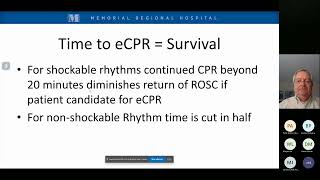
And again, for shockable rhythms beyond 20 minutes, you start to have.
A decreased likelihood of survival. And then for non shockable rhythms, really like 10 minutes.
So how do we run our code at Memorial? So what we've been doing is we've had a setup where our local EMS teams that I've given us talk to beforehand as well. We've given them a number that they can give us a heads up call once they have a patient in cardiac arrest. And then there's a criteria which I'll show in a little bit of who we will consider. And that once that is called or the ED calls, there's an ECMO alert that we initiate as a cardiac intensivist. Once we come down there and decide that the patient is a candidate for cannulation, our CVIC team takes over the code because there are some nuances in running the cardiac code specifically and when to start and stop CPR and also when to start and stop doing defibrillations after a specific time period. In general, we have two physicians cannulating. It's either two critical care physicians or one of our cardiac surgeons and one of our critical care physicians. And then we have ECMO specialists who are nurses and more recently respiratory therapists trained with helping with sterile cannulation. And we have a perfusionist preparing a circuit.
So we do this essentially in a stage cannulation. This is just an overview of one of the programs out in San Diego at Sharp Memorial where they published how they perform their ecpr. And they do it in a staged scenario. First getting vascular access by placing.
Femoral venous and arterial sheaths and determining if the people, if the patient meets ECPR inclusion criteria. Now if they do.
And they end up getting ROSC back, they stop there. But if they still don't have Ross, then they go forward and serially dilate the femoral vein and artery until they are able to get the cannulas in. And then they start heparin and begin to start placing the patient on the circuit. Now if before they actually connect the cannulas to the circuit and the patient.
Don'T, then they Continue.
So that's just one of the methods that you can run an ECPR code.
And this is just basically stating what I just stated. So one of the things that you have to do is maintain and get adequate.
Cannulation and be very precise, because one of the issues is causing critical limb ischemia, which can happen especially when you're trying to do such an intense and invasive procedure under high pressure situations. It also can happen more so when you're cannulating the same side leg, which we try to prevent in general by going on opposite limbs, but sometimes, depending on the patient's vasculature, you're not able to do that. So when we do have to go on the same side, we always place what this is, which is a reperfusion cannula, which gives antegrade flow down to the leg to prevent critical limb ischemia.
So what's the evidence? Well, currently, aha. They give it a Level 2B Class C recommendation. And the European Resuscitation Council echoes this, which is basically saying, now you can consider ECPR for select patients.
And then cardiac arrest if you believe that they have a reversible cause. And the most important thing to remember is ECPR in general does not correct the etiology of the cardiac arrest. With a couple of exceptions, a patient was a primary hypoxemic or hypercapnic, or a patient that was hypothermic.
Any one of those things are the cause. Just placing the patient on ECPR can fully recover them. But in general, with the patients who are V fib, v tach, they tend to need revascularization or a reversal of an improvement of the perfusion. Same thing as in a patient with a massive pe.
So one of the first studies that looked at this.
In a combined scenario is coming from Australia at the Alfred. And that was a chair trial done in 2014. And this was essentially a observational study that showed that the combination of mechanical cpr, hypothermia, ecmo, and again, early reperfusion, so having these patients go to the cath lab improved outcomes. It was a very small study. A total of 26 patients, and 14 out of those 26 patients, or 54%, actually had survival to hospital discharge with full neurologic recovery. So measured as a in a CPC score of 1.1. More recently, as you guys may be aware of, there was the arrest trial, which.
Happened in Minnesota with Dr. Yannianopoulos, which also was a very cohesive.
Study and program that they have, where patients were brought in extremely fast. Actually from the field directly to the cath lab.
And placed on ECMO and then underwent reperfusion for their cardiac arrest. And they only took patients with V fib and V tach and the outcomes were very high. Again, also a small study, I do believe, although it wasn't actually stated, that one of the reasons that this study was stopped early was it was in the middle of the pandemic. But officially they stated that it was stopped early because it was already showing signs.
To do the study would only be providing harm.
Was correct. The risk management group was independent, they're nih and they basically stopped it because everything was going in the right direction. But there are some caveats to that, but yes. Okay, well, I'm sorry to interrupt you, but I just wanted to make sure that was clear it had nothing to do with the pandemic. Thanks.
Yeah, no, no, that's my own personal. I'm sorry, it did not officially have anything to do with the pandemic. That is true.
More recently there was a Prague hyperintensive approach to out of hospital cardiac arrest, which was another single center study comparing ECPR to conventional CPR.
In the Czech Republic. It was a larger study, approximately.
256 patients in total, and their primary outcome was actually looking at survivability with intact neurologic support at three months, in which it actually did not show a difference, mainly because there was a lot of excellent conventional CPR done in a very short time to the hospital. But that did show that the patients who did undergo ECPR at 30 days, which was their secondary outcome, did have better neurologic outcome and rosc.
And the most recent study and the first multicenter study randomized trial was just published in January and this came out of the Netherlands and it was.
14, I believe it was 14 centers.
That.
Performed ECPR versus conventional CPR. Interestingly enough, with this study, a lot of the centers had not had a lot of experience with ECPR, only doing approximately maybe 1 to 2 per year outside of two of the main centers. And one of the things that was noted as a limitation of the study is the fact that there was a very prolonged time to actual cannulation. The patients would get to the hospital urgently within less than 20 minutes. But the people who were performing the cannulations were actually only cardiothoracic surgeons and there tended to be much longer time to actually getting the patients cannulated and actually having the surgeons come down to be able to cannulate. So a lot of the patients, they weren't actually getting on full support until about 74 or 75 minutes. So this ended up being a negative study for early ECPR for refractory out of hospital cardiac arrest.
So our actual criteria is a witnessed arrest with bystander cpr.
Initial rhythm V fib or vtach. We do include PEA specifically because a lot of the patients who arrest from massive PE do fit into this category. And importantly, we look at how long has it been without time to cpr. So no full time of less than two minutes. We do have an age cutoff and we actually split the age cutoff with age less than equal to 70 and a low full time of less than 30 minutes or age less than 40 and a low full time of less Than 60 minutes. And the reason why is because we've seen that not only in our anecdotal experience, but also in the literature that younger patients, you can have good neurologic outcomes if they are down for a little bit longer. And most importantly, the patient has to be agreed upon, every member of the ECPR team.
And our exclusion criteria is initial rhythm asystole, septic shock as a cause more or less traumatic arrest and known poor baseline neurologic function and unknown downtime.
So this is not the most updated because over the past two months, I would say we have done at least three or four more. So about 35 ECPR. Over that six years, our in hospital cardiac arrest survival was about 32% and out of hospital cardiac arrest was about 40%. And in comparison, the household registry is about 28% survival.
So what I ask all of our EMS members to do is when we're considering these patients, and this is what we look at is the screening. So was the downtime less than 2 minutes? Was there witness bystander CPR?
Is the patient less than 70? And is this initial rhythm VTACH V fib or PA? And another important aspect is patient functionally independent. If the answer is yes to these, these are patients that can be considered for ECPR and whom we hope that.
You guys call us so we can meet down in the er, make that final decision and likely cannulate them as fast as we can.
Dr. Washington, a question came into the chat from Dr. Jamison. The number is the 40%. Excuse me. Out of hospital. Was that CPC one too? Was that neuro attack survival?
Yes. Yes, actually, they were all CPC1.
Wow. Phenomenal. Awesome. Okay, continue. Sorry about that. Yes, thank you.
Yeah, no problem. So this is what we've sent out to a lot of the Broward County EMS. ECMO alert. So this is the number.
54265 code. And this is what we utilize as kind of like a trigger to suggest, okay, this patient should come in. I can say on a shift. I frequently get called by our ER staff when they've received a call from ems. So we try to meet them. Well, we actually do meet them downstairs in the er because really, like I said, the faster that we can get these patients on, the better chance of survival that they have.
So I'm just going to pause real quick. We have to jump soon to the other webinar. But with those numbers, why haven't we published that yet? I mean, that's really fantastic data with, I think, a good number of patients. Have you considered or are you in the process of publishing the data?
We are. One of the things that we wanted to do is we're trying to get just gather a few more patients because as of right now.
A lot of that. I wanted to get more of the out of hospital cardiac arrest patients as well. We screen a lot, but the patients that we had placed.
At the time of that I originally did this talk was about 10 patients. Over that period of time, a lot more has been in hospital cardiac arrest. And there was a period of time for about a year during the pandemic. And then right after that, due to hospital constraints and staffing, we weren't actually able to utilize.
Or continue ECPR for out of hospital cardiac arrest.
Right, I got it. And that's really one of the main reasons I wanted to get you on the call today is to really kind of reignite, if you will, this process and have all the medical directors and all the EMS leadership start to let those folks know in the field that we have this number available. Now, are any other hospitals in Broward county doing this? Do you know, or only you guys? I mean, the last I heard was only you guys.
For ecpr, it's us. We. Now, there are hospitals that do utilize va, ECMO or post cardiotomy shock or. But for ecpr, it's just us in Broward county at this moment.
Okay, that's. That's Good to know. Dr. Lee, go ahead. You have a question.
Peter, I think I actually asked this once before, and I hate to show my ignorance, but there seems to be a push to, let's call it play and stay versus load and go. How do you reconcile this?
That's actually a great question, and I would love to hear Dr. Washington said just to kind of add on to that with double sequential defibrillation. Now. In our protocols where after the third shock, we're now adding a second device on, et cetera. How do we reconcile that, Dr. Washington, with that?
Go ahead.
Honestly, looking at all the data it's really been after, if you have not been able to get ross back within.
15 minutes, and that's a little bit on the longer side, really almost like five minutes. When you look at the prog study as well as the, the arrest trial, it really has not been shown to be very beneficial, even double sequential defibrillation. Because there was a study that just came out in October, it was published.
By Dr. Cheskys that showed that.
Yes. So that there wasn't necessarily an improved, significantly improved outcome with Ross. And it may be for several different reasons. But the thing is, when I've spoken to our colleagues.
From ems, what I found out is a lot of times it hasn't necessarily been that it's a quote unquote, stay in play thing. It's just the fact of getting to these patients and getting them, let's say, being able to load them and go from either small apartments or having to break down a door or would have you.
And.
More of a technical thing of.
My stance is that after three shots, if you're able to get them, then they should just come directly on.
Right. So just so you know, and I can send you the webinar, with Cheskys, they had. The odds ratio was greater than 2. I think it was 2.3 for double sequential.
For neuro attack survival.
Okay. Okay. Review that article again.
Yeah. So Larry asked why a hard stop at 70 if there's no. If the person has no other comorbidities?
Is that just.
Yes. So the reason. That's a great question. So the reason why there is a hard stop at 70 is because many times these patients don't always fully recover. So sometimes these patients actually may need.
An LVAD or a heart transplant. So our age cutoff for those is approximately 70. Now the, the other, the other thing is the mortality tends to actually go up once you reach that age as well. So even though we may be able to get them on and get Ross back, their in hospital mortality is higher post the age of 70.
Okay.
Because the functional reserve is just much less.
Okay, perfect. Awesome. Well, I know that we, we are, we've got a little bit over time, but really appreciate it. Anybody, if anyone has any other questions, is it okay if I give them your email so they can contact you and so forth?
Sure, that's perfectly fine. Yeah, please do.
Okay. Awesome. And I had a photo that I wanted to share here, but for some reason I can't. I can't find it because I wanted to show one of. One of the saves, which was a gentleman by the name of Gary. I'm trying to find teams is just a horrible thing.
Let me see if I can find it real quick. Anyway, I guess I can't find it for some reason, but the gentleman that you guys saved was just an incredible case. Young guy in his 50s, his wife and kids and everything. So just. We appreciate all that you're doing. Thanks for being cutting edge. And I'm going to put you in touch with Dr. Pepe, who is like our savant in writing up papers. And even if it's 10 patients out of hospital, my God. I think that's. That's totally worth doing and he could help with that as well. So I'll definitely put you in touch with him.
No, that would be great. That would be great.
If you could.
That'd be much appreciated.
Awesome. Well, listen, thank you so much. We appreciate your time today. And if Angus, if you could take us over to the big show, we'd appreciate it. Thanks, everyone, for coming today. And we'll get you right over to the main webinar. Thanks, Dr. Washington.
More from Peter




Melissa Olen MSN, FPN-C, CCRN: Sudden Cardiac Arrest Training in Schools (Project ADAM) 4/25/25



Pediatric Hospital Readiness: How Teamwork & CPR Metrics Drive Better Outcomes



Chelsea Kadish, MD & Kyle Goodknight, EMT-P, RT: Pediatric CPAP in EMS (3/14/25)