Dr Pereira - Hurricane Ian Update; FORTS USA (11/1/2022)
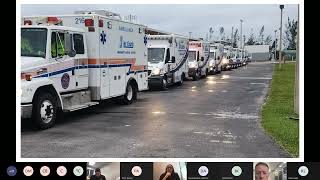
Dr. Carolina Pereira from Lee County EMS describes the response to Hurricane Ian, including how dispatch-based telemedicine held roughly 400 calls while crews were stranded. The county set up fallback locations and mobile clinics across Fort Myers and Fort Myers Beach as infrastructure failed and some calls faced 26-hour delays.
Questions this video answers
November 1 (recording date stated in transcript).
Category 4 with sustained winds of about 150 miles per hour; landfall at Cayo Costa (as described).
Approximately 26 hours (from about Wednesday 5:30 AM to Thursday ~7:00 AM, per transcript).
About 400 calls remained on the list when the storm lifted.
Approximately 16 to 18 feet of storm surge on the barrier islands.
Chapters
Recording started, and then we'll. We'll get started.
Peter, is Paul on? Do you have him on?
He says he's on. He said he's on.
Seymour, hold on a second.
He. He may be on as a.
I don't, I don't see him listed. So.
If he's on time to show himself on a camera, because I don't. Still don't see him. Once he shows himself on camera, we should all see him.
All right, we'll work on the back end.
Do me a favor, send me his phone number and I'll. I'll deal with them in a second. All right, but let's get started. So we started to record. Welcome, everybody. This is the Florida EMS webinar. It's another Tuesday. It's November 1st. Coming to the end of the year. And what I wanted to do this week was two things. Number one is bring back Dr. Pereira from Lee County EMS. She's been the medical director for a little while, and she kind of got thrown into this major, massive event that she's still dealing with. And although it's off of the news, it's definitely not off of our minds. And we wanted to get an update from her to check in on her team, see how she's doing. Then at the same time, I wanted to bring in the same folks we brought in for the COVID vaccine story we told in Israel, the folks who put up these temporary shelters for the Israelis to give vaccinations. And they happen to also be helping out in Lee County. So we'll give them a few minutes at the end. So without any further ado, Carolina, welcome. We hope you're doing well. We're thinking about you and we'd love to hear the update of how things are going.
Yeah, thanks so much for having me. And thanks so much for. I mean, you guys will see in the presentation. But it's truly been a nationwide and very, very much Florida wide effort to support. So we really appreciate all the support. So I have a little presentation that is mostly pictures to kind of walk us through the whole journey. So this has been kind of our response from, from beginning to where we are now. So, I mean, most of Florida is familiar with Ian and its course towards Florida because it was such a huge, huge storm, 450 miles in diameter. And so even as it turned slightly away from Tampa and towards Fort Myers, still the vast majority of Florida felt the effects of Ian. So very large, very large storm. And I think one of the things that's a little misleading about this picture Is Fort Myers is unfortunately not set so far back from the coast. So we got quite a walloping here. This is just the ipath through the area when Ian actually made landfall. It made landfall as a category for they say at Cayo Costa. I'm not entirely sure how you can land at just one spot when the eyewitness itself is 35 miles in diameter, but landed at a Category 4, had wind speeds of about 150 miles an hour.
Then those are sustained speeds. And we saw quite a bit of storm surge as a result. This is actually a picture that I took from my phone itself. This was just the precipitation that we were getting while I was hunkered down in our dispatch center. I had a colleague of mine reach out from Kansas to be like, how are you doing? I just snapped a picture and was like, about like this.
So it captured the eye wall right as it was coming towards us.
For those of you guys that are not familiar, this is a map of Lee county. We have about 800,000 folks here and certainly more when it comes to seasonal variation because we do have a lot of barrier islands and a lot of seasonal tourism here. We had a lot of snowbirds.
So this is a map of the area. You can see that we have pretty substantial barrier islands and very well inhabited barrier islands. I'm sure several of you guys are familiar with Sanibel either from coming to visit yourselves or from conferences that are here. But these are very well known beaches throughout the state of Florida. They got hit pretty dang hard.
So what we did with our cruise prior to the storm is we hunkered down in what we were calling our fallout locations. So this is one of our smaller fallout locations that was at our. At our helipad at Leaf Light. And we put crews kind of together in areas that we knew to be safe from the storm so that when the storm was over we would be able to respond. We knew that during the course of the storm for several hours we wouldn't be able to have EMS response because of the high winds and the ability to flip over ambulances. So we had our crews ready for when we could get back out on the road, especially since we were going to be holding calls. So this is one of our small, smaller fallback locations.
This is, this is just some of the parking at one of our larger fallback locations. Just all of our vehicles ready to go. You can tell it's pre storm because all of the trees still have leaves on them. And we were, we were just doing what we could to get prepared before the storm.
And another one of our fallback locations was the airport. So you can actually see that some of our crews are huddled around playing cards during the storm when they were unable to respond, respond.
Just at a. Just at the airport like normal.
This is actually the location where I was during the storm. And I think that this is something we did that actually worked out incredibly well and we were very successful with. Because we were holding calls for approximately 26 hours, we were unable to respond From Wednesday at about 5:30am Till about Thursday at about 7am.
I was stationed in our dispatch center. So our call takers would still take calls like normal, process them through pro qa, still give them appropriate determinants, just like normal. And because we weren't able to send crews, what we were doing differently is me and another medic were stationed there to essentially call these patients back and see what we could do to help kind of go through medicine cabinets, see what else we could do to sustain them during that storm when we weren't able to send somebody out. So I have two kind of sample cases that I wanted to show you guys. One of them was a little 10 month old boy who has a history of reactive airway disease. So much so that his mom has albuterol at home, both nebulized and an inhaler. And when he initially called 911, you can hear the little boy wheezing in the background. And when I called him back, it was actually significantly worse. Like it's audible over the phone, pretty easy to hear. And mom was. Mom was notably freaked out because she. She has no power, she can't use the inhaler that she usually does to make him better. So she was trying to use. Sorry. She was unable to use a nebulizer, but she did have the inhaler, so she'd been using that. But it was prescribed for the little boy at two puffs every four hours. And it just wasn't coming cutting it. So over the phone I gave her the instructions to use four puffs every hour. And the callback if it was worsening and kind of crossed my fingers that it wasn't getting worsened because I knew that this was actually one of our first calls that came in after we shut down operations. And I was like, oh gosh, this kid, this kid is gonna have to like wait a while before we can get out to help him.
And actually, I'm really, really proud to say that when the crew arrived the next morning.
The inhaler was totally and completely empty. But the kid looked Good enough that the crew was like, are you sure he has to go to the hospital? And I was like, yes, he does.
So we went through the entirety of that kiddo's inhaler in about a day, but it maintained him well enough to get him over that 24 hour period. So this one's a pretty, pretty good success story.
This one has a little less happy of an ending. We got a call for a 78 year old lady in cardiac arrest. Our telecommunicators did their usual thing. We abide by no, no, go in in accordance with Pro qa. And so our telecommunicators gave instructions for hands only CPR pretty early and actually got the patient's husband to start doing compressions.
At about 35 minutes in. I called back to see how they were doing, to see what they like, how things were progressing, essentially to see how they wanted to proceed with this because I knew it was still going to be hours until we were able to respond. The patient's spouse had actually gotten rounded up two of their neighbors and they were doing compressions and rounds. So they were doing everything that they could, doing the best that they could.
But ultimately told them that like I was there to support them no matter how long they wanted to go, if they wanted to go until we could respond back out. I was happy to support them through that.
But ultimately they decided that this was futile and so actually took the time. And I know this is something that we don't typically do because we're sending help, but during the storm, since we weren't able to send anybody, took the time to like talk them through checking a pulse, take as much time as they needed to make sure that it wasn't actually there. But ultimately at about an hour we discontinued CPR and the family was on board with this. And we recategorized that call from a nine Echo for us to a nine Bravo. We were still going to go when we were available. We just couldn't respond during the course of the storm.
And so that was actually, it, actually I think was very helpful. I was initially a little worried that calling these patients back during the storm would just seem to highlight the fact that we weren't coming. But I think it really reassured people that we, we were still thinking about them. We were still like trying to do what we could to help. We would be out like we were still, we were still on our way when it became safe to do so. So throughout that 24 hour period we ended up calling, holding over 400 calls. Those are the ones that Maintained on our list the whole entire time. Certainly we called some patients back and they said, never mind, we're good, we're better. Some of them self transported to the hospitals. But we still had 400 calls on our list when the storm kind of lifted. So this is a picture of our ambulances getting ready to go the morning of Thursday the 29th to get back out at all those calls that we were holding.
The damage. This is on the road to Pine island, one of those big barrier islands. It cuts through a little farming village called Matlache. And this is usually an island that we have road access to, but as you can tell, this wasn't really cutting it that day. At this point in time, we had probably about 95% of our population to be without power. And the part that actually hit us the hardest was the fact that our water infrastructure went with it too. And this is actually what made the initial health response so challenging is all of our local hospitals, even the ones that didn't have flooding, that were doing pretty good, still didn't have water. And so we had to fly any high acuity patients out of the area. So we weren't able to do PCIs, we weren't able to handle high level trauma, anything that needed the OR just because we weren't able to like we weren't able to do simple things like scrub for a surgery. So we had to hold that for a little bit until our hospitals got re established and our water, our water systems got re established.
But that was, that was one of the first things that we were able to get back up and going.
I'm sure you guys saw this picture. This was all over the news. This is the causeway to Sanibel and had some pretty significant damage. So another barrier island that we typically have road access to that didn't have that road access.
At the, at the time we didn't have. We got this up and running and probably about like, I want to say it was like about a week after we had road access back out to Sanibel. And now the barrier islands are still kind of the hardest hit areas, but they're where they're being supported by mobile clinics. So we're actually running a like mobile wound care clinic out of Sanibel and doing some vaccine updates, particularly tetanus, since there's a lot of folks cleaning up out there that are getting cuts, scrapes, that kind of stuff.
And this is a picture of from Fort Myers Beach. Fort Myers beach was also one of the harder hit areas.
What's.
In this Picture is. I don't have any images from immediately following the storm. Fort Myers beach got a substantial amount of sand dumped over the entire island. So much so that we actually had to kind of. This is a. This is a south Florida never thing, but we actually had to use snowplows to get the sand out of the roadways and some just like earth movers to move the sand out of the roadways. It's the equivalent of if you're from the north and have seen those big old piles of snow by the side of the road, it was that. But the Florida version to where it was just this, like, white sand. So super surreal. And fortunately, Fort Myers beach, despite being incredibly hard hit, did still have road access. Now, keep in mind that these barrier islands are at very minimal elevation. We had about some 16 to 18ft of storm surge. So the damage to property in these areas was significant.
So this is a picture of one of our crew members after the storm going out to Pine island.
Kind of getting out there after the storm to kind of surveil what was left and what we had to do.
It took. These guys did great. It takes a lot of grit and determination to kind of get back out there, see how bad it is, and kind of lace up your boots and do it anyway. And so I have nothing but wonderful things to say about the EMS crews here. They've done phenomenal. Now, we couldn't have done it on our own. This is a picture from Fort Myers Beach. On the left, you can see some of the. What used to be more buildings. I know that they don't look like them, but that. That gap where you can actually see water, you can't typically see that. There are several buildings there that got taken out by the storm and the storm surge. But we had so many crews come out and help. Huge thanks to anyone who sent strike teams to this area.
It was greatly appreciated. I think we had in the neighborhood initially of about 30 strike teams, and we're down to five now. We are almost back to completely normal operations aside from Fort Myers beach, where we're doing a little bit of extra support because they lost two stations during the storm.
This is just, I think one of the touching photos for me in that we couldn't have done this alone. Like, we've made so much progress. And it's a huge credit to all these agencies that came out and help us, helped not only the. Our local first responders, but to fema, to Urban Search and Rescue.
It meant, like, I'm used to being on the sending side of help. So to be on the receiving side of help was very humbling.
And very, very cool to see. Fort Myers beach actually now has the. One of the mobile clinics was initially set up in the center of Fort Myers has now been moved to Fort Myers beach. So we can support some of their clinical needs as well.
And one of the cool things that came out of this is that a lot of our crews really came together. So this is a picture not only of some of our EMS crews, but some of our fryer crews and some visiting strike team ambulance as well. We couldn't have done it without a lot of support both externally and internally.
And so this is Maggie Valor. She is one of our crew care team that we actually deployed after the storm. They work with us constantly. I will say that this department has the brilliant insight.
To support mental health in a big way. We have a crew care team of four members. Three of them are two legged and one of them is, you see in this picture has four. But they went out after the storm as soon as it was safe to do so. Maggie actually paid a visit to dispatch because initially the dispatchers were really hard hit by the calls that they had to listen to and support through the storm, but then moved out to different stations where they could support the crews through some of these, some of the things that they were seeing, some of the calls that they were going to.
And then just to do it with a little bit of humor. So trying to get back to our normal. We're far from it, but trying to get back to normal and something that feels more ordinary. So this is one of our crew members yesterday out trick or treating as a, I don't know, a Covid ghost that's prepared and not like even as a ghost, he's not going to catch.
COVID.
And then I saved this one for last, but this is one of my favorite pictures. This is a couple of our crew members that first went out to Fort Myers Beach. Both of them happened to be military veterans and found this flag on the beach and didn't think that it was quite right to leave it there. So to me, this picture represents kind of like seeing what's out there, picking up the peach pieces and going back to normal.
Like I said, we're as back to normal as I expected to be. About a month out, we've removed over a million cubic feet of debris. Our hospitals are back up and running. We have mobile clinics out all of the hardest hit barrier islands. So we have a mobile clinic on Fort Myers beach, one on Sanibel and one on Pine island. And we've restored the road access to those places. So we're far from perfect. We're pretty. And I'll actually credit this one to Dr. Ben Abo. He's the medical director for Sanibel Fire, but he put together a logo that says bruised but not broken. And I think that probably really typifies what we were looking at here. We're bruised but not broken. We're putting the pieces back together. So happy to answer any questions about the process.
Wow, Carolina, that was an incredible overview and it's an amazing tribute to the people and what you've done, the camaraderie, the assistance. And really, it's so nice of you to kind of demonstrate how the entire state came together to help out.
Before we bring other folks in. I wanted to move because I wanted to continue onward here. Part of the help has been in the sense of structures that you've needed. And for those of you who remember, back In January of 2021, we brought in these folks to talk about what they did for the Israelis. I want to bring in now Daniel Ramon, Ellie Pelman, Paul Chamberlain of Fort usa and essentially, Daniel, would you mind introducing yourself? And then I'll play the video. And then I think we're going to go live to Paul, who's in one of the locations. But go ahead and make a quick intro and we'll get right to the video. Thanks for joining us.
Sounds good so much.
Ramon.
I'm the CEO of Ford Services in.
Collaboration with Elite Aluminum Forts usa, Forts Medical and Fort's Logistics.
We had a massive response for Hurricane Ian.
This is Eli Pellman.
Yeah. Paul is the chief scientific officer.
He is an expert when it comes.
To field hospitals and oper.
And you can take it from here. All right, well, Paul, before. Before you start, let me take everyone to the video that you guys have sent me and then. And then we'll get to you right on the field, Paul. So.
Give me one second. And here we.
It.
Hey, Peter, did you put the CME for the day, by the way?
I will. I'll do that now. Thank you.
I think.
All right, so in the sake of time, I just wanted to show everyone what we're talking about here. But Paul, let's take it over to you. So you're the expert. Tell us how you guys have done this in concert with the folks in Lee County. Thanks for joining us.
Thank you. So, very rapidly after the hurricane, we started getting calls from various agencies and Florida help tasks, CDR Health, CDR McGuire with staffing clinics and hospitals. We set up the original one at the old Sears building in Fort Myers as an er. And then there was rapidly a demand on Fort Myers beach because of the incredible amount of time it takes to get on and off the island. The previous presenter was talking about snowbanks being alike in the sand there. And that's really the first impression I got being a northerner was this looks like a snowstorm came through. But of course it was a debris storm. Now to set up the field hospital here, as you can see, we're right in the middle of rubble and so on. So how do we go about it first? Well, we had to sort of survey to find a piece of land that had enough flat surface that we could set up the hospital, have power, parking, access, being able to put all the infrastructure together and field hospital, I'm in it right now. This is an isolation room right behind me and we'll take a quick look. But you need to know first, what are you going to treat in that hospital and then get the equipment and the people for that. Number two, Fort Myers beach needed to be a self sustaining hospital. So we had to produce our water, produce our oxygen, medical air to air exchange because it's full of dust out here, so we have to filter the air inside. We have Covid cases, so we had to have some isolation. So once we determined that, we put this Florida health unit up for eight beds, normally 10, but to be more comfortable, we did eight beds, six er, one procedure bed and one isolation bed. We do 12 air exchange an hour. Because one of the big problems we have, there's tremendous amount of work and debris removal going on. There is dust everywhere, people are inhaling that. So we get those cases. We have a lot of workers with injuries and so on that are coming up. So this is a stopgap to be able to provide local community service service to the responders, the workers on the island and the residents that are returning. So for example, people have lost their prescription, have lost access to medication, are coming in because their diabetes is out of control, their medical situation is out of control. So that's what the hospital does. So I'm going to just rapidly.
Turn the camera if it wants to be nice with me.
That was good. Okay, so this is a typical isolation room, completely isolation, isolated from the rest of the unit.
We have X ray in here.
We have a procedure bed in here. So just like a normal hospital, a little bit smaller, a little bit and so on, stock areas. We're just going to Check that we have and we are over here.
So that gives you an idea. And then peripheral to that we have.
All the services that are needed. So like I said, we produce our own oxygen, we produce our own medical gas, our own power, we filter and make our own water. All this. Hey Paul, Hospital is self sustaining.
We only have about a minute or two and I wanted to bring in people for questions. My question for you is how many patients were you able to see and how quickly after the storm were you able to see those patients? Like just give me the timing wise.
Right. So Fort Myers beach was not as installed. That was at Fort Myers at the Sears Building where we had 10 patient ER and 100 patient inside the Sears building. And we were at about 43 to 47 a day in those facilities.
Wow. Okay, Dr. Pepe, before you head over and we're going to come over right after you. But any questions or thoughts or any comments?
No, I actually wanted to make some comments and really congratulatory comments.
Carolina and I want to have her come on Maine Eagles next week because I, I have a lot of comments to make about it, about what they did. Right. And it was just fantastic. And I just. There's too much, too much to go over. But what I will say is that one of the main things was that when she went down to the dispatch center was there. That's what we've seen in many of our disasters around the world. Whether it was overwhelming the system with calls about COVID Milan or this ice storm in Texas, etc, having either either going there directly or assigning someone you trust down there, our team is going to be really important in that. But that's just number one. And I got six other things on the list and so thanks. Good job. Carolina actually was well presented too. So thank you so much. All right.
It was. Thanks. Okay, we'll be right over.
Yeah, CME is 15323 today. 15323 and I'm going to go over to the Eagle. See you later.
We'll see you there. Dr. Shepke or Dr. Jamison from the state perspective, thoughts? You guys were heavily involved in this response. What are your thoughts, Ken?
Well, I'll echo some of the kudos to Carolina from the state standpoint. Having a trusted, competent EMS physician on the ground was enormously helpful to both Dr. James and I, which were we were both working at the state Emergency Operations center to get valuable insight, to get truthful information in a chaotic situation and to have a true partner to really help, you know, MITIGATE some of the disasters. He was fantastic.
Awesome. Thank you for that. And then Angus.
Yeah, 100% agree. You know, whether you call it the fog of war or whatever, it's often difficult to. To get real information. And being able to just get on the phone with Carolina and know what the real situation was, as well as actually some other physicians inside of healthcare facilities that were affected was an incredibly important strategy. So a hospital CEO can tell you one thing, but a quick conversation with an ER doc or a surgeon will tell you the real reality on the ground. Doctor to doctor kind of thing is. Is invaluable in this. And so thanks, Carolina, for all the work down there. It was great.
Awesome. Thank you, Angus. All right, well, we appreciate it. Carolina, we're going to give you the last word. Take us out.
I mean, the last word is one of. One of humility and gratitude. It goes back to. I feel.
Unworthy of the things that I'm getting currently in that, like, I didn't see it as me helping other people like this. This was really a nationwide and statewide effort to help us. So we appreciate it. And if nobody's seen the logos that have come out of here, probably one of my favorite is one that has Fort Myers with a little heart around the section in the middle. It says my. So thank you guys. It means a lot. We really appreciate it.
Well, thank you so much. And thank you to Daniel, Paul and Ellie for coming on. I wanted to demonstrate that partnership of kind of public private partnership to show that we are ready, we can get assets out there ASAP after a disaster. We have smart people, we have qualified personnel, and we're just very lucky to be in a state that cares for us as residents. So thank you all so much. And if you guys want to stick around, we're going to head over to the Dr. Pepe show where we'll continue on the conversation. So thank you guys and we'll see you on the other side.
Thank you.
Thanks.
More from Peter




Melissa Olen MSN, FPN-C, CCRN: Sudden Cardiac Arrest Training in Schools (Project ADAM) 4/25/25



Pediatric Hospital Readiness: How Teamwork & CPR Metrics Drive Better Outcomes



Chelsea Kadish, MD & Kyle Goodknight, EMT-P, RT: Pediatric CPAP in EMS (3/14/25)