Dr. Rado Raychev: Fast AI App for Stroke Detection in the Field (9/20/24)
Dr. Rado Raychev presents FAST AI, a smartphone app that detects stroke using video of facial symmetry, speech analysis, and arm movement sensors. A study of 400 patients showed the combined model achieved over 90% sensitivity and specificity, though testing was limited to hospital settings with neurologist oversight.
Questions this video answers
September 20, 2024 (webinar date given by host).
About 500 patients collected; up to ~400 patients analyzed in the reported study.
Patients with confirmed ischemic or hemorrhagic stroke within 72 hours of onset; NIH Stroke Scale (NIHSS) 1–15 (mild to moderate).
Approximately a 70% training / 30% validation split.
Facial asymmetry (90-landmark facial keypoint model), speech (MFCC-based audio features), and arm weakness (accelerometer/gyroscope/magnetometer trajectory analysis).
Chapters
All right, welcome everybody. It is Friday, September 20th, and today we have something great in store for you. I am Peter Antevi and I have my host, Tanner Smita. Dr. Paul Pepe is with us today and this is something that we've been following for some time. Rado Reichev is one of a group of several physicians that you can see on the screen. He's a stroke neurologist out of the west coast of the United States who has done something pretty incredible. And I wanted him to present it here on this platform because his audience amongst other audiences is ems. And I wanted to come in, present this information and mainly because I wanted everybody on this call to give him like real feedback. Real feedback, meaning as an EMS leader, as an EMS medical director, does this have value for you? Will you use this? Will your agency adopt something like this? He needs this kind of feedback moving forward.
And for those of you who are in EMS or in the hospital, we all do stroke exams and mainly we here in South Florida we used a race score. Some people use Fast Ed, some people use Van. And the question is, could it be that there is technology that is better than the human being? And so without any further ado, Dr. Reichev, take it away. And thank you so much for joining us here on the Florida EMS webinar.
Thank you, Peter. I really appreciate the opportunity and the nice introduction mostly.
So.
My name is Radoslav Raichev. I'm a vascular eventual neurologist, I practice at UCLA and I am also.
A co founder of a company that created the product that we're going to show you and we're going to show you the research behind it. And I appreciate everyone's attention. This is a collaborative project between UCLA and my Bulgarian colleagues. So I'm originally from Bulgaria. This is what we did the study. This product is called FAST AI, an innovative technology for detection of stroke symptoms. And I'm pleased to present this on behalf of all my collaborators. These are my disclosures. The main one is that I'm a co founder of the company that makes the product.
We all know the problem with stroke. Stroke is very treatable if caught early. So most patients arriving three to six hours are salvageable. However, beyond six hours very few patients are really treatable and salvageable irrelevant of the stroke mechanism. But the real problem is that very few patients arrive in time to receive brain saving treatments. Mostly because of poor awareness and sometimes poor recognition and potentially poor triage by EMS in some circumstances.
How do we improve stroke recognition? How do we enhance stroke recognition among the general Population. We all know the FAST paradigm. It's a well established paradigm for.
Patients and families to remember the most common signs of stroke. However, even after FAST campaigns were launched, one in three young adults who are supposed to remember well don't remember and don't know what FAST is. So FAST remains poorly.
Adopted effort to increase stroke awareness, but it's a good acronym for stroke recognition. And we thought instead of relying on the human intelligence to remember what FAST is, can we use FAST through smartphone? And why smartphone?
Well, smartphone is actually ubiquitous part of our daily lives. As of last year, more than 80% of everyone in the country or all Americans have a smartphone. The average American spends five hours and 24 minutes per day on smartphone. And we check our smartphones 96 times per day. And worldwide the number is even more astounding. 6.92 billion smartphone users. That's pretty significant. And this is again it was last year, maybe this year these numbers even higher. So our original idea was to bring FAST at home for patient oriented technology. But as I'm just going to show you later in this presentation, we also find it used in ems. So how and why we thought this is possible because we know from real world examples that stroke can be detected through video and audio recording. There's real Life examples of FaceTimes and news anchors presenting on video.
Being caught having a stroke before they even knew it. They had facial droop and slurred speech and proper action was taken and patients were saved. So what's FAST AI? Well, it's technology. Like I said, smartphone enabled technology detects facial asymmetry, speech disturbance and arm weakness using the technology embedded in the mobile devices. How do we do it? We use a video recording and out of that video we extract the facial video and the voice recording. And we ask the patient to lift the phone with each arm for 5 sec for 5 to 10 seconds and that way we detect arm weakness and the results are merged and we finally provide output stroke or no stroke. And as I'm going to show you later, we can also detect large vessel occlusion and minor strokes. How does it work for facial asymmetry? So we use a specific stroke specific 90 facial landmark key extraction algorithm that is accentuated on the nasolabial folds upper and lower face and we detect unilateral changes of facial movement and asymmetry.
This is how.
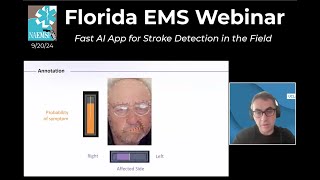
It works or how is it annotated in a real patient? You see this patient has a very obvious right facial droop and the orange bar is showing us that this is over. 80% reliable. In other words, the facial asymmetry is present in over 80% of the frames of the media. How it works from the arms, we ask the patient again to lift the phone with each arm and we detect variance in the trajectory via accelerometer, gyroscope and magnetometer. And you can see healthy versus unhealthy arm. The healthy arm is very linear, no noise, whereas the unhealthy or weak arm has significant variance. This is the data from a gyroscope. Magnetometer is used to isolate the arms and a prone position. So we want arm to be that way. How it works from speech standpoint, we use audio recording and use.
Specific sound variability pattern conduction analysis called MEL frequency spectrum coefficient. And we detect again variability of speech. Normal linear speech has very little variability. This is a graphic representation between the normal and affected speech. And you can see the frequency quite high on the affected speech. So we took this technology, we made the Fast AI mobile app and we asked physicians, neurologists to validate this technology at the bedside on real stroke patients. And we conducted this multicenter study in Bulgaria, where I'm from.
And every patient with a stroke or no stroke, I'm going to show the selection criteria. Next slide was tested with a Fast AI mobile app. Every clinician annotated the results on every patient at the bedside and also provided neuroimaging data. And we continuously optimized the algorithms.
As we went along and we validated through this ongoing research the Fast AI technology and we continue to do it to this day. So far we have about 500 patients in our data set.
These are the centers that took part of the study. We have five centers now actually we're up to six.
This is how we validated each output. In addition to bedside validation, we had clinical core lab validation. So neurologist expert, myself and my colleagues were reviewing every test and make sure that the test is valid. And this is how the annotated test looks like. From the back end we see the video output with proper annotation of right sided facial weakness. The neurologist properly annotated, it's a right sided weakness. We see right arm weakness based on the trajectory of the mobile device in the patient's arms. And we listen to the video and we hear the patient actually has aphasia. And the imaging results are provided by the physician at the bedside. So this is an example of patient with a left middle cerebral artery ischemic stroke. And again we're annotating as valid. So what were the selection Criteria for this study. So all patients were adults. So we had patients with confirmed ischemic or hemorrhagic stroke within 72 hours of onset. We use patients that are rare, relatively mild to moderate with NIH stroke scales of 1 to 15. So we wanted the patients to have one of the three components of FAST. They must have had facial asymmetry or facial droop, slit speech and or myelophasia or arm weakness. We also used a sample of patients that have the most common stroke mimic Bell's palsy. And in those patients they had facial asymmetry, but stroke was excluded by imaging. So we wanted to train our AI to recognize stroke mimics from real strokes just like a neurologist does. And we of course had healthy controls, in other words, patients who had suspected strokes but actually had no clinical deficits. Exclusion criteria were patients who are unable to participate at all and the tests were mute or unable to comprehend. Patient had.
Complete hemiplegia or they had to be able to lift the phone to a certain degree. So we can at least describe the weakness. And patient who had symptomatic hemorrhagic conversion of ischemic strokes. So we wanted to keep the data clean. We want to have ischemic strokes and hemorrhagic strokes separately. This is the study population that was used for this particular study. So we, like I said, we have up to 500 patients in data set, but we analyzed up to 400 patients. Most patients were had ischemic strokes. We had about 10% patients with hemorrhag with. I'm sorry, with Bell's palsy. We had about 70 patients with no deficits. In other words, healthy controls about 20% of the patient populations. And we used 70, 30 split for training and validation. This is a very classic approach in machine learning. So about 70% of patients were used to train the algorithms because. And about 30% of these patients were used to validate the algorithms. These are case examples of facial asymmetry detection. So you see this patient has very subtle, barely recognizable left lower facial droop. And I think this is where the value of the technology is really. When the patient is asked to elicit some facial movements to detect facial asymmetry, the AI is properly picking it and showing us that this the patient's left side. See the purple bar showing his patient side. The orange bar is showing us probability of symptoms. This on the right here is patient with a very obvious right lower facial droop. As you can see, the AI immediately is recognizing his patient's right and is showing us 100% certainty of true symptoms. This is a our central versus peripheral facial asymmetry. In other words, stroke versus Bel's palsy algorithm. This patient has upper and lower facial involvement that is a sign of BEL palsy, not stroke. So when you have upper lower face paralysis, that's Bell's palsy. And this patient has upper lower facial weakness that immediately is picked up by the AI as peripheral. In other words Bell's palsy. Now this patient has central pattern of weakness or stroke related facial asymmetry. And the AI is recognizing it properly as central or stroke because it's only involving the lower face. This is the final output where we combine all the bars. We have asymmetry bar, we have sidebar and we have Bell's palsy versus stroke bar. And this patient has left sided Bell's palsy. Okay, what are the results of our study? These are.
This is the performance of the AI.
From cross validation. So we have sensitivity specificity for each modality. As you can see, each modality exceeds 70%. The most sensitive is specific is the facial asymmetry modality.
When you look at Bell's palsy sensitivity specificity it exceeds 70%, 78 and 70. Still not where I want it to be. I want it to be 99. So we need just more data. But when you combine each modality and merge them together, the stroke sensitivity specificity of the combined three approaches is above 90%. So it's pretty high. If you take a look at a published data meta analysis from human performing fast or fast ED tests in the ambulance or the er. So these were paramedics or ER physicians non neurologists who are utilizing the fast approach at the bedside. The sensitivity specificity was 77 and 60. So the human data, retrospective human data is actually not as good as our AI enabled data. What are the limitations of this study? All fast AI tests were performed by neurologists. Investigators were aware of the patient's diagnosis. Were all neurologists knowing what the patient had? All tests were performed in a homogeneous environment in the hospitals with a when the patient is laying in bed and with the same sort of lightning and and set of sort of same environment. But in conclusion AI can reliably identify kill stroke features and differentiate from Bell's palsy with accuracy comparable clinical impression. I think we can conclude this from our study. How do we see this technology being used? We.
Someone told me this is an EKG for stroke. I love this. I think this is a great idea to call it that way. The EKG for stroke clinic, clinician, a technology. So in other words, we're replicating the neurologist and patients at your pocket. So using the AI to detect things that neurologists can detect easily.
So this could be an EMS and telemedicine environment.
We really think the value is in a patient oriented technology because essentially any human being can be trained to perform an all EMS personnel.
I highly respect EMS and I speak to EMS physician, EMS person all the time. I talk to paramedics every day. And I believe that paramedics are very good and detecting stroke if they're trained properly. But the idea here is really to systemize it and do it the same way all the time with the aid of the AI. But really I think the big value down the line is the self assessment for acute and chronic deficits at home and ambient monitoring, detection and so called IoT smart home video conferencing and even autonomous driving vehicles. If you ask me, all the future poses like if you're driving an autonomous driving vehicle and you have a, God forbid, have a stroke and FAST AI is watching you and detecting that you're having a severe stroke, an autonomous driving vehicle will directly drive you to the proper place or comprehensive stroke center. But that's futuristic view. So I'm going to show you how we wrapped up the product for EMS oriented technology. There's a little commercial video presented by my colleague Brijesh.
Yes.
So now we're going to assess a patient's exam who has a severe stroke with right sided weakness, some expressive aphasia and able to comprehend commands using the FAST AI EMS app. And so now we're going to start the test and you want to be sure to point the camera at the patient's face. And we'll hit start. And Robert, raise your eyebrows.
And show me your teeth.
And close your eyes. Tight.
It's calculating the result. It correctly assessed for the site of weakness and identified as a stroke. Now it asks the paramedic to rotate the phone in order to test for speech. And be sure to point the phone to the side where the patient is looking, especially if there's a gaze or eye deviation. We start the test. It instructs the paramedic to hold the phone directly in front of the patient. Robert, please read the following words out loud.
Please describe the following picture.
It's important to perform through the exam despite the patient's deficits. Please count the number of stars on the following screen. Please follow the dot on the following screen.
Okay. And tells the medic to rotate the phone Back and it correctly detected the gaze. And now we're going to test for arm weakness. There's a sensor on the patient's right wrist that is Bluetooth enabled, and it communicates via the FAST EMS app to assess for trajectory of the arm movement. In order to reliably indicate whether there is any weakness, we hit start test. We ask the patient to rest their right arm. And now lift it up for 10 seconds. And Robert, please, please hold up your left arm directly in front of you. Good. And for a full 10 second count. 2, 1, 0. Good.
After using the FAST AI app to further assess my stroke patient, I founded Very simple to use, easy to navigate, and it gave me a pretty correct reading of what my patient's race score would have been.
All right, Davey, Fire rescue. That's so cool.
So, yeah, thank you. With this presentation, I hope I convinced you that digital transformation, artificial intelligence, is the future of healthcare. We kind of know that already, and we believe the future is now. And thank you very much. I'm here to take questions.
Great. All right, this is perfect. So that's a perfect setup. And we see your screens. Dorado, just unshare.
Okay, just a second.
So this is perfect because I didn't realize you were going to show the demo, which was great. Now I would like to. What I promised you anyway is that I would at least have people on here that would try to poke holes in the theory. So I know there's some great people on this call.
Is there anybody out there? Let's go to Tanner, my partner in crime. And then we're going to go over to any other. Anybody else but Tanner. You. You saw the research, you saw the application. What are your thoughts on. On this app? And rado, we still see the back of your screen, by the way.
I'm trying to figure out how to unshare it. I'm sorry. Let me see.
You know what I'll do? I'll. I'll take it away.
I'm stopping. Share. Okay. There we go.
Okay, Perfect.
You're good.
Now.
Tanner, you're on. All right.
Yeah. First of all, wonderful presentation. I love the idea of kind of a standardized, objective way to assess strokes for EMS patients. I really think it's a brilliant idea. I think that this has phenomenal potential. Just a couple things I was thinking of in terms of generalizability to EMS and EMS systems of care.
Is, you know, first of all, right, in ems, we're assessing patients in a variety of environments, right. We find them in various positions with different light levels when it comes to kind of speech patterns right. In the United States even, you know, even though it's primarily English language speaking, there's dialects in different regions that might lead to some need for, for validation in populations with different accents and dialects. And so, you know, in addition, kind of the population we see might be a little bit less clean than kind of the population that this has been validated in thus far. Right. We have patients that are altered, patients that have trouble following commands. One thing that I was thinking about is patients with dentures, sometimes they can have, you know, quote unquote slurred speech even though they, that might be, might be their baseline. And so, you know, again, really the only thing I would say is I think it needs to be, you know, validated in the pre hospital setting and used by EMS providers which I'm sure, you know, you have, you have plans to accomplish, but really wonderful technology and I think it's really admirable what you've done here.
Thank you. Appreciate the feedback. Excellent feedback. This is, we, we've thought about all these aspects. It's very valid, has to be the technology has to be retrained on different accents, different ratio backgrounds, different environments. 100%. Yeah.
Yep. Great, great comment. Let's see. I want to hear from some other. I know there are folks on the call who are in stroke. Oh, we have, we have some questions coming up on the chat here. Sorry.
Here we go.
Sorry, I didn't see that.
Don says looks like a great tool. I like the speech visual assessment. Any concerns about assessing patients with dark skin tones? Has this been an issue with facial recognition software?
Rado, Excellent, excellent questions. We actually don't have a lot of dark skin tone in our database. We do have some, but not a whole lot and we haven't seen any problem with it. We need again, we need more sample. We have been approached by various countries now to expand our product and you know, in Japan and Colombia is definitely we're going to do it here in ucla. So we have to use more variable data set to retrain. It can easily be retrained. Look, once you accomplish.
A way of training the AI feeding with an annotated data and that's how machine learning is. You just have to extract the data, annotate, classify it and then allow the technology to receive it and to use the neural networks to train it again and to provide proper output. At the end of the day sometimes even my AI experts say I really don't know what's going on there. It recognizes it and gives me the data, as long as we train it properly. Right. It's just like the human brain. It's pretty outstanding. What AI can do.
That's a great, great question, Great answer. This is a great question from one of your colleagues, Adam, who's now a medical student in University of Miami Medical School, but he's from UCLA so he cannot turn on his microphone. But he says he has a great question which is any opportunity to integrate this with video 911, especially now that Apple just came out, I heard with rapid SOS is a technology in the dispatch center that they will now allow people with an iPhone, sorry, Android users, to actually see your video while you're talking to 911. So that's actually a fascinating concept. Right where the telecommunicator says, okay, just hold the phone, do X, Y and Z. And then they're getting the readout of whether it's a stroke or not. Any comments on that kind of partnership?
I think this is. We haven't done this partnership, but this is exactly excellent, excellent.
Scenario where fast AI can be plugged in.
Our video enabled facial symmetry detection is platform independent. You can plug it in any scenario. I can plug it right now into Zoom because it goes to a cloud and it's very easy. Now if you use an iPhone specific technology, we can do that as well because the iPhone.
Facial analysis is way more detailed than our 90.
Landmarks extraction point. But for our standpoint, what we have is pretty sufficient to detect facial asymmetry. So the answer to the short answer is yes, 100%.
Very nice. Let me bring in Lou Steinberg with a question. Lou, go ahead.
Well, I have my whole puncture which you asked for. So as you know, most of our newer clinicians, sorry, are overly reliant on technology, which works until technology doesn't. When your phone doesn't start or whatever, you know, they're saying when in doubt, examine the patient. So since we've gone to BFast, a lot of people confuse stroke screening with stroke severity. Race is a stroke severity, but you need a very fast one minute stroke screening before you set any of this up. Yup, it's a stroke. Let's issue that stroke alert to the hospital. I see this as a better secondary tool. When we get to race, we get to picking up what we might have missed initially to confirm and expand upon that and get to your race plus score. Just as science needs to. Side note in the Bell's palsy, I wrote it in just a recent set of guidelines that if a patient just has facial DROOP do the eyebrow test. That pretty much narrows down and eliminates that. So just my comments on that. But again, it's the overlayance of technology. We need to make sure our people know what to do when it doesn't work.
Oh, 100%. I, I look, I cannot agree more. I'm a neurologist, My father is a neurologist, my grandfather is a neurologist. And all of them, they were working back in the day when there was no CT scans and they were diagnosing stroke based on clinical exam. You know, would I say that my grandfather would flip and grab to see what I'm doing? No, I don't believe so. We are just enhancing the clinical acumen of everyone out there and retraining them and helping. I think if you think about it.
Many people were saying back in the day, well, once we invented the mri, you don't need to neurologist anymore. The MRI is telling you where the stroke is. Why do you need a neurologist? Right. There's always that clinical bedside art of medicine that is absolutely needed in every patient encounter. And our app is actually made, these EMS app is made such way that everything can be overridden by the clinician at the bedside.
Great answer. I'm going to pick on just we only have a few minutes. I want to pick on a few people because I want to get some pointed questions here for you. Rado. So Joseph Zalkin, are you there?
Yeah, yeah, I'm here.
Okay. So you, you ran a very large agency for a long time. Wake ems, big agency, very well respected.
You're still, you're still going strong nationally. Someone comes to you and says, joseph, I want this thing in Wake county ems. What do you say as the guy writing the check.
I want to see.
The clinical background first.
But yeah, just, just some key points. Multiple language. I know there was a point in the assessment where the patient speaks. So we have a large Spanish, Spanish speaking population, variants like that.
Trial for sure. What a key question I have with AI in general is what happens to these assessments? Are they held for retraining of the system or do they disappear after the test?
No, they, they are held for retraining. Yeah, they're, they're held for retraining. Every patient right now, the way it's done right now is always that there's a clinic, clinician annotating it. Okay, so what you saw as an example, as a demo, it's not really actually ready. So it's just a demo, the video, but the real product the, the, the data gathering app. Right now every test is annotated by a neurologist because we haven't launched it in, in EMS yet. And, and we do have a Spanish, you know, you can select when you, the, the product that we have as a demo, you can select your language and we have a Spanish and English version. So if you, if I ought to be just completely frank, the accuracy and the reliability of the, of the actual app hasn't been tested, hasn't been validated in ems. It's just a project.
Okay.
What I showed you was all clinician bedside annotated and every patient is well annotated.
It's, it is exciting technology, especially for those of us in the stroke belt in the south where we see a large number of stroke patients. We also have other systems like ultrasound being tested in the field for LVO detection.
I think it's a great project for stroke centers to pay for, to place in ems.
I thank you for this comment. I don't know if people actually saw the video and I forgot to actually accentuate on that is that at the end of the test you actually send the results via email, text message, however, whatever platform using to the receiving sender. So receiving center actually receives the file and they can play it, you know, so you can. If I'm, I'm, I'm a. Honestly, I as a physician would love to get proper identification early and, and, and hear about it and get to my. Because I'm a neuro interventionist, I do thrombectomies to hear from you and knowing that it's a real stroke patient there, I, I can get my door Device time in 10, 15 minutes if I know upfront. So if I receive a good reliable technology with good.
Evidence for video or some sort of like imaging that I can see that yeah, this is a real patient I know to go. So you're right. You know, in my opinion the hospital should pay for. But it's, it's, it's, you know, it's a, it's tough to penetrate that.
The real, the real question here for me is and for everybody on the call is is there a threshold where this, where fast AI can detect strokes to a X percentage accuracy? Is there a threshold which beyond that everyone says you have to use it because you know, we know that the race in the published studies, it was like, I think the initial study for race was like 60 something percent for LVO. For LVO only in the 60s.
All those studies have never shown that it can get up above into the 80s and 90s. And so I think that if you can have a product that can elevate that number, because, listen, we're in a very urban environment, but people like in Polk county or areas where they would have to fly out that lbo, which is what they do today in some areas, you're getting a helicopter, it's a 10, $15,000 bill, and they get there, and it's a stroke mimic. And you were wrong. So there is some very expensive decisions being made. And if the AI can really perform at a much higher level, I think that's the ROI all of a sudden becomes much more tangible, in my opinion. You know what I'm saying?
Yes, Yes, I agree.
Okay, so I'm gonna let. I'm gonna let Tanner take us out, and then Radha, we're gonna give you the last word and thank you so much for joining us. But Tanner, take us away, and then Radha are gonna give you the last word, and we're all gonna go to Dr. Pepe's webinar. Thank you guys so much.
Yeah, thank you.
Go ahead.
Say thank you again for your presentation. I think we all look forward to validation and EMS systems in the United States and worldwide. We look forward to reading your sensitivity and specificity and positive predictive value, et cetera, in the future.
Thank you, everyone. Thank you, Tara. Thank you, Peter. I appreciate your attention. I hope to continue to be engaged with you guys and continue the collaboration. I appreciate your time. Thank you so much.
Well, the fact that you used Davy Fire Rescue, you're in. We're going to continue to. And in all seriousness, we have a very big community of people who, you know, in ems, everybody wants to do the right thing. We want to do the best for our patients. We want to have the best outcome. So if you need anything from us, let us know. We're always here for you. Thank you, Rado. Thanks, everybody. Tanner just put the link in the chat for Dr. Pepe's webinar. I'm going to join that remotely as I get back into the car. That was great. Thanks, everybody. Appreciate it.
More from Peter




Melissa Olen MSN, FPN-C, CCRN: Sudden Cardiac Arrest Training in Schools (Project ADAM) 4/25/25



Pediatric Hospital Readiness: How Teamwork & CPR Metrics Drive Better Outcomes



Chelsea Kadish, MD & Kyle Goodknight, EMT-P, RT: Pediatric CPAP in EMS (3/14/25)