Dr Scquizzato - ECPR (7/5/2022)
Dr. Tommaso Scquizzato presents ECPR, a technique using heart-lung machines during cardiac arrest to improve blood flow to the brain. His Milan center has performed over 300 cases since 2013. Success requires rapid transport, coordinated EMS networks, and high bystander CPR rates, not just technical skill.
Chapters
All right.
Okay, we are, we are started and then let me see if.
And Kim, you there? Dr. Landry.
Hey, good morning. Good morning. I think Paul may want you to tell the story on Maine Eagles Day. Did he call you on that?
Oh, yeah, he did and he actually sent me the link.
All right, all right. So that. What, what I'm, I think people are going to be pleasantly surprised by that story.
Oh, if we lost Kim.
Hold on, let me answer this call. I'll be right back.
Oh, yeah, yeah, yeah. Go ahead, go ahead. Okay, as far as. Hey, there's Dr. Lee. Hey, Dr. Lee.
Let me make sure that I ultimately get the.
Codes for today. I'll put those in the chat. But let's go ahead and get started because we are at the top of the hour and I really want to hear everything that Tommaso has to say here. So welcome everybody to the post July 4th edition of the Florida EMS webinar. And we are recording today. So just keep that in mind. Today we are being joined by Tomaso and your last name is hard for me to pronounce. Suizalo maybe.
Okay. Who wrote a great editorial in Resuscitation plus on ECMO cpr, ecpr and the title was ECPR Now a standard of care question mark. And he is a social media editor of Resuscitation and Resuscitation Plus. He joins us from Milano. He's a great writer and a great contributor to the field. And when I found him on Twitter and I sent him a message, he right away responded. And so people like that who have kind of EMS in their blood, we really appreciate. So without any further ado, Tommaso, thanks for joining us and take it away.
Thank you Peter for the invitation. Thanks to everyone who is listening and Florida ems so extra corporeal cpr. And when I wrote this editorial, now a standard of care, I received many positive and many negative comments because saying that something like extra corporeal CPR is a standard of care is a very, it's very complex because, you know, there is inequitable assets of.
Ecmo. There is a very hard, complex procedure that are currently not performed everywhere. And so saying this is sometimes very hard. And actually I'm speaking from this hospital, it is my hospital in Milan, it's a research hospital and here ECMO and ECPR is currently a standard of care. We perform ECPR for refractory out of hospital cardiac patient one time per week. And so and this started in 2013. So we perform more than.
300 ECPR cases in this period and we usually perform 100 ECMO, period. So in our hospital, in our EMS system, every patient where the criteria for ECPR get cannulated. So, so in our reality, ECPR is now a standard care. And.
Let'S start from a very rapid introduction to remember the numbers of the problem. Cardiac arrest is a huge problem. Many people die.
Every day and every year in Europe and the United States and all over the world. And the number, you know perfectly what are the numbers. And often 3 out of 10 achieve a recurrent spontaneous circulation. Only between 2 and 15% survive to hospital discharge. Surviving cardiac arrest, as you know, is a race against the clock. You know perfectly because you work in ems. And so every second count when treating this patient. And we know that some factors are protective. And so we know that early bystander intervention, cpr, AD can be protective towards some delays. And so this is a key point to remember for all this presentation. And I ask you, how would you like to survive a cardiac arrest in 2022? We have different options, maybe two options, mainly two options by chance. But we don't like this option, I think and by system. And I think that we have to work on the system. And the starting point to clarify think of a system for cardiac arrest system of care is to remember the chain of survival. I don't want to spend many words on this because you perfectly know what is the chain of survival. But I would like to remember that some links are more important than others. So early recognition and early CPR are the main links of the chain of survival. These links are really improving survival. And the integration with the community is another key point for improving survival. Also, when we are talking with ECMO and these advanced technologies, we must not forget this.
Basic aspect of cardiac arrest care. And if we talk about advanced life support, also in this case, we have many question marks because a lot of interventions were tested in randomized trial coronary angiography, intraosseous access, mechanical devices, incubation drugs, and more recently the highly debated temperature control after cardiac arrest. And all these interventions failed to demonstrate convincing effects on survival and neurological outcomes. Many of these interventions actually fail to demonstrate benefits in terms of survival or neurological outcome. And so this translates that many times we are able to save the heart, but we achieve rosc.
But we can't save the brain. And there's a really key issue.
For saving these patients. And this New England Journal paper published a couple of years ago, remember that the risk of death or the risk of being.
Discharged with a brain damage or admitted to the nursing home is higher when we do not have bystander resuscitation and lower when we receive bystander intervention. And this is another key point to remember. Now let's move to extracorporeal cpr. So ECMO applies during cardiac arrest and let's discuss some of the latest advanced intervention. One of the latest advanced intervention landed in the field of cardiac arrest very rapidly. What is ecpr? This is ecmo. It's a combination of a blood pump and an oxygenator. We deliver oxygen, we remove CO2 and we can also manage temperature. And we can support both the pulmonary aspects and also the cardiac and the pulmonary combined. So we have the VV of the BA configuration. ECPR is the use of VA ECMO in refractory cardiac arrest patients. So the cannulation is perform while CPR is still ongoing. And this is done under considerable time pressure as you can imagine. And usually it is provided as a bundle. So this is not a standalone application intervention cpr. And the rational of course as you know, is the.
ECMO can provide an eiger cardiac output compared to conventional CPR and can also easily control temperature and can preserve the brain while awaiting for rosc. And so we can perform treatment of underlying causes and waiting for cardiac recovery. And this is also, this is all summarized in the concept of a bridge. So the fundamental premise of treating patients with cardiac arrest or also cardiogenic shock is that ECMO is a bridge, a bridge to recovery, a bridge to a more durable bridge, the bridge to definitive treatment or to a decision. So we can support ecmo, temporize circulatory support and can provide supportive treatment to the patient. So we can wait to the recovery of the patient to decide if there is something recoverable. For example, we can exclude the catastrophic brain or cardiac conditions or we can bridge the patient to other mechanical circulatory support devices, e.g. percutaneous.
Left ventricular support or long term bad devices or also even arterial transplantation. And then we move to the comparison of ecpr. So this novel recently introduced intervention, the fetal cardiac arrest to the conventional CPR that.
We performed for many, many years. And so these are very hot topic.
Actually I should have updated these slides because now there are more than 170 observational studies published in available on PubMed. And so this is a very huge topic.
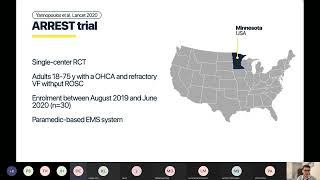
Many of these studies are observational and describe single center experience with a cpr. And these studies reported improved survival and neurological outcomes compared with conventional cpr. Systematic reviews and meta analysis of these observational studies also suggested the potential benefit of cpr. However, we have to remember that we are talking about observational studies and so the risk of bias is very high and randomized trial were needed. And so we move to the recent two randomized studies, a Lancet in 2020 and AJAMA in 2022, the RS trial and the Prague OCA study. These two studies were really needed and important to understand the effect of CPR in patients with cardiac arrest. The first one performed in the US and so you really really know well is a single center randomized trial enrolled patient only with refractory ventricular fibrillation in the out of hospital setting. And a small study, 30 patients in a paramedic based EMS system and.
The intervention performed was in this sequence out of hospital cardiac arrest, dispatcher assisted CPR and early transport with ongoing mechanical CPR. For every patient enrolled in the study and only at hospital arrival the patients were randomized to receive a continued standard ALS or moving to ECMO ecpr. And so this is a very different studies compared to the European one. But we'll talk in a while and the US study demonstrated high survival with ECMO if patient treated with ECMO at 33% survival compared to the 7% of survival in the standard resuscitation group. And this is a huge difference. So this study tested the concept is applying ECMO is effective in patients with cardiac arrest. So the direction effect is clear. We have possibly a very huge benefit. This is the Kaplan Meyer survival showing a very clear difference between the two groups. In this trial patient did not crossover between the two groups. So patients allocated to the ECMO group received ecmo. Patients who were enrolled to the standard ILS group received standard ILS group standard ILS resuscitation in the emergency department. And now we move to the Europe so single center LCT now enrolling also non shockable rhythm, very large study, almost 300 patients and in a physician staffed EMS system quite different from the US study because the randomization were performed in the out of hospital setting. So patients.
Stayed or stayed in the out of hospital setting and continued ALS on site or were immediately transported with ongoing mechanical cpr. So patients without ROSC were declared that on on the outer hospital setting and patients arriving to the hospital because randomized to receive ECMO were treated with cpr. And.
Yes, this is what I currently said and.
In this study crossover was permitted so patients can be crossover between the two group. And this is the the.
Chart of the crossing over. So we see that 11 patients that were allocated to standard strategy crossed over to the invalid strategy and five survived. And nine patients instead allocated to the invalid strategy crossed over to the standard Strategy and no one survived. Overall, 64% of patients allocated to the embodied strategy received ECMO. This means that some of patients actually achieved ROSC during the ambulance transport or after arrival to the hospital. And.
These are very important information that can be seen from this study. Six percent of patients were actually randomized of every cardiac arrest occurring in Prague. So this means that we are talking about a very selective population of patients. If you think in your EMS system, the patient that actually have the criteria to receive ECMO is very, very low. We are referring to a 6% of patients without hospital cardiac arrest. So a very small population of patients, very, very small. And also in this study patient had a sign of benefit, but the statistical significance was not achieved in the primary outcome. So the study was interrupted early and for a benefit in the secondary outcome. You can see no difference in the primary outcome, but a difference in the secondary outcome. So I think that we can say that the direction affects can be clear, we are not doing harm, there is possible some effects. And the secondary outcome indicates us that the survival can be improved. The short term survival can be improved with ECMO in this patient. And this is the Kaplan Meyer survival curve.
And.
Let'S discuss a little bit of what happens when we put together some studies. We decide to perform a very rapid systematic review and meta analysis of randomized and propensity score match studies to reduce the risk of bias. And we found that the direction of effect was really similar to what demonstrated by randomized studies. And again, there is no signal alarm, there is no signal of increasing the number of patients surviving with neurological deficits because you perform cannulation after also one hour of cardiac arrest. And so the risk of increasing number of patients surviving with neurological deficit is possible. You know, you can start almost every time the ART with ecmo, but the brain can be irreversible death. But this is not the case.
There is no signal of increase of survivors with brain damage. And so overall evidence are in favor of treating ECPR with ECPR patients with refractory cardiac arrest. But now let's move to a really important concept because no magic ballots exist in cardiac arrest care. Every time we have to think that ECPR is a part of a bundle of treatment that begin in the pre hospital setting, continue during transport and conclude at the hospital arrival. And to achieve irate for survival in an ECPR program, it is important to accurately select patients. So consider eligibility of patient perform effective high quality, high standard pre Hospital resuscitation that begin with dispatcher assisted cpr, early bystander CPR and defibrillation and rapid identification of candidates from by EMS provider. And prepare the patient for rapid transport. And during transport you have to coordinate with the receiving ECMO center to continue high performance CPR and.
Try to work in a network that collaborate with ECMO centers and and after in hospital arrival. It is important to reduce the time. Because one of the most difficult aspect of ECPR is actually logistics. It is not clinical problem. ECMO centers are really really good in doing cannulation of patients. And most of the problem arise from logistics. And so coordinated different actors. From the pre hospital setting to the in hospital arrival. It is really a huge issue. And then after arriving the icu, rigorous post resuscitation care. And again considering a comprehensive approach to this patient. So from the management of brain injury to the management of cardiac recovery. And also when nothing works can be done to consider organ donation. And our goal should be always to buy.
To reduce. To buy time. So reduce no flow time. Remember that no flow time is our enemy. And brain injury occurs very rapidly after cardiac arrest. So work to reduce timings, so reduce no flow with bystanders, reduce low flow with quick rapid EMS response. And.
Early CPR is always the main and the most effective way to do this. And this is a very schematic representation of actually how the time is when you treat this patient. It is impressive how time flies when we treat those patients. No flow, bystander cpr, ambulance arrival that start bls then advance the life support. And it is important to declare that the cardiac arrest is refractory. And also this there is a lot of confusion what is a refractory cardiac arrest. And it is important to decide rapidly to move to the in hospital setting to continue resuscitation. And.
To support this statement, I would like to show by standard CPR in Europe. Actually alpha case are received by standard CPR in Europe. But in the Prague region, where the Prague study was conducted, 83% is the bystander CPR rate. And.
Initially, before initiating a CPR program is of paramount importance to focus on bystander cpr, CPR intervention and so community initiative and awareness. So without bystander CPR or ad, any further advanced intervention will have only little or no effect on outcome. You can put on ecmo, but this patient already dead, already brain dead. If after 10 minutes of recuscitation, after 10 minutes of cardiac arrest, nobody initiated CPR use an ad. So bystander CPR is Of paramount importance, in Italy, in Milan, it is very difficult to reach the patient with a first ambulance before 10 minutes. So without bystander CPR, the patient we already said would not be possible, because without bystander cpr, the patient died. So another data from these two trials, you can see that these two trials are very high bystander CPR rates. And so this is very important when someone thinks, oh, I would like to start any CPR program, we have to watch what is the bystander CPR rate in your community and try to work and improve the first aspect of the chain of survival. And these recent studies, published, observational studies published in Resuscitation plus from a group in Denmark show that the rate of survival with favorable neurological outcome was higher than 20%. Also per patient.
With low flow times higher than 75 mils. And in this study, bystander CPR was more than 90%. And this is a clear signal of how protective is bystander cpr, how bystander CPR can prolong the time of.
Advance of advancing intervention that can be performed in those patients. So bystander CPR is a key point for every advanced intervention. And when I talk about ecpr, I'd like to make everyone think that the ECR of ECPR means two different things, early CPR and extracorporeal cpr. This is a key concept. Without the first E, early extracorporeal CPR is very hard to work. Patients arrive to the hospital, you can relate the ecmo, but you immediately realize that without bystander intervention and prolonged no flow time more than 10 minutes, often these patients are completely brain dead. And this is a very huge issue, both for families, both for providers, both for the community. And another key point is to create cardiac arrest center like trauma center, stroke center.
Stem centers, also cardiac center should be created in the future in every region because these patients require high complexity, high intensity of care. They require a complex posture, resuscitation care, they require experienced provider temperature control, advanced ventilatory and circulatory support, ecmo.
Left ventricular support devices, cardiogenic shock is often present in those patients. And a comprehensive care can be provided in cardiac arrest center.
Pre hospital CPR is a very complex topic. I would not like to very roughly talk about this topic because it requires a lot of discussion, but this should be considered. The rationale of hospital ECPR is to reduce low flow time, but it's very complex to do ECMO outside the hospital. So EMS system doing these are very, very.
Very good this and they Must be congratulated for the effort because they're really complex doing this and the future, what is the future is a large multicenter randomized trial to confirm those findings and provide firm recommendation also in different settings and different population of patients. And.
We await these results. Many studies are currently enrolling patients both in hospital and out of hospital can relation and we still have to understand which patient might benefit the most and in hospital vessel versus out of hospital. The logistical aspect and how we can generalize those findings to other setting other reality with different system of care. Take home message. I think that from a presentation like this that ECPR requires a substantial investment of resources. It is not simple to initiate ECMO if an. If an hospital never provided ecmo. Starting with ECPR is really complex in my opinion. So better create ECPR center in already established ECMO center that provide ECMO for example for.
Post cardiac surgery cardiogenic shock or VV ECMO for respiratory distress syndrome or other condition. And ECPR.
Randomized trial and observational studies show that it's feasible. There's no doubt on the feasibility of ECPR in trained system and can improve outcome in high performance system. So with high performance system, I mean system that optimize the first link of the chain of survival. So start.
In.
System.
10% of bystander CPR is maybe without any potential benefit. But if you start ECPR in system with 67, 80, 90% bystander CPR rate, you give the possibility to these 6% of patients that do not achieve ROSC in the out of hospital setting to benefit from this intervention. And the results are those show within the randomized trial. So bystander CPR and defibrillation are key for survival and selecting patients is also key. I leave you with a summary of our meta analysis so you can remember all the key points. And if you have any question, you can follow me on Twitter, you can write me an email and I'm very happy to discuss and chat with you all. Thank you for your attention.
Tommaso, that was an amazing review. It's just really nice to see all that data in one place and really all the important, really subtleties of the data. I did want to bring in Dr. Pepe and then Dr. Schepke for a couple of comments. Go Dr. Pepe, unmute yourself.
Okay, thanks. So Buenos Aires.
What hospital do you work out of? I couldn't catch that. I didn't see that.
Yeah, in Northern Italy, Milan. San Rafael Hospital.
Ah, yes. Yeah. Okay, good. Okay, fantastic. We work closely with Roberto Fumigale. So.
We'Ll meet about that sometime. The one comment I think I want to reiterate. You said this already, but.
More from Peter




Melissa Olen MSN, FPN-C, CCRN: Sudden Cardiac Arrest Training in Schools (Project ADAM) 4/25/25



Pediatric Hospital Readiness: How Teamwork & CPR Metrics Drive Better Outcomes



Chelsea Kadish, MD & Kyle Goodknight, EMT-P, RT: Pediatric CPAP in EMS (3/14/25)