Dr Shah - Thorasite (7/12/2022)
Webinar (recorded Aug 3, 2022) where Dr. Amit Shah (cofounder/CMO of Inovital; emergency physician at MedStar Washington Hospital Center) presents Thoracite — a low-cost procedural aid to improve lateral thoracostomy (needle, finger, or tube) site selection. He reviews literature documenting high rates of misplaced decompression needles (many studies showing ~20–30% appropriate placement in recent papers), explains Thoracite's anthropometry-driven design (using DoD anthropometric datasets), and presents validation data: a cadaver study (12 cadavers, wide height/BMI range) showing nearly universal placement in recommended 3rd–5th intercostal spaces between anterior and mid-axillary lines, and a small user study (10 paramedic students) showing accuracy improvement (~62% to 95%). Ongoing larger pre/post real-world studies are active (Milwaukee County EMS ~550 ALS providers; UCSF study). Device is licensed to SAM Medical and priced at about $15/unit (as stated on the call).
Questions this video answers
12 cadavers
From ~62% to ~95% (≈50% relative improvement)
Approximately 550 ALS providers (pre/post design)
About $15 per unit
Chapters
Else who needs to make any.
Announcements.
Joseph Zalkin, from the national perspective, nmsp. Anything on your end that we need to know.
The time is now. If you're interested in FAMS credentialing, if you have three years of NMSP.
Membership and worked with your chapter, you may be eligible. Those applications, I think, run through August.
Great. That's great information for people on the call. Okay, thank you for that. And. All right, so we having a lot of people coming on at this point in time, so let's get started. Angus, thanks for recording. So we're very privileged to have Dr. Amit Shah come on today. How did I find out about Dr. Shah? There's a big conference that was held out in Vegas this year where a few people called me up afterwards and they're like, there's some great presentations and some great ideas and products that are out there. And someone connected me with Dr. Shah and said, you have to see what they're doing. So I reached out to him, of course, over social media, and he was gracious enough to oblige. So, as you can see from his slide, he's the chief medical officer for innovital systems and CLR Medical. He's also an emergency physician at MedStar Washington Hospital Center. So, Dr. Shah, thank you so much for joining us. If you want to fill in a little bit more of your introduction in case I missed some parts and then take it away, we greatly appreciate you coming on.
Sure. Thank you so much for having me, Peter. It's a privilege to present to this group. Can you guys hear me? Okay. I just want to make sure that the audio and visual are coming across clearly.
Yes.
Yes, we can. Fantastic. Okay. Yeah. I've been at Washington hospital center in D.C. which is a level one trauma and burn for the last 15 years, and been involved in medical device development for about eight or nine years now, and want to talk to you about one of the products that we've developed, which is called a Thor site. We developed it for lateral thoracostomy.
And a quick disclaimer. I'm co founder and chief medical officer at inovital and we're the company that designed the device and then licensed it to SAM Medical, where it's available for purchase. So, yeah, jump in.
So this is the general outline for the talk. I'll start with the problem statement. What is the data.
That informs us as to how big the problem is, what the problem is? We'll talk a little bit about how we design the device to address that problem. What's the Data behind the device design. I'll review how the device is used, describe the data that supports its use, describe some ongoing studies, and then pause for a question and answer. But I'll ask that at any point, if anyone has a question, please just shout out. It's a little bit difficult in this format to see people and to read faces like you would in an actual meeting. So please just shout out and stop me at any point if you have a question, criticism, opinion, what have you. I want this to be interactive.
Starting.
With the problem statement.
So if you look at studies back almost 20 years since 2005, and these studies include prospective studies in the civilian and military medical world, observational studies, including standardized patients where imaging is used, cadaveric studies, I think that it's pretty clear that the majority of decompression needles are misplaced. Okay, now that doesn't mean that every one of those misplaced needles causes an injury, but every one of those misplaced needles places a patient at risk for an injury. And I'll review some of this data and again at the end of the talk I'll have a list of references. I'm happy to share all these papers. Again, these are all in the peer reviewed public PubMed world. So anterior needles are almost universally medial to the midclavicular line threatening the heart mediastinum, great vessels, lateral. The site for lateral needle decompression is very often identified below the sixth intercostal space which threatens abdominal contents. Here we have in this image a needle in the liver.
I'm sorry, is there, is there a question?
Okay.
What'S at risk? The structures that are risk, of course, Heart, great vessels, interabdominal contents. And of course a needle that's misplaced is unlikely to vent the plural space and address the problem for which you're placing the needle attaching pneumo. This is another published case study, an interesting 1. A 22 year old woman who's involved in a motor vehicle collision. No right sided breath sounds were appreciated, so an antero needle decompression was attempted. Unfortunately it was placed in the fourth intercostal space, peristernally resulting in an RV puncture. The patient arrested and ultimately had a 28 day ICU stay, was discharged to a rehab facility with bilateral vision loss. So not a, not a good outcome.
And all due to a misplaced needle. And just so you don't think that this is a problem that was sort of in the past and not a current issue, here are four studies published in the last 12 months and they look at sort of a variety of different metrics, but many of them are using imaging to evaluate the needle placement of pre hospital place needles. So the top one shows only 27% of the needles were placed ended up in the right place. A handful of needles ended up in spleen, liver, otherwise intra abdominal or in the anterior mediastinum. These other papers also are citing in the 20% approximate range in terms of appropriately placed needles. The last one, which used standardized patient models in the 60% range for allowed unit decompression. So not great results in terms of accuracy.
Why are these mistakes made? I think the real question is how come they're. How are they ever placed correctly? It's such a difficult scenario to appreciate. There's a rush to address a decompensating patient. You've got challenging environments, poor lighting, distractions, a whole host of different body types. Patient positioning is not necessarily going to be optimal, and the providers themselves may not be experienced in performing the procedure. Now, when you add to that the advent of longer and larger bore needles, this makes appropriate needle sighting even more critical.
So it's a challenge. And I think, and have thought now for some time that it was a problem worth addressing, especially if we could design a solution that was simple. So that takes us to the Thor site. Do you guys have any questions so far about the problem or.
The data?
Yeah, actually. Actually, now is a good time to bring in maybe some. We have a lot of folks who are kind of very experienced in ems, and I'm just curious to see if anyone here is seeing the same problem. I know that in Palm Beach County. I see Chief Coyle is on. We just took the time to create an entire video where we brought a surgeon in just to recap and review exactly what you're talking about, Amit. So I don't know if that's you, Chief Coyle on there, if you want to pop open your microphone and talk about all the education and training that we've done. But if not, Dr. Shah could continue.
Peter Wangley.
Yeah. Oh, hey. Go ahead, Dr. Lee.
I didn't want to interrupt Charlie. I couldn't tell if he's coming on or not.
Doesn't look like it.
I guess my question to you is, in Broward county, you know, our trauma agency, we review our cases on a regular basis. Have been for a long time, to my knowledge, and I've been around for a while. I've never had the trauma agency come back to me and say that the needle decompression was a problem, to my knowledge. So I'm sort of puzzled with the. You know, you said that essentially only 30% of them, plus or minus, were correct.
I would have thought I would have.
Heard from them before now.
Yeah. And there's certainly regional variation, not only in provider experience, but also how these results are tracked. What I'm citing is just the published literature, and most places I go and talk to people, they are aware of at least one incidence of a misplaced needle and a needle ending up intra abdominal. Most commonly it's intra abdominal, but oftentimes it's medial to the midclavicular line.
And.
Causing injury. Now, the question is, if you look at the fraction of misplaced needles and. Or you'd look at all misplaced needles and then ask the question, what fraction of them caused injury? Right. So the. The study that I presented earlier, I think it was Maybe somewhere between 5 and 10% of the needles caused injury, but, like, 75% of the needles were incorrectly placed. So I guess the question is, are you tracking injury or are you tracking appropriate needle placement in terms of laterally anterior to mid clavicular line, third to fifth, and anteriorly second intercostal space, midclavicular line? So that's the first question. Are you tracking just injury or are you tracking needle placement accuracy overall.
And, Dr. Lee, maybe a good idea would be I can ping the trauma coordinators. I know, Candace Madonna in the Palm beach area, and I can ping a few of those people and maybe get back to the group next week to see if indeed they are seeing that maybe the surgeons would know more. But it's something that I can put on the list and get back to you on.
Yeah, I think that'd be worth knowing. I'm not suggesting that maybe it hasn't happened and I wasn't aware of it. Just said it's never been a topic of conversation to any degree that I'm aware of. Anyway, thanks, Peter.
Thank you.
You got it, Dr. Shah. Go ahead. Thank you.
I just actually wanted to respond to something, Peter, that you said about training. Obviously, training is critical.
But if there were, and this is kind of the thesis behind the device design, if there were a procedural aid that could help you in the moment so that you weren't sort of scrambling to identify appropriate landmarks on, let's say, an obese patient in. In the moment and in sort of the heat of the moment, the idea was that that could be a nice sort of augment to training that was happening otherwise. So wouldn't it be in place of the training? But it would be in addition to.
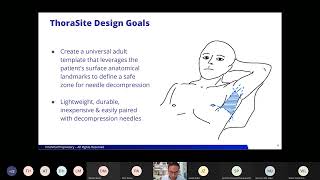
So when we went into this, we thought, okay, if we can create an adult template and a universal adult template that really leveraged and referenced the patient's own surface anatomical landmarks to identify a safe zone for needle decompression.
We would have a solution that would be worth bringing to market, especially if we could create one that was durable and inexpensive and lightweight and really was easily paired with decompression needles. The image that you see here is from the British Thoracic Society.
I think they called it zone of safety. And again, it's a lot easier when you have a thin young man, as is pictured here, a lot of these landmarks become obscured as you leave that specific patient population.
What we did a few years ago now is looked at a database of anthropometric data. Department of Defense, and I believe it was army specifically, had studied about 5,000 men and 3,500 women and collected 132 measurements on these men and women. Among them were height, axillary height, as is shown here, and chest height. And we use this data to create not only the device, but also the safe zone that's shown here. And again, the thought was if we could reference the patient's own anatomical landmarks, we could create a universal device. So the thought was we would design it based on that data and then start, begin to study it and see if it actually worked across a diverse patient population.
So the instructions for the device use are actually on the device itself. And you'll see here how it references the patient's anatomical landmark. So the first step is to push the device into the axilla with the arm abducted maybe 30 to 45 degrees, and push it as far up as it'll go. It does have some rigidity.
In that plane, the plane in which you're pushing it into.
So that it can displace fat. And it was specifically designed for that purpose. So you're displacing the soft tissues and pushing the device into the axilla and pointing it towards the iliac crest. And in doing so, you'll have identified some landmarks. So the anterior edge of the device is the anterior axillary line. The mid axillary line is referenced as well. So you're between those. Those two lines and between the third and fifth intercostal space, as is shown here by these red dotted lines in the image.
Next, you palpate. And so now we're at step three. You palpate within that safe window to feel an intercostal space and then place your needle where you feel the intercostal space. Now if two intercostal spaces are identified, we generally recommend that you select the upper intercostal space. And if you can't feel the intercostal space because of excessive soft tissue, recommending that you place the needle sort of in the middle of the, of the safe zone. And then if you feel a rib, just redirect just above the rib or so if you run into a rib with the, with a needle, you redirect just above the rib.
But again all this is printed directly on the device for ease of use as a four step process.
We've designed it to be useful on either side of the chest and it's clearly labeled right and left. We've also designed it to have the rigidity to displace soft tissue, but also be flexible to conform to the chest wall so that you're actually holding it up against the chest wall with your non dominant hand and then palpating and inserting a needle with your dominant hand.
So yeah, once we had the design down, we figured okay, we have to see if this works.
What we did and then published in Journal of Trauma is looked at 12 different cadavers, male and female, 4 foot 11 to 6 foot 7, 80 pounds to 350 pounds, BMI 16 to 42. The specimens included specimens with shoulder disarticulation rib fractures. And the idea was we placed the needles using the device and shoot X rays in a couple different views and have an independent radiologist tell us where the needles ended up. And this is what we found. Every one of the needles was in the third, fourth or fifth intercostal space, which is in line with recommendations. And all but one of them were between the anterior and mid axillary lines. And you'll see the one that wasn't was 2 cm anterior to the inner to the anterior axillary line. So basically universal appropriate needle placement.
Again as defined by that anterior to mid axial line, third, fourth or fifth intercostal space.
Had done and presented at Special Operations.
Medical Association Scientific Assembly. We had done a user study with a total of 10 paramedic students. And paramedics gave, gave them about three and a half minutes of instruction and did four standardized patients. Now this wasn't image guided like the cadaver study, but we essentially had these same users identify both freehand and with the Thor site, these the appropriate site for lateral needle decompression. And we found.
A 50% improvement in accuracy when the thoracite was used. So 62% to 95%, 100% of users said they would use the Thoracite, if it was available and increased their confidence by 34% and there was no increase in procedure duration. So that was the other thing we were worried about is that, hey, if we introduce a device into this process, it would lengthen the procedure and that could become a problem. And we did not find that.
In terms of ongoing studies.
The biggest one is out of Milwaukee county ems, so.
It'S the city and a few other agencies where medical direction is provided by Medical College of Wisconsin. But 550, I believe, ALS providers, it's a pre and post design. So they're almost done collecting data in the pre.
Dataset where before Thoracite was introduced, just your usual palpation approach. I think the first data point they collected was a needle that ended up in the liver. They're in the next week or two going to roll out training for Thoracyte for those 500 plus ALS providers and they'll collect data on the post Thoracyte launch group to see, to assess the accuracy. What's interesting about this study is they have roped in the Medical College of Wisconsin, er, trauma surgeons, radiology, the medical examiner, the local medical examiner to capture as many of these data points as possible. So it's a very cool study design, a lot of efforts been put into it and we're excited to see see the results there. There's another study out of UCSF which I don't have as much data on and again, these are both independent studies and I don't know what they're doing at ucsf, but I believe that it's a, a similar sort of real world study of the device.
So let me just stop there. I wanted to kind of make it short and sweet and leave the rest of the time open for discussion.
And see what thoughts you had.
So, Dr. Shah, thank you so much. That last slide that you just showed I think really will answer a lot of our questions and I'd be curious to see the pre data. Just as much as I would like to see the post data, I think that would answer some of what Dr. Lee was getting at. Do you know if on the pre, what exactly are they looking at? For those patients who had it kind of the freehand method, how are they evaluating placement, how are they evaluating injury, etc.
Yeah, it's imaging. So the, the patients that end up in the er, I think the majority of them are getting CAT scans. So it's needle placement based on CAT scans. So it's not only, you know, was an injury observed, but also was the needle placed in an appropriate location. And then medical examiner, I believe it's just, it's dissection. I don't know whether they're doing any imaging of the patients that end up in the medical examiner's office, but either way it's pretty definitive. It's either imaging based or through dissection.
Okay, great. And then there are some agencies on this call, including one of mine, where we do finger thoracostomy. Does this device, is this device suitable for that procedure as well?
Yeah, I mean, it's, it's a aid to help cite a lateral thoracostomy, whether it's a needle, a finger or a tube.
So.
I would say that, you know, you're identifying the relevant landmarks for any one of those procedures with, with this device. So, yes, whether you're placing a needle or using a scalpel, it's going to put you in the right place.
Awesome. I appreciate that one. I'm not sure if we have any surgeons on this call here, but what do the surgeons think about this? And are you seeing any adoption at the hospital level with the surgeons who don't have an ego? I know they don't have an ego, but what do they think about a device to help them get spot right?
As you can imagine, our first sort of market that we want to address is not going to be the surgeons, right. Try to convince a trauma surgeon that they need help in identifying.
The lateral site for either a needle or chest tube. That's a pretty big ask. Now, if we think back a few years, it would have been a big ask to have surgeons using an ultrasound for placing a central line, an arterial line, or an anesthesiologist to use video, laryngoscopy or anybody to use an eye. You know, you get the point I'm getting at. So we address first, I think.
Those that.
What are we asking of these, these guys in the field to perform an emergency procedure in the hardest possible circumstances with very little assistance? They're giving in, given a needle and said and told to, hey, remember your training and listen, I'm all for training, but any level of assistance beyond that is helpful. Now, what I imagine will happen is that in addition to this device being paired with needles, I think it may be incorporated in other procedural trays. And at each one of these institutions that, you know, I've worked at, not only has this been something we've seen from ems, but junior surgeons, emergency physicians in training, placing a chest tube in the abdomen, I've seen at every institution that I've worked At. So I can imagine trainees or less experienced providers even in hospital benefiting from a device like this.
But yeah, the training.
Okay.
I'm not going to hold my breath for those guys.
Yeah, there's a lot of really smart people on this call and I want to see if any of them have any questions for you. I mean, I think all of us are data driven and knowing that there's an EMS study out there, an institution that we know, and we know the people at that institution, and they're gonna actually be. They'll be on our next call, actually, with Dr. Pepe, who is. Are you Dr. Viper today? Paul?
Mute.
I was originally going for Irma Vep, but I. I didn't want to, you know, take that for. For whatever reasons. You know, that's vampire. It's a thing. But so I stuck with Viper. It's pretty good. But yeah, next call because I've got to switch over to it at this point in time. Did you get the CME code out there, everybody, by the way?
Yes, I did. It's in the chat and it is 15265. Thank you.
Thanks.
But I'll get back to you later. That's okay. Okay, so just gotta move.
Yeah, absolutely. I see. Anybody else on the call? I know there's a lot of people have a lot of experience on this call. Anyone want to raise your hand or just put a comment in the chat? Um, let me ask the obvious question, Amit. Do you know what Sam is selling this for?
I think it's about 15 bucks a pop. References. In case anybody's interested in looking at these papers, there's a number of them.
Okay, here we go. I see some questions, Dr. Dye. Okay. Answered the question. Yeah. Dr. Jamison is asking, what do some of the medics on this call think of this? So we gotta hear from our folks in the street.
Let me bring in Brett Cross. You're. You're. You're a ground medic and you're an air medic. Thoughts on this, Brett?
Good morning, Peter.
Can you hear me?
Yeah.
I think it's a. I think.
It'S a good idea.
I had a same similar question to you when you asked about the finger Thor costumes. That's something that we do as well. You know, I. I appreciate the research. I think I would like to see one, feel one and see how it works in real life. You know, when you got next to a patient. It is one more thing, I guess too.
That's.
That's my first thought. It's one more thing. But if it's one more thing that's helpful.
Yeah, I guess it comes down to do you feel like it could improve? Right. If you feel like your providers sort of universally are getting it right with either anterior or lateral.
I can see why this would not be something you want to introduce. Right. It is one more thing. But if you feel like there's room for improvement.
Especially given the price point that we've, you know, that Sam has placed it at, it seems like we try to make it an easy thing to adopt, not only from the procedure standpoint and incorporation, making it an easy device to use, but also from. From the price.
Right. Okay, awesome. Let me see. David, Bill, and Rebecca, you're being called out by your medical directors.
So let's get one of you to unmute and.
And talk. In the meantime, Andrew says.
Our medic seems surprised when I tell them how often the tubes are not positioned in the plural, the needles are not positioned in the plural space. Providing more entry site consistency will be helpful. Dr. Dyer says. What's the shelf life on this, Amit?
That's a good question. It's measured in years. I'm sure somewhere between three and five, but I can get back to you on that. I'm pretty sure Sam would have that listed on their website, but I'll let you know. See, the thing is, because they're also looking for military adoption, they've got to have. So DOD has some standards in terms of the products they adopt, and I'm pretty sure five years.
Is what DoD generally wants. Let me take a look and see if I can find that just while we're on this call.
Okay. All right, we have another minute or two left. We'd love to hear from one of the other street street folks.
Hey, Doctor, this is Brett again. Can I ask two more questions?
Sure.
One question I have is, how's it stored? And two, do you have any idea how people are storing. That's a bag space and where it goes and if it's flat. You know, those are all things that also have a role in.
Yeah.
Can you guys. I'm gonna stop sharing so that you can see my camera.
More from Peter




Melissa Olen MSN, FPN-C, CCRN: Sudden Cardiac Arrest Training in Schools (Project ADAM) 4/25/25



Pediatric Hospital Readiness: How Teamwork & CPR Metrics Drive Better Outcomes



Chelsea Kadish, MD & Kyle Goodknight, EMT-P, RT: Pediatric CPAP in EMS (3/14/25)