Dr. Sheldon Cheskes - DSED Update 2024 (5/17/24)
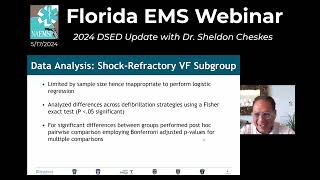
Dr. Sheldon Cheskes presents updated findings from the Dose-VF trial testing double sequential external defibrillation (DSED) for refractory ventricular fibrillation. DSED produced substantially higher survival to hospital discharge and neurologically intact survival versus standard defibrillation. A single DSED shock achieved roughly 75% ROSC and 40-50% survival.
Questions this video answers
May 17, 2024.
Cluster‑randomized crossover trial in six Ontario EMS agencies.
Ran just over four years; paused for six months in 2020 due to COVID and the DSMB stopped it in May 2022 for operational challenges.
355 patients (per‑protocol).
17% shock‑refractory VF and 83% recurrent VF.
Chapters
All right, welcome everybody. It is Friday, May 17, another edition of the Florida EMS webinar. And this one is going to be great because we have a repeat offender, my great friend Dr. Shelchesky from Toronto. Many of you know that he's been on the webinar before talking about dose vf, which is double sequential external defibrillation and recurrent and refractory vs. He has much more information to fill in since the publication of his paper in New England Journal in 2022. November, I believe. Right, Shell?
Yep.
It's been that long.
Wow.
So, without any further ado, Shell, if you want to make any further introduction, the Florida folks love you. Bring it on, baby. Let's do it. Take it away.
I love it. I was going to call this the Peter Antevy hour, but I decided to really go with still the the State of Florida EMS webinar. And it's actually cool because, you know, back in November 2022, you guys were the first that I actually spoke to about the results. And then a cascade actually occurred after that. But it's great to be back. Fantastic group in Florida. And today, like I said, we're going to talk about alternate defibrillation strategies, but this time we're going to focus on shock refractory and recurrent vf. We're going to sort of look at the results of dose vf, but perhaps under a bit of a different lens that I think will really challenge the dogma of what we've all learned in the past about recurrent defibrillation. So the following. Here is my disclosure slide as well. Here is my research funding slide. So I think before we understand what we're going to talk about, I just thought sort of a short overview of the dose VF trial would probably be important. So as we know, many patients remain in VF after multiple defibrillation attempts. Both the technique of DSED and vector change defibrillation have been proposed as alternate therapeutic strategies. But prior to dose vf, there was really no high quality evidence to support or refute the use of double sequential or vector change. And really prior to the recent change in the IL4 guidelines, both AHA and ERC didn't support the technique of double sequential external defibrillation. As everyone knows, this trial itself was a three hour cluster randomized trial with crossover. It happened in six agencies in Ontario, Canada and ran for just over four years. The trial itself was paused for six months in 2020 due to Covid and eventually stopped by the DSMB in May of 2022 due to Covid related operational challenges at the participating services. The primary outcome of the study was survival to hospital discharge, secondary outcomes of VF termination, ROSC and neurologically intact survival with a modified Rankin scale score less than or equal to 2. The inclusion criteria for the parent studying was patient had to present in VF or pulsus vt, they received standard ALSA therapy if available, and they had to have a minimum of three successive shocks given in V in VF for pulsus BT at the fourth rhythm analysis and all those shocks initially were given with the pads in the standard AL position. Services were then randomized to continuing resuscitation with standard care or pads in the AL position and two intervention arms. One was a PAS were change from AL to ap, otherwise known as vector change defibrillation and the third arm of a second defibrillator being brought on scene and shocks given sequentially through two defibrillators known as double sequential external defibrillation. The results that everyone already knows showed significant improvements in both unadjusted. These are the unadjusted outcomes of double sequential infector compared to standard defibrillation with really large increases in survival to hospital discharge being noted, particularly for DSED compared to standard defibrillation. If we look here at our adjusted outcomes, you'll see that double sequential was superior to standard defibrillation for all primary and secondary outcomes in the study, while vector change was superior for RE termination and survival to hospital discharge, but not neurologically intact survival. So this is stuff I think that we all know already, this is really the study that we did. So I think when we look at the study, I think one of the things that we use is we use the pragmatic definition of refractory vf. And what I mean by a pragmatic definition is patients presented In VF had shock 2 minute CPR, shock 2 minutes of CPR. And we did this for the reason that this is something that the paramedics do well and is very, very simple to implement. Those in the EPS world and perhaps the defibrillator manufacturers look at this and say, well, you know what? These patients may not have actually been in true refractor VF from an EPS point of view. So if you look at the EPS point of view, you'll see this picture here. You know, patient gets shocked, does not come out of vf. And that's really what the EPS folks would say is shock refractory vf, whereas recurrent vf, the patient gets Shocked, they go into a organized rhythm but then go back into vf. And the reason this is important is important for a number of reasons really. Survival data in the past has showed us that survival for shock refractory VF may be actually less than 5% but actually probably greater than 30% for recurrent VF. And I think why is this really important? I think we have been led to believe in the past, again from defibrillator manufacturers education, that from an EPS perspective if someone goes into recurrent vf, it's not an issue with defibrillation but actually an issue with drugs with resuscitation or perhaps a blocked lad, but it's not a defibrillation problem. But from a clinical perspective really the implementation of a pragmatic protocol is very very simple. It's quite difficult to put in a protocol based on shock based identification during the resuscitation by a paramedic. So the question we therefore asked was we wanted to assess the impact of alternate defibrillation strategies on clinical outcomes for those patients presenting in shock refractor and occurred VF during the dose VF trial. And we had hypothesized that DSCD and vector change defibrillation would be superior to standard defibrillation regardless of the mechanism by which we defined vf, whether it was pragmatic or shock based. So what we did was a secondary analysis of the dose VF RCT and we categorized cases into shock or factory recurrent VF based on the first three pre randomization shocks based on our assessment of the defibrillator file. If we saw no evidence of VF termination during the first three shocks we we define the case as shock refractory vf. If we saw evidence of VF termination during any of the first three shocks, we call the case recurrent vf. Remember here we're trying to understand the mechanism by which the SED or vector works. So in this study we only assess those in the per protocol population. To ensure the patients receive the allocated randomization strategy. We assessed the impact of all post randomization shocks of DSCD vector standard on clinical outcomes. We employed logistic regressions and adjusted for the Utstein variables, antiarrhythmus and epinephrine. Each defibrillator file was reviewed by two reviewers. The reviewers were blinded to the allocated treatment strategy. Differences were decided by consensus of all the reviewers. All the other variables that we collected were part of the original randomized control trial. Our primary outcome was survival to hospital discharge. Secondary outcomes of VF termination, ROSC and neurologically intact survival with an Mrs. Less than or equal to 2. We used descriptive statistics for all our included variables based on the type of vf. The primary analysis we did unadjusted to unadjusted as well as multivariate logistic regression with survival to hospital discharges or outcome of interest. The exposure of interest was the type of vf. The results of the regression model were presented as odds ratio at 95% confidence intervals. Our secondary alsace was similar to primary outcome primary outcomes with the outcomes of interest VF termination Ross and neurologically intact survival. Certainly for the shock refractory group, we knew that we were going to not have as many cases in that group, so clearly being a sample size would be inappropriate to do logistic regression. We analyzed the differences across defibrillation strategies using a Fisher exact test. And then Ian Drennan went to work and did some fancy mumble jumble and adjusted the P values for multiple comparisons. Do some work that he only knows really well. He tells me if it's significant or not and I believe him. So let's take a look now at the population we had here. So we started in the dose VFitt population with 405 patients. The per protocol population had 355 patients. Ten patients were excluded from our analysis because of difficulties in actually assessing whether they were shock or fractured or recurrent. At the end of the day, we ended up with 17% of patients with shock refractory VF and 83% with recurrent VF. So that 17% is quite high when comparing to previous observational research. And we'll talk about that later in our discussion. If you look at the patients with shock refractory and recurrent vf, they were actually quite matched with respect to Utstein variables. A bit more bystander CPR and a bit more in public locations for the recurrent group. If we look at the quality of cpr, and I think this was a real strong piece of our original publication, regardless if we can categorize the patient as shock, refractory, recurrent, the quality of CPR was to the guidelines. I think this is a key part of the study that I stress whenever we talk about this. If the quality of CPR is not measured and it's not well, is not good, who knows whether the intervention succeeds or fails based on CPR quality. If we look here at drugs and times on scene, yes, refractory VF did get a bit more antiarrhythmic and did get a bit more Epinephrine, which in our mind does make sense because these were thought to be more refractory cases. If we look here at our unadjusted outcomes, you'll see the first thing that's really incredible about this study. Despite the fact that the VF termination rates are similar in the three arms, survival to hospital discharge and neuro intact survival were much, much greater in the DSCD arm compared to the standard arm. In fact, we did not have a single person survive who was randomized to standard defibrillation and was in true shock refractory bf. If we look at the patients in recurrent bf, DSCD and vector was superior for all outcomes. Most importantly, there was a 10% absolute difference in survival to hospital discharge and neuro intact survival for patients in recurrent VF who received alternate defibrillation strategy of DSCD compared to standard defibrillation. If we look at our regression model, we see that DSCD was found to be overall superior to standard defibrillation while vector change was not, and those in recurrent VF did better than those who were in fact in refractory vf. If we look at a regression model for recurrent vf, we feel this is likely significantly impacted by our sample size. DSCD and vector change both were not found to be statistically significant difference, and I'm going to talk about that here in the next couple of slides. So I think when you look at this work, what you found was DSCD was superior to standard defibrillation overall and for shock refractory vf, I think there's a big difference between clinical relevance and statistical significance. I think anytime you have an absolute difference of greater than 5%, almost any clinician would say that's a better strategy. And we saw this in the DSCD arm being 10% greater for survival and neuro attack survival than standard defibrillation. I think what's important is shock refractory VF had a higher survival despite the fact that there were similar rates of VF termination in the three arms. And what that tells you is terminating VF into a asystolic pea or perfusing rhythm is a very, very different kettle of fish. What you terminate VF in is is very, very important. All our secondary analysis were similar to a primary analysis and again, not a single survivor of shock refractory VF in the standard arm for recurrent vf. Vector change overall was superior for VF termination, improved VF termination in the recurrent group, but no significant improvement for the survival outcomes and These findings were very consistent with the per protocol findings of the parent study. So we saw the same thing per protocol with vector change in the dose VF rct. So one of the things I think people talk about or wonder about is why was our rate of shock refractory VF so much higher than what people have previously described? And remember here we're comparing a randomized trial to registry data and these are two different, completely different kettles of food fish. In the randomized trial, we had to have successive shocks in a row fail before being randomized. Most registries do not have the granularity to tell you whether the shocks were successive or not. And successive shocks versus total shocks are two different things. We excluded bystander AED shocks in our study. Bystander AED shocks are oftentimes included in registry data that impacts time in VF and also the refractoredness of an underlying rhythm. So I think this is why our study itself had a much higher rate of refractor VF than has been seen in previous registry data. I think I mentioned this earlier.
Because you terminate VF does not necessarily imply that you're going to get the same outcomes. When you terminate VF into a perfusing rhythm or an organized rhythm is much different than when you terminate VF into an asystolic rhythm. And I think that's critical. The other point though is that if you terminate VF and you do it for 20 seconds, is that the same as terminating VF that actually terminates for a minute 10 and then goes back into VF or actually gets a profusing rhythm? We think those two things are very, very different. And that's been shown in previous research by my good friend in Amsterdam, Rudy Coster, that the time in VF is incredibly critical to survival. VF is one of the most oxygen consuming rhythms there can be. So you're critically going to do much better if your time in VF is shorter. And if you can see this piece here, you'll see that the time in VF and neurologically intact survival are actually very, very clinically related. So I think the piece here that's important, and we're doing this in our research right now, is we're looking at every shock that was given during the dose VF trial. We're calculating the time in VF and what we hypothesize is those in DSCD and vector change have shorter times in VF than those patients who receive standard defibrillation. So I want you to stay tuned for that paper because I think it's going to be very, very important. I think the future directions, and Jason Colt did some great work here with logistic regression and AI, and AI and machine learning is what if we could pick up patients and refractory VF after one shock or as early as possible based on this study? If you can pick that up early using this, using amsa, it would make much more sense to move to an alternate strategy, such as, such as dscd, such as ECMO, early, as opposed to giving standard defibrillation that we know will not in fact work. So you guys may say, oh, my God, early dscd. Ceskas has lost his cookies here. Well, I'm going to tell you, I have good company around the world. So I'm helping out with and I'm aware of four different RCTs looking at the concept of DSED around the world. The Swedes are looking at DSED versus standard after one failed EMS shock. In Norway, they're looking at DSCD as the initial shot. In Denmark, DSCD versus standard after one failed shot. But they're looking at vector and double sequential. So all these three studies are looking at a different question of dose vf. They're looking at early dsed, not DSED for refractory vf. The Germans are actually doing DSCD versus standard after three failed EMS shots. So this concept that I'm saying to you folks today about refractory VF and early intervention I think is critically important. And at the end of the day, what I think this study has done is challenge the dogma of recurrent vf. Recurrent VF may not be because of drugs, resuscitation or effective standard defibrillation. What we may need to prevent refibrillation is more effective defibrillation in the first place. And I think that's what DSED in fact offers. If people wish further information, we can have it here in our paper. People are free to read this and send me more questions about it. And at the end of the day, I thank Peter, but I also thank what I consider to be the most amazing paramedics in the world. These are the paramedics that took part in the dose VF trial. And without them, none of this could actually happen. So, Pete, I really thank you for your time and I'm happy to answer any questions.
Wow, Shel, amazing job. I love how you always highlight your folks in the field who did all this. I know several of them are on the call today. I know Ian, I see, is on the call as well, you really do have a great team. Let me bring in Dr. Pepe. Paul, go ahead with your question.
So Sheldon, this is great and you're right on target about differentiating the refractory versus the persistently recurrent because of the implications as you're. It was great study again. So I wanted to just make a comment that I think about the, the issue about how we defined what was recurrent versus refractory here when you came up with your numbers and it just may be, you know, an artifact of what you're seeing there. I think what happens very often is that you may deliver the shock, it actually stops the fibrillation there. But by the time we actually see it on the scope again, it's recurred within like really just matter of seconds and a lot of times it will not show back on the scope for a while. And so it may have already been. So that may be part of the reason versus where you're in the EP lab and you're actually monitoring what's happening at that time. So. But it doesn't really matter I don't think. I think the whole.
And I think you're right, Paul. I think what we wanted to say to people, we. I get this question a ton. My feeling is whether it's refractory, I think we've shown here is whether you use a pragmatic definition or a shock based definition. It doesn't matter. These patients do better with dicd. I think that's a take home point. I think what people have to understand as well is even with the concepts of see through cpr, that concept that filtering can be used to allow us to understand the underlying rhythm. I caution everyone, filtering is far from perfect. It's far from perfect, particularly in patients with deep compressions. You cannot filter all the way front. So I think people sometimes think that we can get around this through the use of things such as see through tbr. But I don't believe that. And I think if you ask paramedics, many of them favor the concept of a pragmatic definition because listen, that's what they do on a day in and day out basis and I think that's the easiest by far for them to implement.
One last thing because I have to go over to my own meeting but I wanted to comment on is it's just. And you're going to. I know you're going to agree with me. I just wanted to re. Offense. Re. Reinforce it to the crowd. Is that when you did the vector only change? It looks like. Well it's not as good. Let's just do dsd. It's the combination of the two, I think, that are important because everybody thinks of VF as being this sort of random whatever, but it's moving around in various angles. So to capture it in different places and to capture it at different times really helps out with your thing. And I love what you emphasized today, that it is the most energetic, consuming, you know, rhythm that's out there. And, and so I think everything you've been saying and the place you're taking us to has been fantastic. So thank you very much. It's about time someone really got out there and put this down. So I really appreciate it. But it also brings up the issue about the rhythm, you know, I mean, the recurrence. Can we, you know, stop it with the various drugs etc, or whatever else that we need to do to improve blood flow to the heart. So, so it just really, it helps to reemphasize this. So thanks again for this tremendous work.
Okay, thank you. No problem at all. Pleasure.
So.
So Shell, I want to, I want to ask you, I want to kind of frame it in a way that everyone understands here that if you have a population of 100,000 people, you would expect 100 arrests and 50 of those, you would work. That's the 50 patients that were working in 100,000 population. 20%, as we know, are typically VF. At least 10 patients. What you're saying is that around 20% of those 10 are going to be in refractory or recurrent. So that leaves us two. Am I, am I accurate on those numbers in a population like I'm sitting here and in my town here?
So probably not quite accurate. I think, to be honest, I think in the populations that have VF, about 20% of patients are going to present in VF. We're seeing less than that in Canada now. But certainly let's say we take 20%, 55% of that are going to require greater than three shocks. So it's going to be higher than that. So 50% are going to require greater than three shocks. That's when you have to break that number down into your refractory versus recurrent. But I think from a pragmatic definition, but 50% of patients are going to require greater than three shocks. So I think what we need to get in our head is how can we prevent those patients from going into recurrent VF in the first place? So I think for me, community responders, early bystander AEDs, more frequent AD use, so you'll see them places with lower rates of refractory vf. That's probably because they're getting ads shocking patients earlier, decreased time in vf. And that's the key. And I think the correlation between time and VF in neuro intact survival makes a huge difference and hopefully we'll show this in our next study. If you're in VF for a shorter time, your low flow time is decreased, your perfusion to the brain is increased and you get burned. Neuro intact survival, that's what Coster showed in his early study and I think that's what we're likely going to show in the next study we're doing. So that's how I kind of think about this, this piece and, and hopefully we'll be able to prove this in our next paper.
Can I just. Here and Sheldon, we always have to remind people is that there are all these other confounding factors that no one's really controlling for. Well like our group not doing CPR or interrupting it, you know, the adequacy or doing it well enough or interrupting it too much or the real thing that's not controlled is that there's, if there's an adequate lung inflation given to the patients and yet controlled ventilation. So you're not, you know, cardiac output. I think we haven't. We still have to keep that the back our heads of all these cases, let alone the, the cases you're talking about. So. Sorry.
Well, no, no, it's fine. That's a great comment. So Shell, I mean that's a big number, right? Because we know where the money's at, right? When you look at survival of cardiac arrest, the money is in the vf. You're telling me that half of the cases are going more than three and that's why these other folks across the pond are looking at early bsed. It surely seems to me that that's where this is going and what I wanted to do is share this is something that I did by just finding information off of the Internet. But. And I showed this to you the other day when we were, when we were in Boston together. But on the left hand side is all CARES data, the Netherlands data I kind of found by speaking to someone out there and looking at some research. And then here are the Saudi data. So what you're saying is that the reason that their data is so much better than ours as far as Ross survival to discharge neuro impact, you're saying it's because they're getting there earlier and they're actually getting the patient with CPR and shock way earlier than we are. And they're not getting the refractory cases because of the B2 delivery of shock. Am I saying that correctly?
100%. So take a look at the numbers. AD Prior to CMS. EMS, 65% burst bystander defibrillation, 41% initial or shockable rhythm, 50. So that's why you can't compare registry data to the randomized trial. You're looking at a completely different population. And the Netherlands has an incredible community first responder program. They have their own app. When they send out a community responder, send out a signal. They're sending it out to 100,000 responders. They. And in data that I was just Speaking in Germany, 87% of the time they have someone respond to that app. 87%. Someone's responding. That's like in a different world compared to North America. And I think that's something. Some other research I'm doing looking at community responder programs is improving what we do, because the earlier get them, the less time they're out of vf, the more shockable rhythms and the greater chance you have of these patients. Actually, when EMS gets there, these patients already have Ross and they're talking to you. Do you know what I mean? So I think it's just a different. It's just a different. It's just a different mentality, a different look at cardiac arrest and a different way to theoretically prevent recurrent vf. Get them as early as possible.
Absolutely.
So if there's anyone on the call, I know we're going to end in a couple minutes, but I'm sure that there's questions out there.
I'm always. And if you have a question, just please raise your hand. I'll bring you in. We have people. We have Matt Levy from Baltimore, from Hopkins. We have a lot of folks from around the country who are on this call to please comment. I'm curious as to why this is still a weak recommendation, both by ILCOR and the aha. And you know.
And the fact that it's a weak recommendation, it's preventing people from actually doing this very important thing and adding it to their protocols. So, Shell, what's your comment on that? If you have to give people a. Should you do this and add it to your protocol tomorrow, what score would you give that, like 100%? Or is there a reason to say no today? Any reason?
I think you need to be very careful with lcorp. So weak recommendation, low quality of Evidence is exactly the same as epinephrine that we use every day. Antiarrhythmics. There's not one study out there that has ever shown antiarrhythmics improve survival to hospital discharge. The third thing is this recommendation is exactly the same as a recommendation for ecmo. And I think what happens is when you apply grade to a, to a study, it's not uncommon to come up in an EMS world with these types of recommendations that we still use every single day. And I think that's a challenge of doing something where you apply grade to it. We argued with the ILCOR group that the recommendation should have been higher, but ILCOR decided to do what they want to do. I think the one, the one thing, you know, we've answered every sort of comment or every concern of this trial. At the end of the day, it's the single rct and that I would agree with. Anytime you have one rct, you're going to have people who are going to be hesitant to actually deploy an intervention. But when you see even in a single rct, that level of difference in survival, neural attack survival, that really does need to make you think a little bit. And I think that further research will actually help, help to understand this. I think I'll make one comment, Pete, and then let people go. We looked at a shock by shock analysis of DSCD vector change in the Dose VF trial, and we found that the ROSC rates were approximately 75% after the first DSED shocks. The survival rate after one DSED shock was in the 40 to 50% range. And that's the challenge when you're looking at a superiority study. After a single shock, your baseline is going to be great greater. But the data that we've got from Dose VF suggests that in fact, you may actually see those numbers. So I think, you know, I provided that information to these investigators. So we may be quite surprised to see an efficacy early on in the resuscitation. Larry. But Larry asked, what was the timing between the shocks? So we do, Larry, we do sequential shocks. We do one person presses a button as quick as possible on the two defibrillators in the paper that my PhD student was going to give today, but I spent all the time babbling myself. The time frame was 650 milliseconds, so it was under one second was the timing of the two shocks. The one very interesting piece of that particular paper that my PhD student did and that we've published was that we think that simultaneous dscd, which was what we were doing before the trial actually had better rates of Ross than sequential DSED than we did in the study. The caveat then is the defibrillator manufacturer caveat. The thought that doing so simultaneous DSED may in fact increase the risk of defibrillator damage was a reason we didn't do it. But we've never damaged a defibrillator simultaneous sequential. We've never done that. So I think the point is becoming moot over time.
And, and Shell, if you want to comment on that case that, that you and I are aware of, where they actually double sequential or they, they double cardioverted. And as we know, that happened at the same exact time. And, and those defibrillators did not go bad.
Yeah. So I think. So this is something that's going to come out in JAMA Cardiology, should be coming up very shortly.
What investigators were looking at to this use of cardioversion, natrial fibrillation for patients with large bmi. So when you have atrial fibrillation, large BMI is very difficult to cardiovert that subgroup of patients. So the investigators took 200 patients and they randomized them to get double sequential cardioversion versus standard cardioversion. Double sequential. As you can imagine, synchronized cardioversion is right to the millisecond. What they found was that the conversion rate in double sequential cardioversion for atrial fib was about 98%. Single cardioversion in this group was about 85%. And every person who had single cardioversion fail actually cardioverted with double sequential cardioversion. But the most important piece of this is, is this was done simultaneous. And guess what? Not a single defibrillator got damaged. So what that tells you is it's unlikely the timing that the issue is it's more likely the positioning of the pads in ensuring that those pads are placed in the orthogonal position that has been shown in animal models to minimize damage, any chance of damage to a defibrillator. And that's a position we described that we used to in the dose VF trial. So again, you're going to see some very interesting stuff being published that's going to further sort of give us some, some food for thought on the importance of different vectors and different mechanisms by which we can defibrillate the full ventricle and cardiovert the full ventricle as opposed to what we've been doing for such a long period of time.
I guess it, I guess it's not called double. Maybe we should call it double Simultaneous.
Yeah, exactly, exactly.
External cardioversion. Okay. And then let's see. Armando, Dr. Cliff from City of Miami. Are there any data showing that if there were, that any of the other interventions made an impact here, such as, you know. Yeah, that's a great ecmo, et cetera?
Yeah. So what we did, Armando, is we just published a third paper looking at PCI and angio because New England Journal asked us about this. They wondered could those patients have had better outcomes because there was a difference in proportion of patients who got angiography and pci? And what we found that the rates of angiography and PCI were no different in the two groups. And in the publication, you'll see that the amount of antirhythmic, amount of drug, all these things were very similar. Pre hospital, post hospital, the same. Our system doesn't use ecmo, so that would not be a reason to explain the study results.
Awesome. Great, great, great comment there. And great question. Excellent. Well, Shell, this is amazing work. I. I really hope that people take this to heart. They forward this to the people at their agencies to make the protocol changes. And this has just been incredible. Thank you so much for joining us again, as usual.
And we, we are going to. Yeah, go ahead.
I want to give you the last word, but I do want to make.
Yeah, yeah, yeah. No, I'm, I listen, I love your group. This is an amazing group. Whenever I speak here, there's an incredible turnout. So it's just an honor to be here. And, and I think what's going to happen, you'll see, you know, the ILCOR guidelines have already come out and made recommendations would be very rare to see AHA and ERC go against those types of recommendations. I've almost never seen it in my resuscitation career. And what I'm seeing right now is this is being done in a large number of places in North America where I'm seeing a huge change in pickup is in Europe. And the reason I'm seeing a big change in Europe is because of the EOCOR guideline. Changes in Europe is very guideline focused. So if ERC doesn't say it, we generally don't make a change. So I think now people are looking at, okay, here's what we say now, how do we implement this in our system? And that's where I think what we're doing a fair bit of speaking on that piece.
Well, and I think you may see some US agencies, maybe some in Florida who may make some changes as well. But you started off the conversation kind of Teasing me about. This is the Peter and Tevi show, so I figured maybe now the time to make a little bit of an announcement. But many of you know that this gentleman, Tanner Smita, has been, maybe he's been on this webinar the most. He is, as many people know, an MD and PhD student in. In West Virginia. So I've asked him to join and help me along the way in managing and hosting these webinars. He is a brilliant mind in ems. He is, in my opinion, the future of ems. And so I know Tanner is on today, but you'll be seeing more of him. We're gonna start to prepare and figure out how we're gonna make this happen. So it's not just the Peter and Debbie Show. Just so you know.
I love.
I. I love Tanner too. Fantastic. Young, young. The future as well. Like Tanner, Ian Drennen, all These really brilliant.
PhD trained.
Researchers are really going to pave the way for the future. I see Lou Steinberg has a question.
Yeah, go ahead, Lou.
Just a quick one. We've discussed this before your slides, the Resuscitation Academy. Everyone shows basically anterior anterior placement. It's not really lateral. We know first shock success is really important and capturing the most of the ventricle is important. Was that addressed at all and was that studied, etc.
Yeah, that picture is full of shit, Luke.
We drew a picture, okay? We didn't mean it to be the exact position of the actual pads. Our pads were in the anterior lateral position. I believe the lateral pad should be in the mid clavicular line. And me and Peter just spent.
A full day at Zoll headquarters improving the positioning where you actually put the pads on these on the patients. What I find interesting about the whole issue about where the pads actually went was like, we've been doing resuscitation trials for 15 years as part of the Resuscitation Outcomes Consortium. We have excellent survival rates in my system from vf. No one ever asked me where we put the pads. Now the issue of pads all of a sudden has come up like we forgot where they actually went. I think people have to understand that diagram, even in New England Journal was a picture was not meant to show the exact pad position we use in our services. So that would be my response to you. I agree, Lou, 100% that the lateral pad should be for me, it should be in the mid clavicular line. And I think you'll see guidelines come out that strength and the recommendation of where that anterior patch. But I don't care if you put in the midclavicular line, I can assure you you will still see refractory vf. You may decrease it, but you're not going to get rid of it completely. Okay.
And the edge of that pad. Sorry. So shell, the edge of that pad should be mid clavicular, not the center of it.
Yes.
Gotcha. Go ahead, Lou.
Okay.
No, I just asked because I know even in training that the inclination when they put on pads, it goes more anterior than it goes lateral.
Lou, I totally agree with you and I think that's a training issue. And I think people have asked me like, should we be doing DSCD sort of right out of the gate? And the Norwegians are doing that. I think the Norwegians are doing it only because they do three minutes of cpr. They're the only agencies that I know who do three minutes cpr. So they didn't want to delay the intervention. But I think the, the beauty of doing anterior lateral initially is it's quick. So people sometimes say, you know, should we be doing AP initially? And I actually think AP is a better vector, but you can't do AP as quickly as you can do al. So I think the initial pad position, you have to bet. You have to sort of. You have to sort of balance shock efficacy versus quickness of being able to provide that shock. But that lateral patch should be in the right position. I think we've all seen them be too anterior, be too low. And I think that's a. It's a very important teaching point. But I personally do not believe it takes away from the efficacy of dse.
And what I did was I actually just put into the chat a folder that I've been collecting over the years with all the peer reviewed DSED papers. And I may not have the most recent one of yours. I think I do our protocol. And then Shell and his team created a bunch of how to videos which I think for some reason are not in that folder. I'm not going to add them back in, but yeah, we will.
What I can do is. What I can do, Peter, is I'll send you. I have a. We have a Link on our First 60 Resuscitation website at U of T. I'll send you the link after and if you can send it out to your group, they'll be able to see every combination you could imagine. So. Manual, manual, manual. Aed, aed. We've done all of these already and I think when you receive these videos, it will dispute the myth that you must have two manual defibrillators actually do dscd. We show it with mechanical defibrillation with mechanical cpr. So I'll send along to your group and you can distribute the link to these training slides. Perfect.
I think today's webinar is going to change a lot of minds and protocols. And so I really thank you for your time, as always. You're a great person and a great researcher, and you have a great team. So thank you, Kjell. We appreciate your time. And everybody, look into the chat. There's a link to join the Eagles Webinar, which is happening now. Thank you, guys. And Shell, you're the man. Thank you so much.
Thanks so much, guys. Enjoy. Have a great day, everyone. See you.
More from Peter




Melissa Olen MSN, FPN-C, CCRN: Sudden Cardiac Arrest Training in Schools (Project ADAM) 4/25/25



Pediatric Hospital Readiness: How Teamwork & CPR Metrics Drive Better Outcomes



Chelsea Kadish, MD & Kyle Goodknight, EMT-P, RT: Pediatric CPAP in EMS (3/14/25)