Dr. Steven Schauer: National Whole Blood Use (6/7/24)
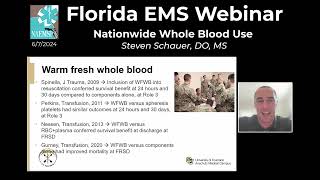
Webinar (6/7/24) in which Dr. Steven Schauer (Army Lt Col, critical care fellow) presents on national trends and practical issues in whole blood use for trauma. He reviews historical military experience with warm fresh whole blood and evidence from deployed settings (Spinella 2009; Perkins 2011; Nessen 2013; Gurney 2020) showing survival benefits versus component therapy, explains definitions (warm fresh whole blood, walking blood bank/emergency donor panel, cold-stored low-titer O whole blood), and summarizes civilian uptake using TQIP (Trauma Quality Improvement Program) data from 2021–2022 showing rising numbers of centers administering whole blood (overall, pediatric, pediatric-verified centers, women of childbearing age). He describes the San Antonio regional program (donor screening for low anti-A/B titers, rotation strategy with EMS/level 4 centers → return at 14 days → bigger centers to minimize waste), shelf-life/preservative differences (CPD 21-day vs CPDA 35-day), estimated startup and per-unit costs (San Antonio initial setup ~$41,000; year-one administration cost/unit $795; estimated cost per life saved ~$7,940 — tentative), and discusses reimbursement challenges (limited CMS/insurer pathways; hospital-based programs more likely to be reimbursed). He addresses implementation questions (pediatric use advocated, walking blood bank possible within ~5 years pending regulation, dried/freeze-dried plasma as nearer-term shelf-stable alternative).
Chapters
Welcome everybody. It is Friday, June 7, and it's another Florida EMS webinar. Very grateful everyone could join us. Today we have an amazing guest talking again about whole blood, which is becoming a recurrent theme because it is that important. I've gotten to know Dr. Shower only over the Internet on Twitter, but and because he his posts are quite incredible. He's very data driven as you'll see in a second. And I first learned about him through my good friend Dr. Mark Peel. So Mark, if you wouldn't mind, give us a couple words about Dr. Schauer and then we're going to give it to him to take it away. Can you hear me Peter? Yep.
Gotcha. Yep. Hey. So I've gotten to know Steve over the last couple of years. Been a Privilege. We actually CO PI'd a good sized Department of Defense trauma research grant together and gotten to know him through that. Steve is a EM physician, formerly at bank in San Antonio and now as a Critical Care fellow at University of Colorado, which you see on the screen here. And Steve publishes about one paper per.
Week on trauma research that he has.
Done mostly for military databases, but increasingly a lot of civilian stuff too. And so he's widely published and quite knowledgeable about this topic. You can follow him at armymed Doc, that's on Twitter and Instagram and he posts a lot of cool stuff on topics that we all care about. So I'll turn it over. Thanks Steve for being here. So thanks for that introduction. Small world. I didn't even know Mark was going to be here. He and I have collaborated on several projects and we have the mutual interest of figuring out how to get blood products into people that are hemorrhaging faster and doing this in a pre hospital setting where we don't have a nice beautiful Belmont sitting next to us. So I'm going to give kind of a brief talk here, just a nationwide whole blood use. See why my slides aren't advancing. So like I said, my name is Steve Schauer. I'm a lieutenant colonel, active duty in the Army. I'm currently a Critical Care Fellow at the University of Colorado. I'm the director of the Alert Research Lab, an associate professor in the Department of Military and Emergency Medicine at the Uniformed Services University.
So disclosures, disclaimers. These views are my views and my views only. I have received funding from the DoD for multiple projects unrelated to what I'm about to present to you guys here. Other than that, I have no other conflicts.
A little bit of background about me. I've had a Little bit of an atypical path here. So I finished Emergency Medicine residency a little over a decade ago at the Berkeley Medical Center. For two years after that I was the medical Director for the Department of Emergency Medicine at Bain Jones Army Community Hospital and also the Associate medical Director for the Fort Polk EMS Medical Service there. I came back to the isr, which is the Institute of Surgical Research in San Antonio, where I was a capability area Manager for a little over eight years. For those of you who don't know, the ISR is the Army's now the DHA's biggest research lab focused on combat casualty care, which basically means everything from the point of injury through their initial hospitalization. So everything from what happens down in the dirt and mud with the medics all the way through getting them through their initial hospitalization. I was also core faculty at the Department of Emergency Medicine at Berkeley Medical center, which is just adjacent to the isr. The lab and the hospital are actually physically connected, albeit separate units and separate chain of command. I'm also a clinical associate professor at University of Texas Health San Antonio, where I worked part time previously when I was in San Antonio, And I'll explain kind of how that comes up a little bit later on. And then I decided to go back and do training, retrain into critical care. So I'm currently a fellow in Anesthesia Critical Care Medicine at the University of Colorado. I think the military is probably about the only place you'll ever see people kind of go back and retrain mid career. But it's one of the unique things we do in the military.
So whole blood's been around for quite a while. We've had whole blood in World War I, we had it in World War II, we had the Korean War, we had the Vietnam War. Back then we had limited screening capabilities which led to a hepatitis risk. And that's when we started to see the blood products kind of disappear after the wars died down. Data from early on in the Iraq and Afghanistan conflicts really showed us that we needed to move back to a transfusion based resuscitation methodology. Previously we were using crystalloid. It was something we were taught in etls. Back when I was in medical school, they were still teaching using crystalloid to determine whether someone was a fluid responder or not. But we determined just a few years into the war that giving people a bunch of water that are hemorrhaging is probably not the best thing to do. We then figured out after that, using these things in some balanced method, a one to one to one transfusion Strategy pretended better outcomes. And one thing that's quite unique to the military is the use of warm, fresh, whole blood, which I'll cover here in a few minutes. We also found out that use of warm, fresh whole blood really was the superior product even to component therapy. The more warm, fresh whole blood we use, the better outcomes we were finding.
Shortly after that, the components started to become much more widely used. One of the limitations with components is they do have varying storage requirements and varying shelf lifes. Namely, the one that's the most challenging is platelets. Platelets have a very short half life, short shelf life life, typically only useful for about five to seven days, which for the military is particularly challenging because if we obtain platelets here in the US by the time they get down range to wherever we want to use them, you may only have two or three days left at most to use these before you have to toss them. So whole blood confers a lot of logistical benefits, you know, particularly for the military.
So what exactly is warm, fresh whole blood? So it's kind of what it sounds like. You're getting blood directly from the donor and then it's going directly from the donor into the patient. And when I say directly, I mean it's going into a donation bag and then you're walking, you know, the next room over there and hanging it up and giving it to your patient right away. So it's not a true direct transfusion, but it's warm, it's fresh, it's straight at the donor and hasn't undergone any kind of processing or refrigeration or anything like that. It's obtained through the formal term as the emergency donor panel. I think we probably more commonly know this as the walking blood bank. This may be low titer whole whole blood or it may be type specific. Early in the wars we were typically using just type specific warm, fresh, whole blood. However, we have moved into using low title whole blood for a pre screened population. Many of the units that are rotating downrange now pre screen a lot of their donors, especially the units that are involved in direct combat operations. They started with the ranger regiments and they determine people that have low titers and can basically serve as a donor pool. So they go out on a mission and they have a list of all the people in the unit that have low titers that they can pull from should they need additional blood products beyond what is just available that medics are carrying in terms of cold products. The other advantage too is that this can potentially be re infused back in the donor. But not used for up to 24 hours. So for particularly high risk missions, they may draw off units of blood when they anticipate needing them. And then if it turns out your casualty only needs, you know, one, two or three units, and that's what you have available for cold storage, the blood that you drew off the donor that's right there can be given back to that patient. So they're not necessarily losing all that valuable hemoglobin and not necessarily pulling them out of flight, the fight or, you know, potentially, you know, causing slight alterations in our physiology after the blood drawn. Andy Fisher and I made a training video here as part of a research project that was funded through the DoD to basically train 68 whiskeys, which are your combat medics, the second largest MOS in the military, train them how to do these procedures from beginning to end. This video is publicly available, so if you guys want to take a look. Andy Fisher is by far one of the military subject matter experts in leaders and developing this. So, you know, great video to take a look at if you guys want to learn how to do this and learn from a Pro.
So in 2009, there was a paper by Spinella where they looked at the inclusion of warm, fresh whole blood into a resuscitation strategy. They found that it conferred a survival benefit at 24 hours and 30 days when compared to components alone. This study was done at a Roll three facility, which is a deployed trauma facility that's going to have pretty much all the capabilities you're going to have at a trauma center here in the US for the most part, except for maybe like MRI or something like that. It's going to have all your specialists, it's going to have all your surgical capab capabilities, pretty much everything you have there. So a deployed trauma hospital for that study took place. Perkins published a paper in transfusion in 2011. They looked at warm, fresh whole blood versus those that received component therapy with apheresis platelets, finding that it had similar outcomes at 24 hours and 30 days. Again, this was performed at a Rule 3 or a deployed trauma center.
Nessen published a paper in transfusion in 2013, looked at warm, fresh whole blood versus RBC plus plasma at a roll 2 facility. A forward resuscitative surgical detachment. These used to be referred to as forward surgical teams. These are typically very small teams, probably less than a dozen people that consist of a general surgeon, a crna, some of your support staff, and occasionally an emergency medicine physician. The reason why they compared warm, fresh whole blood to RBCs plus plasma is because platelets simply are not available that far forward for the reasons I can outline previously, just because they're short shelf life is at least during the time that this study was conducted. This is pre deployed use of cold store platelets and they found that it conferred a survival benefit at the time of discharge.
More recently, Gurney looked at a paper.
In 2020 comparing warm fresh whole blood versus components alone, again finding improved mortality at the forward resuscitative surgical detachment setting.
So cold stored low titer whole blood is what we're going to see. There is some discussion of developing emergency donor panels. Several trauma centers are trying to figure out a way to implement that. I think that's a ways off. However, I do think there's a good chance that we will see that capability in our careers as they start to develop their methodology and determine better methods for screening. But for right now, cold stored low tight or oval blood is pretty much what you're going to be seeing in the city of the US setting. So people that go in and donate their screen for the anti aid anti B antibodies. The Military uses a less than 1 to 256 concentration for these antibodies as their threshold for determining who is considered low titer. However, there is no universally agreed upon definition. You'll see some definitions kind of all over the map, but I think most of them kind of center around the 1 to 256 is what we use in UF military. We published a paper which I'll get into here. It's kind of the thrust what I'm going to talk about. We found that at least 302 trauma centers as of 2021 had documented use of cold stored low titer old whole blood. Cold sore low titer whole blood is supported by substantial retrospective data and some limited prospective observational data. I do want to point out that the TOAR study and the MADC study are both randomized controlled trials that are underway that are using cold store low titer OHO blood. So I think these will give us a much more kind of definitive answer as to what the role is for low tyro whole blood in the civilian trauma setting. It's nice because it's got the idea of balance of the components in one single bag. So instead of separating everything out into different pieces, shipping in different pieces and then trying to reconstitute it as you're pouring it back in your patient, you now have one single bag to hang it. Makes it easier from a storage standpoint, makes it easier from a logistical standpoint. The one notable thing though is that the platelets do start to lose function after about 14 days in the storage. So we haven't found a way to necessarily combat that issue there. So that's one one of the limitations currently of the low tidal blood. It's used by one of many of the pre hospital systems. San Antonio, which is where I came from, is one of the early adopters and really one of the leaders in terms of using low titular whole blood pre hospital. I'll get into their system a little bit here.
So the question is who's actually using low titer oho blood? And it's hard to answer that question. So there was a paper published a couple years ago where they went to a bunch of pediatric trauma centers and they asked a whole bunch of them, you know, how many of you guys are using this and how many of you guys plan using this in the near future. So what is the current state of low title blood use in the US here? And that's kind of what we sought to answer here. We do have published reports which I'll get into from San Antonio, but that's kind of limited. So we don't really have a good sense as to how many places are actually using it. So the Trauma Quality Improvement Program, also known as the National Trauma Registry, it captures data from verified trauma centers that contribute data.
Which is the most recent data set. They have over 800 participants.
Metrics is that they capture blood products for the first four hours of hospital arrival back in 2000s when they started get distinct variable for whole blood. Previously whole blood was rolled up into the other components. We don't actually know previously 2021 how much whole blood was being used. So 20 is kind of the first time we were offered insight into this particular use of product. So 2022 is the most recent data set. It was released about two months ago. Our previous study only reported on the 20 to 21 data. And then there's a number of facility. Basically what happens is they provide you facility codes that are de identified so you know what patient went to what facility. You don't necessarily know what the name of the facility was, but we can tell you how many distinct facilities are contributing to this based on the facility codes.
So I'm going to show you guys some kind of trends of overall whole blood use. So on the left here in the blue, what you're going to see is the number of centers that had documented use of whole blood. So it's not necessarily the number of places that have whole blood in storage. These number of Places that have actually administered whole blood to a patient. You can see a couple of things here. Number one, the number of contributing trauma centers has slowly started to climb. So in 2021, we had 780 distinct facility codes. And then in 2022, at 816 distinct facility codes. And you'll see the number has slowly started to move up here. From 287, we had a little jump to 302 and back down to 298. Small little jump up and down. I'm not totally sure what to make of that small decline. I tend to think that some of that may be centers that are coming in and out of the registry and not necessarily dictated by people stopping use. However, I don't really have data to support that statement necessarily.
So the next question is how many of these are actually using in pediatric population? So initially, at least in San Antonio, ruled this out. We were using this primarily in a adult population. There's two major trauma centers that initially started using this in San Antonio, which is the Burkegory Medical center, which is a verified level one trauma center. However, we are not pediatric designated. The other trauma center across town was UT Health San Antonio. They are pediatric designated. They also have low tetral blood. So the question we looked at was how many places here that have seen a pediatric patient have administered blood to a pediatric patient? So, as you guys probably know, there's a lot of verified trauma centers that are not necessarily pediatric verified. They do, in fact, take pediatric patients just because they're the only trauma center in the area, or they may be the closest trauma center, you know, in the center extremis. So here we can see a slight increase going from 64 to 90 to 113. That had documented use across all centers, not just necessarily pediatric designated, that are administering this product to pediatric patients. In this particular analysis, we define pediatric patients as less than or equal to 15 years of age. A lot of times the patients that are 15 or greater or even 16 or greater will go to the adult center. So we wanted to exclude them.
Okay. Further nailing it down, we looked at patients, pediatric patients that were brought to pediatric verified centers. So there's a separate variable within the database that tells you whether the center they went to is pediatric verified. So as you can see, the number of centers that are pediatric verified and had pediatric patients coming to them slowly went up. However, we do see an increase here all the way up to 2022. We have 33 documented centers that are now using pediatric whole blood at a pediatric designated center to Pediatric patients. So we're seeing a climb in the amount this is being used across basically all the population and pediatric patients.
So another question that comes up too is that most of the blood here is low titer, O positive, oh, whole blood. So one of the challenges of administering this to a female of childbearing age is that we don't always know what their blood type is ahead of time. They may be Rh negative when they come in. However, most of the time when they're actively hemorrhaging, we don't have a method to screen for their blood type quickly before we start pouring product in. So we're kind of playing the odds here in administering this, knowing that the Rh factor negative patients are relatively low proportion of the population. But the question is, how often are we doing this in women of childbearing age? And as you can see, what we did is we looked at the denominator, which is the green bar. That's the number of centers that have seen a patient of female childbearing age, which we defined as 12 years old to 51 years old, slowly started to climb. At the same time, so did the use of low tetrahole blood. So 183 centers here administering this product to women of childbearing age.
So a little bit about how the San Antonio system works here because I think we kind of have a unique system in a lot of places that kind of mirrored or tried to mirror what we do here. We have a mixture of Level 1, Level 3 and Level 4 trauma centers all across the region. We have no level 2 trauma centers currently, at least in the region right now, along with some non designated centers. As you can see, it kind of spreads across the vast area. When you look down here in the lower right, you'll see our catchment area. So both of the level one trauma centers and all of the trauma centers in that region will accept patients across southwest Texas. So that's the area that we cover. So it's quite a substantial area in terms of square footage that we're receiving patients from across the region into our program where we have low tetrahol blood at these centers.
So the general gist of what happens is you go to the donation site. We have several donation sites in San Antonio that can obtain low to blood and perform the antibody screening. And once we determine the person is eligible to be a low, tight or whole blood donor, they donate blood and it is processed through the center and the first place it goes out to is the places that are far out and it goes out to the EMS. So the Air EMS, the Ground EMS and the Level 4 trauma centers receive the blood product first. So the product rotates out there in its freshest form. And then at about 14 days, when the products have hit 14 day shelf life, they rotate them back to the bigger centers. The reason why they do this is that the smaller centers don't tend to burn product as fast. And we want to minimize wastage as much as we can comparatively. When you get back to the big centers, when you get back to BAMSEA and UT Health San Antonio, these are big centers that are going to burn through products. We want to optimize the chances that product is going to get burned before 35 days. What we don't want to do is we don't have it reach day 36 and ends up in the trash. And now we've lost a unit of low tolerable blood which is not necessarily easy to come by. So it goes out to those sites, goes out to the ems. They have storage method to keep it within the air and ground ems. Once you hit 14 days it goes back to the donation site where then rotates back to one of the bigger centers. For the most part, that's going to be the big level one trauma centers and some of the level four trauma centers that are, that are busier and more likely to use it.
So the next question that we often get asked is, well, how much does it cost to actually do this? Because you're looking at, you know, creating a new program that requires, you know, some sort of methodology in order to obtain the blood. And then when they give the blood to the ems, this is unfortunately not something you can just stick on a shelf and let it sit there. There's very stringent storage requirements, quality assurance that has to be in place to ensure that we're adhering to all those storage requirements. We're doing all the proper documentation and that we're adhering to the dates that we need to in terms of rotation of the units of blood. So San Antonio did analysis here. Julia Matt published this a few years ago in pre hospital and disaster medicine. And they figured that the initial cost for setup for San Antonio Fire department was around $41,000. So we're talking a relatively large program across the city with over a million people cost about $41,000 for the initial setup. Then the cost of administration per unit in year one was 795. Now they have estimated that the unit cost has continued to decline as they figured out better methods to basically to use the units and rotate the units. And we've come up with better methods in order to obtain better donation pools and stuff like that. The cost has continued to go down. They attempted to estimate the average cost of a life save in year one, which they estimated around to be $7,940. That number, I would kind of take that with a grain of salt. We don't necessarily have good data as to what the number needed to treat is with whole blood. Like I said, I think some of these randomized control trials that are coming out will potentially answer that question. But based on best estimate and best available data, they're estimating that it costs around $8,000 per unit per life saved.
So that's all I have in terms of our nationwide whole blood use at this time. I'll be happy to open this up for some questions here, and hopefully we can kind of generate some discussion here and be interested to hear what you guys have to say.
Awesome. Stephen, let me just remove this real quick. Remove spotlight. Stephen, that was amazing. I love to see the data. Hold on.
I do have some problems myself. One second.
Oh, can you hear me?
Okay, I got you now. Yep.
Okay.
First of all, thank you for your service. You've done so much and the presentation that you made today. For a few items, I have a quick question for you with respect to the pediatric usage of whole blood. What I've recognized, not just here in the state of Florida, but across the country, is that people are getting through the door first with the adult, and then ultimately later on sometime, they're going to go and start doing it in kids. Now, I know that in military. Sorry, my dog's barking. I know that in the military, there's lots of pediatric data, et cetera. What is your message to all the EMS folks who are listening today about pediatric whole blood administration in the field?
You know, I think it's still lagging behind. One of the things I've kind of found frustrating about pediatric care is that it takes a while for some of the kind of, you know, adult practices to penetrate their way into the pediatric setting. And for me, I think this is one of the easiest things that we could potentially do from emergency medicine and EMS standpoint to bring the same level of care to them. I mean, it's really of no surprise. There's been multiple studies that have been published for the military setting. We have more and more data coming off in the civilian setting that, you know, at least when it comes to hemorrhage, kids are little adults, and they do need blood products back they don't need crystalloid. So I don't think at this point that's kind of any kind of mystery. So I, I think that's one of the potentially easier ways we can get this, you know, get pediatric pre hospital trauma care up to the same level we have for adults, at least for this particular indication. Did I answer your question?
Yeah. Yeah. And I believe Randy Schaefer may have sent me something yesterday stating that they're actually putting in some sort of regulation that if you starting a blood program you have to specify what you're going to do about the pediatric population. So I'm happy that people are looking at that. Captain Alex Lamb from Palm Beach Gardens Fire, who we just got started with whole blood about two months ago, he asked, what does your blood bank in San Antonio do during its processing of donor blood to extend the shelf life to 35 days?
I don't have a good answer from that question. It's always been 35 days. They use, I believe they use the same storage process as what the, the military does. I'm not sure. 35 days, as opposed to some of the places I do know, use a shorter shelf life. And I'm not sure that's a matter of the amount of citrate that's in there. I don't know. I don't know if Mark's on the call, he may be a good one to potentially answer that question as well.
Angela, Angela says it's based on. Angela, you want to unmute? Actually, let me, let me see if I can allow people to unmute their mics because I turned that ability off.
Go ahead. Go ahead, Angela. And we'll go to Mark.
Hi, I've just done a lot of.
Research on this and there are two.
Different types of medium that they used.
To preserve the whole blood. One of them has a shelf life of 15 days and the other one is around 28 to 30 days.
Red Cross.
I know that their blood is stored.
In the longer lasting preservative.
Okay.
And then. But the other question is, are there some folks who, when they receive the whole blood, other than splitting it up into components and then getting, and then getting more use out of those components.
Do you know if that's happening in San Antonio? Yeah, yeah, go ahead.
Hi everyone, it's Mark Yazer here from University of Pittsburgh. Humanized Toxicity. So there are two main.
Solutions which we collect whole blood. One is cpd, citrate phosphate dextrose. That means the unit of whole blood is wasted at the end of day 21. The one that Steve was using in San Antonio was cpda.
Preserves the red cell light for two extra weeks. So those whole blood units are good for 35 days. What we used to do in Pittsburgh was at the end of day 14, we would take our CPD 21 day whole blood and we would make a red cell out of it. And we could use that red cell because it was.
It was a way to recover some cost. But because the demand for whole blood is so intense now, we don't bother doing that. We keep our whole blood to day 21. And if you had the 35 day, we would keep it for 35 days. So yes, in theory it is possible to recover a red cell before the expiration of the whole blood. But I know a very few places that are doing that. And that's primarily because the blood centers don't want to take the whole blood back. They don't kill them.
They would want documentation of the fold chain and all that. And they just don't want to get involved in that. So the blood center is not going to manufacture or the red cell. And if you make a red cell out of whole blood, it can only be used locally. So there are attractions to doing that. Like I said, primarily if you're using whole blood and you have a pre acute demand, you don't want to minimize its availability. You want to use it right after, you know.
And I think all of these, all of these blood banks do something different. So it would behoove you to figure out what your blood bank does obviously before you launch your program. You will know this Brandon, once I meet you. Thanks, Mark. Brandon, want to go unmute yourself and ask actually a question?
Yeah, thanks Stephen. And I know John Kramer's on here too, so he may have an answer, but I was looking for any references or resources as far as reimbursem of the costs associated with providing pre hospital transfusions. I know that's probably one of the biggest obstacles to EMS actually implementing this right now. Even though we know it's standard of care. We're working on this at NEMSAC level with creating an advisory to encourage CMS to reimburse these costs. You know of anyone that's actually getting paid for this right now?
I don't.
I don't think San Antonio gets reimbursed for it, but please don't quote me on that.
Yeah, and, and guys, I think, and Steven, maybe you can comment on this, that the San Antonio model, it being a military city, if you will, it's quite different than Kind of the rest of us. Right. So what, what's happening out in San Antonio is, is different from the aspect of they have people there who love whole blood, who are pushing whole blood. The blood bankers love whole blood, are pushing whole blood. Whereas when you come out to places like South Florida or Arkansas, I'm sure it's, it's not the same vibe. Right. It's not the same feeling. So I wouldn't expect everyone to have the same feedback as what the San Antonio folks are having. And if anybody else wants to comment on that, please, please go ahead and do that. Any other, any other questions? Oh, Angela, CMS does reimburse hospitals for whole blood. And if John Kramer's on the line, I know John has been working very diligently. John, can you come on and talk to us about reimbursement with respect to what you're seeing at the national level with cms? If you can update us on that.
Yeah, I apologize for the background noise on the road, but yeah, the reimbursement is very, very sketchy. Hospitals do get reimbursed by CMS and if they're operating air medical programs or ground programs that come back to their facility, they can potentially be reimbursed by bundling it into the hospital charges. There are a couple of private insurers that are looking at the issue. The Prehospital Coalition is reaching out to some of the private insurers to get more valid information about their approach. We have initiated some conversations with CMS and they're very receptive. But as everybody knows, the CMS process is going to be a while. So the long and short of it is there are very few programs that are able to be reimbursed for their pre hospital transfusion programs.
Okay, great. And Brendan, can you comment on this loophole that you're talking about here?
Yeah, it's the hospital based air medical and ground agency. So because they are an extension of the hospital, if they administer in the pre hospital setting, the hospital bills and collects for that. So that's what we're trying to get CMS to expand to non hospital based EMS agencies. A lot of people working for the same goal here. We know it's the standard of care. We're just trying to make sure EMS.
Can get paid for it. Excellent. Stephen, I have one more question for you. You know, at Eagle this coming week, we're actually going to do a demonstration of the walking blood bank. You know, warm, fresh, whole blood. Do you, and I know that you alluded to it, but do you see a future or in how long do you think we'll see the first walking blood bank in a civilian population in the United States? Are we talking five years? Are we talking 10 years? Are we going to have synthetic product that's going to come in before that that's going to obviate the need for that? What are your thoughts on that?
I think five years is a reasonable time frame for that. As long as we can get through some of the regulatory hurdles. I mean, the mechanics of running an emergency donor panel is not particularly hard.
I mean, the military has been doing.
It for decades and so the mechanics of it are not necessarily that hard to do. I can tell you when you request blood from the walking blood bank, it always takes longer than what you think it's going to. So no one is as fast at obtaining blood as they think they are. As far as synthetic products, that stuff is a long ways off. We've been looking at things like HBO and stuff like that for decades. And the HBOX have, you know, are nowhere near being ready for clinical use. And there's all kinds of challenges associated with those. I mean, I think we're lucky to start seeing, you know, stuff like dried plasma, which is not a synthetic product, but we're start going to start seeing some products like dried plasma potentially on the market in the next maybe five years. And that'd be the closest thing, I think, to a synthetic ish type product though. Again, it's not synthetic, but it's something that is shelf stable. That would be much more EMS friendly than trying to carry around a big huge refrigerator in the back of your rig because you can just have these things sitting at shelf temperature, room temperature for a while. So I think dry plasma is probably the closest thing we're going to see in the next few years. And there's a couple of companies that are pretty close to getting either a freeze dry plasma or spray dry plasma across the finish line into the US market. And just have a side note that the military has been trying to get dried plasma for probably at least a decade, maybe 15 years now. And we're kind of slowly inching at that.
Yeah, I know, I know companies like Veloco are working on that. You know, aren't these products already in Europe, Steve?
They are. They're available in several countries actually. And we just published some data from South Africa where they use it. It's very cheap. There's, I think it costs somewhere between like 35 to 40 bucks, you know, per container of freeze dry plasma, which is you know, far less than what the whole blood costs. And again, you can stick this stuff on a shelf and it lasts for a year. So this stuff is available in Europe, it's available in other countries, There's a number of manufacturers. It's just getting through the regulatory hurdles and having somebody that can meet the requirements and get it across the finish line here in the US So the stuff is already out there. This is not novel stuff. And we've been using dry plasma dating back to World War II at least.
So, yeah, like I said, getting to the regulatory hurdles and getting it, getting it to market.
Last question. Before I want to give you the last word, but my question is someone came to me the other day and said this, this whole blood thing is definitely a big city thing, it's not a rural thing. Do you agree with that?
No. I mean, so the map that I showed you guys from the state of Texas has got rural areas. I mean, so while you look at the map and you're like, oh, well, you know, it just looks like it's not that big of an area when you start talking about the size of Texas, which is, is absolutely massive. And then even the catchment area that we have, which is absolutely massive, I mean, these places are pretty far out there. There's EMS units that are over an hour from San Antonio that are carrying this stuff. And we figured out a way to rotate the product around and make it, you know, usable. It's not easy to do. I mean, setting it up took several years, but it's feasible to do as long as you move the product around in a way that doesn't cause products to get wasted. So I definitely think this is something that can be pushed further out. And I would even argue that it's the places that are further out that need this more than the places that are in the city. I mean, if I get shot in San Antonio, I will be at a trauma center of some sorts, either that, you know, level one or level four within 10 minutes. You know, if you get shot somewhere north of San Antonio, that's an hour outside the city, you're lucky if you're at a place that has trauma capabilities, you know, within 30 minutes. So, I mean, it's the rural places, I think that need this even more than the ones necessary in the city.
Right. So if we have the rural folks who can carry fresh, can carry the cold stored whole blood, give it to the EMS unit, therefore obviating an easement to pay for it and then swap it out, if you have that little loop going, then you could potentially have full blood out there, hours away from a trauma center. So. Yeah, and then. Excellent. So I'm looking at the folks on the call here. There's a few people who have whole blood programs already started and then many who don't. What, what is your comment to those people who are on the fence who are still thinking, is it worth it? What, what's, what's your commentary? If you were advising them, what, what would this be? And I'll give you the last word.
I mean, I think the best thing to do is start to link up with guys that have done this before. I mean, certainly there, there's a number of point of contacts, Dave Wampler, a number of other people at San Antonio Fire Department who can talk to you about how they did it. You know, the number of hurdles they had to get through. This wasn't just something where they came up with this on a whim. And then, you know, a month later we had a whole blood program. It took a lot of effort to get through all of the bureaucratic hurdles and get everyone on board. So, you know, if you guys are thinking about doing this, please, early on, talk to the systems that have done this. You know, find out about their lessons learned and how to, you know, potentially sidestep some of the landmines they found along the way to make it easier for you to do.
Excellent. And if you folks on the call don't follow, see on social, I would highly recommend you do that. Everything he posts is evidence based. He will push the envelope on you, which is what I love to see on Twitter or on x dot com. Steve, thank you so much for making this happen so quickly. I know it was a last minute thing for you and you rocked it. So appreciate you all the work you do and thanks for your service. Appreciate it.
Thanks for having me.
More from Peter




Melissa Olen MSN, FPN-C, CCRN: Sudden Cardiac Arrest Training in Schools (Project ADAM) 4/25/25



Pediatric Hospital Readiness: How Teamwork & CPR Metrics Drive Better Outcomes



Chelsea Kadish, MD & Kyle Goodknight, EMT-P, RT: Pediatric CPAP in EMS (3/14/25)