Dr. Tom Aufderheide - 30:2 vs. Continuous Compressions (1/25/2022)
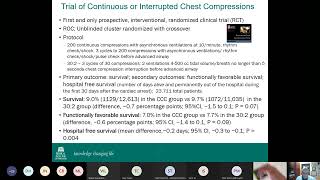
Dr. Tom Aufderheide reviews historical and recent evidence comparing continuous chest compressions (CCC) to the 30:2 (30 compressions / 2 ventilations) strategy for professional-rescuer CPR. He summarizes small before/after studies (rural Wisconsin—improved witnessed VF survival but likely confounded by earlier defibrillation; Arizona—overall survival rose from 1.8% to 5.4% after CCC implementation) and the large ROC randomized cluster-crossover trial (23,711 patients) in which overall survival did not improve with CCC (difference ≈0.7 percentage points; p=0.07) and hospital-free survival was significantly worse with CCC (p=0.004). A later, more rigorous per-protocol pooled analysis using an automated 6-minute ECG/impedance algorithm (≈26,810 patients) found that when CCC was actually delivered, survival was substantially lower (≈28% lower) than when 30:2 was delivered. Aufderheide interprets the totality of evidence as showing no benefit—and possible harm—from CCC for professional rescuers, and offers physiological explanations (atelectasis without ventilation, impaired pulmonary blood flow, CO2/acid–base considerations) to explain why 30:2 might be superior.
Questions this video answers
23,711 patients.
Absolute difference ≈ 0.7 percentage points (9.7% for 30:2 vs ~9.0% for CCC); p = 0.07.
Hospital-free survival (p = 0.004).
About 26,810 patients assessed for per-protocol CCC versus 30:2 classification.
Survival was about 28% lower with CCC when adherence/per-protocol analysis was used.
Chapters
There was no information to justify doing that, but he just did it in people anyway. He did not have consent. He did not. He just did it. He was able to get IRB approval for the ultimate publication though, and it was done in rural Wisconsin in all adults without a hospital. Cardiac arrest. Now, the continuous chest compression was 200 compressions, a rhythm check and a shock if they needed it. Another hundred compressions until the first pulse check. This was done in rural Wisconsin. So usually there's only one provider who showed up. When the second provider showed up, they did some asynchronous ventilation only and delayed a definitive airway until after three rounds of CPR.
Or the patient got rosc. If for whatever reason, this was a witnessed arrest and the downtime was more than 12 minutes, they prohibited any breathing at all until after three rounds of CPR. And Roscoe, it was a three year before period and a 12 month after period. For other reasons that are curious, Killam did not really report anything except witnessed VF arrest.
He included information on all the other patients in the study.
And published it. But you have to go and do your own calculations to figure it out. So for witnessed VF, there were 14 survivors in the three year before period, which was 15% survival. And for witnessed VF in the after there were 16 patients. Because of the lower denominators, it was 48% survival in the 12 month period after and that was statistically significant.
However, one of the major differences in the before after group were that 47% of patients in the before group.
Were shocked within seven minutes versus nearly 90% in the after group that were shocked. So the after group got shocked earlier and obviously these were all witnessed vf and if you shock earlier, you would have a reasonable likelihood of better survival.
No unwitnessed shockable patients survived and no non shockable patients survived.
There were really no survivors at all with continuous chest compressions except witness vf. And Kellam was straightforward and basically said it was not possible to determine if improved survival was due to continuous chest compressions or not particularly given earlier defibrillation.
So it had to be considered as preliminary. So following this, Bob Rowe basically did a similar trial with a.
Before after study design in the state of Arizona. Now, this was similar. 200 chest compressions, a rhythm check and a shock if they needed it, followed by another 200 compressions. The airway was delayed until three complete cycles or they had ROSC. Breathing was addressed as follows. They put an oral airway in. They put a bag valve mask over the mouth, but they did not ventilate. It was passive breathing only. There were a number of EMS providers who refused to do that. So they allowed some asynchronous ventilation if the agency wanted to do that. They didn't really report who got asynchronous ventilations and who didn't, but that was their approach.
Survival was remarkably low. In the before group it was 1.8% overall with continuous chest compressions. In the aftergroup, it was 5.4%. And this was statistically significant.
There are a number of limitations to this study. It was a before after design. There were lots of unmeasured confounders, for example, they didn't implement, they didn't capture hospital based care. Therapeutic hypothermia occurred during that time. Maybe that was a potential unmeasured confounder that could have been responsible for improved care. There's a potential Hawthorne effect. That is, training in cardiac arrest and calling EMS's attention to resuscitation may have motivated providers to provide better overall care and that might have accounted for it. There are a lot of limitations and basically the authors said these findings are interesting, but they require confirmation in a randomized trial. So that brings us to the ROC study. So the ROC study was the trial of continuous versus interrupted chest compressions during cpr. This is the first and only, as far as I know, interventional randomized clinical trial that addresses these confounders and eliminates those confounders, most of those confounders in a large randomized trial. It was an unblinded cluster, randomized with crossover study design. And in this study, continuous chest Compressions again were 200, followed by another 200 compressions with asynchronous ventilation. So all patients got asynchronous ventilation at a rate of 10aminute during continuous chest compressions. The other patients randomized got 30 to 2 with fairly just standard 30 to 2 with recommended ventilation, volume of 400 to 500 cc's per breath and not.
Stopping chest compressions longer than 5 seconds to provide those two breaths. The ROC study had a number of different outcomes. The primary outcome was survival.
Secondary were 2. One was functionally favorable survival with Mrs. Less than or equal to three and hospital free survival. Hospital free survival was defined as the number of days alive and permanently out of the hospital during the first 30 days after the cardiac arrest. So this was a big trial. It was 23,711 patients. And at the end of the day survival was worse with continuous chest compressions. It was 9% overall survival, which continuous in 9.7% with 30 to 2 now in cardiac arrest. A single percentage point difference in survival is considered very clinically significant because essentially if widely applied Nationally, it represents 5,000 patients a year who would go home to their families who otherwise would not. The difference here was 0.7 percentage points. The P value was not significant, but it was close. It was a p value of 0.07. Another way to interpret that P value is that there was a 93% chance that continuous chest compressions provided a worse outcome than 30 to 2. But we all agree to reach statistical significance that we need to have a 96% chance that this was due to continuous chest compressions. Functionally favorable survival was similar. It was 7 versus 7.7 did not reach statistical significance. Got kind of close with a p value of 0.09. Again, it was a 91% chance that continuous chest compressions produced worse favorable survival than 30 to 2, but again not statistically significant.
Hospital free survival, on the other hand, was this was significantly worse with continuous chest compressions with a p value of 0.004.
So I can tell you, as an author, and maybe there are some of you that were authors on this paper who are here today also, that there was considerable debate within the authorship group about how to manage these findings. First, the New England Journal really won't let you do anything except say you either make statistical significance or you don't. And if you don't, then you have to say there is no statistically significant difference between the two groups and that's in stone and they won't allow anything else. However, there is also an issue of clinical significance. Is it clinically significant? And that's where you get into subjectivity. One person can think it is clinically significant and another person may think it is less clinically significant. So the authorship group really fell into what I would call three different camps. The first camp was there's no statistically significant difference between the two. They're equal.
The other camp was that the in hospital, the hospital free survival.
Was statistically worse with continuous chest compressions. That the difference in survival and functionally favorable survival were clinically significant, especially for those major outcomes. And some expression of harm should be stated in the discussion. And then I think you could probably throw the other authors into Camp 3, which is we agree with both of those things, but we think we should be a little less pointed in our discussion, et cetera. So this debate occurred for months, went on and on. Another thing about the Rock trial was that adherence to the different two groups was not high and therefore what patients actually got.
Was an important issue to look at. So in fact, about half the patients who were supposed to get continuous chest compressions actually got continuous chest compressions, and about a quarter of those with 30 to 2 actually got 30 to 2. And when you adjusted survival for those patients who actually got it, and it's called the per protocol analysis, the difference was very significant. It was significantly worse for continuous chest compressions with a p value of 0.001. However, there was a lot of problems with this separate per protocol analysis. One was that many patients did not have enough electronic data to determine definitively whether they really got 32 or really got CCC. The amount of data collected in that secondary analysis was less, and so it was impossible to fully adjust for all these unmeasured confounders. And outcome was not known in 40 continuous chest compressions patients and 2330 to 2 patients. And that separate analysis was important, but was a major limitation because of those limitations in the data analysis. At the end of the day.
The.
Authorship group stated in a conclusion that continuous chest compressions performed by EMS providers did not result in significantly higher rates of survival or favorable neurologic outcome than did interrupted chest compressions. Which is kind of a funny way to put it, but it was the ultimate compromise given the controversy within the authorship. My personal opinion since I've been asked to give it, was that rock really missed. I was full disclosure here. I was in Camp 2 and I thought that there should be some more pointed statement of concern for harm given the collective information. But a more modest conclusion for that study was stated that it didn't produce higher rates than 30 to 2. So fast forward to this year, we took that limitation and said we could probably address this more thoroughly and more rigorously. This limitation of the per protocol analysis, Rob Schmicher, Graham Nicol and a number of investigators, myself included, did that. The study was designed to address this limitation and determine the adherence to 32 versus CCC and to get a more rigorous per protocol analysis outcome than the ROC study could provide. We identified at the end of the day a large group, 26,810 patients that were assessed for per protocol CCC versus 30 to 2 treatment. And to get those patients. We looked at patients in CCC ALPS and part study as well as our ROC CPR registry patients, and the importance of putting those in is that after ROC there was a lot of division. Some EMS systems wanted to do CCC, others wanted to do 30 to 2 as a standard of care. So it included patients that where CCC and 32 could be determined with a high degree of reliability, patients who were entered in studies and patients who simply received this as a standard of care in their own EMS systems. So the Rob Schmicker developed a electronic automated algorithm that could tell whether or not with six minutes of data, whether they reliably received CCC versus 30 to 2. The table here shows what those criteria were and the algorithm was developed first, then tested, then updated again and tested again and compared to with manual review and the CAPA statistic for that was 0.84, which is almost perfect agreement. This automated algorithm is really a good algorithm and actually represents an excellent new tool for investigators or for clinicians to use in their own QA projects with their own electronic data in their own EMS systems.
Overall, there were 26,000 patients who were intended to get CCC, 60% were CCC and about 40% should have gotten 30 to 2. The per protocol classification of those 26,000 patients showed that about 45% got CCC, 26% got 32, and about another 7,500 just simply couldn't be classified. There were some gamish of both okay and were unclassified. So adherence was about 60% with CCC, about 50% with 30 to 2. So the first thing you learn is that 30 to 2 is harder to provide reliably and consistently than CCC, which stands to reason at the end of the day for the intended strategy of continuous chest compressions.
When it's adhered to and provided.
It was significantly survival was significantly lower. It was 28% lower than with 30 to 2. And as for the intended strategy of 30 to 2, when it's adhered to, survival was higher. 30 to 2, however, had a lower adherence rate and it was more difficult to provide, possibly because it's a more difficult strategy to administer than just simply doing continuous chest compressions. So that's the collective data that's currently available and my interpretation of this is as follows. So the large ROC trial and the recent per protocol analysis addressing its major limitation.
I don't see any primary survival or secondary survival with good neurologic outcome or hospital discharge rates. Any benefit demonstrated for use of CCC CCC is either statistically significantly worse or non significantly worse. Further, the randomized trial and per protocol analysis in my opinion strongly suggest harm with the use of ccc and the preponderance of the available data in my interpretation do not support the use of CCC for professional rescuer resuscitation. So there you have it. I'd be happy to entertain different opinions, different interpretations and further discussion. So thank you, Peter, and thanks, Paul.
Wow, Tom, thank you so much. I felt like I was at a resuscitation rock concert right there. That was amazing. My question for you is the following. Can you propose a reason that the 30 to 2 platform, if you will, does perform better? Does it relate to the fact that those two ventilations, while compressions are not happening, enhance blood flow? I mean, is there a reason in your mind physiologically why 32 would work better than CCC?
Well, yeah, I could come up with a lot of different reasons, Peter. They're speculation, but physiologically they make sound sense. So first of all is that you get with continuous chest compressions, you get a ton of atelectasis in the lungs when you don't breathe. And that's been demonstrated by CT and MRI scans in pig models. And it doesn't take long. It takes about 20, 30 seconds. And there's just collapsed atelectatic lungs bilaterally.
That impedes blood flow through the lungs. A single breath or a couple of breaths restore the functional anatomy of the lungs and restore blood flow. So it's a significant dam to blood flow going from the right to the left heart and significantly compromises blood flow. Second, theoretical consideration that there's been is that with.
Asynchronous ventilations while chest compressions are being performed, could cause rupture of alveoli and significant pulmonary damage that's being performed because of the high pressures that are occurring during chest compressions. So those are two physiologic reasons why 32 may very well be better than continuous. Other physiologic reasons are just simple, simple thoughts of the process of cardiac arrest. So first of all, someone has a sudden event and collapses the metabolic. So they're not breathing. There is no blood flow. They have to be identified as having a catastrophic problem. Somebody has to call 911. That call has to go through the dispatch, get to the center, the EMS has to scramble, get in the truck, find the patient, get to the patient. By this time, there's a significant amount of acidosis, hypoxia, etc. That has accumulated with time. Now you have. They may or may not get bystander cpr. Now you have a professional rescuer that does not get rid of CO2 because they're not breathing for the patient. Blood's flowing, but they're not breathing. And you reach sooner or later, a Mystical point of a metabolic milieu where successful resuscitation and successful cerebral outcome becomes impossible.
Wow. Very well said. And that does make a lot of sense. And I wish we could continue this conversation for another hour, but I know we have to go to the main show, but Dr. Pepe, you want to make some final comments before we move over to your show?
Yeah. So a couple things, and Tom actually knows this, but make sure this is clear to everybody's mind that this he's talking about once the rescuers arrive. Because in the dispatch office we have done clinical trials that show that in those early few minutes, compressions only made sense. I put in the chat the original study I was working with Al Hofstram on back in the 90s, where we knew that you're probably more apt to be gasping if you're going to survive early on, and that by the time we get to compressions, blah, blah, blah, at the dispatch office. So that all kind of made sense and it ended up being a good thing. Then it got extrapolated later on because we did have a debate what happens after four or five minutes because adelectasis is developing. Blah, blah, blah. Plus, to emphasize what you said, Peter, and what Tom just said nicely, is that we do have to sort of re recruit a lot of those lung zones, not only for oxygenation purposes, but for blood flow purposes. So therefore it cannot be a small breath. It has to be a good lung inflation. That means it gets into the lung, by the way, et cetera. But what I'll do is I'll. And by the way, there's more to this story in the future in terms of how and when to give those breaths. And we'll talk more about that later on. And so in the meantime, I have to switch over to the other call. But Tom is usual brilliant. And hopefully you'll stay on, see a few things we do and then give a representation maybe in a shorter version. I don't think you have to give loud the background. Just tell us what's going on, what you found in your more recent analyses. Okay. So all right. With that, I'm signing off and I'll see you guys later. Okay, so take care.
Bye Bye.
Thanks.
Was you put it up 15172. Okay, see you later.
Bye bye.
That's correct.
Thank you, Tom. Thank you so much. It was amazing.
All right. I really appreciate, really appreciate it, Peter. Thanks so much.
Okay, bye. Thanks all you do. Okay, bye. Bye. We're gonna take it over. Angus will take us over to Paul's big show.
Thank you.
Recording.
More from Peter




Melissa Olen MSN, FPN-C, CCRN: Sudden Cardiac Arrest Training in Schools (Project ADAM) 4/25/25



Pediatric Hospital Readiness: How Teamwork & CPR Metrics Drive Better Outcomes



Chelsea Kadish, MD & Kyle Goodknight, EMT-P, RT: Pediatric CPAP in EMS (3/14/25)