Drs. Juan Duchesne & Mark Piehl: Prehospital Blood Data Update (5/31/24)
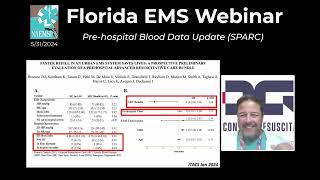
Webinar (May 31, 2024) on prehospital blood resuscitation led by Dr. Juan Duchesne and Dr. Mark Piehl. Speakers review the SPARK strategy, single- and multi-center observational data showing survival benefits from early prehospital blood/ARC bundles (blood + TXA + calcium) in predominantly penetrating trauma, discuss timing/infusion speed and airway-first vs circulation-first approaches (X-ABCDE), and describe the growing SPARK registry and training (Spark Academy).
Chapters
Okay, so welcome everybody. It is Friday, May 31st. It is 2024. We are here for another Florida EMS webinar. This is going to be a great one. We have two great speakers and we're going to be talking about a very hot topic backed by some powerful data. So we have. Dr. Juan Duchesne is a trauma surgeon out of Tulane Medical. He's a medical director for the TICU and he's very well published. And we're so proud to have him on the team as we move towards whole blood penetration throughout the United States. And then also joining him today will be Dr. Mark Peel, a very close friend, someone who has done quite a number of things, both on the clinical side and he's helped us with the lifeblood device, which he's the inventor of, that we use for whole blood and for fluids in the field. So gentlemen, without any further ado, take it away, Juan. I know you're going to start and then Mark's going to continue. Welcome.
Let me just give a disclaimer that though I have a relationship with 410 Medical and our devices used in these studies, there's no funding provided. These were all done out of Tulane and without any company funding. So just wanted to.
That's good.
That's a disclaimer. And one more title that you left out, Peter, for wand is he's now a medical director for New Orleans ems.
So yes. All right.
I love that.
I help them. That's how I call it. I just help them.
All right, so thank you everybody for your attention. We're going to be talking about moving the pendulum of resuscitation. And I can talk for four hours about this. But what I decided to do is to basically put together together what our journey has been and what is looking. Looking forward of what is going to basically progress to. So.
So how all this started because everybody, I think everybody now have seen spark and people ask why spark? What is spark? And it all started during the COVID time when basically a lot of trauma surgeons decided to figure out why we still have patients arriving to the emergency department with injuries that could easily be basically resuscitated effectively in the pre hospital setting. And then when the patient arrived to the hospital, those patients would fare better. So we put this paper together, was published in Shock, which is basically called selective pre hospital events Register of care SPARK strategy to prevent pre hospital death from non compressible torso hemorrhage. So basically what this paper is, which I definitely recommend anyone that is interested in pre hospital care to take a Look at it. If you need a reprint, just find me an email. I'll be more than happy to send it. And what it is is basically that it says that those individuals on the scene that are taking care of the patients are the ones that can make a difference in patient's outcome. So we need to empower them with procedures, technology and all the equipment necessary to effectively resuscitate the patient not with crystalloids, but with blood plasma, whatever you can give that the patient is bleeding. So. And other interventions to stop the hemorrhage. So from scoop and run we basically start talking more about scoop and control, which basically encompass control of hemorrhage resuscitation.
So Daniel Remick is basically the senior editor of the journal and he basically asked us, he was the one that gave us the thumbs up. We liked your paper, we're going to publish it. And then he stayed in touch with me about how much this paper is being cited. So it's a hot topic out there and I think that people are finally getting a grasp of it. So I surrounded myself with an amazing group of people that are so much smarter than me, that are basically in this meeting today and we put something together. We call this the Spark Academy, which basically is education about resuscitation and advanced procedures on the field, on how we can provide this education to the pre hospital people.
So what take us there. I'm going to talk quickly about our experience and our studies. The first study that came out from our institution was the faster refill in an urban setting where basically we were. This is the first study that actually look at a fast pace urban setting. What is the impact of giving blood? And first of all, is it feasible? And what was interesting is that when we compare the patients that receive what we define as the ARC bundle, advanced resistative care bundle, which consisted of 2 grams of calcium, 2 of PAC red blood cells and 2 of TXA. When we compared those to a historical control, it was interesting to notice that actually the shock index was effectively lower than the patients that received crystalloids. The injury severity score was basically the same. And we're talking about specifically penetrating trauma. These people are dying en route. The 24 hour mortality from 19% dropped down to 16% and the overall in hospital mortality from 23% to 10%. So this was the first study that was like a slap in the face, especially to me, to us, because we were in shock, that wait, everybody was saying that this is a waste of time. So maybe it was a waste of time because the Patients that were receiving the blood products, we're not getting that in a very fast pace. And I think that basically thanks to technology with Mark rapid handheld infuser and having the, basically the blood, the transmic acid, the calcium, it created a huge impact. And what is interesting is that, and I will talk about this later, we are not the only people doing this. There's other institutions that are actually seeing the same mortality and that's what's really interesting. So more to come on the multitudinal approach. But in summary for this specific study that was published in JTAX in January, the arc bundle convey a survival benefit. And what was interesting is that that dogma of heating on the gas diesel is all you need. No difference. No difference. Now we're going to talk about timing in the very last study that we did. But just put that in your, in your, in your brain pre hospital time pressing on the gas fast, fast, fast was not protective or increased survival.
Hey Juan, can I, can I come in a point just you. You may not highlight this yet but notes the endotracheal intubation stats which is totally fascinating. You found your teams found that they basically had to intubate no one in the blood phase. They resuscitated them, the patients woke up, they didn't need pre hospital airway management which I think is obviously the mortality is the key thing. But this is a totally fascinating finding.
Yeah and, and that's, let me tell you a quick, quick.
Tease. The packed study from Light network have seen a decrease in intubation in the pre hospital setting and I don't know they're gonna be mad at us but something is happening right now with pre hospital intubation is going down dramatically. So that's, that's another food for thoughts but great point.
So that take us to the next second study that we put together the ABCDE where basically everybody knows that that's what ATLAS has been pushing over the years. Now we're not going to get into the details of how that work out but basically there was no good level one scientific evidence to just say that for trauma hemorrhage ABCDE is the way to go. So basically last year we were invited in the spring cot to discuss the algorithm. And what was interesting is that in that same meeting.
The director of the committee of ATLs expressed new algorithm or the new mnemonic X A, B C D E F where X stands for hemorrhage control circulation. So they didn't want to call it cab. That's their problem. They put a stupid X in the front and. But it works for us, it still works for us, right? So we play with whatever mnemonics you want to put on. And for anyone that is interested, right on the bottom, that is the link. Take a picture. That is a link for the whole presentation. It's a very good presentation from the ATLS chair. So we decided to look specifically and be the first ones to spearhead this and our program after four years in evolution, we finally started in 2021 10, 2021. And basically with this ARC mode of resuscitation, the goal was to prioritize circulation. And basically this is a quick video.
So this is just the amazing neonic Ms. Team, medics and paramedics basically giving blood, calcium and txa. So we decided to look at that experience where basically circulation was actually prioritized prior to incubating the obtained patient after penetrating trauma, hemorrhagic shock, penetrating trauma. And the algorithm was very simple. Basically for prehospital ARC bundle it was triggered by low systolic in the 70s or systolic less than 90 with a heart rate greater than 110. And once that was checked, basically the spring truck which carries the blood will basically have ready the blood. Two units of blood, two of TXA and two of calcium. And that most of the times, I would say 90% of the times has been given prior to patients arrival to the hospital. So this is the heat map of neonic Ms. Pickups for transfusion. And as you can see the X is where our trauma center is. And then the rest of the heat map you can see.
Where we have the other patients we have up to date. And I bet that number have increased because this presentation was done couple of weeks ago. And I believe I Review at least 5 to 7 new blood giving pre hospitals. So I bet you that the team is very close to 260 right now.
And then from there we basically decided to do the study. And the study was to compare what happened when circulation was achieved first versus the typical airway, breathing and circulation. So we look at 62 patients in the ARC bundle circulation first or X ABC versus the abc. And what was interesting is that the in hospital mortality, all right, was 13% for the patients that circulation was achieved first prior to intubation versus in the typical routine ABC where intubation was performed first, the mortality was 47%. You can see that that is problematic. That is huge.
It's.
And when I first looked at these numbers I was like there's no way on earth this is happening and it was very disturbing because what if you think about this, what is happening is that this group of patients, if you think about this, they were basically creating our own problem, meaning increasing the mortality by basically decreasing the preload with intubation and then basically with paralytics as well as with compliance. So a lot of things can be done better and I think that this study is sending that signal that X ABC is here to stay.
So in conclusion, in pre hospital with basically hypertensive patient after penetrating injury, this type of care where circulation is first prior to intubation, it definitely improved patients outcomes.
And last I have here is the last paper that we put together entitled Every minute matters Improving outcomes for penetrating trauma through pre hospital Advanced Resuscitative care. Now this was a very interesting study and everybody the reason why we did this study is because we keep hearing and hearing and hearing it doesn't matter, bring the patient to us, we'll give the blood here. So we say okay, if that's the case, I believe we have data to say that that kind of thinking is wrong. So what we decided to look to do was to compare for patients that received pre hospital blood versus the controls, the ones that received blood once they arrive to the hospital. We compare the outcomes and mortality. And what was very interesting and what we identified in this study is that prehospital blood started eight minutes after patient contact when compared to that received blood in the hospital arena 26 minutes later. And that's huge. Just think about the physiology, right? I mean we're talking about close to a lot of like 20, 19 minutes, 20 minutes for these patients to receive the first unit of blood when you're in full blown examination. And what we basically identified in a quick summary is that there basically there was a compared to patient who first received blood after hospital arrival with blood press, when blood press was started 19 minutes earlier after initiation of pre hospital blood program. And there was definitely a survival, a survival for early pre hospital blood use was demonstrated with 11% mortality increase for each minute delay. And that's huge. Okay, so I think we're putting the puzzle together and it's making more sense and more sense and there's so much more to come. So I just wanted to put now what has been presented, what has been published. That being said, we did our first Spark Academy in March 12, 2024 and it was simply amazing. We had more than 100 plus people first responders in that meeting. And this is a quick video of how what sparks looks like, hey, start.
Blood I'm going to keep working this massive hemorrhage.
So an amazing group of.
First responders and team members have basically joined the cause and it's been a blessing to work hand in hand with them. And we are ready for our second Spark Academy coming up in June 11, 2024. So at this point, I'm going to stop just for more questions, but before I do that, I wanted to bring to the attention that our Spark registry is increasing. We have 497 patients in the data right now. And.
The data that we're getting out is sending some heavy signals. I'm not going to tell you what for what, but it's some heavy signals. And let me tell you, this data has, from crystalloids only to pac red blood cells to whole blood to plasma, cold, warm, you name it. This is going to be a beast. And the way it's molding out is going to be simply amazing when we start putting this data outside. So thank you so much. I'll be now open for question. And Mark, feel free to.
More to the presentation.
No, it was awesome. One, let's just take questions.
Yeah, so, so Mark, I know you have slides. Right.
But no, I, I think Juan's covered it all. Let's just, let's just let people ask questions.
Okay, so, so let, let's, let's ask this question first then. So the, the Tulane registry is now going to be the Spark registry. I love that. And we have people on this call, David Long, I see his face, who is giving a lot of blood. Are we getting everybody in that we can to the registry? Because I think that's going to be the key point here.
Yeah. I can tell you.
It'S been interesting to see the evolution from just two lane to now up to nine centers. I think over time we're going to get more and more people. I think the right limiting factor is who's going to put the data in. And like for example, we had an explosion coming from the Rockies and an explosion coming from Florida. So, you know, once we identify who's going to be that designated person, I think I'm going to keep populating the data. Okay.
All right, excellent. Let's, let's bring in questions. We have a lot of people on the call today. I see Candace is coming in now. You know, what do you say to the naysayers? Right, so, and I'm just, you know, I think we have to mention this because there's the refill trial that was published out of the UK that showed pre hospital blood doesn't work. We have our friends and colleagues in San Antonio who are showing something different with respect to penetrating trauma than you're showing in New Orleans. And then we're showing here in South Florida. And I see, I see Matt Levy on the line. I'd love to hear from him too. But what do you, what do you say to the people who still are not believers yet based on what you just presented and what's been published in the past?
Yeah, I think that is crucial to, to understand that what may work for us, it may not work somewhere else. Right. I think that the population that we are taking care of penetrating at a very fast paced environment that might be very different from many other centers. Our transport time we're talking about is 11 to 12 minutes on average. And that I think will be hard to replicate in many other trauma centers. I believe that. I don't know if we have people from Grady, but I believe their experience has been very similar to ours with the fast transport time. So I think that everything needs to be basically molded to what you have. If your transport time is going to be longer, you may need to think different. Different. You may need to think about other modalities of resuscitation. Not only just blood, but maybe whole blood. Start adding some pcc. So much more to come. And I believe that we don't have the answer to all those modalities out there.
And, and, and I know Mark, you know, he's hesitant to talk about this, but I will because I can. But I do believe that the rapid infusion, because the folks in, in San Antonio are not doing that.
What are your thoughts about the rapid infusion versus the non rapid infusion of blood? Because I think that's an important factor.
No, thank you for bringing that to my attention. I think that that was my priority when we started the program. You know, I was, I don't want to say disappointed at the combat trial because it was kind of like expected their outcomes based on no way to infuse this in a timely manner. So having the product in the unit is not going to save lives. End of story is how fast you get that inside the intravasculature of the patient. And you need to figure out that, I mean, I've been blessed that through social interaction I met Mark and we put the puzzle together and, and it's working perfect. So I think that that's something that people need to take into consideration. Neonic Ms. Has been able to put 500ccs of blood within a very short 10 minute transport. Time. So this makes a big difference.
Peter, I would. The other thing is to contrast the refill trial and if you'll note, Juan's first study was titled Faster Refill. Kind of a play on the UK refill trial where they took 90 minutes of pre hospital time to give their couple units of blood, 9, 0 minutes and didn't show a difference between saline and blood. Whereas in Juan's team, in New Orleans team, actually, I think Juan, in that first study, the average transport was eight minutes. So eight on the scene, eight in transport. And maybe you're showing that tightening up since then. But a lot of interventions, effective shock resuscitation interventions provided in a short window. And I think that's probably the key to the survival benefit and the reduction in pre hospital airway management that they're seeing.
Yeah, the refill study is definitely different. Definitely different and different way of resuscitation.
So we have other questions coming in. Let me, let me start with Dr. Mohammed Dyer. Any data on blunt trauma patients?
Right now that answer is going to come from the multitudinal study because most of our patients, 90% of them, are penetrating, if not higher. So but from the MIT that we have the data collection in Spark, we have quite a bit of blunt. So I think it's going to be interesting to see the impact of tbi, mild, moderate, severe, and how that impacts overall outcomes in the long term. So more to come.
Let me bring in Chief Coyle.
I was going to say Mo has to understand that there's, the traffic is so bad in New Orleans that it's like a parking lot. It's hard to get killed there.
And Chief Coyle, can you, can you pop in real quick and talk about our blunt trauma outcomes? I know that you just sent me our spreadsheet today. I can pull it up if you need me to. But you want to talk about our mechanism of injury data?
Sure.
And as always, what an honor to be on here. And Dr. Chesney and Dr. Peel, amazing work as always. It's an honor to work with both of you on the Spark Academy. But it was crazy. I looked at our, our data last night because I just got the dashboard up and we had 49 blunt cases that are related to motor vehicle collisions. We had a couple in the fall category. And essentially what we're showing, survivability. You know, basically we determine the outcomes if the patient walks out of the hospital. So we look at shock index before and then we look at shock index after the administration and then we look out. Does the patient make it out of the hospital? We were showing. I believe. I can't see the number because I'm on my cell phone, but I believe it's like 80% survivability, and we're showing 88 in the penetrating world. So I was shocked by MVCs to have, you know, almost 50 cases and show 80% survivability. I don't. I don't know what that mirrors across the country and what other people are seeing, but to me, that was a pretty significant number.
That's awesome. Hey, Chief Coil, do you have. Did you have a comparison, like, even historically speaking?
No, I don't, but we have enough cases that don't that didn't get blood. Like, you know, if we retrospectively look back where we could probably easily make that comparison. So I just. I would have never thought. I would have saw 80 survivability with a blunt force trauma secondary to an MVC.
Yeah, but with the. With the proviso that they had shock indices that were low. I mean, or high indices. Right, Correct. Yeah, correct.
So I want to bring in a couple of people. Chief Cardona asked a question. I'm going to table that only because that's what we talk about heavily at the. At the Spark Academy coming up in June. And it's probably a longer answer, but I want to bring in two people. So David, long out of Tidewater EMS in Virginia, has done incredible work, has put blood across a huge portion of that region. So, David, please make some comments, and I'm going to go to Matt Levy from Hopkins after that.
Sure, Doc. I'm happy to. And I think, like Chief Coyle said, you know, certainly an honor and a pleasure to be here, and I appreciate all the. The trailblazing that you all have done, and we've certainly learned from, you know, and just essentially replicated and attempted to look at what was unique in our region and figure out different ways to attempt to move. To move the needle for us. We've followed the New Orleans model that Dr. Duchesney, you know, talked about for us. Our advances, resuscitative care bundles just a little bit different. We do 2 grams of TXA, one unit of whole blood, and then we do a gram of calcium gluconate. And then with it, we have submitted an IRB. We have the review on June 6, and with that, we're looking retrospectively at three years worth of data in regards to what calcium levels are, you know, in our trauma patients or those suffering hemorrhagic shock to be. To be Fair, because we're also looking at our medical cases. But what we've already seen, just starting to pull the data. Anticipation that the IRB will be approved and things of that nature is. Richie. And shocking. I mean, ionized calcium levels at about 0.87 to 1, which we know is significantly hypocalcemic. And what we're interested in. And we will be submitting a follow on prospective study to be looking at the same data elements, except now looking forward with us administering calcium to determine what does. What does 1 gram of calcium gluconate do to raising calcium levels, you know, and then we can essentially, I guess, finesse our way into what we believe is the most appropriate dosing, you know, of calcium gluconate. So we were a little bit more conservative than the cows than using calcium chloride likes being done down in New Orleans. But we've had. We've. We've seen some significant impacts and results, you know, doing this. So Dr. Peel was gracious and. And provided me, you know, with a lot of information that he used for the Spark Academy that we essentially created our version of it here. We've administered across our four jurisdictions that are involved in the blood program, and we've seen a significant reduction in the number of innovations occurring, which is also impacting our survivability to discharge. And I think the surprising thing for our folks has been in two instances, we've significantly impacted patients transfusing blood, and only to have a helicopter EMS crew and a emergency department essentially move immediately to RSI and trying to innovate patients that weren't. And both patients immediately went into cardiac arrest. So from an EMS provider perspective, their eyes are completely open to that hemodynamic stability and. And holding off on, you know, which has sparked conversations in our region about what the future may look like in regards to bypassing the emergency department and going straight to the or. So those are some interesting conversations that are. That are taking place, but we are working desperately to get into the registry. We're having a problem with one of our healthcare systems, so we're trying to connect them to Madonna and hopefully that that will resolve some angst with doing that, but. But otherwise appreciate everything that you guys continue to do, and we look at everything that you guys publish and. Or communicate. So thank you very much, David.
I know Juan's gotta jump. Juan, you want to say some final words before you go? I know you gotta jump to a meeting.
Oh, yeah. I just want to say, David, you have the. The. The best people next to you. Madonna Cheese. Amazing. She's gonna think problems for you. But I want to say quickly, David, I urge you to look at Herman Dukes Trauma center in Houston. They do have already an established protocol validated on how to activate from the scene. Take a look. Take a look at that protocol because that may actually empower more of your system. All right, team, thank you so much. Have a great weekend. Looking forward to see most of you at Spark. Awesome.
Thanks, Juan. Let's go to Mark and then to Matt.
Go ahead.
Just quickly, David, I wonder if you address those. Those survivors from. From traumatic arrest, which is amazing. And two, the ical numbers you mentioned were those before giving calcium. That's just someone who came in. In hemorrhagic shock. And you checked the calcium. Just confirm that.
Yeah.
So those were numbers without calcium. So. So that that's coming in.
And one of the things that we've identified and why we've, you know, in our data collection tool, we recognize that we may have a patient that comes in, trauma wise, that doesn't receive whole blood, that we want to get that information on a patient that does receive whole blood that may not receive any calcium supplementation. So we know that there's potential for three distinct groups of folks. And now we have to look at that. Those numbers and parameters.
Yeah, that's great. And we're looking forward to that data. Thank you so much for getting that done. And then last but not least, Matt Levy from Hopkins. You guys are up and running. Give us some of your insight and your wisdom.
Hey, everybody.
Good morning.
I'll be very brief because I know the other calls are starting soon. Sorry for joining late. Actually, one of my senior residents was presenting about blood. So a couple quick things. I would echo the comment. I think the devil's in the details here, and I think it does the time, the timepiece is really a big thing. Increasingly, I've been. When we speak about blood and teach about blood, yeah, we talked about a bag of red stuff, but really talking about a bag of time. Right. And we're buying time back. This is just a temporizing measure to get definitive hemorrhage control, source control, while we effectuate a comprehensive resuscitation, be that in the. Or in the ed, wherever it needs to be in the field. And to that end, I think that the time does matter, the details matter. So I would echo those comments strongly, at least observationally. That's our experience. We have made the commitment that once we prehospile, say, go for blood, that we want it in within five minutes. Right. And so how that happens, it depends upon the circumstances. But, but we all recognize that the priority there. The only other piece, Peter, I would add, and I would say, is we're dealing with an intrinsically sick population. And yes, obviously we all care about the definitive outcome of walking out of the hospital alive, but they have to get to the hospital alive to walk out of the hospital alive and they have to make it to the, to the OR suite or the NGO suite and every place in between. So while I am the biggest patient centered advocate for outcomes based research, I would also say that we have to not ignore the interval fractile metrics as well. They're super important here. Along the way, I'll turn it back to you over. Great to see everybody.
Perfect. And that's why we all have to work together and pull our data, pull our knowledge. A lot of the stuff we're doing, we're just learning from other people. So if you're out here in the audience today and you're thinking about it, you haven't done it yet, you started and you need help. We're all part of this one big group. We have a Dropbox folder that I can share with everybody that's got tons and tons of protocol data, whatever you need. But let's work together and make this happen. And if you can get your data into the Spark registry, that's just going to help the next person get going. So, Mark, let me give you the last word. Take us out. And again, thanks for all that you do, your innovation, your clinical work, your speaking, everything you're doing. Thank you so much. Take us out. Give us the last word.
Well, thank you for highlighting this topic. And I just push the credit back to Juan and New Orleans team, who have really been the first folks to innovate in the way they have and publish the first data to show that blood in ground ems in urban environments reduces mortality. That's never been shown. I think it's dramatic. Finding minutes do matter and they're proving it. So I can't wait to see the outcomes of this larger multicenter trial that should be coming soon. So thanks, Peter, for having me.
Thanks, Mark. And you have published a lot. We put some things in publication. Matt just put his publication in the chat. So if you're going to do this stuff, folks, you got to publish it. There's no reason not to connect with us if you need help with that or just send your data to Juan and he'll publish it. So with that being said, thank you guys. Have a great Friday. Enjoy the weekend. And there's a link here in the chat to get to Dr. Pepe's webinar. I'll put it in there again and we'll see you guys on the other side. Thank you so much, everybody. You got it. Thanks, Mark. Bye.
More from Peter




Melissa Olen MSN, FPN-C, CCRN: Sudden Cardiac Arrest Training in Schools (Project ADAM) 4/25/25



Pediatric Hospital Readiness: How Teamwork & CPR Metrics Drive Better Outcomes



Chelsea Kadish, MD & Kyle Goodknight, EMT-P, RT: Pediatric CPAP in EMS (3/14/25)