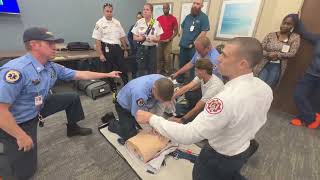
Davie Fire Rescue runs a high-performance CPR training session focused on uninterrupted chest compressions. The instructor assigns team roles, limits gear to a monitor and med box, then leads a one-minute compression drill with planned critique and hands-on practice.
Chapters
I'll kind of talk through everything.
And then after that we're going to transition over to room 16, I believe, still, and actually bring the patient there. You guys will start to provide care, and then we'll call them that one after you do, like maybe a first line treatment. All right, and then we'll wrap it up, we'll tell you it's done, and we're going to bring everybody back in here to actually practice the compressions and ventilations so we can make sure at the end of the day, you kind of heard it, you've seen the data, you've gotten the hands on, and then from there we'll be back as often as we need. Rescue ready. So we have a rescue crew here and an engine crew. We're going to have the rescue crew be the first on scene. We'll look to the chief marrow to make sure they're good to go.
Engine will be just behind you.
So we micromanaged a lot of the actual way they're responding. Right. We talked about compressions, we talked about ventilations, we talked about gear placement. We take it a step further. We tell our rest of the crew, when you get there, we don't want you to bring the stretcher. All we want you to bring in is the three key pieces of gear we need. So they're going to bring the monitor, their aerobag and their med box. That's it. They're going to come in, they're going to make patient contact, they're going to have an app running to make sure our metronome is keeping them on a good sequence of our compression rates, and they're going to make sure they're ready to go for that first defibrillation as quick as they can. So rescue's arrival. Right now we have a cardiac arrest case in the parking lot of hca.
So we do have a student with us today, too. So I'll give them a little critique as we go through everything. So on our right side of our patient, we're always going to have compressions. We're going to have the airway bag at the top of the patient over here. That way we're able to get into our bag for easy IO as well as our airway equipment. Our med box is going to be over here so that when that next crew arrives, they're ready to go with their medications. The priority right now is uninterrupted, high quality compressions. After that's completed, the second priority is going to be getting our monitor connected, getting our pads connected. To our patient. So if they're in a shockable rhythm, we're able to shock the patient. All right, so two minutes going. We have airway started with the bag here.
If you went back about four years ago, you would have heard that second crew get there. Where are you at? What do you need? What's your next priority? What's possibly your medication? What has to happen again immediately. They're going to come in. They already know the vacancies. I need somebody on medications. I need somebody to get the advanced airway ready, and I need an ECIO established so they're immediately going to start to do that treatment. You want to have to be ready. So Captain Mitcher is using an app to control our compression rate. You're hearing the clicking. You'll also hear it announced to ventilate the patient. And At a minute 45, it'll tell us to free charge the monitor. At two minutes, it'll tell us to shock the patient. The alarm you're hearing on the monitor right now is just detecting DFib, which typically we shut off because we don't want to hear the noise. So if you can just go and hit the silence button there, I'll take. Just so you hear it.
All right, so we very intentionally put you with people that you're not used to working with or who you wouldn't have kicked to work with. That way we can show you how we can all work together and still get perfect amount of care. So, that being said, we're going to start with compression, so we're going to get the other man. Here's a bright drop off. Do compressions. All right. So quick. Because of compressions. Patient. Yeah, patient's right size. When you're doing compressions, you're going to do compressions how you would normally do them. I'm not going to give you any coaching. We'll give you no feedback. We're not going to use a metronome. We're not going to show you the synthesis. We just want you to do one minute of live compressions like you would if you worked your code yesterday. Okay, so whoever's ready to begin, once we have the syntax connected, we'll have you just go ahead and start. Give me one minute compression.
Just do one big compression. This will be the only time that we give you no feedback. And then the next minute, I promise, we'll give you feedback. We're going to give you critique at the end of your minute, and we're only going to show it to you so nobody else on your team will see that. They'll give you feedback on how you deal for your compression rate, your recoil.
So this is just basically do it in your head.
Just work the code like you normally would.
This will be the quietest time and I promise we'll give you feedback the rest of the time.
Members looking at rate and depth.
You.
Almost 15 minutes.
You just started watching what you saw. You were doing.
Okay you can stop or you have the nurse with the biggest guns in there working the chest compressions the whole time. We got to rotate every two minutes. Doesn't matter how big you're a how small you are every two minutes you have to make sure that you're rotating that compressor out. I had everybody just now do one minute. Is anybody tired after the one minute? Yeah, some people were. That's normal. So at two minutes you are done. Rotate out, let a new person come and do compressions. I.