EMS Lighthouse Podcast Discusses Handtevy App Research Study
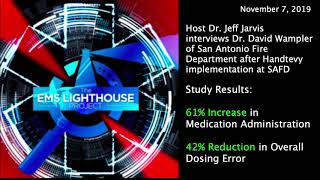
Dr. Dave Wampler studied how the Handtevy app, which calculates pediatric drug doses by age, changed dosing accuracy in San Antonio Fire Department paramedics. After six months of use, medication errors over 10% dropped, and paramedics stopped systematically underdosing fentanyl and overdosing midazolam.
Questions this video answers
Patients under 13 years of age.
Fentanyl (for pain) and midazolam/versed (for seizures).
A dose differing by greater than ±10% from the correct dose.
Interrupted time series with a six-month wash-in period; retrospective analysis after implementation.
Using age-based ideal weight methodology (the same mapping used by the Handtevy app) to calculate per-kg doses.
Chapters
What is a lighthouse? It is a tower with a bright light at the top.
Located at an important or dangerous place. The main purpose of a lighthouse is to serve as a navigational aid and to warn of dangerous areas.
Welcome to the EMS Lighthouse Project podcast.
Illuminating the darkness of current EMS clinical practice with the bright light of science. Here are your hosts, Dr. Jeff Jarvis and Mike Verkest.
Howdy, y'.
All.
Well, this is Jeff and we are at EMS World Expo and I am sitting here with Dr. Dave Wampler. He is from the University of Texas Health Science center in San Antonio, and he is presenting three different research projects and I want to have a conversation with him about what he is looking at, what clinical question he is trying to answer, and what he found. So, Dr. Wampler, welcome.
Thank you for having me.
Did I get all the titles right?
Absolutely.
Same place?
Yes.
I like it. So why don't we jump into another project that you've been working on, and this is decreasing medical errors. And I believe what you're looking at is the impact that adoption of the hand heavy application had. So can you tell us about that project?
So the idea behind this project came from the fact that we historically San Antonio Fire Department Office of Medical Director and the Health Science center have always used and taught and subscribed to the Broslow tape. Okay, well, the problem, the limitation of the brasotape is it just doesn't have all of the critical interventions that we are interested in. We were looking for something a little bit more comprehensive, and so we started using another phone app that.
We thought would be really helpful because essentially what it does is you select your patient age and that roughly corresponds to a patient weight. And then it takes all the math out of having to do drug calculations. The app knows what the concentration of our medicine is and it tells you by weight, exactly what volume to give. So it tells you give 0.3 milliliters of this medicine rather than having to go and estimate the patient's weight and figure out what the mgs per milliliter. And it's just hard to do when you have a really, really sick patient in front of you.
And this is the Hand Tevy app.
This is the Hand Tevi.
Perfect. We don't have to keep saying it, but I think most of us are familiar with the app. So it does help to know more or less what we're talking about. And those protocols are based on your protocols, not generic protocols, not generic recommendations, but on what you have on your trucks.
Right. The app is custom tailored to Our system, and it's adaptable. In this current day of today, fentanyl is available. Tomorrow I can get fentanyl, but it's a completely different concentration in a bigger bottle. So it's customizable to what we're actually carrying.
Interesting. Good stuff. Okay, now, what was the population you were studying?
We are looking at basically two populations. San Antonio Fire Department, EMS patients under 13 years of age who received either fentanyl for pain or midazolam for seizures.
Okay. And so your inclusion, you mentioned was under 13, received fentanyl or received.
Midazolam. And any exclusions.
Other than over 13 and didn't get these things right?
That's basically it. No, it was patients who either needed pain management or in some sort of neurologic extremists.
And I'm not familiar with this project, so I'm just shooting in the blind here, but I'm assuming this was an observational study.
It was a interrupted time series.
Okay, so explain that. What does that mean?
So we did an intervention.
Okay.
And we wanted to look at before the intervention and compare that to after the intervention.
Okay.
And then we had a little. We had a six month, what we call a wash in period. So six months at the beginning of the year, looking at the old way to do it. And then we taught our paramedics the new system. And then we looked to see how much medication error was happening after implementation of the app.
An interrupted time series sounds like that is a fancy way of saying a before and after.
Correct.
Okay. And you mentioned a wash in phase. Is this in that period where people were getting used to the app and being trained on it? Did you include data from that period in your analysis?
No, we didn't. We weren't looking at that because there was a transition. It takes an agency the size of San Antonio Fire Department. It's a effort to get everybody trained up and it's impossible to do it in a short period of time. So it took a while.
And I think that's actually a strength here because of this methodology, is because if you were to include data in that in between period, you would have some people who were trained on the new device, some people who weren't, and it would really kind of muck it up and make it dirty. So was this prospectively collected or after you had implemented it? Did you go back and look?
It was retrospective with respect to. Yes, we waited till we reached the six month mark after implementation and then we went back and looked everything very good.
What was your primary outcome Here. What were you looking at?
The primary outcome was overall reduction in medication errors. And we defined a medication error as plus or minus 10% of the correct dose.
Aha. So you were not. This was not self reported dosing errors. This was. You're looking at the variation between what they say they gave and what you calculate they should have gotten.
Correct. Perfect.
Now, since the. There are two ways of. You have to know what they're. So how did you base what your gold standard, what they should have gotten? How did you determine what they should have, the amount they should have gotten?
Essentially, we did it through the same methodology that the Hentavi app uses. It's based on the patient's age and because really both of these drugs are water drugs and so their ideal weight, regardless of what their actual body weight is. Really, these drugs are based on the patient's ideal weight.
So you used for your gold. So it's a, it's a per kilo dosing. So you needed to somehow figure out what the kilograms were and you base that on their age.
Yes.
Okay. And you based that on their age for the before and after group.
Correct.
All right. And then you calculated what that was, and then you compared what they actually gave to what they should have gotten.
What they documented. They did.
Okay. And then. So that was your primary outcome. How did you measure it? So the difference you were looking at.
So basically we.
We just compared what the ideal weight we calculated versus what they documented as.
What they gave.
I probably didn't. I think I just repeated myself three times. And you're like, jesus, Jeff, I've already answered this. How did you report that? So was it a variation? And you're looking at mean or median?
Oh, yes, yes. Yeah. So these are continuous variables. And so yes, we did. We looked at that. And basically what we looked at was the. The difference. So each medication administration was a discrete event. And we looked at plus, minus the thing, and then we considered anything greater than 10% of the dose to be an error. And so that was where it became dichotomous categorical.
So you reported it as a. You reported the proportion of patients with.
A med error and the, the delta, how far off they were.
Two things. You had two measures that you were. So ultimately you have two groups before and after, and you have two measures in each group that you're comparing. You're comparing the proportion of patients with a med error before and after, and you're comparing. I'm assuming you did median and iqr, or did you do mean and standard standard deviation? Okay, so mean and standard deviation, and then for the absolute. Nerds. So EMS Lighthouse Project podcast is known for our nerdom. So what fit right in exactly? What. What statistical test did you use for the proportion.
For the purport? We just use a T test, 95% confidence intervals.
Okay. For the categorical.
For the categorical, we used Fisher exact test.
Okay.
Chi square.
Chi square. There we go. All right, and then for the continuous. So you're looking at. You said you were reporting mean and standard deviation.
Yes.
Okay.
Mean, standard deviation and 95% comprehensive.
Okay, outstanding. So let's just cut to the chase. What'd you find?
Well, I think probably the most interesting thing, the two most interesting pieces of information were we gave more medications after the implementation of the antennae.
Interesting.
And our age for the fentanyl was pretty much the same, but our age for the Versed was significantly lower. The mean age was.
So you're giving it more often and you're giving it to younger patients.
Correct.
So did you look to see whether there had been an influx of young children with seizure disorders that moved to San Antonio during this time, or do you compare it to historical standards?
I don't really know how to do that. Okay. We don't have. I mean, we can look at how many seizure patients overall we ran, but I don't think that's necessarily reflective of the patients who are actually having. Who are sick by EMS standards, because, I mean, we have. We have a lot of seizure kids that, you know, typical. Right. Ems. By the time EMS gets there, the kids are waking up and they're fine. Right. Remarkably, a lot of patients survive seizures.
It is amazing, isn't it?
It is.
You know, so I went to residency. One of my attendings was Dr. John Jaffe, and he actually trained as a pediatrician before he cross trained in emergency medicine. And he said, jeff, I got to tell you, here's what you do for seizures. The nurse or the tech runs in and says, patient seizing. Patient seizing. Get in here. And you go, okay. And you get up and follow them out the door. They turn left to go to the seizing patient. You turn right to go to the coffee pot, pour yourself a cup of coffee, enjoy it, then go to the patient's room. And by the time you get there, they will have stopped seizing. And you didn't have to do something that could have some adverse events. So I like it. First off, just ignore them for a little bit. And there is no way. I actually just said that. That would be horrible advice. I wouldn't want to pass that on to anyone.
Well, no, no, no. I absolutely agree with that. In fact, whenever I was teaching this to my medics, I just asked a simple question is, do patients breathe while they're having a seizure?
Yeah. Good, good.
And you know I'll get a mixed reaction. Yes. And. Okay, so do all patients breathe while they're having a seizure? Get a mixed reaction. And I say, okay, have you ever seen a seizure last five minutes? And everybody's like, yes.
Right.
Can anybody in this room hold their breath for five minutes and exercise? Because essentially, that's what your seizure patients do. And so clearly, patients breathe while they're having a seizure. Maybe you need to help them a little bit. Little bvm. Don't get aggressive. Don't get terrible.
There is some movement of gas going on. That's correct. Awesome. So.
What can we take away from this research?
So the other sort of interesting piece of information that I found was, and this was completely unexpected for me, I figured the medication errors would be sort of on both sides. We'd have, you know, some of our patients would be getting overdosed, some of our patients would be getting underdosed. But pre deployment of the hand Tevi app, almost all of our patients were being under dosed for both medications.
Okay.
Once we deployed the app, we cut our greater than 10% down significantly and we started giving more.
We stopped under dosing our patients.
Okay, so from a proportional, your dichotomous variable, what was it before? Just proportion of patients with a med error, what did it go from in the before and what did it end up with in the after?
So, for example, for versed, we had 43 correct doses in total.
96% of those were overdoses, 4% were underdoses.
And.
After deployment, it was much closer. It was 44% were underdosed, 29% were overdosed, and the rest of it was the correct administration.
And honestly, if I had to choose between underdosing and overdosing versed in seizure patients, I'm going to vote for overdosing every day. We can. What's the worst thing that could happen? Well, they could have respiratory depression. Turns out we know what to do for that. And if you look at the pediatric literature on seizure, man, I always have a hard time saying this. Seizure cessation, the main thing that causes intubation in seizing kids is seizing. So the sooner you interrupt the seizure, the better the odds of not.
And that's exactly what the Rampart trial shows, right?
Go big or go home, even in adults.
Yeah. And even if you go big, patients still do better.
Awesome. Well, Dr. Wampler, I really appreciate this. I think we've covered three interesting papers that have been presented here at EMS World Expo. We talked about isopropyl alcohol compared to IV on Dansetron and it turns out they both work equally well or both equally well. We also talked about the epidemiology of EMS witnessed cardiac arrest. And we talked about using an app based device based on age to calculate dosing of medications and turns out using that, it decreases the underdosing and increases the likelihood that you're actually going to get the medication.
Great stuff. Again, thank you very much for joining us.
I really enjoyed it.
This is a lot of fun. Thanks.
You've been listening to the EMS Lighthouse Project podcast, a proud member of the Flightbridge Ed podcast family, and a fire dog production. Visit flightbridged.com for more information.
More from Peter




Melissa Olen MSN, FPN-C, CCRN: Sudden Cardiac Arrest Training in Schools (Project ADAM) 4/25/25



Pediatric Hospital Readiness: How Teamwork & CPR Metrics Drive Better Outcomes



Chelsea Kadish, MD & Kyle Goodknight, EMT-P, RT: Pediatric CPAP in EMS (3/14/25)