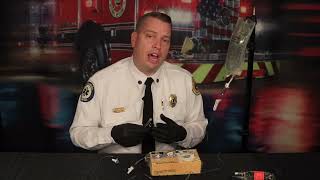
Peter Antevy demonstrates how to mix push-dose epinephrine on scene using a 1:1,000 vial and a 50cc saline bag, creating a 1:10,000 concentration. He covers exact volumes to draw, timing the 1 ml push over one minute, and accounting for IV tubing dead space so the drug actually reaches the patient.
Questions this video answers
Do not prepare in the morning; mix on scene because the prepared solution is not bacteriostatic and can grow bacteria.
1 milligram.
0.5 milliliters.
500 micrograms in 50 ml.
10 micrograms per 1 ml.
Chapters
So let's go over how to mix epinephrine, 1 in 1,000. We're going to go over how to dilute this for the 1 in 10,000 concentrations and the 1 in 100,000 concentrations. So let's show you how to do this again. I want you to remember that this should not be done in the morning in preparation for culls. This has to be done on scene. If you were to go ahead and draw this up in the morning and as this sits out, this is not bacteriostatic, so it can grow bacteria and you can introduce an infection to the patient by preparing this ahead of time. This has to be mixed on scene. So let's go ahead and go through the steps on how to do this. So again, I'm going to have my 1 in 1,000 epinephrine. I'm going to have a 10cc syringe, my medication label and my blunt tip needle. We open up the needle, we're going to attach it to our 10cc flush. I'm going to go ahead and remove the COVID and I'm going to waste 1 milliliter.
Then I'm going to remove the cap from the 1 and 1000 epinephrine.
We're going to draw out all of the epinephrine.
From the vial into the syringe. Now, once I've got all of the epinephrine out of the vial, that's 1 milligram that's into this syringe. Obviously this is just a syringe filled with saline in anybody else's mind until I put a medication label on it. So the medication label has to go on this during this process. Please do not forget this. So now I have epinephrine, 1 milligram, 1 in 10,000. So now.
I can go ahead and safely administer this to the patient in cardiac arrest. And this is going to be IV push.
So the next drug we're going to talk about is mixing 1 in 100,000 epinephrine from a 1 in 1,000 concentration. And we're going to talk about using the saline bag as our medication vial. This is something that we did briefly for a short period of time, not that long ago. And once the 1 in 10,000 epinephrine became readily available, we went ahead and put that away. Well, we're back to this again. So once again we're going to go through the steps we're to going on how to mix this. So you're going to need a 50cc bag of sodium chloride. You're going to need a 1ml syringe, your blunt tip needle, 1mg of epinephrine in the 1 in 1000 vial and obviously your medication label. So here's what we're going to do. We're going to take out our 1ml syringe. And again, like I said before, this should not be prepared in anticipation of calls. This should be prepared on the call on scene. You do not want bacteria to grow while this is sitting on the shelf. Alright? So now I've attached my blunt tip needle to my 1ml syringe and I'm going to draw 0.5mls out of here, which is going to be 0.5mg out of this medication vial.
Air goes in.
Fluids, medication should come out as the medication comes out. Here we go. We are at 0.5-ML.
Now I'm going to take this amount of medication.
And we're going to inject this into the 50cc bag of saline. We're going to use the medication access port and we're going to inject all of this into this 50cc bag. This goes into my sharps container. And now.
Put my medication label on the bag. This leaves me with a concentration of 500 micrograms in 50mls. So as I begin to pull out 1ml, that should give me my 10 micrograms. So again, as I'm going to use this dose for push dose pressor epinephrine, what I want to do is I want to draw from this bag and we're using this as a medication vial. We're not spiking this and running a drip. That is not happening. We're using this as a medication vial. I'm going to access the medication through the port and I'm going to draw out one ML. This comes out, my sharps goes into the sharps container. And now this medication is pushed every minute on the minute, over a minute until I can restore the blood pressure.
You can repeat this as needed. And this is going to give you actually 50 doses, which is more than you're ever going to need for any patient. It's more than you're going to need for almost two patients. So again we are just using this for a medication vial. When you're done with the call, this goes into the trash. So while we're on the topic of push dose, press or epinephrine, let's go ahead and talk about some tips of administration. The first thing I want you to remember is we are giving a 1ml dose over a minute. And let's just stop and think about the IV tubing here. So your J loop, or your map, whatever you're used to calling it, holds roughly about one and a half ccs of fluid in it. And then for every six inches of IV tubing that you have, you can say that that's about another ML of fluid. So one of the things that we got to remember when we are administering this drug, and let's say we're using the first wye site on this IV tubing, that there could be as much as two cc's that I have to fill this with before my medication ever makes it into the patient. So one of the problems that we see pretty frequently is patient is, especially students, they administer the drug very slowly, but it only makes it to about there in the line. And then we flush it rapidly and this turns into a rapid administration of this drug instead of a slow administration over one minute. So let me show you a trick on how we can do this where we can steadily administer this medication over one minute. And we know that it's actually getting into the patient at the rate we're infusing. So the first thing that I want you to do, and this is going to sound like heresy to those that went to paramedic school a long time ago like me, but I do want you to pay attention to this because it does work. So we're going to go ahead and open up our drip chamber on most of these patients. They're going to have a bag of saline that's going to be flowing anyways. And pay no attention to the bubbles in this line. This sponge is not alive, but this is going to be flowing into the patient. Now, as this is flowing into the patient, and I can be very sure that if I when I administer this medication into the line, it's going to go into the patient at a dependable rate. Because here's what I'm going to do. We're going to go ahead and access this Y site with my syringe with epinephrine in it. Now, I'm not going to pinch this. I'm not going to occlude this drip chamber. But what I am going to do is I am going to look at my watch and I am going to time this and I am going to slowly administer this over one minute. And I am going to watch my drip chamber. And as this is going in, over one minute.
As long as I have drips in my drip chamber, I can be assured that my medication is not backing up into the IV tubing, It is not going this direction. The volume of this bag is continuing to be infused downstream, and it's going into the patient as I push the syringe, and it's not going to load the medication up into the IV tubing. So again, we're about 30 seconds into this and the IV to the drip chamber is still dripping.
We continue to infuse this 1 milliliter of epinephrine. This is 10 micrograms for patients that are hypotensive.
We got about 15 seconds left, and as you can see, the drip chamber hasn't stopped at all.
And we've hit about one minute and here we are. We're done with the medication again. Now I can go ahead and go back to my medication vial, draw up one more ML of epinephrine and go right back to the site, reattach it and continue to administer this medication. By doing it this way, this prevents the medication from loading in the line and staying in the line. And this is a more dependable route of administration. For this, push dose pressor epinephrine. Thank you so much for your time. I appreciate it. I hope you learned something today. Have a great one.