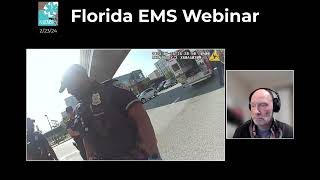
Eric Jaeger examines how physical restraint and ketamine sedation have contributed to in-custody deaths, including Elijah McClain and James Britt. He argues chemical sedation needs the same formal safeguards as intubation, with changes to protocols, training, and leadership.
Chapters
Welcome everybody. It is Friday, February 23rd and we're here for another Florida EMS webinar. We have an amazing guest who's been on the show before. Eric Jaeger is from New Hampshire. He is a man of many talents, an RSI paramedic. He is an attorney and he has really been very educational to us on many different points in the pre hospital setting. And for those of you who are at NEMSP this year, Eric gave a series of talks on this topic. He showed some incredible videos and it really stirred up a lot of buzz. I think this was maybe some of the most popular talks of the entire conference. Especially after what happened with the folks in Colorado. There is no better time to hear all of Eric's advice and insight. So without any further ado, Eric, thank you so much for joining us. If you want to make any further introductions and my friend, take it away.
Thank you so much Peter for having me on the on the podcast. This is a topic that I'm fairly passionate about. I've been on the webinar once before talking about death in custody where we primarily focused on pathophysiology. I think of this talk we'll briefly reprise that piece of the conversation, but I think of this talk as sort of part two. How do we address it? How do we work with our paramedics and EMS colleagues to ensure that we can reduce the risk of this happening again?
Some key points we have misapprehended the danger of physical restraint and death in custody. This creates a risk not only for our patients but also for EMS providers and law enforcement. I think it's time to upgrade chemical sedation of the agitated patient. We should begin to treat pre hospital chemical sedation as a procedure like RSI which over the decades we've enhanced building and safeguards like pre ops, apneic oxygenation and push dosepi to help enhance the safety of that procedure.
We are going to be discussing and viewing some video clips of tragic incidents where patients died. I just want to give people a quick warning. I always remind people when I show these video clips that it's not for me or for us to judge the actions of the paramedics and other individuals involved in these tragic deaths. Instead, really the goal here is to learn from these incidents to keep future patients and EMS providers and law enforcement safe. And I think that's a key perspective when talking with EMS and law enforcement community.
I am going to first mention Elijah McClain, which Peter mentioned. Elijah tragically died in Aurora, Colorado in August 2019. He was walking down the street, minding his own business. Police were called by a 911 caller who said, hey, I see a guy looks kind of sketchy, might be good, might be bad. Elijah hadn't that night committed any crime or any night. Elijah wasn't on drugs that night or any night. But police attempted to take him into custody. They restrained him for an extended period of time on the ground. EMS arrived while he was restrained. They administered 500 milligrams of ketamine. He's reported as having been unconscious when they moved him to the stretcher, and he suffered a cardiac arrest in the ambulance. He was resuscitated but ultimately died from anoxic brain injury.
This is the headline Peter was referring to. The trial of the police officers were on trial last year, and one of them was found guilty of criminally negligent homicide. And the two paramedics. Their trial concluded in December of this year, and both paramedics were found guilty of criminally negligent homicide and the death of Elijah McClain. This really has sent shockwaves through the EMS community because, sure, we see paramedics criminally charged from time to time. They assault the patient or do something else clearly inappropriate here. This was really more. These guys were charged with violating their. Criminally charged for violating their protocols is really what this amounts to. And that resulted in criminal charges. And these guys are going to end up going to jail. And so it's really raising questions that I'm not going to have a chance to address today from more medical, legal perspective, how this impacts paramedics operating in the street. I want to tell you about another individual, though, who didn't get as much press and who died just a month after Elijah McClain. James Britt died in Mount Pleasant, South Carolina, in September 2019. You can see James Britt right there. He's a. He's a big guy. He was driving down the street intoxicated, curbed a tire pulled over, tried to change his tire. The police came on scene. Very polite interaction initially, but he's eventually told he's going to be arrested and his car impounded. And he gets upset. So he's restrained on the ground by police. As you'll see, because he's intoxicated and obese, he struggles to breathe adequately. Paramedic administers 500 milligrams of ketamine. He's kept in the prone position until he's unconscious. When lifted onto the stretcher, he becomes apneic. Paramedics fail to appreciate the danger. He, just like Elijah McClain suffered cardiac arrest and later died of anoxic brain injury. And these two are not alone. These also haven't seen as much press, but there's at least six other patients that have died in similar circumstances, each of these involving EMS administration of ketamine. So key questions what is causing these deaths and what changes need to be made to protocols, training and leaders leadership to reduce the risk of future deaths?
I am going to talk briefly about the pathophysiology of death in custody. For years we focused on excited delirium excuse me, as the cause of many deaths in custody. We trained paramedics on it. We built it into protocols. In 2021 the AMA committee of the AMA came out with a report that took a hard look at excited delirium and said excited delirium and potentially fatal restraint are inextricably interwoven. Restraint was described in 90% of all excited delirium deaths. There is no evidence to support excited delirium as a cause of death in the.