Eric Jaeger - Deaths in Custody (5/17/2022)
EMS educator and attorney Eric Jaeger examines deaths in custody using the Elijah McClain case and others, questioning whether paramedics are trained to recognize risks from prone restraint, positional asphyxia, and ketamine. He argues EMS and police need clearer roles and better protocols to prevent harm.
Chapters
So have you been doing anything yet? I'm taking over for Peter, so I just wanted to make sure I was not missing any duties here and supposed to ask a couple things. First of all, you know, Angus, if you've started the recording, it looks like you have, correct?
Yep, we're good to go on the recording. We still got a couple folks trickling in.
Okay, good. So just so you know.
Peter's had kind of a family emergency that's come up, so he asked me to, you know, sort of do this in the interim as we're waiting.
Give me a signal when you think we should, you know, go ahead and get started because I like to always get this started on time for this one so we can get to the next one as well. And Eric, thank you very much. And I'm sorry I haven't met you before. You're up in New Hampshire, right? In Exeter, if I remember correctly.
Exeter Hospital in Seacoast New Hampshire. Correct. Okay.
Okay, cool. Okay, good. Well, anyways, I'm gonna do a quick.
Set of announcements and then turn it over, if that's okay.
Absolutely. I just wanted to make sure. You want to. Yeah, let's get started. You know, let's.
Yeah.
So just for everybody that's part of the Florida group here, please make sure, if you haven't already, to go to the Mobilize website and RSVP for both the FAEMS MD meeting as well as the Eagle session on Mobilize. Our event listings for both of those. It's important that you RSVP so we can have the appropriate information there for you specific to your system. I've got, Paul, 20 people already signed up to join the Eagle session and hopefully we'll get a few more.
I don't see Melissa here, but obviously happy EMS Week to everybody. And if you don't have the dates of the next meetings on your calendar, please be sure again to go to Mobilize. Any questions, send them my way. And Paul, let's go.
Okay, thanks.
Way.
One thing I will say is that I did want to make a quick announcement and congratulations to our new NAMSP elected chapter. You know, elected officers. And Peter and I were going to go through this and actually talk about the people who ran but may not have been got the highest number of votes because we thought they were just all great. And so we're going to defer that to maybe next week, I guess under the circumstances. I'm still going to go through this.
A little bit.
At the Eagles meeting itself, I think. So we could get on with this particular talk that's so important here. So I just want to let you know the election results are in. But briefly, Peter Anteby was elected president. The vice president, from what I understand, was Rachel Simmons and also Carolyn Pereira. Carolina Pereira got the secretary position. And if I remember correctly, I think it's Desmond Fitzpatrick and Carrie Bacista who got the directors at large thing, and then Ben Abes who got position for the professional member position. So congratulations to those guys. We're going to talk more because I do want to address some of the other people who ran who are fantastic people as well. So with that, let's move on to the next thing. And I will have to leave, of course, and if you can help with the transition, I'd appreciate that, Angus, because I'll have to be getting on my meeting at 10:30. Okay. Or 11:30. All right. All right. So one of the things that obviously that came up this past year has been all the issues that have come up with a lot of cases. Death in custody with the police have been a big, big issue the last couple years, but they've taken on more and more of a concern for us in ems, particularly when you go back to the death of Elijah McClain in 2019. And so one of the people that we need to talk about that would like to talk to us about this issue is really timely and important is Eric Yeager, who's our special guest here today. And Eric, you know, I need to cut things off pretty much by about 20 after 25 after. I hope you can do that so that we can take a couple questions and then we have to go over to another session at 10, at 10:30 sharp.
Okay.
So, and then with that, and as I, for those of you around before, I think I mentioned that, you know, Eric has been a paramedic up there for many years at Exeter Hospital and Exeter, New Hampshire, and has been frequently a high level lecturer for us in the EMS circuits. And he basically has been a terrific asset to us. We just really so welcome, you know, glad to have him here on our session today. So with that, Eric, if there's anything else you want to say about yourself, please do and we'll turn it over to you. Okay. Because myself is I've got bad thyroidis. I've got illness myself. So go ahead.
Well, thank you so much. I think this is a very important conversation for us to have.
You know, my name looks like it shows that I'm Emerald Isle, but that's sort of one of my things that I do. I'm Paul Pepe. Okay. So. And I proved this message. All right. See you later.
All right, Dr. Pepe, thank you so much. I am an EMS educator and RSI paramedic up in Exeter, New Hampshire. I'm also an attorney and for many years represented healthcare clients in Boston before switching gears. I also have an undergraduate degree from MIT in Computer science. So I, I have a little bit of unusual background as a paramedic. I have no disclosures to make today. All of the materials I'm going to be sharing with you, including videos and various sources, can be found on my website, truenorthgroup.org if you search overview. I am compressing a 3 hour talk down into 20 minutes, so please bear with me. I have definitely simplified some points that I recognize are more nuanced and I'm happy to have that conversation with people in a longer version of this talk.
We need to have a conversation about death in custody.
I'm going to be challenging some of the assumptions and dogma we hold and I just ask that you keep an open mind and bear with me as we go through this conversation.
Most of the time when I talk about clinical topics, I feel as though I've got good evidence that can provide reasonably solid answers. That's not true here. I don't have answers when it comes to this topic. I have questions and that's why I say it needs to be a conversation.
My take home points we have misapprehended the danger of physical restraint and death in custody. This creates risks not only for our patients, but also for EMS providers and for our law enforcement colleagues. We must ask whether there are failures of EMS protocols, training and leadership that must be addressed to reduce these risks.
I'm going to be talking about death in custody, which I define as being physical restraint by law enforcement or ems. I'm not going to be talking about individuals who may have been shot by the police. This includes individuals who have been arrested by the police who may be suffering psychiatric emergencies that we encounter or may be exhibiting bizarre behavior due to stimulant abuse.
Our story really starts here. There's a headline in the New York Times from last year. Three officers and two paramedics criminally charged in Elijah McClain's death. A grand jury has issued charges on the 2019 death of Mr. McClain, a young black man who was walking home from a convenience store when he encountered police. Couple of notes about Elijah McClain as you'll see in the video I'm about to show you, Elijah McClain is different. I don't know if he'd been formally diagnosed, but I suspect he was somewhere on the spectrum. It's also important to note that Elijah had no criminal history and there's no record that he's ever used any drugs, this night or any other.
This footage can be found online. I've edited it for brevity, for the sake of our conversation, but this will follow Elijah's events that night.
It's August 24, 2019, in Aurora, Colorado. A security camera.
Can everybody hear? The video.
Picks up 23 year old Elijah McClain at this shell gas station buying soft drinks and wearing a face mask.
Mask.
His family lawyer told NBC News he was in the habit of wearing this mask. After paying for his items, he turns around and bows to the man behind him in line. His family told NBC News this was his signature gratitude bow. At 10:30pm a man calls 91 1.
Yeah.
Elijah McLean is walking home from a nearby Shell gas station. He's holding a plastic bag with his purchases. At 10:43pm Aurora Police Officer Nathan Woodyard spots McLean.
Stop right there. Hey. Stop right there. Stop, stop, stop, stop. I have a right to stop you because you're being suspicious.
Nine seconds after exiting his vehicle, the officer initiates physical contact. 10:44pm Officer Jason Rosenblatt and Officer Randy Wodema are now also on the scene and surrounding.
No, I am an introvert. Please respect the boundaries that I am speaking. Stop messing up.
Stop.
Relax. I'm going home. Relax or I'm going to have to change this situation.
The situation escalates when the officers try to move McLean onto the grass. All three officers wrestle McLean to the ground.
Give us more. Give us some more units. We're fighting them.
The ground.
We had to use coroted.
I'm different. He come out?
He's out.
Was he out?
I heard snoring completely. He didn't lose consciousness. I'm just different.
I said it was different.
It was actually wrong. Rosenberg.
For your gun? Dude, I have no gun. That's where I try. Crowded. I don't do that stuff. I don't do anything. Other units that are not here. Slow it down a little bit. I don't do.
Do we have anything other than being suspicious people?
No. I mean, I tried.
Start walking away.
Yeah.
Responding officers later tell an investigator that McLean was actively resisting and fighting the officer's attempts to place him into handcuffs.
I tried. We started it because he reached for Rose's gun. We had him on the wall.
All right.
At 10:49pm McLean throws up a first time.
Oh, yeah, I'm sorry. I wasn't trying to do that. I can't breathe correctly.
Because.
At 10:54pm McLean is still on the ground. And an officer says this.
So when the ambulance gets here, we're going to go ahead and give him.
Whatever he's on. He has incredible strength.
10:59Pm, a fire medic administers 500 milligrams of ketamine to McLean in an attempt to sedate him. Two to three minutes later, he is loaded onto an ambulance. And at 11:07pm Just over 20 minutes after the first officer made contact, responding Officers are told McLean does not have a pulse.
He just poured. Are you serious? Yeah.
Okay.
So.
McLean was resuscitated at the scene and taken to the hospital, where he would be declared brain dead three days later.
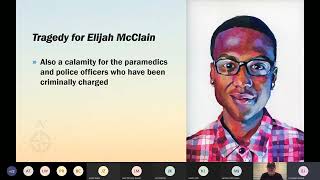
Clearly, this was a tragedy for Elijah McClain and for his family. But I also contend it was a calamity for the paramedics and the police officers who have been criminally charged.
Often when I hear about these events, people say, hey, these guys screwed up. We wouldn't do that. I want to be very clear. It is not for me to judge the actions of the individuals involved in Elijah McClain's death. That is for others. My goal instead is to ask what work we need to do to reduce the risk of this happening again, to protect our patients, to protect EMS providers, and to protect our law enforcement colleagues. And ask whether Elijah's death represents a failure of EMS protocols, EMS training, and EMS leadership.
And Elijah McClain is not alone. I'm going to play this short clip from ABC News in Dallas, Texas, from November 2020.
After months spent examining autopsy reports, court filings, and news stories, we found example after example of law enforcement agencies largely ignoring the warnings. We know of at least 107 deaths, seven in Texas, that followed prone restraint since 2010. There are likely many more. We found families impacted by loss in places like Louisiana, North Carolina, California, and in our own backyard, North Texas.
It's just going to continue until somebody puts a stop to it.
So what are the key questions regarding death in custody?
When we show up at a scene where the police are wrestling with someone, when does that individual become a patient?
If we see the police doing something dangerous, should we intervene? And if so, how do we intervene effectively and safely?
And if we decide chemical restraint is necessary, what assessment must be done? How should we use it safely and what could go wrong, and how should we be prepared?
Let's talk a little bit about excited delirium.
For years we focused on excited delirium as the cause of many deaths in custody.
But there's now become a question as to whether excited delirium is a valid diagnosis, and I understand this is controversial. In the past, ASAP and the national association of EMS Physicians have recognized excited delirium as a valid diagnosis. But more recently, the AMA and the APA have taken strong stances against excited delirium as a diagnosis.
The AMA published a report in June of 2021 looking at this issue where they noted excited delirium and potentially fatal restraint are inextricably interwoven. Restraint was described in 90% of all excited delirium deaths. There is no evidence they found to support excited delirium as a cause of death in the absence of restraint.
I understand excited delirium has now been rebranded as hyperactive delirium with severe agitation. I think that's fine. But I think it misses the no one, including me, is suggesting that excited delirium doesn't exist as a clinical entity. The real question is, is it excited delirium that killed Elijah McLean and so many others in custody?
Let's get Back to Elijah McLean. I'm going to quote to you from a couple of different insights from a couple of different sources. The City of Aurora convened a blue ribbon panel to look at the events surrounding Elijah's death and they included Dr. Melissa Costello, who's an ED physician. She noted in the report that she is concerned there was a failure to take steps keep the patient, the officers and medical personnel safe. I recommend you all to take a look at the report and I'm going to give you a couple of excerpts here. I'm also going to be quoting from an article published by Paige, Wolfberg and Worth. This is a national EMS law firm who published an article entitled Patients in Custody and in need of Treatment.
They addressed the question when is the individual in custody of patient? Dr. Castell noted a widespread sense that the patient is not a patient until the police say they are. She said this represents a problem of both policy and culture. The lack of clarity regarding which department is controlling when has the potential to create major problems for patient care. PWW said EMS cannot just sit back and complacently wait until the police say it's okay to assess the patient.
What should EMS do if police are managing a patient unsafely? Dr. Costello said EMS must feel adequately authorized and administratively supported to proactively step in and voice patient safety concerns in real time during a problematic encounter.
How should EMS providers intervene effectively intervene in a positive way to interrupt bad behavior. Use calm and non defensive phrases. Hey, it looks like he's having trouble breathing. Can I get in there and check him out?
How can we improve? Pww said. We need to work with law enforcement to develop a procedure clearly identifying the roles of law enforcement ems. We need to train and train and train using role play and mock case scenarios and we need to practice communication skills to intervene effectively with police.
What should the providers have done after gaining access to Elijah McClain? EMS personnel should have initiated at least a primary assessment and conducted a brief hands on evaluation including finger stick glucose, peripheral pulses, etc.
Did implicit bias play a role? And I spoke about this several weeks ago during the podcast we overestimate young black men as taller, heavier, stronger and more muscular, Dr. Costello said. Our perceptions of black people is more threatening. Impact judgments about the force necessary to restrain black suspects and influence non officer civilians to excuse officers Use of force against black suspects.
Did anchoring bias play a role? Aurora Police reported that Mr. McClain had incredible strength, was pouring sweat and appeared to be on something. This apparently led medical personnel to reach a conclusion that they did not confirm through an independent examination.
So what about the ketamine?
Why do we prefer ketamine for managing combative patients? For the most part, it works rapidly, better than Haldol or Ativan alone or together. It usually doesn't cause hypotension and it usually doesn't cause hypoventilation. But it's important to understand that there are key caveats. For example, patients in pain or distress who are compensating disassociation with ketamine can wipe out their fight or flight response, affecting blood pressure or breathing, or both. It's also important to know that a rapid IV push of ketamine can cause transient apnea.
It's been alleged that Aurora paramedics misjudged Elijah's height and weight. They estimated his weight at 200 pounds when his actual weight was 140 pounds and they administered 500 milligrams of ketamine. An enormous amount of attention in the press has been focused on the overdose of ketamine. I think this issue, though, is largely a red herring. I'm not a pharmacist, but the general understanding is once you've reached a fully disassociative dose, you can't further disassociate the patient.
Studies have been done since that time looking at the safety of ketamine that have largely concluded ketamine appears to be safe in a July 2021 study. They looked at over 11,000 EMS patients who received ketamine, and deaths were rare. Only eight patients who received ketamine died from a cause where ketamine could not be ruled out as a contributing factor.
There's also been a lot of focus on the fact that the police requested EMS administer ketamine to Elijah McClain. I also think this is. It's important, but I also think it's a red herring. I think both before Elijah McClain and after paramedics understand that we do not administer medications at the direction of the police or in support of law enforcement goals.
So what actually killed Elijah McClain? I want to be clear. I'm not a forensic pulmonologist or pathologist, and I'm not going to pretend that I know the definitive answer to this very important question, but I have a pretty good idea. Elijah McClain died the same way that so many others have died in custody. Positional asphyxia due to prone positioning with weight on his back or side for an extended period of time. While he was restrained prone on the ground. Before the ketamine was administered, his fight or flight sympathetic surge was keeping him breathing and alive. Ketamine was administered by the paramedics. That ketamine obliterated his sympathetic surge. And if you heard in the video, they said he was held down for a couple more minutes and at the point where they got him up, he was unconscious. Or we could wonder, was he actually dead at that point?
Let's talk about prone positioning and positional asphyxia.
I don't have many answers to the questions I'm asking today, but one answer I do have is that prone positioning for an extended period of time is inherently dangerous. I understand that. As paramedics, we understand not to restrain patients prone to the stretcher. That's not what I'm talking about. I'm talking about the use of prone positioning during the initial struggle to gain control of an individual. This is especially true with a knee or weight on the patient's back or side, hands secured behind their back, or alcohol or drugs on board. Prone positioning is occasionally necessary to gain control of an individual. The danger lies, as I'll show you in a moment, in the decision to keep the patient in that position once immediate control has been established.
This is Dr. Martin Tobin. He's a nationally known ICU physician, pulmonologist and physiologist. He was one of the key witnesses in the trial of Derek Chauvin for the death of George Floyd. And I'm going To play just two short clips from his testimony that I think help illustrate the dangers of prone positioning.
Dr. Tobin is asked here what caused the death of George Floyd?
Dr. Floyd died from a low level of oxygen, and this caused damage to his brain that we see, and it also caused.
A pea arrhythmia that caused his heart to stop.
Is this what some persons might refer to as asphyxia?
Yes, it has been called asphyxia. To me, it's not terribly helpful. What we're really talking about is a low level of oxygen. Other people talk about hypoxia. That, again, is just the Latin term meaning a low level of oxygen.
Have you formed an opinion to a reasonable degree of medical certainty as to what the cause is or was for.
The low level of oxygen in Mr. Floyd?
The cause of the low level of oxygen was shallow breathing.
Small breaths, small tidal volumes, shallow breaths that weren't able to carry the air through his lungs down to the essential areas of the lungs that get oxygen into the blood and get rid of the carbon dioxide alveoli at the bottom of those.
He's asked what's caused Mr. Floyd's shallow breathing. And he notes that Mr. Floyd was prone in the street with his hands rammed into his back, a knee on his neck and a knee on his back inside.
And then here, the. The prosecutor notes, George Floyd's last words were, I can't breathe. And he's asked, are those words significant to you as a pulmonologist, those words significant to you as a pulmonologist?
Yes. I mean, obviously, they're important different ways. One, he's complaining to you of difficulty with breathing, but they're also telling me that at that time when he's saying, please, I can't breathe, we know at that point he has oxygen in his brain, but. And again, it's a perfect example of how it gives you a huge false sense of security, because very shortly after that, we're going to see that he has a major loss of oxygen in the way that he moves his leg. And so it tells you how dangerous is the concept of if you can breathe or if you can speak, you can breathe. Yes, that is true on the surface, but highly misleading. Very. A very dangerous mantra to have out there.
Dr. Tobin has asked about studies that seem to show the weight on the back of a prone individual is okay, and he points out they're highly, highly misleading. He notes that they track pulse oximetry, but his observation is pulse oximetry is not very sensitive to know if something is going wrong. It will only fall at the very end. We're as clinicians very familiar with this concept. This is the oxygen desaturation curve that we're all very familiar with. That shows us everything looks okay until that moment of decompensation. And shortly after that, the patient's pulse oximetry reading is going to be zero.
I'm going to just show you one more clinical example before we end. This is Mario Gonzalez, who died in April 2021 in Alameda, California. Mario was probably a vagrant in the park. He definitely is on something, and police are there to move him out of the park and get him to the hospital.
I'm going to play you this very short clip which illustrates how this can happen so rapidly. You're going to hear Mario struggling to breathe. His difficulty breathing in the prone position exacerbated by his obesity and by the drugs he has on board. You hear the police in a crucial moment say, do you think we should roll him up on his side? And then you'll see a sudden change in his affect when he goes unresponsive.
Mario, calm down.
Please stop kicking.
Mario.
Stop.
Stop. K.
Think we can roll them on the side?
I don't want to lose what I got, man.
Okay.
Can you grab the wrap out of 111?
Mario, just please stop fighting us.
It's all right.
We have no weight on his chest.
No, no, no. No.
No, wait. No, wait.
No, wait.
Mario.
Mario.
So Mario was not unresponsive. Mario was dead. They roll them over. They immediately begin cpr. EMS comes rapidly, but they're unable to resuscitate Mario.
So where does all this leave us?
What work needs to be done? I think we need to take a hard look at our protocols. We need to take a hard look at our training and ask what changes need to be made so that we can ensure that we're providing, giving providers the tools they need to be able to manage these situations safely. And as leaders, I think we need to focus on these issues, and I think we need leadership at the state level, at the agency level, and at the EMS medical director level.
Thank you very much for your time. I realize this is a very abbreviated look at death in custody, but I appreciate you taking the time to have this conversation. Thank you, Dr. Pepe.
So, Paul, I'm not sure if you can unmute or if people can hear you, but I'm sorry.
I'm sitting here talking.
I apologize.
Sorry.
I'm dealing in cat land here, you know. So any event, I was going to say, is that our Conversations that we've had here previously in Florida regarding this. One of the things we really make try to prioritize is get meetings between, say, the fire chief or whoever is in charge of EMS and the police chief ahead of time. Because, as you know, in some of these cases, you know, when the paramedics didn't cooperate with the police and made their own independent decisions, then they came under criticism later from the police department as that went downhill. So up front, this needs to be a. You know, there may be some positive that came out of this in the sense of getting some better coordination and understanding, like you've said, in terms of make sure there's an independent assessment, which is a key thing there. I wanted to see if there's anybody else that we really supposed to be ending right now. But is there anybody has a burning question for Eric at this point in time.
And Eric, thanks for great, great, good videos and good context, by the way, especially showing Elijah up front. Okay. Yeah. Before the event happened.
Yeah.
Any questions? Well, if not, I do want to reinforce the. Tyler or if that's who it is. In a second. I'll come to you in a second. Just want to make sure Everybody knows today's CME number was 15236. Or is 15236. Okay, there was a hand raised there. Who was that?
Yeah, that was. Hey, Eric, it's Tyler Busch. Got a couple people from duluzio watching as well. I appreciate you taking the time today. Do you a little off the wall question, but there was a physician in Maryland who spent some time working on advocating for EMS body cameras. So just wonder if you have a position on that since most of the evidence that you presented today comes from only the perspective of law enforcement.
Yeah, I think EMS body cameras are an important conversation that we need to have. As with so many of the pieces of this equation, I don't want to pretend I'm an expert or have a definitive view on that topic, but I think it's a discussion that we need to have as to whether they would provide both some benefit and help ensure that we can do effective review of these events when they occur.
Okay, great. Is that use Kim Landry, do you have a question?
Yeah.
Very, very good topic. Thank you. Very good discussion. But should we be allowing officers to carry and train on using pulse oximeters, a little finger probes for monitoring pulse axis. You know, that's a wonderful question. I haven't heard any discussion about that as to whether that would be a beneficial intervention. I really think honestly what we need to do is have this conversation to help police and EMS understand the dangers of prone positioning. They actually train on this at the police academies. And in multiple videos I've seen, one police officer says to the other, hey, should we roll him up on his side? I think it's as simple as recognizing that once you gain control, maintaining them in the prone position is dangerous. And if we follow the training they're already getting and let them know the dangers of prone positioning, then if we get them up on their side, I don't know that we need to worry about having police officers monitor pulse oximetry, but other people may feel differently.
Yeah, just my opinion has been to have police officers have pulse oximeters. I think two or three of the best things you can have out there when you're, you know, in the sort of especially a far forward position is to have that. But to your point, that's a late determinant. You're already beyond, you know, if they're crashing on their pulse oximeter, it's, you know, you've gone too far at that point in time. There has to be an earlier recognition of the issue.
I just was thinking it would might help to differentiate for the officer that maybe the reason he's behaving the way he's behaving is in fact because he's hypoxic. And if they recognize that early, they could discontinue their struggle. Yeah. So, interestingly, all of these individuals and all of these videos, the police say, please stop struggling, please cooperate. And of course, none of them can because they're all profoundly hypoxic and they're fighting not to get up and punch the police officer. They're fighting to get up because they can't breathe and they have that air hunger that's telling them to get up. By the way, I did want to mention before we close that Elijah McClain was not the only individual out there where ketamine was directly involved as administered by Ms. There are others out there. I didn't have time to include it in this conversation, but I think we need to focus on that piece of the equation as well.
All right, I guess it really is pretty much time to wrap, and I apologize for those who didn't get asked a question, but we have to be on the other call right now. Angus, you're gonna pull us over the. Thanks again. If we could all be out there, we can be giving their clapping for you. Okay, Eric, you're doing.
Thank you for bringing this to us and in making us giving us more insight, in fact, to an issue that's really plagued us all. So thanks again. And so I'm going to switch over and then, Angus, you're going to take care of the switch over from your end, right?
Yep. All right, thank you very much, Paul.
Okay, see you later then. Take care.
Bye. Bye.
I'm sorry I've been so sick. I'm not thinking very clear today, so I apologize.
All right, let's see. How do I get out of here?
All right, well, thanks again to Eric for a fantastic presentation. I'm going to go ahead and stop the recording now.
More from Peter




Melissa Olen MSN, FPN-C, CCRN: Sudden Cardiac Arrest Training in Schools (Project ADAM) 4/25/25



Pediatric Hospital Readiness: How Teamwork & CPR Metrics Drive Better Outcomes



Chelsea Kadish, MD & Kyle Goodknight, EMT-P, RT: Pediatric CPAP in EMS (3/14/25)