Erin Markt, BS, PM: Pre-hospital Communication using eBridge (7/25/23)
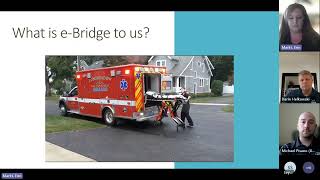
This is a transcript of a YouTube presentation (7/25/23) by Erin Markt, EMS Manager at Bay State Health (Western Massachusetts) describing implementation and outcomes from using General Devices' eBridge platform to improve pre-hospital communication. Key points: limited radio coverage in western MA hindered early STEMI notification; prior EKG modem system yielded ~19% pre-notification compliance; after eBridge implementation EMS EKG transmission compliance rose to ~82% (2022 data). Bay State receives ~120 ambulances/day; their pre-EBRIDGE first medical contact-to-balloon (FMC2B) averaged ~94 minutes (goal 60); cohorts: pre-launch ~223 patients, post-launch cohort ~43 patients; eBridge-only cohorts showed reduced FMC2B and door-to-balloon times (average ~14 minutes shaved). eBridge supports secure live communication (text, voice, images, 12-leads), works over cellular or Wi‑Fi, integrates with paging, and is customizable for STEMI, stroke, trauma, MCI, COVID workflows; adoption required training and device provisioning but was affordable and achieved buy-in through data and social-media recognition.
Questions this video answers
1739-517395
About 120 ambulances per day
About 19% compliance prior to eBridge implementation
About 82% compliance for EMS transmission rates for STEMIs (data from 2022)
Pre-launch FMC2B averaged ~94 minutes; internal goal was 60 minutes
Chapters
Today. And so one of the things I wanted to do is make sure everybody knows today.
That we have today's CME code. So I'm gonna look that up real quick. I could have it here, my item. Yep, it's 1739-517395. If someone would be kind enough to put that into the chat. Item Appreciate. But I'll try to remember that once I.
Okay, so today. And Aaron, remind me, what's your last name?
Marked. M A R K T. Marked M.
E R K T. Okay, got it. Okay, good. Aaron Marked is going to be joining us today, is from basically Medical center up in Massachusetts. And I don't know if you know much about the Berkshire tears. And I'm trying to get it out of this. See, I'm trying to get away from this thing. I don't know if you know much about that whole area, but, you know, it's relatively hilly, ups and downs and all over the place and beautiful, beautiful land out there. And one of the things you do sometimes have communication problems as a result. So Aaron was seeking a way to try to see if they could obviate some of that. And, and one of the ways that became, you know, is, is what you're going to be seeing about today. And I don't know if I'm explaining it well enough.
To take them away on that errand later on, but I think it's a really kind of intermittent. And this is not a commercial for a particular product. It's just, we're just saying what was your experience with this? So we all are aware of it and tell us both the pros and the cons of it as you can, and so we all can learn for it. So really welcome you. This is a group of mostly medical directors, EMS chiefs and others from the state of Florida. We kind of call it the Gathering of Seagull. And it's a fantastic group and we always have really great people on every, every week and really glad you could join us this week. We also have a lot of other people actually joining us from around the country listening in as well. And I'm Paul Pepe and I approve that message. Okay. So with that, take it away. Okay, Erin, thanks a lot.
Thank you. Thanks for having me today. So I'm, as Dr. Pepe said, my name is Erin Marks. I'm the EMS manager for the Bay State Health System up in Western Massachusetts. And we're going to talk a little bit today about kind of embracing technology and EMS communication to the hospital in general. So I have no disclosures. I am not here as a representative of general devices Ebridge. This is just the platform that we're using and at our health system and so it's what I'm familiar with. This is our EMS division over at Bay State Health and so we currently have obviously the EMS manager position but we also have four EMS coordinators as well as three EMS fellowship trained physicians and one fellow currently in his fellowship here at Bay State. So I have been involved in EMS since 2006 and a paramedic since 2009 in the Springfield Massachusetts area working in a very urban high call volume setting and delivering patients to the health system that I currently work at. Now I do hold a degree for.
SORRY from Eastern Kentucky University in emergency medical care and I'm currently pursuing a master's degree in health law from Northeastern University. So this is our EMS team. It's hard to get a picture of all of us together. This was just a kind of a group outing, team building experience that we did recently.
But we're going to talk a little bit about why we needed Ebridge here in the western Mass area. And so this graphic shows you, we're over to the left hand side in western Massachusetts about two hours from Boston. And that one red dot is our only PCI center in all of western Massachusetts. And the next closest one is about 40 miles away. So everyone in this green area and partially some of those in the yellow area on the map are transporting their PCI patients to Bay State Medical Center. And we receive about 120ambulances per day. Our cath lab is available 24 7. However it does have off hours from 5pm to 7a. And so it's important for EMS to communicate very early on that there's a STEMI patient coming in if that's, you know, if we're off hours so that our caf team can make sure that they're getting into the hospital. We're the only pediatric emergency department in western Massachusetts. A primary stroke center, SANE site birthing center and then a level one trauma center as well.
So a little bit of the background. So why did we need ebridge? Well, as Dr. Pepe mentioned, the radio infrastructure is not well maintained in western Massachusetts. And this red circle that you're seeing on the graphic right now is the only radio coverage that we have in this area. So if you have a STEMI patient coming in from perhaps the Franklin county area which is up north, if you're following 91, they're about an hour away and they were not able to notify our hospital that they were bringing in a semi patient until they were within that radio coverage, which is only about five to 10 minutes away. So it just, it really wasn't ideal. In addition, prior to the implementation of General Devices Ebridge at our health system, we were using a WI fi modem based system system for EKG transmission. And while that was great, it was really cost prohibitive for a lot of the EMS services to maintain. It also, just operationally was not great for our hospital. We looked at some of our previous data before implementation and we're about 19% compliant with pre notification of STEMI alerts, which is just subpar at best. The way that that system worked was EMS would have to hardline into their monitor with the modem and then transmit over the last EKG that was taken and it would pop up on a fax machine in our emergency department and hopefully somebody was sitting there to see it and heard the alert go off. And then they would run it over to a physician. Great. But then the physicians weren't necessarily activating CATH lab on those borderline EKGs and so they were waiting for that radio report, which was again, five to 10 minutes.
And so, you know, those borderline stemis we weren't activating the CATH lab for. So we were missing, we were missing a lot. After the General Devices EBRIDGE implementation at Bay State, we're up to 82% compliance with our EMS transmission rates for STEMI's. I mean, we will say that that data is a little bit outdated. That's from 2022, so it's possible that our numbers are even better at this point. So this is just a quick video to kind of show you what E bridge is to us.
Sam.
Sa.
So.
So Ebridge, Ebridge. I mean, that's a great synopsis of what Ebridge does for us here at Bay State. We do have similar platforms set up for our trauma patients as well as our stroke patients and general Medical. That was just an example of a STEMI patient. So EBRIDGE enables live HIPAA secure communications between first responders and the hospital teams. It also allows to share pictures and voice and text messages. It allows you to send in the 12 lead and the vitals pictures of a. Pictures of a patient's license. So you could look up their chart to see if there's any, you know, previously borderline EKGs before the patient even gets there. So there's lots of, you know, other integration that EBRIDGE allows for too. You could potentially start registering patients before they even arrive. To your emergency department and put in orders and it's, it's completely customizable and configurable to your, to your hospital. So this is just our implementation timeline. We started out with the STEMI module obviously and then we went live with general medical stroke, cardiac arrest, trauma. We also, I'm going to talk a little bit about COVID but not too much. And then since then we also had three of our community hospitals come on board with Ebridge as well. So how did we get buy in and how did we bring Ebridge to the health system? So we did a significant amount of ongoing training with our EMS partners as well as internally in the emergency department and the Cath lab. And then we've grown even further since then. We have iPads in our CT rooms and in the blood bank in our trauma rooms at this point. And so there's just ongoing education all the time where our EMS team, like I said, is quite robust and so we're fairly available if issues and you know, communication concerns come up with the platform. But it's not usually a thing. We have a fairly large following of EMS folks on social media and so as semi patients were coming in we would highlight really great cases or really, you know, record setting first medical contact to balloon times and we would blast that out all over, all over our social media and people seem to love that. Some of them got, you know, up to 5,000 people reached and you know, hundreds of shares on some of the stories. Our STEMI coordinator at the time was quite amazing and she made a, you know, a friendly competition among the EMS agencies of the best first medical contact to balloon times. And then you know, we snapped some pictures of everyone when, when this happened and we posted these on our social media and then at the end of the year we gave out awards for the best times and so that's, we really got the EMS buy in and the cath lab buy in. I think if you're looking at implementing an application like this, having an internal physician champion who has bought into the application and bought into the, you know, increased collaboration and communication is key. I think that's. We had Dr. Amir Lotfi who's on the left of this picture and he was just simply amazing in getting the platform up and running for us at Bay State. So this chart is a little bit, a lot to look at, but what you're looking at here is in the first cohort, these are our STEMI numbers prior to Ebridge launch. So we had about 223 patients and our first Medical contact to balloon time was about 94 minutes, which is not ideal. And our internal goal was 60 minutes. So the second cohort that you're looking at is post E bridge launch with 43 patients. And this is combined both radio and ebridge. So you can see that we're already starting to trend downward, which is great. The third and the fourth cohorts, the third one is radio only. So this is when EMS crawls in over the radio and they're not utilizing ebridge. And then the last one is EBRIDGE only. And you can see there's significant difference between the radio coverage versus the EBRIDGE coverage. What I would like to highlight here too is it's not just first medical contact to balloon time that decreased. It's the door to balloon time internally within our health system. We were able to save, shave off, you know, 14 minutes for average patient, which is just pretty impressive.
This view here is just what EMS sees on an iOS device when they're logged into eBridge. It is also available for PC and Android, but it looks very similar. What I also would like to point out is that we've got our four community hospitals on here in our. In our level one trauma center, but two other area hospitals also bought into EBRIDGE after seeing the success that we had with ours. And we knew that, you know, as a community, all of the hospitals in the area, it would be ideal if we could all be on the same system so that EMS didn't have to log into one application to go to this hospital and another to go to the next hospital. So we kind of formed this EMS pre hospital coalition amongst each other and we're able to make that happen for ems.
One of the things I think that, you know, general devices, EBRIDGE is great at, and probably most of these applications, right, are they're very customizable to your hospital. And so you can have MCI modules and respiratory alert or translation. You need a Spanish interpreter immediately down to the emergency department. You could utilize EBRIDGE internally to make that happen as well. So to highlight one of the customizable options that GD allows is a quick story. Back in March of 2020, when Covid first started becoming quite prevalent in the area, we were getting a lot of alerts from EMS in the general medical module. And what we were seeing was that EMS was coming into the hospital in their ppe, right, which, you know, we didn't know about fomite transmission at that time. And they were touching everything and the patient's nebulizer was still going. And so As a hospital system, we decided that we wanted, you know, EMS to have an escort and go directly to, you know, a specific Covid room. And the only way to really do that and enforce that was through earlier communication. So the case that you're seeing right now on the screen is a real life Covid case. And you'll see that in the video. You saw the flow box who first got the alert, they're talking to EMS and they're staying, they're saying, you know, stay in the vehicle until you have your escort and then we'll bring you in appropriately. So just the enhanced communication, I think is, is really key.
On the back end. General Devices also stores all of the data which you have access to as the healthcare administrator. So these are our numbers, but you can pull similar graphs for your semi patients or your trauma patients or how many ambulances did you get over a certain amount of time. So that's just, you know, helpful information to have for data tracking. One of the other things that Ebridge allows for is kind of integration with older technology. We did have a couple folks who, you know, did not want to get rid of the pager systems and, you know, perhaps had flip phones still and weren't buying into the newer technology. So we worked very closely with our paging system, our one call paging system and the general devices IT team to make sure that that integrates. So what you're seeing on the screen right now is a case that came in through Ebridge via EMS for a trauma alert, but then came over onto our phones as a, as a page and then it can go to these older, older fashioned beepers as well.
So, you know, future plans for this technology and application, we'd love to use it to its fullest potential. I think there is a lot of room for growth with this program, especially internally at the health system. Just recently, you know, we were talking about our critical care transport team and how can they talk directly with our pediatric icu and the answer is Ebridge. We can place an iPad up in the ICU and have the critical care team call them or directly for orders. And so, so, you know, we're looking at the potential to build out an MCI module that would alert, you know, all of the local EMS services in the area as well as our, you know, C med system and make the proper notifications to DPH and things of that nature. So I think there's a lot of opportunity for growth with this program and we'll go from there. But if anyone has any questions, I'm Happy to answer them. And my contact information is on the screen right now if anyone needs it. And that's all I had for the presentation. I'm happy to take any questions.
I'm sorry, I was supposed to speak. I had my mute on. Thank you very much for the great talk and the great timing and all that. And it really was insightful. So then I always ask, this is like the typical thing I'll do. Is that. Okay, is there a downside here to. Is anybody complaining about it? Usually people complain about when you start anything new because they got to do something new. But beyond that is, was there. Are there any downsides, Any complaints? And then, as you know, an EMS coordinator is one thing, an EMS manager is another. You got to deal with budgets. So those are two areas I'd like to try to learn the downside kind of thingies. Right.
So, yeah. So I, you know, I'll tell you.
The downsides with implementing eBridge. I guess they're perceived, too. Right. So some of the concerns that we heard from folks were, well, what is the patient going to think when you're pulling out an iPhone and texting? Right. So, you know, we had this conversation with all of our EMS services and said it's the same communication that you would have when you go to sit in the captain's chair and you're going to call on your radio report. Right. I'll be right back. I'm just going to call the hospital and let them know that we're coming. So it's the same thing, you know, and you can show them on the phone, too. Like, I'm just letting the hospital know that we're coming. So that was one kind of speed bump that we ran into with EMS services. I think another one was initially, a lot of the EMS services didn't have devices, and so they had to invest in an iPad or an iPhone or some other type of device. But the other thing that is great about Ebridge is you can put this on any device. So we did have some EMS services that were using their personal devices for a short period of time. And again, HIPAA compliant, it deletes off your phone after a certain amount of time. So that was also easily, you know.
Easily addressed. And then, you know, I think that those. That's really IT technology in general, like I said, we had some generational issues with some folks who just didn't want to get rid of the, you know, didn't want to get rid of the pager or still had the flip phones. But I think after They've seen, you know, how successful this is. They've really bought into the technology in general. So.
So I guess that always begs the question, did it have a major impact on your budget, or are you able to show that you're offsetting costs elsewhere as a result of this?
Yeah, so.
I'm getting some feedback. Sorry. No, I think we were able to show, I mean, it's all relative, too, so patient outcomes in general. So if we can show that our first medical contact and door to balloon times are significantly decreasing, you know, that's, that's the goal is, is all about your patience. But.
I, you know, and I don't necessarily want to speak out of line here either about the budget, but it is, it is very. It's an affordable. It's an affordable program and it's good.
Yeah, that's fine. Yeah, it's just worth it for people to look into it. That's, that's what I'm getting at on the average. So let me jump around to a couple of people, especially up on our pan, the guy who handles the panel. Okay, so, Kim, Kim Landry. What's going on? What questions do you have? Hey, Aaron, Great presentation. So what is your backup if the WI fi is down or cell service is down? Is it interchangeable between cell service and WI fi? Or what is your backup plan for when you've got a down system?
Yeah, so it can work off either WI fi or cell service, whatever is available in that area. And then in general, our health system, all of our hospitals, they also have recorded land as well as the radio infrastructure is still in place. That's, that's never going to go away. It's there for mcis in case we need it. But those are, those are our backups. And it does work off both cell or WI fi.
Good. Did that answer your question? All right, good. Anybody else have any questions or comments that you want to make about. Hey, so Aaron, does it tell you how many, how many Dunkin Donuts that you'll pass on the way into the hospital?
I wish I know where they all are, though.
Yeah. Inside joke between us. That's great. Well, anyway, so that's been fantastic and it's really great to see. And then obviously there's the issue of that during disasters or multiple casualty incidents, it could be of great use there, too, that we haven't really embarked upon there. So Judge is throwing some of that out as well. So particularly for someone on scene of such an event, that kind of thing, communicating about the various hospitals. Anybody else had experience with this, by the way, that's on the call or have any other comments to make at this point in time.
And let me just see how many people we got on the go. I do want.
Check out, see, because I'm not sure if the. Yeah, I got. We got a pretty good number, but I'm not sure if the, the invitation went out. I'm not sure if a lot of people caught this, but I just wanted to make sure and I did for that purpose. I may end up talking to you later about having an invite for another meeting that we have. Usually that'll come out after this one. Maybe we could do it in a few weeks or something like that. We'll stay in contact. Okay. If that's all right with you. Okay, that's good. Thanks for the great work you're doing out there keeping Western Western Bass in shape. That's been really good. It must be really rewarding for you as well, so to get all this done. All right, anybody else, any other comments or I'm going to be going, going, gone over to the other one who's going to do the switch over. Who's here today covering that. Hey, Paul. Saying I'm going to do it. Although I'm going to be dipping in and out between meetings. I'll get it set up for everybody.
So let's just reiterate the CME for today for this meeting. This last half hour has been 1-7395. 1-7395. You've been, you've been, you've been on the Florida EMS Physicians Meeting. And it was great to have our guests, Aaron Mark from Bay State Medical center, and it was great to have your contributions here today and.
We'Ll have you join us again in another form. Okay, so I don't hear from anybody else. I am signing off. Okay. So with that and I'm gonna go count down to 10. 9, 8, 7, 6, 5, 4, 3, 2, 1. See on the other side. This was fantastic. Thank you so much. Bye bye.
Leave.
More from Peter




Melissa Olen MSN, FPN-C, CCRN: Sudden Cardiac Arrest Training in Schools (Project ADAM) 4/25/25



Pediatric Hospital Readiness: How Teamwork & CPR Metrics Drive Better Outcomes



Chelsea Kadish, MD & Kyle Goodknight, EMT-P, RT: Pediatric CPAP in EMS (3/14/25)