Florida Whole Blood Coalition: Stem Cells and Drones (9/7/23)
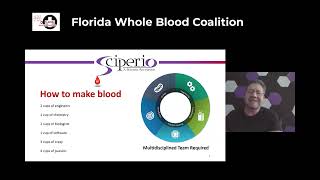
Kenneth Church and Gordon Folkes present two approaches to blood supply: manufacturing whole blood from stem cells using voxelized bioreactors and ferric citrate media, and delivering blood via drones integrated with 911 dispatch. Early data shows prehospital blood transfusion reduces shock and mortality compared to waiting for hospital care.
Questions this video answers
Approximately $80,000 per unit (DARPA early program).
Replaced transferrin with ferric citrate; approximate cost reduction from about $1,000 to about $0.30 for that component (speaker's illustrative comparison).
Human body: ~5×10^9 RBCs/mL; their target cost-break density ~3×10^8/mL; current achieved ~1×10^8/mL in bioreactor.
About 18 seconds (preflight check to deployment initiation).
Safe to fly up to 17 miles per hour sustained winds; above that the system is taken offline for deployments.
Chapters
All right, everyone, welcome. Super excited about today. On behalf of myself and Dr. Pepe and many of us who are on the Florida Whole blood Coalition, including Dr. Jim Roach, Chief Heath Clark and many others, we welcome you. This is our fourth installation of the program and we have seen just incredible movement starting of course with the folks in San Antonio, of course started this whole thing and then into New Orleans and then obviously Broward Sheriff's Office and then Palm beach county and now I have to mention Chief bank out in Texas, who was probably maybe the earliest person to do this. But what we wanted to do was just to have another webinar and just get more people around the table and bring more ideas to the table. However, before we get started, I wanted to just touch on something that's very serious, very unfortunate. Many of you know and heard on the news that Broward Sheriff's Office Captain Teresa Jackson unfortunately passed away.
On August 28th. His funeral is tomorrow.
So let's just take a moment of silence.
And for those of you who can, who can attend, that'd be wonderful. I don't know if Chief Clark or Dr. Roach are on the call. I'm looking to see if they want to say a couple of words. Chief Clark or Dr. Roach, are you. Are either you here?
Okay.
Peter, One of the reasons why it's probably relevant with respect to Captain Jackson is that they were the principal people, the first get blood out there, you know, out in South Florida. And, and they, they were, they're moving it and helping where we are today largely was the, from the pioneer work and, and he was one of that. That was, we did it with air rescue is how we got started. And so it is kind of relevant to us and it's part of our family in a way.
Okay.
So.
Yes, yes, thanks. Thanks Dr. Pepe. And I think many people don't recognize how difficult of a job that, that everyone who's in the field has. And so just great respect and our mission and Dr. Pepe helped with this one. It's worthwhile reading. I'll read it. To develop and sustain an involved, highly collaborative and productive stakeholder group who can promulgate and implement the ongoing use of whole blood and other life sparing blood products across the state of Florida in the pre hospital, hospital and any immediate post injury settings or in any other relevant emergency crises. Using evidence based guidelines to actively contribute to a national Data Registry regarding 911 emergency blood product use. And let's move on to. If you've missed a coalition meeting, you can just use that QR code. We'll send you a follow up email with all the links at the end so you don't have to worry about getting to this.
Now.
This webinar will be in there as well. So let's, let's actually get on with, with the show and, and talk about our intro, the agenda. First we have Kenneth Church, Dr. Kenneth Church from Sipario, who I heard about him on the news and I reached out to him. He was kind enough to come to our, to our webinar. He's going to blow you away about what his company is doing as far as creating whole blood.
Just using stem cells. I'm really looking forward to that conversation followed by Gordon Clinton, folks, iii, who is the CEO of Archer First Response System Drone delivery of blood in the field, which I think is also very, very neat. And then we're going to go around the horn with some people who have been with us on the coalition for quite a while. Lt. Col. Randy Schaefer, Dr. Mark Peel, Dr. John Kramer, Dr. Juan Duchesne, and Dr. Danielle Tatum. And of course I'm counting on Dr. Pepe to help me, as he always does, moderate the session. So without any further ado, Kenneth Church comes to us from Orlando. He is the CEO of sipario. Again, I mentioned earlier what they do, so I'm going to stop my share. Kenneth, thank you so much for joining us. If you want to give a further introduction of yourself, share your slides and welcome to the show.
Peter, thank you so much. I appreciate tremendously the opportunity. It sounds like you guys have lost a very dear friend and so I want to go ahead and salute that. Absolutely. I appreciate that very much. Appreciate the friendship that goes on in this community and the heartfelt sadness right now to the captain and his family. So thanks so much for making that. Peter, before I start, can you see the slides? Are we okay?
Yep, you can see it.
Okay, Roger that. So again, my name is Kenneth Church and I am not a biologist. And so we'll just start with that and, and go from there.
The title of my talk, I guess I went back and I was trying to think about it. Who am I talking to? And I guess I didn't know who I was talking to. I titled how to Make Blood and so maybe I was thinking I might talk to a little simpler people than you guys. So if this is a little too simple, we're going to try to, to beef it up just a little bit to make sure that we hit some things that are interesting to you. I want to give a shout out to my team here, those that are listed super important. Those are the smart people on the team. Those are the people that, that make it happen. And some this is happening right here in Orlando, Florida. We're very excited about what's. What's happening here. And so again, shout out to my team and how that's working. This is not the entire team, but these are sort of leaders in their areas. I also want to talk about sort of the genesis of this and how this happens. So if you're familiar with with darpa, lower left hand corner, darpa, a gentleman named John Mockford was a program manager, and they did what was called blood farming program in 2008. And what the DoD wanted is they wanted to make blood for the warfighter that they might be able to replace. And maybe it replaces is an exaggerated word, but certainly supplement to replace what you could for the war fighter up on the front line. So how would you do that? Because sometimes it gets very challenging getting blood up there. So that was one of the things they did. And just in the very DARPA fashion, they start this off and they were. They were quite successful, very frankly. And so they did generate a number of different cells from, you know, a biological point of view. Started that in 2008, finished that 2011, 2012. And then like DARPA always does, they leave you alone, so they give you a lot of money and then they go away and it goes into the valley of what we call the Valley of death and just sort of stays dormant for a while. You'll get some people who will pick up the research and start playing with a little bit. And that's what happened. And then a number of years later, it actually started around 2019, Dr. Terry Roush from the.
The Defense Health Agency came back in. He said that it was very important, this blood was. So he wanted to pick it back up. He went back over to Dr. Mockford and said, put your team back together. I want to move this forward. And so Dr. Mockford put his team back together, added a few other players in that, and John and I had been friends for a while. And so we came on and you'll see why we came on. We came on more for an engineering reason. There's some things. And it wasn't just engineering, but engineering, chemistry, some science. And so we put all that together. It became very important how we try to move that thing forward. And so this is really. How do you make blood? It's really what I said. Two cups of engineers, one cup of chemistry, two cups of biologists. One cup of software, three cups of crazy, and four cups of passion. It became very important that if you're not just a little bit crazy, this is not going to be a good place for you. Because we have our ups and our downs. Things go well, things don't go well. But overall, what we have, what we have discovered, you need a multi discipline team. You need people who can truly understand all aspects of it. One of the reasons that we have been very successful, very frankly, is our engineers had to learn some biology. That became very important. Our biologists had to learn some science, some engineering. That became very important. And it really got down to this. When the biologists have a need and they try to tell the engineers, instead of using words like I need this thingy and it needs to do kind of something like this widget, the engineers are like, man, I have no idea what you're talking about. So we want the biologists to be able to communicate more clearly and effectively to the engineers. And then the engineers need to do that back to the biologist. Instead of the same thing say, you know, give me some, you know, you want something red that does what to it. It was really more, let me start learning about cells and let me start learning, learn a little bit about cell biology and let me most importantly, communicate effectively with you. And that's really what we're about. So our multi, multidiscipline team works and works very well for one reason we are probably crazy and passionate, but really one reason we have learned to communicate with each other effectively and that became very important. So it leads me to the need. It's, it's really kind of preaching to the choir. Why am I telling you guys about the need? Since you guys live and breathe this every day, but nobody knows this more than, than, than you guys, what the need for blood really is and, and what the challenges are in blood. And so again, we would appreciate all those who donate blood. And, and so the story goes, and there are some challenges in that. And the question is, can we come back in and can we really make a difference in that? That's, that's really what we started looking at. Our mission very, very frankly was not necessarily to put it out that way, it will ultimately be that way, but our, our mission right now, as we have seen, that is to make sure that we are keeping the war fighter in mind. So where this thing starts, and hopefully this is not too foreign to most of us, but a hematopoietic progenitor cell, you know, stem cells of sorts, those things can Start dividing, and they can start deciding what kinds of cells they're going to be. They. And what we do is we want to take those things, expand those out, and then divide those. And so if you look at it from that, from that hpc, from that one alone, it can become a B cell, a T cell, natural killer cell. You're looking at neutrophils, other kinds of white cells. If you're looking at mega keracytes for platelets and then red blood cells, all of that can come from that same, same starting point. And that'd be really interesting if you can start from that same starting point and drive it that way. So CD34 positive are the specific cells that we're looking for. That is our starter cell that we look at. So when we start talking about making blood, some people come back and say, oh, you're making synthetic blood. And our answer to that is, no, we're not making synthetic blood. It is real blood. It's just very young blood. And that becomes a very important concept as we start moving into this thing. This is real blood that we're driving toward. So we start with a CD34 positive cell, and those are typically harvested from. Not there's not just these three, but these are the three main ones, whether, you know, bone marrow cord blood or peripheral blood. What we have found that for, for us, a great source for us is the umbilical cord blood. Mama has a baby, and it's not uncommon to harvest those cells from that. A lot of the parents are given that option. Would you like me to freeze some of those in case something happens in the future? One of the things that we've worked on also is tissue engineering. One day it's going to be very interesting that we store cells, we freeze those for, you know, however many years, and sometime down the line, when we truly start growing lungs, we start growing kidneys, we start growing maybe even complete hearts, you do it with your own cells. That becomes really interesting all of a sudden. And so for right now, it's not weird to harvest from umbilical cord blood. And so when they give you that option, and so what we have found, it's a good source for us because, number one, it's abundant. It's also good allogeneic source. And so what we're really saying is, obviously you're not getting your own cells. Just like in blood, someone donates blood, you're. You're not getting your own blood back. That's, that's. But you, you do want a good Match. And so we could start looking at that and say, let's look at O positive O, negative A, positive A, negative B. Those things are possible. But right now we're going with the abundant O and start looking that way as it reaches across. But it really gets down to this. It is a good source, but it's also young. We talk about that. So if our cells are young, that means what we're going to do also is our product is going to be young, our blood is going to be young, and that can become very important to us also. And so as we start, really quickly, as we start driving this thing, we start with the CD34 positive. You look on the left there, a small vial of frozen cells. And so we say a small vial. We're talking a, a few million cells. And remember, you're talking, you know, trillions of cells, you know, 1 to 2 trillion of cells in a unit of blood. So we're talking about a small vial starting with millions. We saw that, and then we put that into a bioreactor. And I always like to say it this way, you know, when people talk about bioreactors, one of the best bioreactors that we know of is you. The human body. The human body is a great bioreactor and you can punch out a lot of cells. And you do it, you, you do it incredibly efficiently, super efficient. And so what we want to do is, is say something similar to that. What are we trying to do? We need a bioreactor. And so you'll see this a little bit. We're going to try to mimic just a little bit that human body. But then the same thing is we've got to feed it. And so you put the cells in, you have to feed the cells. And that's what cell culture media is about. And, you know, putting that, that in there. And just like, just like the human body has wasted, cells have waste. And so we have to deal with the waste. And then when we come through, we have to filter. We want the good cells to go where they're supposed to go, and the cells that maybe didn't, you know, sit in the nucleated state or, you know, maybe it's a different kind of cell. We want that removed. So we have to filter that. And then you end up with what you have. And that is hopefully, I guess what we'd say are, you know, a bag of, of blood, you know, and that's where we're trying to get to. So what was, what was our mission first off? When the, when the DARPA folks did this, and it was really kind of excellent when they did this. And I'll go back in one slide. When DARPA did this, it was $80,000 to make a unit of blood. And so I don't know if that's going to be very cost effective. I think that might be a problem. I could be wrong, but I think one blood, when they collect and they distribute, it's a little cheaper than that. And so we came back, our mission was really quite simple. We need to lower. Lower the cost and we need to increase the volume. And so it's that same thing. So with our team members, we put it together, we said, this is really where we're going. We're going to drive this thing, starting with the same things with. With, you know, hematopoietic progenitor cells. We're going to have media, put it in a bioreactor, go through a startup, you know, phase, so that we're ramping up this thing running out RBCs or neutrophils. And I put. I list those right now because those are the things that we're the most mature on is in, you know, when we start making things, we have made T cells, we have made natural killer cells, we have made neutrophils. And. But our most mature cell right now is the red blood cell. And we are working with teams right now on platelets as. As well. And so when we looked at it, the mission really wasn't just to make blood. Dr. Roush said, I want whole blood, which made it quite interesting. But then also he wanted it forward deployed, and that became an interesting concept. So forward deployed to the DOD is in a forward operating base, and a forward operating base means it's not coming out of the United States. So if we were having a conflict somewhere overseas, then forward operating base is somewhere overseas. And so what they want to do is they want to make this over wherever it gave them the best advantage. One of the issues that we have in moving blood, you guys know this very well, it's logistics. And so from a logistical point of view, where do I keep the blood? How do I keep the blood? How much does it cost to keep the blood? As a matter of fact, the speaker coming next is part of that logistical train. So that's a very interesting a conversation that's happening next. And so it really got down for the DoD its logistics. How do I move a lot, a lot of blood overseas. And I don't think it's any crazy secret these days, but we're struggling with air superiority unlike we've never had in the past. So in the past, we were just absolutely dominant in the sky. The rest of the world is definitely moving that needle. And so that means when you start moving large volumes of frozen product, it's not only just very expensive, but is now also very dangerous. That's a slow moving craft. And so they say we need to start looking and thinking about this and how are we going to do this? I want you to think about it from an advantage point that you guys might have though. If we can move and make blood in an FOB type position, isn't a hospital parking lot almost FOB or, you know, some things around that? So wherever it's at, it might become really interesting. It's not just the fact that, you know, maybe we're saying this is for the warfighter. We definitely have a dual purpose. And so one of those is definitely a civilian. And so we're going to talk about how we're trying to, to move eventually into a hospital parking lot. But red blood cells and of course, platelets are for trauma. That's what really helps the war fighter if he gets in trouble. But if you're in an operating room and you've had, you've been radiated, you know, chemotherapy, and you're losing white blood cells like crazy to the point that it can be lethal. Neutrophils are almost magic. They can, they can bring you back to life in a crazy cool way. The problem with that, that therapy where you're, where you're extracting neutrophils from a human body and put in another human body, I think there's only two places in the United States that's able to do that. And you have to have everybody on the hospital bed at the same time. You have to have yourself a couple of donors running at the same time. Because these neutrophils are really not very rugged cells. Red blood cells, they're pretty rugged. Once you get them going. You can freeze them, you can thaw them, you can use them. They really are pretty rugged when we make them. You can, you know, stir reactors, you can spin them. They'll handle the shear stress. Neutrophils are not quite the same. They go boom in a hurry and they're made to go boom. That's what they do. They go wrap themselves around something and just. And die. But they take it with them. And so the whole concept of how do I get neutrophils into a human. It's very expensive. It's problematic and even though it's an amazing solution, it's just hyper complex and hyper expensive. So it's not, it's not readily used. If we can manufacture neutrophils, that would change a lot when we start talking about chemotherapy and some of those other actions. So that becomes a very exciting sort of side note in what's happening. So the DoD created what was called the On Demand Blood program. And so that's really where we're at right now. And that's, that's who funds us. Dr. Terry Rauch, of course, is, is my hero. Anybody who gives me money, I'm not going to lie to you, is my hero. And so he is my hero right now to very frankly the tune of several tens and tens of millions of dollars that he has into this thing. And even with that, we're still short of money to, to draw it. And so we keep drawing back against it looking for those, those right resources. So we had a five year plan and at the end of the five year plan, we were going to try to drive into human trials and start the FDA process. And what happened is, well, that nasty thing called Covid came along. And when Covid came along, we got swept and that was a piece of beauty.
But.
And while we got sweat, what we just did is we extended our money and pushed it out in a very skinny way, I guess you might say. We did an amazing job of making progress over the COVID period. Certainly on the RBCs, made some good progress on neutrophils. But as we start doing it, you know, we attacked the natural killer cell, we attacked the T cell, so we attacked some of these other cells in a demonstration phase. But then really where it got down to when you start looking at say somewhere around year two, year three, and so we call those funded years. We are in year three right now, funding funded years. And so we are supposed to start looking at plasma components. And right now that is on hold with us for, for just a bit due to funding. We are funded pretty pretty well on the red blood cell and reasonably well on the new on the neutrophil. And so that is what we're driving right now. They're very interested in platelets. We're working with a couple of folks on the platelet side. People are making platelets and the mega Kerasite makes a really nice platelet that they've seen. That's what they've been able to do. But it wasn't very efficient. You know, one mega parasite for one platelet is, is not A good ratio. And so they needed a lot more. So they had a group that got it out there to 100 for one. That was exciting. But unfortunately, those were not functional. And so apparently you want the platelets not just to be real, but you want them to be really functional as well. And so we're back, back to another team that we're working with that we feel very good about making functional platelets. And then our job is to try to increase that volume. And so again, our job is decrease the cost, increase the volume. And how do we do that? If you look there, we have a little sort of CG representation of doing this in a box. Again, appreciate the next speaker flying the blood around. That's. I think that's a beautiful vision, very frankly. But we also, right now, in our facility in Orlando, our bio lab is in a Conex box. And that is interesting. We actually made a BSL2 Conex box, mostly because that was our mission. And so when you walk into our conex box, you're quite surprised when you walk in because it looks just like a bio laboratory. Pristine, lots of equipment. Eventually, we'd like it not to have to be a BSL2 laboratory. We'd really like a BSL2 in the bioreactor itself. But right now we're sustaining the mission and showing that we are going mobile, and that's really what we're trying to do. So what we've seen is the average human produces lots of RBCs, and the bioreactors produce about a thousand times worse. So what are we going to do? What we came in, we called a voxelized bioreactor. So don't do it all in one big tank divided up. That's really where we tried to go. So that was attack number one. Attack number two was what you feed the cells. Start tweaking what you feed the cells. See if you can lower the cost in. In how that goes and optimize that. So what I want to do is I want to increase the number of cells by what I feed that per milliliter. And if I can do that. So the human. The human body is 5 times 10 to the 9th per millimeter per milliliter. If we can get to 3 times 10 to the 8th, we are at a very good cost break point. We are sitting about 1 times 10 to the 8th right now. By tweaking the. The media. The other thing we did tweak in the media, we said, what if we could replace the expensive things with something cheaper? Transparent is very expensive. And so we replaced it with ferric citrate and we dropped the cost significantly. It's, it's like, you know, thousand dollars versus thirty cents when it comes to transferrin versus ferric citrate as a great move on, on that part. So that became very important when we started doing, and we did that and maintained the performance. So here was the system, we said, okay, but we're wasting a lot. You, you, you feed it, the cells grow, they make waste, and then you get rid of all the waste and you put brand new media in. We said, wouldn't it be nice instead of just putting brand new media in, if I could refurb the media, get rid of the lactate, get rid of the ammonia, keep the rest of the media spike what's gone, and then recirculate it and feed it back in. And we dropped the cost of the media by 80% by doing a refurb recycle. We then went back in and we said to make the separation of the cells, when it says cell media separation and the filters, that became very complex. And so we moved to microfluidics. And if you look here on the microfluidic side, that is a, that is a tiny, tiny chip. And when I say a tiny chip, you could not see the size of those channels. So what will happen is your cells will actually flow into those little, those little channels and spin around. So think about a centrifuge. And that's how you, that's how you separate, you know, it out. Now this is like a centrifuge on a chip. And so when you, when you start moving media through that, when you start moving cells through that, depending on how fast you move through, if you're going very slow, you know, it's just sort of sitting there, you can see it fill in all the channels.
And, and so basically like the, the fundamental theory of how this, how this functions is we've got, each system has a database of 60,000 coordinates that we can send this aircraft to and make emergency deliveries to. So we integrate into 911 computer aided dispatch softwares, which I'll show you in a second. And when a 911 call comes in to the ECC, the latitude and longitude of that particular caller is pushed over to us. And then we respond back to the assignment dispatcher with a point on the map where this delivery would occur and with an ETA as well. From there, the dispatcher can make a determination if they want to deploy this system based on standard operating procedures or based on the particular type of call, and if so, they can click to confirm that deployment. All of our backend infrastructure then does a pre flight check where we look at live air traffic, temporary flight restrictions, advisories, the health of the aircraft, of the housing unit, and the system itself. And if all of these variables are within their accepted threshold, then the aircraft is deployed. And that whole process takes about 18 seconds. So the last kind of piece I want to show you is what that looks like from the dispatcher screen. So I'm sure some people on this call are familiar with rapid sos. We've integrated into their Rapid portal platform. We've also integrated into and our partners with Rapid Deploy in their RADIUS plus platform. But just to kind of show how this works, on the left side of the screen here usually is where the 911 calls will stack up in an ECC center. When you click on a particular call, the map will zero in on that caller. And on the top of the screen there's a Request drone button. So the dispatcher will click that and they click to confirm sharing that data. And what's happening here is they're pushing to us that 911 caller's location. And then we respond back on this map. I don't know if you can see here this little icon where that delivery would occur. The dispatcher can click on that icon. They can see an estimated time of arrival. And then we provide them with a confirmation link like do you want to confirm this deployment? If they click that, then that confirms that deployment initiates our housing unit rolling, open that pre flight check. And then if all those things pass, then the aircraft is deployed. And then we actually stream the aircraft's location back into this map so the dispatcher can watch as the aircraft takes off and makes its way to that particular location. So as the aircraft flies, the dispatcher can relay information to the person on the scene, like, hey, we're sending you a unit of blood, we're sending you a defibrillator, we're sending you Narcan. It'll be on the scene in a minute and 16 seconds, you know, and they can kind of walk people through either CPR or tourniquets, or trying to triage the event in general. Once the aircraft gets to the scene, just like in that video, we, you know, we hover over that scene, we lower that payload down to the ground and the aircraft just simply returns back to that station and lands. So all of this is already integrated into rapid sos. So if you have an agency that uses this platform, we can Literally call the Rapid SOS team, have them toggle on this tool and you'll have it integrated directly into your platform without any change to the platform or to any other systems that your ECC might use.
And we also have simulated versions of this system. So if you're an agency that's like ah, this could be cool, we kind of want to see how it would work.
No problem.
We can spin up simulated versions of this system, populate it with delivery coordinates like you saw, activate it in your rapid SOS portal, and then you can start using it and deploying it to live 911 calls, seeing what the response times would be, see how it work in your dispatch workflow and so forth. So yeah, so that's the rapid SOS integration. It really helps us helps streamline the integrations into emergency communication centers and into agencies existing dispatch workflows without any kind of major change to the dispatch process.
Lastly, I, yep, Gordon, just real quick before you go, there's a few people asking about weather or wind. Can you address that real quick?
Yes. Yeah. So in that automated preflight check we, I thought that I mentioned it, but I maybe skipped that. We do look at hyper localized weather conditions, both current and forecasted, both for the takeoff point and where that delivery would occur. So for a deployment to be approved, improved, we have certain weather thresholds. The aircraft that we fly is safe to fly up to 17 mile per hour sustained winds. So anything above that, we take that system offline and it can't be deployed. But if it's, you know, less than that, then it's good to go. So yeah, so we do look at hyper localized weather conditions, both current and forecasted as part of that pre flight check.
And then, and then the other two good questions are, does it, does the payload, is the payload being dropped or are you landing? And then how many items can be put into the drone at one time? Is it just one payload?
So we lowered the payload down to the ground on a tether. We keep the aircraft. It's actually a good kind of segue into this last video here.
On, on these aircraft we have emergency parachute recovery systems which help facilitate operations over people, property and moving vehicles that are not necessarily a part of that operation. Basically the general public.
So this is just a short video through our certification process of these parachute recovery systems. So if the aircraft were to have some type of critical failure that forced it to fall out of the sky, this emergency parachute recovery system deploys, inflates and then slows the descent of the aircraft. So there's not any damage on the ground or any harm to people on the ground. So kind of back to the question of do we land or do we lower the payload down during operations? We keep this aircraft above its minimum deployable altitude for that parachute just to help minimize the ground risk of the operation in general. So we always keep the aircraft at 200ft unless it's taking off and landing at the fire EMS station. That's there.
Great, thank you.
Yep.
That was. That's kind of like just the last video. The last little piece of content here to share is just us going through this very intense parachute certification process to certify this emergency parachute recovery system on the aircrafts that we operate.
And then the other question that was asked, how many devices or how many things can we put in this payload? So we can carry about six to seven pounds of payload. When we carry defibrillators and Narcan, we put both of them in a single payload and we just deploy it and we load it to the ground and the dispatcher walks the victim through, or basically the lay rescuer through.
You know, which device to use, how to find that particular device.
And so forth. We figured that it's, it's. We don't want to like necessarily over engineer it and take time to swap payloads and have some additional points of failure into the system. We'd rather have a single unit that has everything in it. But. So when it comes to blood transit, you could probably fit one or two units of blood in there along with the cooling systems and so forth. But yeah, so I'll play this video one more time because this kind of shows the US in this video, it looks like the payload is being like free dropped, but it's actually being like controlled on a descent on a tether here. So it's actually being lowered here. And we lower it down to the ground. Yeah, we lower it down to the ground as quickly as we can without causing any damage to the devices inside of that payload.
Yeah, so that's kind of the gist of the system. There's a lot of moving parts. All of the aircrafts and the housing units are all run over at and T FirstNet. So we have the prioritized connection that first responders receive on that network, which is great. But all of this is. It's very real.
It seems kind of like a off in the distant future, but with the rapid SOS integrations, the parachute certification systems and all the infrastructure around it.
This is, this is here and it's here and it's and it's effective, so I will.
So, Gordon, are you. Yeah, are you. And maybe I missed it, but, you know, are you currently live with the AED aspect of it with agencies?
So we have our first two agencies. First one slated to go live this year, second, the first quarter of next year, and then taking them out from there. So first ones will go live this year.
Okay. And then, so it sounds like you're. You're kind of geared up for the AED Narcan items. And then as far as whole blood, what is as far as a, you know, a realistic time frame, number one. And then secondly, if, if. Let's say the hospital was where the whole blood was coming from, right? Because they have the blood bank, they have the storage, etc. How does that look at the hospital side? Do they have to have someone kind of sitting there near, near the roof or the, or the launch point to say, okay, I'm putting the blood in and the drone knows what to do because of rapid sos Is that how that happens or how you envision it happening?
Yeah, exactly. So there's. With these systems, there are standard operating procedures around their operation. So obviously for like, defeat litters and Narcan, the shelf life of those devices and items is a bit longer than, you know, units of blood. So whatever the shelf life of that unit of blood is, maybe it's, you know, 90 hours or so. You know, you'd have to swap and put a new unit of blood in there.
So which, which may you, you know, you may end up deploying a system or deploying a unit out before that 90 hour, you know, mark hits. But yeah, I mean, you could put these systems at a hospital system. We've talked with some agencies about putting them at their blood bank so that the operation is a bit more smooth. You can just, you know, every day or so swap in a new unit of blood. And the cool thing about all of this, because all of these are connected on LTE cell networks, the. The housing unit in the system doesn't necessarily have to be installed at an EMS station. It could be installed at a hospital, it could be installed at a blood bank and still be dispatched by the emergency communication center through rapid SOS or through their computer aided dispatch software. So if there was a 911 call came in, there was hemorrhaging or, you know, some type of event where they needed a blood unit or, you know, that emergency communication center, and those assignment dispatchers would be able to deploy the system directly to that 911 caller's location regardless of, you know, where the initial takeoff and landing location is.
So, so now, now I understand it, what you're saying is that no one at the hospital has to do anything because there that drone is prepackaged with blood. It's, it's in its cooling, you know, it's in its cooler. It's credo, what have you. Delta cooler. And it's just waiting for a signal to be launched.
Human being there.
Yeah, exactly. In a way it's kind of like a cocked and loaded gun that's just waiting for someone to pull the trigger. And when the trigger is pulled, then that database of delivery coordinates is, we do what's called a geospatial query again to determine which one of those 60,000 coordinates is the closest to where that 911 call came in from. And there's a waypoint mission associated with that coordinate. So that mission gets grabbed, uploaded to the aircraft housing unit, rolls open, that pre flight check happens and then if everything is passed, then the aircraft is deployed, runs that mission, comes back and lands. And then you know, then someone would follow a reset standard operating procedure to put a new payload, new blood in the unit and so forth.
That's, that's incredible. The other, some other interesting question is if you have an issue at an airport, you know, we had the Fort Lauderdale airport shooting, Dr. Pepe, etc was there. Does the FAA have any restrictions with you going towards an airport and dropping?
Yeah, absolutely. So there are various different airspaces, various different controlled airspaces. Getting very close to airports is fairly challenging. Especially if you were to fly like into an airport. That would be probably, this probably wouldn't be the best solution for getting blood like directly on a, on a tarmac or something. When we install these systems, that 35 square mile circle we look at basically like what airspace does this overlap and if it does overlap, for example, say we're three miles away from Orlando International Airport. That's a class B airspace, I think from service level to 1500 in that 3 mile distance from there. So to operate within that class B, we work with Federal Aviation Administration. You get what's called a certificate of authorization to be approved to operate within that particular airspace. There might be some caveats from the FAA to get that approval and then, and then you could, you know, move forward and operate from there. There's other airspaces like class G, which are unregulated airspaces where you, you don't necessarily, or you don't need a certificate of authorization, you just need particular waivers for certain rules. From the faa. But yeah. So flying directly onto the tarmac Evan Airport would be probably the. The most challenging place to fly.
Okay.
Yeah.
All right. Well, and I want to bring in Michael Taylor, and if anybody el Please raise your hand. But Chief Moran from Davy says perhaps you could drop it off at a staging area and bring it in by ground, which is another one. So, Michael, come on in and ask Gordon your question.
Can you hear me, sir?
Yes.
Yes.
Hey, Gordon, great presentation. You make it sound like you're sending nuclear launch codes and blowing open the doors of the ICBM silo. The which I hope our federal government has as sophisticated a system for their ICBM's as you do for your drone.
But we're just worried about the UAPs.
So a couple questions. One, I see the video you showed us says TGH on it and also says Manatee county, which I'm in Hillsborough county, so this is my neck of the woods. Do you actually have them deployed there now?
That's one of the initial installation locations that we'll be taking live soon. Yep.
Okay. And.
What about avoiding helicopters? We got a lot of. We have a lot of helicopters flying around Tampa Bay.
The recreational ones, the sightseeing ones, and then a bunch of medical helicopters that are also going to be flying into these scenes. So how do we make sure that your drone doesn't get sucked into the blades of one of my helicopters?
Yep, good question. So that's one of the bigger questions around flying unmanned air systems. Beyond visual line of sight is this concept of detect and avoid and being able to understand where aircraft are in the national airspace and to give way. Basically, unmanned air systems are at the bottom of the totem pole when it comes to right of way. So all of our aircraft have to have the capacity to give way to all manned aviation, the national airspace. So there's a handful of ways of managing detect and avoid. For example, there are some airspaces, for example, what's called a mode C veil. And every. Every manned aviation or manned aircraft in that airspace has to broadcast their location over a radio frequency called ADS B. So we have ADS B in receivers, so we're able to receive that frequency, understand where everything is. And we use that to actually help determine whether or not our systems can be deployed. So when we do that pre flight check, we're actually looking at the live locations of aircraft in the national airspace and determining whether or not there's one within a close proximity of that of that particular flight path that we would fly for that mission. And then if there's not. Then we deploy. And then as we're en route, if there is something that looks like it might intrude and and break a less than well clear barrier, which is basically 2,000ft horizontally or 250ft vertically, then we initiate avoidance maneuvers which might be we're returning home and landing. We might loiter and decrease altitude or we might emergency land somewhere to get out of the way. We also are working like we work with hospital systems for our standard defeat of transit and RCAN solutions. And for example, one of our hospital partners, we work directly with their air care team. And so when we deploy, we actually send them notifications of, you know, where we're taking off from, where we're going, what time it is, what time we expect to get to that location, when we expect to leave, and so forth. So there is a level of coordination with the air care teams as well.
It can be different from institution to institution based on procedures that they follow for dispatch and routing and so forth. But so it's a combination of monitoring air traffic through a variety of different means as well as a coordination between the air care teams and our infrastructure.
Yeah, great.
Thank you.
Great question. Let me bring in Dr. David Miramonte, San Antonio Fire Medical Director.
David, so I have a couple questions. So this obviously is not going to work in Washington D.C. with restricted airspace right around the White House.
It's not impossible, but it's improbable. I would say, you know, usually you do the path of least resistance for rolling out new technologies. And I would say doing this operation in D.C. would probably be the path of most resistance given the airspace restrictions, just as you mentioned. But it's not impossible. It's the type of thing where you request certification or approval from the FAA and that would just be a highly scrutinized certificate of authorization to receive from.
The FAA about around federal bases. For example, I have Camp Bullis in Lackland. Camp Bullis is one of our really remote training bases for Army Air Force in our area. Do you have restrictions and flying into federal reservations like that?
So the cool thing about this infrastructure is that like we like we would lease it to that institution or that agency or whomever it is that's managing that base. And their EMS team would be operating it or that institution would be operating it. So we would help them with the waiver process and if they needed certificate of authorizations. But if like, you know, you wanted to put this on an Air Force base where there's, you know, an airstrip and there's People flying in and out. We would tailor those delivery coordinates to certain locations and the waypoint missions associated with them to make sure that they didn't cause any distress or distraction for the actual operations there. But so it's. That would be more of like a case by case operation. Class G systems, like, you know, if we're here in Florida, we want to, you know, cover a particular part of Osceola county or something. You know, that would be likely a class G airspace. And less, there'd be kind of less considerations than would be putting it on a particular Air force base. But because this infrastructure can be run by whichever agency is managing that area, it would, it would, it would look less like me coming in and doing it instead of, instead of, instead, it would look like me equipping this agency or that institution with infrastructure and then them implementing it. And that would probably be the way that an installation in an area like that would look.
Fantastic. And what is a guesstimate cost? You know, that doesn't have to be exact. What are we talking about?
Yeah, so we try and keep the price between 120,000 to 150,000 annually for these systems. And that includes, includes the infrastructure, the satellite analysis, maintenance, both reactive and proactive. And then that, you know, that provides 35 square miles of coverage with average two and a half minute response times.
So we're not buying a drone, we're leasing it.
Usually like a lease and service agreement is our standard kind of model. But you know, we could sell this infrastructure and then like sell it and then provide a servicing agreement. Aside from that as well, we're pretty flexible. We try and work with sponsors so that agencies can get access to the equipment without like it being a massive chunk to their operational budgets. You know, our goal as a company is to provide as much coverage as possible, really to help prevent cardiac arrest overdoses. And now that we've had so much influx and ask about blood transit and that this is becoming a lot more of a common ask, it's certainly something that we're looking at to conquer as well.
Now, is that 150ish per unit or per region?
Yes, that's per system. That's basically like per 35 square mile chunk. So it's. Yeah, exactly.
Okay, well, it makes sense because if you look at how much we're spending on refrigeration and cooling and all the other logistics around whole blood around a region, it ends up costing, you know, quite, quite a bit of money. So it's very interesting. Awesome. Great. This is fascinating. I'M sure there's a, probably a lot of other questions. One last one that I thought was good. Dr. Siegler from WashU, if there was a change in drop off location mid flight, how does that work?
Yeah, so if basically you could like pop to a different one of those delivery coordinates.
Okay.
So if you needed to adjust, you could, but usually with at least with like the rapid SOS integration, we're getting the, the latter longitude of the GPS unit from the actual cell phone. So it's usually within 50ft of the caller.
Okay, awesome. Well, Gordon, man, this was incredible. Thank you so much for educating us. And I think a lot of people on this call are realizing for the first time that we're like, we're already here rather than just being like some thought process in the future. So you're, we're, we're going to be following who you deploy with here in Florida and if people want to reach out to you, would you mind just putting your, oh, there you go. You put your email.
Yeah, yeah, I just, yeah, I dropped my, my email in the chat there. And we're, yeah, we're looking for partners here in Florida and, and outside the state of Florida as well for all things for defibrillator transit, narcan transit, blood transit, tourniquets, really any type of a time sensitive lay rescue or medical device or even I guess blood isn't really lay rescuer but could be certainly helpful in that scenario as well. So.
Well, the gentleman who asked you the question last. Yeah, the gentleman who just asked you the question that Dr. David Miramonte is if anyone's going to do it, he's the guy. So you guys should talk.
All right.
I was going to ask if they, if we're at a SWAT standoff, can they drop by Pizzas? That's the other thing.
Right.
As long as it's under, I mean a calzone might be easier, just more aerodynamic, you know.
But yeah, great.
Thank you.
Awesome. All right, well, Gordon, thank you so much. You can, you know, we're going to be moving on to the next segment, so we appreciate your time and thank you for joining us today.
Of course. Yep. Have a good one, everybody.
Okay.
All right, excellent. All right, moving on. We're kind of on time here, even with interruptions. We're bringing on next a fan favorite, Lt. Col. Randy Schaefer, who is, you know, been very helpful to many organizations around the country who are setting up their whole blood program. And you know, she's been on our webinar coalition before and I I asked Randy, can you give us a lay of the land across the country? So Randy, take it away.
Hey, thank you for the invitation. As part of the pre hospital blood transfusion working group that I'm working with, I've been trying to closely track the status of EMS agencies across the country that are doing blood air. I don't have a breakdown yet but we do know that by scope of practice it is allowed in all 50 states. Air can be somewhat a fickle industry with agencies coming in, leaving, being bought and sold. So I will tackle that. But I focus primarily on the ground agencies now 115 that I'm tracking across the US and hopefully this is the first look at the type of agencies that are doing it and the blood products that are being used. So right now almost split between fire based EMS and third service that 20% miscellaneous is either a hospital based EMS program. We have several law enforcement agencies now that are doing blood. So again the preponderance being split between that fire based and that third service. Since we I guess last talked. West Virginia now has their ground program up, up and running in Cable County, Birmingham, Alabama has rolled out their blood program. Maryland State Police on the aviation side and I have to give credit to the tenacity and persistence of that program. Doug Flacari and his team I started working with in 2019 I believe to get blood rolled out there. So kudos to them for finally going live on that. And then I see Scott Brainy's on the call that received word that Colorado did receive their waiver from the state to start doing pre hospital blood. So I know he's going to rapidly add to our map that we are building.
Looking at the types of products that the agencies are using. Predominantly low titer O positive whole blood with a few agencies out there that are doing low tidal negative whole blood followed by PRBCs and plasma. There's 5% that I was not able to track down the types that are using but.
Those are the big players. There is no centralized reporting mechanism. It really has relied on personal correspondence. I know I've sent you emails and text messages and phone calls on this group trying to track down the accuracy, some Internet searches and social media. So if you're tracking a program that's coming up online, if you could definitely let me know that Eric bank is also working with me on this. We're getting this mapped out and we'll hopefully have a publication here in the next month or two. Going out to the Journal of Trauma on behalf of the national program that I'm working with. Let's see.
Awesome. And so if. If people want to reach out to you and, and, you know, just to get your advice, etc, they can email you here.
Absolutely.
Also, I saw, Randy, that you posted this. I added this slide. You posted this a few weeks ago on LinkedIn that the international association of Emergency Medical Services Chiefs put out a very nice, strong statement about it. You want to comment on that?
Actually, John is. John Cromer is on the line. I know he engaged directly with them.
Okay. He's coming up next. Perfect. Awesome. So, Randy, any. Any last thoughts or. I hope I didn't cut you off there.
No, you're good. The question of leuko reduced. Non leuko reduced. I'm not there yet. But as I continue to build the relationships with these agencies that we'll be able to find that answer. We're also working as part of a national project with America's Blood Centers and American Red Cross, and they're getting ready to send a survey out to their blood centers to try to get a little bit of clarity on the types of products that they're providing for their prehospital clients.
Excellent.
And Dr. Duchesne, you have a question? Go ahead. For Randy.
Yeah, I don't have that much of a question. I just want to make sure that we actually push all these efforts that you're putting together into legislation because you have enough data that we can potentially start looking at disparities in care. And I think that it is our job as a coalition to show legislation and all these people in Washington, D.C. of the disparity in outcomes between patients are getting blood and those that are not. And we need to standardize this. We need to stop the politics. We need to start putting money where it belongs. And I think that you have the tools to do so. So let me know how we, as a coalition can make this happen.
Absolutely. Thank you. And John will talk a little bit more about the national efforts that we would love to get you and some of the registry involved with.
Oh, I love to fight with politicians. Put me on.
All right. Well, this. This one you won't fight with. He's an incredible human being. So we all know and love Dr. John Kramer, who is immediate past director of the Office of EMS at nhtsa. And, you know, he. He just couldn't retire, and he's really engaging in this, in this arena. So. Dr. Kramer, thank you for joining us. And please give us an update.
Well, thanks, Peter. We really appreciate it. And it. It is very exciting. And, and encouraging not only the activities that you've got going on in Florida, but North Carolina, Colorado, Texas obviously, and a number of other states. The National Coalition initiative has been very busy over the last couple of weeks. We did a briefing to the National EMS Advisory Council a couple of weeks ago, did a briefing yesterday to the Federal Interagency Committee on ems. As Randy mentioned, we have had some follow up meetings with aabb, the American Blood Centers and the American Red Cross, not only to gather information to supplement what Randy is working on, but to make sure that.
They are.
Will be.
Participating as integral components of the National Blood Coalition that Randy alluded to. We are very optimistic and hopeful that the formal announcement and press release will go out to the community, including your coalition, other coalitions, the national organizations that we've been. We've had outreach. With the press release going out next week, we're hoping to start meetings of the four pillar working groups within the next several weeks as well as the larger overall coalition. So what we're looking at right now is formal announcement early next week, followed by what will probably be a very informal survey to identify a best option date for a meeting within the next four to six weeks. And then we'll get things rolling very aggressively. So again, this coalition is being formed just to bring anybody and everybody who is interested to the table. Talk about issues, talk about activities, talk about legislative issues, reimbursement issues, scope of practice issues, and help to coordinate the activities so we can try and make all of these things happen very, very quickly. Anybody has questions or.
Want more information, please email me and we'll make sure that you get included on the distributions.
Thank you, John, so much. I can't tell you how important it is to have you making those movements at the national level at the same time as some of us are doing it on the ground level. And then you have people like Randy and Dr. Duchesne who are kind of the glue, that are kind of helping everyone understand the power behind it, looking at the data registries, etc. And let me bring in Dr. Pepe Paul, you have any comments?
Yeah, Randy, I think Dr. Schaefer.
Had said something about that. There was a statement, a position paper coming out from the Fire Chiefs Association. Is that right, John? And said you knew about it.
Well, yeah, actually the, the statement that was referred to was by the International association of EMS Chiefs. There had been a joint policy statement on hemorrhage control, including the use of blood products. The joint statement being ASAP and AMSP and the American College of Surgeons. Committee on Trauma.
Okay.
Following along that line, the IAEMSC put out their position statement just a couple of weeks ago, which is very consistent with and very supportive of the other positions decision. Statement.
The reason I was asking is because I've been tasked to write up something on behalf of the Metro Chiefs and the Urban Fire Forum. And so as a result I want to make sure it's in sync and whatever is going out there, I'm saying the same language. It'd be great to have those. That'd be good. You got it.
Awesome. Thank you so much.
You send those along to me and I may call you later about it as well. So.
Okay.
Okay.
Yeah. Yes. Okay. Awesome. Thank you so much. That was incredible. Update. And now we're going to move into the data side which is, you know, really extremely important. Yeah. Yes.
If I can just interrupt because I just.
Go ahead.
Saw the chat question there about reimbursement or funding issues and yes, that is one of the pillars that we're working. We will be working very aggressively and we've started some preliminary work, but it'll be working with the community, federal agencies and, and potentially Congress.
And by the way, if this drone thing works and it's at a hospital, the cost of the blood goes away. It's now not an EMS problem. Storage cost, reimbursement, it's all on the hospital side. So that's why I really, you know, love this. That's this idea. So. Randy, you want to say something?
The only reimbursement that's currently available is with hospital based programs, whether they're air or ground.
Got it.
Yeah. Career costs are real. I had the opportunity to spend a couple days in North Carolina and atrium Wake Forest Baptist in Winston Salem. I can't believe I got all that out. They are actually a hospital based system that is supporting pre hospital blood and they're spending thousands of dollars a month on courier fees. I don't know if we should get that recorded in case the administration figures that out at the hospital to send the blood out to these rural agencies to support it. So courier costs are a real thing?
Yep. All right, excellent. So let's move into the data. One of my favorite people, Dr. Mark Peel, pediatric ICU physician, EMS medical director, founder of 410 Medical the Life Flow. Mark, you have been working with the registry and I'm gonna have Dr. Duchesne come on right after you. But if you can, I know you have some exciting data to talk about if you wouldn't mind.
I do. Peter, I'm Trying to share my screen. Am I allowed?
Yeah.
Here we go.
Yep. I made you a co host.
I have the privilege of working with Tom Dransfield and others and Wandu Chesney in New Orleans on some of the exciting data they are.
Working on and producing through their program. Can you guys see the screen? Okay?
Yeah.
Yeah. So Tom, if you're on, maybe you can kind of speak to some of your recent numbers. Almost 200 administrations since you started your program. A lot of exciting outcomes which Juan will detail here in a second. Probably too much data to go over.
Here.
In the time we have, but just exciting to see what in short transport times with a severely injured population afflicted by pretty high rate of gun violence. What you, what outcomes you guys are producing. So Tom, do you want to comment here on, on some of the, on some of the numbers?
Yeah, we're like I said or like.
You said, we're like 196 as of like yesterday. I think we had another one this morning. So. And that's holding pretty consistent. If you see our numbers for 22, the whole year was 104 total administrations.
So we're 77, 78 right now for the whole year.
This year so far we go in spurts and Dr. Duchesne could probably go speak to that. We'll have like some months we're having 14 or 15. Just bam, bam, bam. And then like then we'll hit a lull and that's.
We've.
We haven't had any administrations for a while, but yeah. And then, you know, it was like we're just. Some of the things we're looking at is like people ask all the time what our initial access is. And so I did a little comparison of that of the 196 of them. So majority of them are either peripheral IVs or humeral head.
So I owe interosseous.
So that's a curious thing that they wanted to look at. And then the airway question is always there if they were innovated before or.
Had some kind of advanced airway before.
They, you know, whether they got CPR or not.
So that's just some of the stuff we track. And then got some updated heat maps. But this is an older one through July.
But you can see we're kind of.
Spread out throughout the whole city. It's not just one geographic area where.
We'Re having all of our shootings. So it's just kind of all over the place.
Well, thanks for what you're doing, Tom. It's super exciting. I think notable here we'll show you in the data. But in the group that got blood, the rate of pre hospital intubation compared to before you started has gone down a lot. So the value of resuscitating before you intubate. And remarkably almost half of the patients are getting their blood through a humeral head IO. So that's pretty interesting as well.
I'll let Juan address some of the outcomes here. But just one of the studies that we worked on was looking at a cohort of patients who got the whole bundle that the New Orleans team is giving, which included 2 units of PAC cells, 2 calcium, 2 TXA for penetrating injury and shock hypotension. And in these studies the isolated head injuries and pre hospital cardiac arrests were removed. And in this first bit of data which I think we discussed briefly on the last webinar, we just looked at shock index reduction from hospital, sorry from scene to hospital. So pretty dramatic improvement in shock with that bundle being administered in about a nine minute transport time and a fairly low mortality, unexpectedly low mortality rate among these super sick patients, low rate of need for advanced airway as well.
And then something that we are putting attention right now, this is what we call the platinum first minutes after injury in hemorrhage patients. And we're going to try to put this as a statement paper out there because what we're noticing is obviously everybody's talking about the death diamond, which is the acidemia, hypothermia, cognopathy, which is nothing new. But now we are adding hypocalcemia. And as you know, hypocalcemia correlates with clotting factors and it correlates with contraceptives, ductility of the heart. So when we give more in hospital blood and this group of patients that are already hypocalcemic coming from the scene, that actually might be a problem. And what we are going to start looking at in the future studies the impact of the ARC that we are doing in with early refill and the death diamond so that there's more to come. I just wanted to put that as a prelude of what we're doing because what Mark demonstrated is that the mortality for patients that actually had signs of life on on the scene actually have dramatically go down and that we will be presenting that data at double HD on Friday.
And I want to. Can you guys see this screen? I have a Word document. Can you guys see that screen?
No, I'm sure reshare it.
Yeah, we still see your PowerPoint. You got to go New Share.
All right, new chair.
Here. All right.
Let me know.
Yep, we got it. See it?
Right, so. So this is the other hot study that actually got accepted as Southern Surgical to be presented in Virginia in December. And actually we were looking at the impact of early intubation in. In the pre hospital setting in patients that had severe hemorrhage, which is totally less than 90. And this is from pre hospital. This is not in hospital. We demonstrated that in hospital. It pissed off a lot of people. But that's. It is what it is that actually the mortality went up in those group of patients. But then the question was what really happens in the pre hospital. So we look specifically at that and when we put circulation first versus intubation and in this group of patients we had intubation first in one group. Actually we have it here. Intubations first in one group versus resuscitation first in one group. Okay. The mortality 13% versus 47%. Now pay attention to this. This is huge. And it almost pisses me off because actually what I'm telling you guys is that this might be iatrogenic, meaning we are causing this. So that might be an eyebrow razor for a lot of people. Enough is enough. And I think that if we prove that, I mean we already proved that this patient had the same demographic systolic clinical indices. One group received proper attention. The other group was just tube. These are patients without TBIs. And look at this mortality. This is huge. When I saw this finding, I was very pissed off. Actually the resident that worked with me, he was kind of scared of me because I tell him this is, that's criminal. There is a big problem with that. And anyhow, I just wanted to say that out the pre hospital circulation first approach was definitely survival. It conveyed protection to patients with severe hemorrhage. And as you can see, this is the problem, this GCS, right? We are basically looking at the GCS in this group of patients maintaining less than 8. We need to intubate them. No, the answer is no. We need to give them what, what is going to increase their gcs. And that's blood. That's not intubation. Let me know if you see this other word document.
Yeah, we see it.
All right, this is this one we submitted to Western Trauma association where we put here every minute counts extending the continuum of care through early pre hospital blood administration. So obviously I would love to give you more information about this, but this just got submitted. We still don't know if he's going to be accepted or not. So I Just wanted to just quickly give you at a glance what we find out. And this is one of the things that we find out. We basically look at the patients that receive pre hospital blood versus the ones that receive in hospital blood and no pre hospital blood. And we develop a timeline on this. And what we demonstrated is that the mortality in the prehospital blood was still in the 11%. And this is in hospital mortality and for the controls was 35%. Voila. That's the number has been reported over the last two decades. Right. So this is the first study that actually when we look at this, the time of blood administration, it creates a huge impact. Not rocket science, but it needed to be right on a paper. And this is, I think that I just want you to, I want to share with you the conclusion that we had, which basically compared to patients who first received blood after hospital arrival, resuscitation with blood products was started 19 minutes earlier. Put that in the back of your brain 19 minutes earlier. After initiation of pre hospital blood program. Despite a five minute increase in pre hospital time, a survival for early pre hospital blood was demonstrated with an 11% mortality increase for each minute delay to blood administration.
Wow.
And I would love to drop the mic, but.
But this is where we are, team. This is the legislation we need to keep pushing for, to make it standardized and for those, you know, the determinants of health are real and we need to pay attention to which community we're going to be affecting and helping with this. So that's all I have now. Peter, before I finish, I have a quick update. I have Northeast Georgia Med Center Tenant Health, Memorial Healthcare, Luton county, our left leg and two lane six centers right now that have approval to put data. Now I need champions to start putting the data. So I want to know when we can get those champions that if you have names of those champions, please forward to them. We need to start putting information into the data.
I have Candace, before I get Dr. Pepe in here. Candace Pineda, Trauma Coordinator, Memorial Regional Walking through the emergency department right now. Can you answer that?
All right, so at Memorial, in our exchange program or which piece.
At Memorial as far as putting data in on each trauma patient coming in, Right, Putting it into the registry.
Yes. So the hardest piece is obviously getting through the legal and the duas and everything.
But once you do that, it's very quick and easy.
They send you the spreadsheet of things that you need to enter and you can enter it through redcap.
The data elements I can pull up for you.
But it's all of our pre hospital vitals, our first set of vitals, all.
The interventions that we're providing and our.
Resuscitative efforts and vitals.
So are you, are you the champion at Memorial Regional Kansas? Who's doing that? And I see Madonna chiming in at St. Mary's is that a you thing?
Yes.
Okay, awesome. And Madonna, that's a you thing at St. Mary's Yes. Okay. So it looks like we have our folks covered down here. But Juan, if those other locations, I believe that we know the folks, you know, especially at Loudon and other places. We're happy to reach out and help out. Just, just, just let me know.
Yeah, no, that's, that's, that's the purpose of this. So thank you so much. And as soon as we start gathering data, we're going to start putting some numbers out there so people can see a bar graph or where we're headed with this.
Can you, can you do me a favor and just repeat the list of, of of locations one more time so that because I see Brandon's going to help out with Northeast Georgia tomorrow.
Yeah. So Northeast Georgia Tenet Health Memorial hourly of the lake and I'm assuming is Memorial Loudone County. Is that the same or is that's two.
That's different. Loudoun County. It's Virginia. Yeah. Okay.
And then.
Yeah.
Okay. All right. So. So definitely I believe that the chief from Loudon was here.
Mark?
Mark, are you still here?
I'm here.
Yeah.
I don't see him.
No, no, no other Mark.
Galino is it isn't. Is it anyway I can reach out to him. Dr. Pepe, let me bring you in.
And Dr. Dr. Duchesne, just a quick plug for the next trauma symposium in South Florida or whenever we can bring that ARC training to South Florida will be happy to champion it. We know a lot of people that would be interested to taking on the whole resuscitative in the field.
Yeah, send me the invite. Candace, I would love to be there and I will urge to invite Tom. Tom Dransfield is the, you know, is the heart and soul of the system here. So we need to have him involved. He's a great person.
Okay, thank you.
Mark from Loudon. You unmute yourself. Are you guys, are you guys submitting data into the registry yet?
Not yet, Peter. I'm still kind of tied up with a couple things. I mean I'm tracking everything. I just haven't had a chance to.
Dump it in yet.
It should be someone on the hospital side though to do that. Right. Not the.
Oh, yeah, okay.
Right.
Because.
Email from someone from Tulane.
I'll have to reach back out to.
Them to clarify everything, so. So I know exactly what I'm supposed to be doing.
Yeah, I'm gonna put down here my email so everybody can have it.
Okay, thanks, doc.
Awesome. All right, let's. Let's close it out. Dr. Pepe, how about some final comments?
Well, I just want to remark a little bit on what Dr. Duchessio, as you remember, I think a month or two ago I was saying we need some data on time, you know, to get the blood product on board. Because people are saying, oh, we're in an urban area, not a problem. We get to the hospital really quickly. So I think that's really critical. The other reason why, if we really are preventing intubation from happening, because you're keeping them from getting that sick and getting more bund on us and we have to tube you. Once you put the tube in, then there's so many other complications, especially in a hypovolemic person who is more susceptible to positive pressure ventilation effects on intrathoracic pressure, you know, in preload. I mean, they're hypersensitive to it, so it'll have that effect, let alone issues about VAP and all the other complications that you're preventing and forgetting inside. And cost, by the way, which is a good point right there about that.
Oh, Dr. Pepe, I think we are.
In a bad area, so I'm zooming into later. Lastly, on the calcium thing, I thought it would be really good to make sure maybe we do have some data. Maybe I need to learn. You can get blood products, are they hypocalcemic and how often and is there any correlations with that? And I think I'm understanding, but even more so important here to know just. Just being hypocalcemic up front, even without blood in the citrate and so on, is an important thing to make sure we collect more data on, I think.
I don't know.
Do you agree with that, Juan, or what do you think?
Yeah, no, I think we need to have our next discussion. Just a topic on calcium and what. How it goes down and what is impact of that?
Just a quick observation from our data we've noticed and Tom is the one that actually brought this to me.
More from Peter




Melissa Olen MSN, FPN-C, CCRN: Sudden Cardiac Arrest Training in Schools (Project ADAM) 4/25/25



Pediatric Hospital Readiness: How Teamwork & CPR Metrics Drive Better Outcomes



Chelsea Kadish, MD & Kyle Goodknight, EMT-P, RT: Pediatric CPAP in EMS (3/14/25)