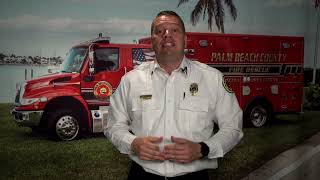
Palm Beach County emergency responders learn why starting chest compressions immediately beats waiting to apply the LUCAS device. Local data shows faster time-to-first-shock with manual compressions, and the target is 90 seconds. Witnessed arrests survive at much higher rates than unwitnessed ones.
Questions this video answers
90 seconds
2 minutes
2 minutes 45 seconds
5 minutes 27 seconds
10% per minute
Chapters
Today we're going to take a look at cardiac arrest. We're going to review some data, and we're going to talk about some ways that we can improve our service delivery to the people here in Palm Beach County. So let's go ahead and start off with cardiac arrest in patients that when we arrive on scene, maybe compressions are not being done. Unwitnessed cardiac arrest. In unwitnessed cardiac arrest, these patients have a typically a poor outcome. Their chance of survival goes way down in unwitnessed cardiac arrest. However, in witnessed cardiac arrest, these patients have a much higher potential of surviving this and being discharged to going back to a CPC, which is a cerebral perfusion score of 1 or 2, which basically means they go back to almost a normal life afterwards with very few issues afterwards. This is always our goal in cardiac arrest. Remember, it's not about how many people we get to the hospital with pulses. It's about how many people walk out of the hospital alive, functioning, contributing to their family, to society. That's our goal. That's always our goal. So what that tells us is that hands on the chest is crucial to these patients surviving. So we want to take that train of thought into what we're talking about next. And first off, this is going to be the importance of hands on the chest early on in cardiac arrest. When we arrive on scene. Whether you arrive on a rescue or an engine, your primary function, number one function, needs to be getting hands on the chest as soon as possible. The second goal, and nothing can ever get in the way of the second goal, is early defibrillation. The studies are in complete agreements on this. Early defibrillation saves lives. This is something that we need to be concerned with because a lot of times we have that tendency to want to go ahead and grab the Lucas device and get the patient on the Lucas right away. And I want to go ahead and ask you to go ahead and slow down on that. Let's get the Lucas on. After our first shock, hands on the chest is crucial to positive outcomes. As a matter of fact, when we reviewed our data here in Palm beach county, one of the things that we found, whenever we put hands on the chest, the time it took to deliver the first shock with just manual compressions was 2 minutes and 45 seconds. If we waited until after the Lucas application, that time got extended to 5 minutes and 27 seconds on average. And obviously, there's going to be some shorter and some longer. We do not want to be in that business. We want to make sure we get hands on the chest right away, and early defibrillation happens as soon as possible after that first shock, or maybe you dump the shock because they're not in a shockable rhythm, then we're going to go ahead and proceed with putting the Lucas on. So those are going to be our goals. The next metric I want you to be aware of is our goal for 90 seconds from patient contact to first shock. This needs to be a priority for every single person coming off that apparatus, whether engine or rescue, no matter where the patient's at. And I know there's always situations that are just not achievable. That's why we're going to extend, extend that to two minutes as a minimum standard. But our goal needs to be 90 seconds from patient contact to first shock. So what that means is I should be leaving that Lucas off to the side while manual compressions are being performed. And we put the pads on the patient and immediately take a quick look to find out if this patient's in a shockable rhythm. For every minute a patient's in a shockable rhythm, their chance of survival goes down by 10, 10%. And as you know, our response times being what they are, we're not there right away. And if bystander CPR was not being performed while we were responding to the call, that patient's chance of survival goes way down. So witness cardiac arrest with bystander cpr, their chances of survival going go way up. So now let's talk about how we can achieve this. We come off the truck, we just need our gear bags and we need to make patient contact assessments soon as possible and get hands on the chest immediately and try to get that first shock delivered within 90 seconds. That second arriving unit can show up, they can get the stretcher out for us, they can get everything that we need to continue this code. What we got to do as a first arriving unit is have your immediate gear bag so that you can defibrillate and that you can start to run this code and then everything else comes in after that.