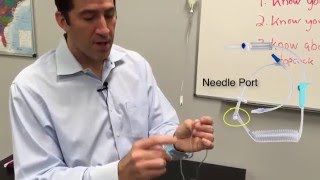
Peter Antevy covers three essentials for giving adenosine: know your IV tubing, know your syringes (luer-lock vs non-luer), and know how to use a three-way stopcock. The video shows why non-luer-lock syringes fail with needleless ports and demonstrates the preferred setup for rapid adenosine delivery followed by immediate saline flush.
Chapters
Hello, my name is Peter Hentevi. Welcome to another edition of the Hentevi Minute. Today I want to talk about adenosine tips and tricks. The three important items for adenosine in order to do it correctly. Know your tubing, know your syringes, and then know about the three way stopcock. So let me show you what I have today. It's all you'll need for adenosine. You have your normal saline bag, your IV tubing. I have a vial access cannula, which I'll show you in a minute. I, I have a 1cc syringe without a Luer lock. I have a 1cc syringe with a luer lock. Here's my normal saline flush and a three way stopcock. So let me talk about the tubing which is very important. What tubing do you have at your agency? It turns out that different agencies have different tubing. So you can see that here we're going to the patient. The port here is a luer lock port, needleless port, and you also have here, this is the needle port. So you can see here that you cannot put a needle through here, but you can put a needle through here. Now that poses a problem with adenosine. And let me show you what I mean. If you use the needleless port with a non lower locking syringe. When I put this in, it just wants to pop right back out. So if I let it go, it will just jump out. So if you have this type of syringe and this type of port, you could still use it, but you have to hold it down and give it. That's a problem. I would recommend Instead having the 1cc syringe filled up with your adenosine. If that's what the dose calls for. You can simply then lock it in and there's your adenosine in your port. So now what do we do about the flush? You can see here that the flush will not attach because it's not a luer lock. And I don't recommend using a needle here. So what we can do alternatively, we can use what we call a vial access cannula, which I'll do now. The vial access cannula is what we do to remove medications from the vial. But in this particular case you can use that through this port. And now you have your complete system that you can flush, flush and you're in. But there's a better way and I want to show you that way. So let's take this off, put this down and let's show you how to set up this whole system with a three way stopcock. So here's your adenosine that goes here, here's your flush that goes here. And then the key is to have this off to nowhere, meaning it's a completely open system. This is open, this is open until the patient will be open. And watch what we do here. We can come to the luer lock port right here. We can simply attach the whole concept here. And now, because this is open everywhere, you can squirt and then flush right away. And watch how I do this. You pinch off here.
And then you're going to flush and then flush your medication. And now you've given all your medication very quickly through a completely open three way stopcock because this is off downward. And so try this at your agency. If you don't practice this, you won't get it perfect. And I think that if you know this and how to do this, you'll treat SVT on scene. And again, that was the hen tevi minute. Thank you very much.