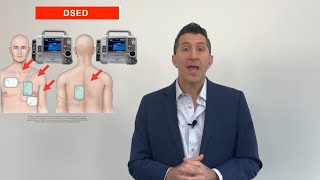
Dr. Peter Antevy explains double sequential external defibrillation (DSED) for refractory cardiac arrest. A 2022 trial found DSED produced more than twice the survival rate with good neurologic outcome versus standard defibrillation. The technique involves placing a second defibrillator pad set perpendicular to the first and shocking simultaneously after three unsuccessful shocks.
Questions this video answers
Over 350,000 per year.
Just over 140,000.
17%, approximately 25,000 patients.
Between 85% and 97%.
April 1, 1994, by Hoak and colleagues (Journal of the American College of Cardiology).
Chapters
Hey everyone, it's Dr. Peter Hantevi. Welcome to another edition of the Hantevi Minute. Today we're going to focus on cardiac arrest, specifically the treatment of refractory V fib. By now you know that in the US every year over 350,000 people suffer out of hospital cardiac arrest. According to the most recent 2023 CARES data, just over 140,000 of the over 350,000 arrests had an attempted resuscitation by EMS. As an EMS Medical Director, my team and I look at every single arrest and what's become very clear is that the patients who have a witnessed arrest and an initial shockable rhythm had the highest chance of survival. So going Back to the 2023 CARES registry, amongst the over 140,000 who were arrested, only 17% of them, or about 25,000, had a shockable rhythm. From an EMS perspective, if you arrive on scene and have a patient with a witnessed arrest who presents with a shockable rhythm, that's the patient with the best likelihood to survive. So what you do on scene and how effective your BLS care is will impact survival in this group more than any other group. But here's the question. What should you do if your patient remains in VF even after the standard three shocks? Well, this is exactly the situation EMS Captain Darwin Zelaya and his crew found themselves in at Palm Beach county fire rescue just one month ago. They arrived on scene to find a 74 year old man in cardiac arrest on the tennis court at 8.30am the tennis pro and another bystander were performing CPR and already shocked the patient twice. Our crew shocked him once more and then moved to double sequential defibrillation. How did I know this was happening? Well, I got this text from my father in law who was playing tennis on the next court over. Knowing that he was in Palm Beach County. I knew that we definitely weren't going to give up on him. Let me ask you, what do you think would happen to a patient like this in your community? What's the first question the ED physician would ask you when you arrive? You know the question, how long have you been working the patient? And in many cases they would hear your answer and just give up hope. And the data shows that the mortality associated with refractory VF ranges from 85 all the way to 97%. We owe it to our patients to do more. So what other options do we have? One option is vector change, meaning changing from standard pad placement to to anterior posterior pad placement. Another option is adding a second Set of pads and shocking the patient with double the energy in sequential fashion, pushing two buttons as close together as possible. Our patient from the tennis court. He was pulseless for 30 minutes and fortunately regained a pulse prior to arrival at the ed. I'll tell you how our patient did in a bit, but let's talk about DSED when it was first described and what the latest recommendations are. Believe it or not, on April 1, 1994, the first case series of double sequential defibrillation was described by Hoak and his colleagues in the Journal of American College of Cardiology. All five patients were in the electrophysiology lab and had already received between seven and 20 standard shocks before receiving a single double sequential dose. All of those patients survived. Neurologically normal. What a way to get out of the gate. Since then, there have been seven more case reports. If you add all these case reports together, there was a 48% survival. That's pretty impressive. But then in 2019, a study by Beck and colleagues compared 71 DSED patients to 239 patients receiving conventional defibrillation. Now, all the patients in that study had received first at least three standard defibrillations. They found that DSED patients had a significantly lower rate of rosc and they concluded that DSED may not be beneficial. But here's the important thing to note. If DSED is used too late, it's not as effective. And in many of the case reports, DSED wasn't being used until late in the code, not right after the third shock. And this is why we needed a well done randomized controlled trial. And for that we looked north to our friends in Toronto, led by none other than Dr. Sheldon Cheskes. If you don't know Dr. Cheskes, he's one of the most brilliant minds in EMS and he tackles difficult questions with well designed clinical trials. To answer the question of what to do for a refractory VF, Dr. Cheskes and his team conducted a cluster randomized trial with crossover among six Canadian paramedic services to evaluate DSED and vector change defibrillation, comparing it to standard defibrillation. These were all in adult patients with refractory V fib during out of hospital cardiac arrest. Patients were treated with one of the following three techniques, standard defibrillation, vector change defibrillation or double sequential defibrillation. The primary outcome, survival to hospital discharge. Secondary outcomes included termination of vf, ROSC and most importantly, a good neurologic outcome. Over a four year period, a total of 136 patients were assigned to the standard defibrillation group, 144 received vector change and 125 received vector double sequential defibrillation. The results were significant Survival with good neurologic outcome was more than two times more common in the DSED group than the standard group. And what about vector change? Well, while it yielded more survivors in standard defibrillation, there was no difference in neuro intact survival. This study was published in the prestigious New England Journal of medicine in November 2022 and has since been added by both ILCOR and the AHA as a recommendation if three shocks have not converted the patient. But remember that if these patients arrive to the ED still in vf, there is a very high likelihood that they will not survive. So if you have the resources to bring a second device, I'd strongly recommend that you do. Dr. Cheskys and his team have also created videos on how to use two AEDs or one AED and one monitor defibrillator to accomplish DSED in the field. We'll have a link to all those resources at the end. His team's contributions have been very impactful and we are all very grateful for what they have done. Now I'd like to end by telling you the outcome of our patient on the tennis court recall. He was pulsars for 30 minutes but he'd been receiving high quality CPR within minutes of his arrest. He was unconscious for nearly a week and then began to respond to commands. Then came the moment that we'll all never forget this video just a few days ago when he was moved out of the icu. Here he is rocking out to the Chicago song getting stronger every day.
And there's music Chicago.
He'S sitting.
Outcomes like these take a village and we are so thankful to the bystanders, the dispatchers, our incredible EMS personnel at Palm Beach County Fire Rescue, the hospital staff at Delray Medical center and all those who cared enough to see our patient live to see another sunrise. Take this story to heart and make DSED part of your practice in your community. Implement strategies that give your patient a fighting chance to survive. And as we approach April 1, 2024, the 30th anniversary of the first DSET publication, let's remember our goal to be the kind of fools who bring laughter and joy not just through our life saving efforts, but by enriching the lives of survivors and their families. This has been Dr. Peter Antevi. Thank you for joining me. It.