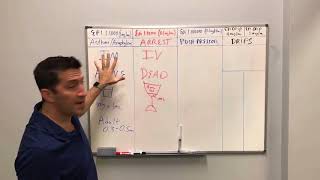
Dr. Peter Antevy breaks down epinephrine formulations and when to use each. 1:1,000 goes IM for anaphylaxis and asthma. 1:10,000 goes IV for cardiac arrest. The video includes recipes for diluting and dosing by age.
Questions this video answers
1:1,000 (administered IM, lateral thigh).
0.3 to 0.5 milliliters (adult); pediatric doses are smaller.
1:10,000 (IV/IO for arrest).
Take 1 mL of 1:1,000 epinephrine and add 9 mL normal saline (resulting in 1:10,000).
Description: withdraw 9 mL from a prefilled epinephrine syringe, then add 9 mL normal saline to produce the more dilute solution (verbal recipe in transcript).
Chapters
Hey, everyone. My name is Dr. Peter Hentevi. Welcome to another edition of the Entebi Minute. I wanted to put the epinephrine picture in perspective all over again for you guys. I think this is very important to understand what type of EPI you're going to use and why you use it. So let's start with the basic outline of Epi 1 to 1000, which we know use for asthma and anaphylaxis. Epi 1 to 10,000, which we know use in arrest. Epi 1 to 100,000, which is what we call push pressure. Epi. We'll get to that in a minute. And then, of course, you have the EPI drips. Let's start with each of these one at a time. Let's start with EPI one to one. We know that you're going to be using this for asthma phylaxis, and you're going to be giving it im. Now, this is IM Lateral thigh. And of course, these people are alive.
Think of EPI 1 to 1000 as very concentrated. That's why you have to give it in the muscle. And think of it like a shot of tequila, right? So tequila is pure alcohol. Epi1.1 is pur. Epinephrine. And that's important because every milligram equals one milliliter. Okay? So for EPI 1 to 1000, you know, you're giving a very small amount to a lot of people intramuscular. And remember, the adult dose.
Is 0.3 to 0.5 milliliters. So the pediatric dose is going to be less than that. Okay? So you'll never be using anything but a 1cc syringe. Okay, now let's talk about EPI 1 to 10,000. EPI 1 to 10,000 comes from EPI 1 to 1,000. They just had to make it more dilute so it can actually go into the vein. It's the only reason it exists. Right? So what they did was they took this epinephrine and they actually made it into a margarita. Right? So all they did was they took that one ML, they put it here, they added nine mls of, let's say, normal saline. And now you have something that can go through the iv. And that's why we. That's why they made that, so it's more comfortable for the vein. Remember, that's only through the IV or an IO. And this is for dead people. Okay? So if you ever have a shortage of this drug, you just dilute it and you make it. And now you have EPI 1 to 10,000. I put it in red because it's for dead people. Now we have a lot of questions about, okay, the patient's on anaphylaxis. The patient's not dead, but the patient is looking almost dead. Right? They're in severe anaphylaxis, but they still have a pulse. What do you do? Well, it turns out in order to go IV not to dead people, you have to dilute it even further. And that's where this one goes here. So this is for IV for severe anaphylaxis, asthma, post ROSC management. And so this is the first time that you can give EPI IV to an alive person. And so all you're doing is you're taking 1mL of this, right? So you're taking EPI 1 to 10,000.
You'Re emptying out 9mls, right? And then you're going to add 9mls of normal saline. And this is how exactly you do it. So I discarded nine mls from this EPI syringe. This is the pre filled. I take a flush and I basically fill it up. That's epi one to 100,000. Okay, so now I can hook this up. I can hook this up to an IV now and slowly give 1ml per minute, 1ml per minute. And I just, I'll watch the patient's blood pressure get better. I'll watch the patient get better. This is how you give EPI for the first time to an alive person. It's quick, it's dirty, it's easy. Okay, so the push pressure EPI was for those of you who want to make a drip. It's really an awesome thing to use. But then there are some of us who want to use a drip, right? If you want to continue something after the patient's improved. So now we move to the more dilute version of epi. And this is four mites per milliliter.
And this is one microgram per milliliter. I showed you how to make this with your EPI syringe, your pre filled. How do we make this? Very simple. You take 1 milligram of epi.
And you add it to 250.
A 250 ML bag, right? So now you have 4 mics per milliliter. How do you make this? And this could be normal saline. How do you make one mic per milliliter? You take one milligram of epi.
And you add it to a one liter bag of normal saline. And so we went from 1,000 mics per milliliter to 100 mics per milliliter to finally, the alive epi. 10 mics per milliliter. Quick and dirty way. Four mics per milliliter or one mic per milliliter, these are basically equivalent. But the point of this whole story is you need to know what type of epi, what route and for what type of patient. This explains all of that. Thank you guys for joining me today. We want to see you guys at EMS World Expo. We're also going to be at AMTC in Fort Worth. Stop by the booth and we'd be happy to talk to you guys. Thank you. Have a great day.