This content was created by Peter Antevy. This content was uploaded by Peter Antevy. This is a YouTube video titled "Handtevy Minute: Severe Traumatic Brain Injury (TBI)" created on August 8, 2022, featuring Dr. Peter Antevy discussing the critical aspects of treating traumatic brain injuries, including physiologic abnormalities, treatment recommendations, and insights from the EPIC TBI trial.
Chapters
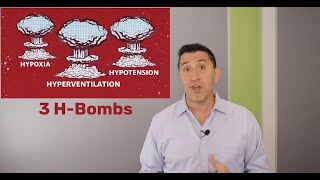
Hi, I'm Dr. Peter Entebbe and this is another edition of the Entebbe Minute. There are over 60,000 traumatic brain injury related deaths in the US every year. That's 176 TBI related deaths every single day. And if we think of the physiologic abnormalities that occur after tbi, it's no wonder why every moment of treatment from the field to the ED and into the ICU is so critical. The brain after all fits snugly into a space that cannot expand. Just imagine the physiologic complications that occur as the brain swells immediately after the injury, all the way through the evolution to a new normal. This is why understanding the physiology and treatment recommendations are so important as what you do on scene, as minimal as it may sound, can be life saving. The most important pre hospital study to date on TBI comes from the great state of Arizona where a well known group of researchers conducted a very large multi system before and after study that took place over eight years. But before we get to that study, let me give you a classic TBI case as an example of the type of call we're talking about. This case involved a 17 year old male pedestrian struck by a car. The scene is safe and PD is present and your patient's on the ground supine and clearly unresponsive. His GCS is three. He has an obvious traumatic brain injury and a right femur fracture. His airway is open and he's breathing on his own at 10 breaths per minute with an O2 sat of 96%. On room air his heart rate is 96 and his BP is 140 80. He tolerates an OPA. So here's the first question. Which of the following would you do next? A nasal cannula at 4 liters per minute. A non rebreather at 15. A BVM at 10. Or would you go with an advanced airway and ventilate at 10 breaths per minute? Now if I had to guess, most of you selected D placement of an advanced airway, but we'll get back to that in a moment. You now reassess at 5 minutes. And while he's still breathing at 10 to 12 times per minute and a SATs are 100%, his BP is now significantly lower at 96:54 with a heart rate of 130. Based on this new information, what will you do now? Normal saline, 1 liter wide open. Place an IV but only start fluids once his blood pressure falls below 90. Or no IV needed at this time. Keep your answers and we'll see how you did at the end. But this gets us right into what the goal of the EPIC TBI trial aimed to do. They gave targeted TBI education to 133 agencies in Arizona on three important physiologic parameters for the head injured patient. They then evaluated real patient care to see if it improved outcomes. Remember, this was the first study to have assessed the association of evidence based guidelines with survival. It's worth pausing here to describe the three types of tbi. We're talking moderate, severe and critical. Each of those is based on injury severity scores. This is important because it turns out that the moderate TBI patients have a very low death rate. The critical TBI patients have a very high death rate. And this means that the patients that can have the most impact are the severe TBI category. And to that extent, the TBI education focused on avoiding three main things. Number one, hypoxia. The goal was to keep sats at 90% and above and therefore they advised that every patient get a non rebreather at 15 liters. Second, they advised to avoid hypotension, which they defined as a systolic of 90 and for which they recommended infusing isotonic IV fluids. Lastly, they sought to avoid hyperventilation by keeping the end tidal between 35 and 45 with an ideal respiratory rate of 10 in adults, 20 in kids and 25 in infants. Let's take a look at whether avoiding the three H bombs of hypoxia, hypotension and hyperventilation made a difference in the outcomes. Here you can see that over the eight year period there were over 21,000 patients enrolled in the study. Just over 15,000 were enrolled in the pre intervention phase and 6,624 in the post intervention phase. The results are simply astounding. Here you can see that for severe TBI there was a two fold increase in survival to discharge if the H bombs were avoided. And in patients who required an advanced airway, the severe TBI patients had a threefold increase in survival. What's even more fascinating is the additive danger of having two of these physiologic derangements occur together. Even just one time. One episode of hypoxia in the field led to a five times worse chance of bad outcome. One episode of hypotension led to a threefold worse chance of a bad outcome. But if the patient had both hypoxia and hypotension just one episode each, their chance for a bad outcome was 17 times higher. So let's go back to that patient we started with. The 17 year old with severe TBI GCS of 3, but breathing on his own with a good room, air sat and a normal bp. The correct thing to do for him at this time was to provide supplemental O2 using a non rebreather of 15 liters. And that's because we want to ensure that he never becomes hypoxic while he's with us in the field. Not even once. There's no need to intubate him at this time because he's not a respiratory failure. And if we intervene, there's a potential that we can make him hypoxic or hypotensive in the process of taking his airway. Next, I told you that at the five minute mark, his blood pressure decreased by over 40 points, down to a systolic of 96. Well, what did you choose to do here? Well, the correct answer was to give normal saline 1 liter wide open. Remember, our goal is to limit any episodes of hypotension. The swollen brain requires perfusion and any episode of hypotension can lead to a worse outcome, as I showed you earlier. Now here's where it gets interesting. In July of 2022, the same EPIC researchers released a second study from the same data set which gave more insight into what the ideal blood pressure is for a patient with severe TBI. And here's a hint, it's nowhere near a systolic of 90. In fact, using the same data set, they determined that the lowest mortality occurred with systolic blood pressures in the range of 130 to 180. Now, before you fall out of your chairs, I know the two words you're thinking about. Permissive hypotension. This is the practice of keeping the blood pressure at the minimum physiologic level to allow for clotting and to minimize internal blood loss. But here's where the physiology is important. In a multi system trauma that includes severe tbi, the brain takes precedence over every other organ in the body. So for agencies out there who carry whole blood, use it. If you don't, isotonic IV fluids will do. Furthermore, if you need to use a pressure to help increase your blood pressure, that's what you should do. Every second that the brain isn't being perfused or oxygenated leaves it at a higher risk for a bad outcome. This goes for both kids and adults. Actually, the Pegasus trial in 2016 looked at pediatric severe TBI patients across five trauma centers, neuro intact survival was significantly higher, 37% versus 27% simply by avoiding an episode of hypotension or hypoxia. So if you're on shift today, you can use this information to help the very next TBI patient you see. Give them all a Non rebreather with 100% FiO2. Avoid hypotension at all costs. And if you take their airway, be sure not to hyperventilate them. This has been Dr. Peter Hantevi with another edition of the Hantevi Minute.