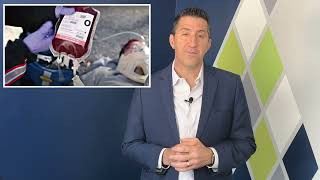
Dr. Peter Antevy (Handtevy Minute) advocates for prehospital whole blood transfusion as a major advance in trauma care, arguing it outperforms traditional crystalloid resuscitation. He cites wartime-driven advances over the last 17 years and a 2017 study reporting a 20-fold survival increase when blood was given within 30 minutes of injury. He reviews civilian EMS whole-blood programs: San Antonio (started Oct 2018, >1,000 units administered), New Orleans (program began 2021; first 21 field patients — 81% gunshot wounds; average time to blood 9.7 minutes; 47.6% on-scene administration; of 14 non-arrest patients who received blood, all were discharged), Broward County (100+ units; ~90% survival among those who received blood prior to arrest), and Palm Beach County (~50 units; ~90% survival pre-arrest). He also notes trauma causes >5 million deaths annually, firearms became the leading cause of traumatic death in children in 2020, AABB (2018) supports whole blood use in pediatric hemorrhagic shock, and logistical practice of using low-titer O+ (vs rarer O-) to expand prehospital availability. The talk concludes as a call to adopt whole blood in the field and previews two more episodes.
Questions this video answers
A 20-fold increase in survival.
More than 5 million deaths per year.
2020.
Began October 2018 and have administered over 1,000 units.
81% gunshot wounds; average time to administer blood 9.7 minutes; 47.6% received blood on scene; of the 14 non-arrest patients who received blood, all survived and were discharged.
Chapters
Hi, everyone. I'm Dr. Peter Anteve. Welcome to another edition of the Hantevi Minute, where today's topic will be the importance of whole blood use in pre hospital care. For the past 50 years, trauma resuscitation in EMS has relied on the use of crystalloid solutions. Yes, that's normal saline and lactated ringers for the acutely hemorrhaging patient. This has to stop. The last 17 years of war have brought tremendous advances in pre hospital and trauma care to both the military and civilian sectors. Evidence now suggests that whole blood is a better option for trauma resuscitation and can increase survival of severely injured patients. Take this study published in 2017, which demonstrated a 20 fold increase in survival and if blood was administered within 30 minutes of injury. But ever since this study was published, many of the naysayers challenge whether combat data correlated with civilian medicine. And it turns out it does. But the key to success is speed to delivery, and this makes perfect sense. Trauma is a leading cause of death for both adults and children worldwide, responsible for more than 5 million deaths every year. This number includes things like accidents, falls, violence, or natural disasters. But motor vehicle accidents account for a significant proportion for children, especially those under five. The impact of trauma is even more pronounced with drowning and burns being common causes. But did you know that in 2020, firearms became the number one cause of trauma related deaths in children? As you can see in this graphic, there's been a significant and alarming shift in the patterns of traumatic injuries. And it's one we have to prepare for as EMS professionals. This is something I experienced firsthand as an EMS medical director for the Coral Springs Parkland Fire Department on scene at Marjory Stoneman Douglas High school. We lost 17 beautiful souls that day. And we still feel the impact of that fateful February day more than five years later. Since then, I've been committed to preparing my community for the unexpected. And that means getting whole blood to the streets. Whole blood transfusion in pre hospital settings is important. It's life saving, and it's the biggest improvement we've seen in trauma care in the past hundred years. In 2018, the preeminent trauma surgeon, Dr. John Holcomb, wrote a paper titled get ready, Whole blood is back and it's good for patients. And boy, was he right. It was that same year that our colleagues in San Antonio under the leadership of Dr. C.J. winkler, began their whole blood program. And since October of 2018, have administered over 1000 units of whole blood to both medical and trauma patients throughout their region. Their Program has demonstrated a reduction in early mortality and in patients with hemorrhagic shock.
A few Years later, in 2021, New Orleans EMS began their blood program and have also seen great success. Their Chief Medical Officer, Dr. Meg Marino stated that they have reversed the murder rate in that city. A recent publication described the first 21 patients they treated in the field. Let's take a look in their data. Gunshot wounds represented 81% of the mechanisms of injury and the average time to administer blood products was only 9.7 minutes. Blood was administered on scene in 47.6% of the time and the remainder provided en route to the hospital. While seven of the 21 patients were in traumatic arrest prior to blood administration, the remaining 14 individuals who received blood all survived and were discharged home. That's just incredible data and this makes sense. We have all seen trauma that leads to massive hemorrhaging resulting in the loss of life before the patient makes it to the trauma center. By providing whole blood in the field, we're replenishing what the patient has lost, correcting coagulation disorders, restoring oxygen carrying capacity in the field. The value of whole blood transfusion isn't exclusive to adults. It's critical for kids too. Pediatrics. Although some consider them a unique population, but when it comes to blood loss, it turns out their needs are exactly the same as adults. Since 2018, the American association of Blood Banks has recommended that whole blood can and should be used in severe hemorrhagic shock in children. Here's a question we always get asked. Why use O positive blood instead of O negative, which we know is a universal donor? Well, it's because only 7% of the population is O negative. Compare that to the 40% of the population who have O positive blood where it's been shown that using units with low levels of antibodies, which we call low titer, is safe to do. This significantly increases our ability to use whole blood for patients in a pre hospital setting. Here in South Florida. Thanks to the leadership of Dr. Jim Roach and Chief Heath Clark, Broward county now has whole blood in the pre hospital setting as well as all three trauma centers. Over 100 units have been administered by the Broward Sheriff's Office EMS Division with a 90% survival among those who received the blood prior to their cardiac arrest. In Palm Beach County Fire Rescue, thanks to the leadership of Chief Kennedy and Chief Coyle, we are seeing the same results. Our program began approximately one year ago and we've given approximately 50 units of whole blood and also have seen a 90% survival amongst patients who received the blood prior to going into arrest. What we are experiencing in this country is not just an evolution in practice, but a revolution paving the way towards increasing the survival rate of both traumatic and medically hemorrhaging patients. We have the potential to reverse the grim statistics associated with trauma related deaths. It's time to challenge the traditional practices and embrace this life saving intervention that is whole Blood in the field. As EMS professionals, let's continue to lead this change and prepare our communities for the unexpected. This is the future of prehospital trauma care. It's here, it's now, and it's making a difference. This has been Dr. Peter Antevi. Thanks for joining me today and stay tuned for two more episodes in this series on Whole Blood.