Hatzalah of SF Florida EMS Webinar 3.29.24
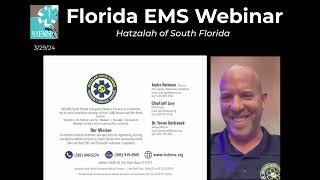
Webinar (Mar 29, 2024) introducing Hatzalah South Florida: history, mission, and operational integration with local EMS. Speakers (Andre Roytman, Executive Director; Jeff Levy, EMS Director) describe Hatzalah’s origins, volunteer structure, training/licensing, dispatch and response model, geographic coverage across Miami–Boca Raton and occasional Central Florida operations, and partnerships with county EMS/fire systems. Key facts discussed include legislative change in 2021 enabling transport, volunteer scale and vehicle inventory, dispatch/response metrics, hospital/MCIs integration, and international/air transport links.
Questions this video answers
March 29, 2024.
Peter Antevy (host), Andre Roytman (Executive Director, Hatzalah South Florida), Jeff Levy (EMS Director, Hatzalah South Florida), and guest Josh (Hatzalah Air representative).
2010.
2021 (house bill signed).
~250 members; 14 ambulances, 17 first-response SUVs/cars, and 3 motorcycles.
Chapters
Welcome everybody. It is another Friday, March 29th. So happy you can join us here in the Florida EMS webinar. We have now over 155 presentations that have been done, all thanks to the start of this, which was Dr. Pepe's idea back in the COVID days. And we continue to do this to bring the best and the brightest people in EMS to the forefront. And this is a special presentation today because.
For those of you who don't know about Hatsala, they've been in many communities around the country. And then in 2021, the state of Florida really passed a law to allow them to function like other EMS services. And I will tell you from a personal perspective.
I was at a party at a hotel about a month or two ago and one of the family members.
Basically had a syncopal event. And who showed up first was Tetsala. And they did everything right, started an IV, they had the 12 lead on. When, when the local EMS came, they basically looked and said everything has been done. And it was such an eye opening experience for me to see what had happened. And it really was a privilege that we were able to have them so close. And they got there literally within minutes. And so today we have on the call Andre Roytman, who's the Executive Director of Hatzala South Florida, and Chief Jeff Levy, who is the EMS Director of Hatzala South Florida. And I asked him to come and give a presentation explaining how Hatzala has evolved over the years and hopefully open up for a nice Q and A at the end. So, gentlemen, thank you so much for joining us and take it away.
Thank you. Thank you, Doc. It's great to have Josh in here. If I say something wrong, Josh, feel free to pop up and correct me, please.
First of all, Dr. Entebbe, I appreciate so much everything you do to our community.
It's really humbling to be able to be part of this presentation today.
Even more looking around the names that some of them will recognize in this, in this, in this forum, it's really, really humbling to be here today and appreciate Dr. Entebbe for giving us the platform, the opportunity to present and introduce a little bit more and clarify the concept of what Hatzala stands for, where it come from and what we're looking forward to be.
I'll give a little bit of a background about Hatzala. Chief Levy is also the Deputy Chief for Lauder Hill Fire. He's our EMS director and he'll be going a little bit more into details on the practicalities of how we function and so forth. I just wanted to give a quick overview on what is at Sala, why we exist, where we come from.
And hopefully you'll be happy when we finish this presentation. Have a much more clear understanding what it'sal is all about and what we're trying to accomplish here. Hatzalah, the name Hatzala, which sometimes I get confused by Hezbollah, which is not the same at all. Hezbollah is a terrorist group. Hatzalah would try not to be terrorists. Atsala means rescue, is a Hebrew word for rescue. So that's basically what it is. Hatsala is.
A Orthodox Jewish Orthodox volunteer organization. Were guided by the principles of the Jewish faith. Every Hatzala, it's a requirement to have a rabbinical board. So we follow the halacha, which is the Jewish principles and guidance in regards to the laws that we have to follow.
And I can get into a little bit more details, but Hatzala started over 50 years ago in New York. Basically a member of the community was frustrated with a friend of his that collapsed and nobody knew what to do. Everybody looking at the member on the floor and nobody had a clue what to do. He got very frustrated. He basically got himself basic medically trained as a first responder. He got himself oxygen tube, oxygen tank. And he used to go around everybody that was having some difficulty breathing, somebody having some issues. They're basically.
He was just running around with an oxygen tank and trying to help the people in his community. Over 50 years later, that evolved into an important EMS agency. Hatzala Today is one of the largest volunteer EMS agencies in the world. Hazala exists in New York, but exists also in Chicago, in Los Angeles, in Baltimore, in Florida. And if you go beyond the United States, exists also in Australia, of course in Israel. They're very, very strong.
In Europe, in many different countries. In Latin America is basically in almost all Latin America country in Brazil, Argentina, in Panama, in Mexico, in Venezuela. So everywhere that we have a organized Jewish community, Hatzalah has become part and center of that community. And the idea is that when you have somebody, a family member that is a doctor.
The first person you're going to call when you don't not feeling well is that uncle, that's a doctor. Hat solo basically is because we are from the community, we live in the community, we work in the community and we go to the same synagogues as the people. So it's like another family member that has some level of medical training. So the idea of Hatsala is.
If every person is trained in cpr it just increases the possibility, the potential for saving a life. If you go a step further and everybody's training as an emt, it's even better. If you could train everybody to be a paramedic would be amazing. So we do everything we can to maximize the potential of the community, to be able to help each other. So the idea of Hatsola is basically to service the community from within the community. Although we are a Orthodox Jewish organization, by no means we ask our dispatchers, we never ask what is the religion of the ethnicity of the person that is calling. We service the entire community. Anyone that will call within the region where we have volunteers, we will respond. And that's the essence of HAT Sola. We will function based on our volunteers. So the community go to become. They go to become EMTs, paramedics, they become volunteers. And now we have a program going. HAT Solo is fully funded by the local community. We're a 501C3, we're a charitable organization. And Hatzala is fully funded by the community. So the community needs to understand and believe in the values of Hatzala in order for Hatzala to exist in the first place. So basically, in summary.
ATSALA is an EMS agency. We're all from the community. The response time becomes significant, lower than normal EMS just because if you can have in the community Neighbors There are EMTs, the response time is going to be quicker because they are within the community. Imagine like a uber of the EMS world. That's.
In a synopsis what Hatzala stands for in regards to the technicalities of how we function and how we organize today. I'll let Chief Levy continue. I'll just tell you. We started at Solar in south Florida in 2010 with 15 people that became certified CPR. Then they became certified EMTs. Hatsala has evolved from that from a first responders group to become a EMS transport agency with over almost 250 members and 14ambulances, 17 flight cars, three motorcycles. And we're here today with an important mission which is to be part of the EMS world. Join forces with the local EMS and fire departments and the police departments. And for us, when Chief Levy was willing to volunteer into the organization, it was the right message, the right approach we're looking for to help integration of Hatzala with the local EMS world. And Chief Levy has been an amazing advocate for Hazala in the EMS world, has helped us communicate and bring communication forth to a whole new level. I was so appreciative for his work in Hazala and He's got today a strong knowledge of Hatzala and ems, and he's been able to combine them and bring the best of the both worlds to the table. So with that, I'll let the chief take over.
Oh, shucks. Thanks, Andre. That was so nice. So, yes, I appreciate this. Good morning, everybody. Just a little background on myself. Like Andre said, I wear two hats. I'm the deputy fire chief for the Lauder Hill Fire Department by day and by night and weekends, I'm the volunteer EMS director for Hatzala South Florida. I am humbled to be a part of this amazing organization. So back in 2021, when the house bill was signed, Andre and the others from the executive board of Hatzala asked me to.
You know, provide some insight as to how they were going to be functioning up in Broward County. Like Andre said, Broward county, or they've been. Hatzal has been functioning in Dade county since 2010. It was a first response agency, no Transports, up until 2021 when the House bill was signed by the governor. So I asked Andre and the executive board to give me the opportunity to help bridge the gap coming into Broward county and expanding up into Broward county with ambulance, ALS and BLS transports. It originally started with BLS transport and then evolved into ALS transport in Broward County. Made the introduction to the Broward Fire Chiefs, I thought it was very important because we as firefighters are creatures of habit and don't like change. So I felt it was very important that we take the opportunity to make the introductions, do multiple presentations and, you know, meet with the Healthcare Coalition, the Fire Chiefs association, the Police Chiefs association, and the various fire departments where Atzala is functioning in Broward County. So that being said, we made that jump and into. Me and the executive board made that jump into making these introductions. I was not a part of Hutal at the time, and probably about 18 months ago or so Andre and the board finally said to me, enough is enough. We want you to take on a different role here. It's volunteer. It's not going to take up much of your time. Yeah, it's. It's volunteer. It takes up a lot of my time, but I love it anyways. My wife tells me I'm crazy, but my problem is I can't say no, as many of you on this call know that. So Andre went over the mission for Adsala. We are an ALS organization that stretches from Miami beach all the way up to Boca Raton. Currently, during certain times of the year, we function in Orlando for The, as I call it, the mass migration of Orthodox Jews into the Orlando area for certain types of Jewish holidays throughout the year. The most recent one coming up is Passover. Right, Andre. Just making sure. And you know, when we start functioning in Orlando, we've met with the Orange County Fire Department, the Osceola County Fire Department currently trying to reach out to the Polk County Fire Department. So if anyone's got a contact for Polk county, please send it my way so I can reach out to them. But just to let them know that we'll be in the area, we will not be responding with ambulances in the Central Florida area. Like Andre said, it's members of the Hot Salah community that come down from various parts of the country that are.
Dual certified. Not they're NREMTs, but they're dual certified from the state that they reside in to also the state of Florida. So they will be functioning as BLS first responders in those specific areas. They will not be responding Code three in those areas. They'll be responding within the neighborhoods that they reside in. So we do have a medical director. Dr. Yoram Good friend is our medical director. Dr. Good friend is a ER physician out of Jackson Health Health Care System and he also has some associate medical directors that assist him in the system as well.
See if I can control this PowerPoint here. Here we go. So like I said, all of our, all of our paramedics and EMTs are state certified and nationally. Well, they were originally nationally certified and they're all state certified, state of Florida certified EMTs and paramedics. The licensure is the same. The certification is the same certifications that our fire rescue personnel go through. And we are covered under the state of Florida. We are licensed with the Department of Health in the state of Florida. We are inspected by the Department of Health in the state of Florida and.
All that jazz. All of our personnel are required to go through continue education training. We do have weekly CME trainings within the respective neighborhoods. We also have a weekly call review where all the members can attend and get CMEs. And then also just like most agencies, we have an online.
Learning management system as well. All of our members are required to go through EVOC as required by the state of Florida as well. One of the unique things of Hatzala compared to a fire rescue agency is that Hatzala will only respond to the communities. Like Andre said, our.
Current orthodox community related areas. So for instance, you will never see a responder from Hatzala responding from south beach to Hollywood License Irons that's not how it works. It's basically closest unit response within the system. So you know, some of our areas are, you know, in Broward county. You won't see responders coming from Dade county up into Broward County. But what you will see is they do routinely obviously traverse the tri county area in their personal vehicles. So when Hatsala receives a call, we have a dispatch center that is staffed 24 hours a day, seven days a week, 365 days a year. As you most, most of you know that in the, in the, or in the Jewish religion, certain times of the week, the Sabbath, you know, Jewish sensitivities and cultural does not allow for use of electronic devices, driving and whatnot because like Andre said, we fall into the rabbinical laws. And as a Hatzala responder, Hatzala means rescue. Those Hatzala responders are still able to drive their personal vehicles to emergencies on the Sabbath. They are allowed to carry radios on the Sabbath. They are allowed to have their cell phones on the Sabbath for the purpose, excuse me, for the purpose of emergency use. So I'll use an example. A few years back when we had a potential hurricane coming, a hurricane warning was announced in Dade county to where they had to do evacuation of the barrier islands or hurricane watch, whatever would it be? It happened to be on a Friday night where most Jews are in synagogue and unable to have access to any electronic news information. So you know, imagine having 230plus volunteers across the tri county area that can get the message to the rabbis about, you know, certain types of natural disasters, man made disasters or any types of emergencies. That's what Hatsala brings to the table as well.
So back to how we respond. We'll get dispatched to a call. If we provide services in that area, the Hat Sola responders will be dispatched in that area. We have an average of 2 to 3 minute response time into that area. The way Hatzala responds is we will dispatch responders directly to the scene in their personal vehicles. They are allowed by state statute to have red and white lights and sirens in their vehicles and respond code three to calls in their personal vehicles. So we will dispatch EMTs and paramedics directly to the scene. In addition, if we have an ambulance in that area, because we don't have ambulances in all of our neighborhoods yet, but if we have an ambulance in that area, we're going to dispatch additional responders to go get the ambulance and respond to the scene. The ambulance is usually on scene within five to 10 minutes, you know, but the initial responders are on scene within two to three minutes beginning patient care.
So if we don't have an ambulance in that area, had will still dispatch the call to its our responders and then we'll also reach out to the local PSAP to where we're residing, for example, Coral Springs parkland area. We do have responders in the call in the parkland area, but we don't have ambulance transport in the parkland area. So they will dispatch responders into the parkland area. I say they. We will dispatch responders into the parkland area and we also contact the Coral Springs parkland PSAP to have a rescue respond if the need arises on certain types of calls.
Oh, so I can scroll my screen here. Our vehicles are unique. They are not able to be misrepresented for something else. Our vehicles are lime green, not to be confused with the mdfr. Lime green. It's a different lime green. We don't want to be confused with that. But it's lime. They're lime green and blue. They, they are not, you know, mistaken for any other vehicles. They do have Hebrew writing on them. They do have full again state of Florida requirements for licensure.
We do have the ambulances, as you can see in the top screen. We do have SUVs and we do have scooters, motorcycles that can respond into the densely populated areas of certain crowded downtown areas. The uniqueness about Hatzala, not just for areas where we respond to, but I want everyone to understand this, that Hatzala provides a resource to the community. So if your community does not have responders from Hatzala responding, but you do run into a unique cultural sensitivity of an elderly person.
Holocaust survivors, immigrants, language barriers issue on Shabbat, people coming in from out of town. You can still call upon Hatzala to assist with, you know, if, and I'll give you an example back before Hatzala existed in Lauder Hill and this was many, many years ago when I was on the road as a paramedic, we had a elderly female that was walking to synagogue on a Friday night trip and fall. We got called, she was injured, but she adamantly refused to go to the hospital by ambulance on Friday night. She, she would not, she would not go to the hospital. She wanted to sign a refusal. She was able to sign a refusal, but we did not feel comfortable with letting her walk back to her home.
I hat Salah did not exist in Lauderhill at the time. So what we did is we, we wheeled her two blocks down the side of the street on our stretcher back to her house. But to my point is that Hatzala can help bridge that gap of the cultural sensitivities. If you have somebody that is the Orthodox.
Religion and adamantly refuses to go to the hospital, but you know, they need to go to the hospital, feel free to call our hotline and we will have somebody respond to assist in bridging that gap. Now, Hatsala does, you know, respond at the request of. We have been called to the local hospitals for again, Orthodox family members that one of their loved ones has passed away and they were having a difficult time manipulating that situation from the hospital side. We've been reached out to by the hospital. The ER has contacted us and we've responded members to the hospital to help bridge that gap and help calm the family and help bring the cultural aspect into the hospital to assist with navigating that sensitive time of a family member passing away.
See here all of our members, when they respond, there's two forms of id. Every member here has this ID on their person. It shows their first name, last name, their EMT or paramedic licensure number. It shows their level of certification, whether it's an EMT or a paramedic. But also on the back of it, there's a QR code similar to this that anybody can scan. If there's any concern of authenticity of this member being a responder, they can scan it. The QR code will bring up all their active.
Certified information and it will show if they're an active or not active member with Hazala. In addition, these two stickers are on the personal vehicles of Hatzala members. If you see a Hatzala member responding code three or you see a vehicle responding code three in the South Florida area with red and white lights, they are probably a Hatzala responder. And to confirm that is on the front and rear of the vehicles, we'll have these two placards, one on the front windshield and one on the back windshield or the back side of the car, which will have these again have QR codes on there. They are renewed every year. And again, by scanning the QR code, it will confirm by anybody that's got a concern whether this is legitimately a hot, solid responder or not.
Like Andre said, we have multiple ambulances in multiple areas throughout the county or the Tri county area. You can see here, and I'll read them out because it's small, but we have Surfside, Bal harbor area, North Miami Beach, Aventura, Boca Raton, Hollywood, North Miami Beach, Aventura, Miami beach. And that's where we primarily have our ambulances. Right now we have more ambulances and then we do have communities. We have multiple ambulances in some of the communities because of the call volume in those areas. We do again, provide ALS and BLS transport in those areas and work alongside the fire rescue entities in those areas. We have been working with Miami Dade Fire Rescue, as Andre expressed, since 2010, you know, since the House bill was signed and we provided transport. We work closely with Miami Dade Fire Rescue in the Aventura North Miami beach area and the Surfside areas. We also work with Miami Beach Fire Rescue, Hollywood Fire Rescue, BSO Fire Rescue in the Hallandale area. This has to be updated because we do have an ambulance in Hallandale now, but we, we also have ambulances in Hallendale and work alongside BSO Fire Rescue and in those areas.
These are the neighborhoods we. At the bottom, these are the neighborhoods we. We have services in. Miami Beach, North Miami Beach, Surfside Bay, Harbor Islands, Bell Harbor, Sunny Isles, Aventura, Highland Lakes, Hallendale Beach, Hollywood, Lauder Hill, Deerfield Beach, Boca Raton, Parkland is coming on board as a full fledged neighborhood soon. And then at certain times of the year, should be the Central Florida division of Hatzala. We respond to all types of calls for service. You know, when Andre told you that back 50 years ago, Hatzala started up in New York, a lot of our residents down in the South Florida area have migrated from New York or north, the northeastern part of the United States, where all they know is Hatzala. They were brought up, you know, in all they knew was Hatzala. Their families called Hatzala instead of calling 911. Again, it goes back to this right here where, excuse me, the cultural sensitivities and a lot of it is due to the Holocaust survivors. As you can understand back from the Holocaust, a lot of people that had family members or were directly affected by the Holocaust don't like uniforms. You know, hat Salah members don't respond in uniforms or respond in plain clothes. We do have polo shirts, obviously, we have jackets. We have all the swag that our members want. But we're not truly uniform members responding to a call. We're people in, you know, T shirts and polo shirts responding to our neighbors.
So when, you know, you know, people move down from certain type parts of the country or they are on vacation for certain time for in certain times of the country, all they know is Hatsala, they might call their local Hatsala number because it's ingrained in them and they call their local Hatsala from New York and what the. All the Holocaust. Excuse me. All the Hatsala dispatch centers have each other's numbers and know where we provide services. So, you know, the, the Hatzala in Brooklyn can.
Transfer the call to Hatzala South Florida and vice versa. And you know, that's, that's, that's how it works.
I think it. Just to add, Chief, to what you mentioned, every responder, when they respond to the. In a private vehicle, they have the full equipment equivalent to their licensure. So EMTs, they have all the equipment that EMTs can carry. And paramedics, each paramedic carries their own life pack, which is. Makes a very expensive operations for us. But every paramedic has their own life back in their vehicle. So they don't. They're not dependent on the ambulance into. In order to start treating patients. So just a side point, maybe, maybe. I don't know if you have time for Q A. I know that.
Let me, let me finish up with two more things, doc, if I can, and then we'll go from there, if that's okay.
In the Broward county area and the Dade county area, real quick. Had Solid has been recognized as EMS responders in those areas. One of the biggest things is, is Broward County 911 system is a public safety radio system. And you know, it's, it's. Broward county does not allow anyone onto their public safety radio system unless they're law enforcement or fire rescue in Broward County. To show how Hadzala has been recognized into the South Florida system, Broward county has now allowed Hat Sala onto the public safety radio system for use of the hospital direct communication channels. Instead of having to utilize the UHF channels, the state required UHF channels. We now have access to all of the Broward hospitals in Broward county and all of the Broward county fire rescue tactical channels. Because Hatzala is part of the mass Casualty Incident Response Plan in Broward County, Hatzala is invited to all MCI drills in Broward county. Most recently the airport drill last year and the Seaport drill that last year as well, to work alongside fire rescue entities to train on the MCI process. Now that Broward county has authorized us access to the system in the hospital direct channels, Dade county has also authorizing us to have the hospital direct channels in Dade county. And then shortly thereafter, we'll be working with Palm beach county, our partners, to, to do the same thing. So, you know, I just wanted to kind of show that. You know, one other thing is Lauder Hill has been allowing Hadala members from across South Florida. We're the only entity right now to allow Hadala members to ride alongside us, to gain the experience, learn who they're responding side by side with, and bridge that. That gap. Like I said at the beginning of firefighters, fire, rescue personnel, being creatures of habit, and we don't like change, Hatzala is not here to take anyone's jobs. Hatala is strictly here to help respond to their emergencies within our communities. And we've responded last year to over 6,000 calls for service from Palm beach all the way down to Miami Beach. And I'll stop it there and see if we have any questions.
Wow. Wonderful presentation, Chief. And Andre, and I must say that, like any idea, like any good idea, it evolves over time. And to see what you guys have done from the Miami Dade days and now into what. What's happening with the law being passed and how you blended so nicely into the community is really a model for the rest of the country. So congratulations. I'm so glad, Chief, that you're officially part of the team and kind of. I. I selfishly wish that Hatala comes into our neighborhoods. I'm in, Davey, by the way. Let's open it up for. For Q and A. It's the bottom of the hour, so we're gonna have to jump over to Dr. Pepe's webinar. But I would love.
For.
I would love to hear from. I see Josh still on the line.
I think. Joshua.
Yeah, I'm still here because.
Oh, Josh. And Josh, if you. If you could also discuss. Because I know that you. You've also done some incredible work that.
With.
With even flying around the world and picking up people with Hatzala. So if you can come and sprinkle a little bit of that in. And also just thanks, like Chief said, for you joining today.
Yeah, no problem. I. It's. It's my pleasure. I appreciate it. I'm generally on the the Eagles, but don't get onto the seagulls. So Hatzala, as Andre and the Chief mentioned, is really an international organization made up of several chapters. One of those chapters is an AIR chapter. And so Hatzala Air does emergency medical transport, flight medicine all around the world. There are multiple planes. Some are based in the Northeast, some are based in the south, but they can traverse the country and traverse the world. We've taken many patients in and out of Latin America to South Florida, actually, many, many a Lot from South Florida to and from the New York area from a general populist perspective. And then as you can imagine, we've done many trips to and from Israel, between Europe and Israel and the United States and Israel. And they're staffed both by flight paramedics, by flight physicians, and, you know, fully a full complement, depending on the call, respiratory therapist, sometimes. And a lot of it is done through the spoken hub philosophy that Hatzala has. So a lot of the local chapters will do the ground transport to the airfields and then we'll take the patient via air to the next. Next location, which we picked up by the local chapter there and taken to wherever the patient's destination was. So it's just another added service that is provided through the Hatzala network of chapters.
Amazing. And the reason I wanted you to highlight that, because that actually just happened where Hatala, South Florida, waited for the plane to come in from New York. They rendezvoused there and they went to pick up somebody in the Bahamas. I mean, just the amount of logistics and what, what happened there was just mind blowing to me to see how the local community interacts with the, with the national community of Hatzala. So it's incredible, incredible stuff. So anybody else have a comment or question, Other folks who may be involved, who wanted to make a comment, feel free to do so.
All right. We have a lot of. A lot of great people on this call today. So. And I'm sure that there are people on this call who are wondering, hey, how do we get Hatzalah in my community? If there is a Jewish community there, can you just really describe, just really quickly describe that aspect of it before we go?
Either Andre, Jeff, or either one.
Andre.
Andre. I'm mute.
There you go.
Doc.
I'm sorry I missed your last comments.
If there's a community out there who does have a big Jewish population, who doesn't have Salah yet, how do they. How do they link in? How do you adopt a new community?
So usually the process is that the community will go to a local rabbi. The local rabbi would then communicate with the Hatzalah leadership and we will provide them all the. Everything they need from. From the, from the infrastructure, communications, supplies. We did that. We were, as you mentioned, we were just Miami Dade. We grew into Broward Hollywood. The community came to us request. That's all there. We worked with all the rabbis around. We provided without any cost for the community, all the supplies, technology. We brought an antenna there to put our radios. The same thing happened in Lauder Hill. The same Thing happened in Deerfield beach in Boca Raton. So as the community grow and they require, they want to have hatzala locally, they communicate with the local rabbis. We work with them. We provide all the infrastructure they need. But the most important, valuable asset is local volunteers. Everything else is sort of so easy, so to say. But the most important part and the most difficult part is to have a team of EMTs and paramedics willing to volunteer 24 7. You know, we don't take for granted we have 250 volunteers. It's not an easy task to bring a volunteer to train, to make sure that they upkeep with their trainings and everything, all that it takes. It's not easy for a guy that is working on a. I'm a banker. We have builders, we have developers. Like we do our lives and we stop our life in order to go to the call. It's not so easy to get volunteers in that in those areas. But once we have a team of volunteers, that's the heart of essence of the community, to be able to. So we can develop the hat solo there. Right?
This is a true community effort. Amazing job. You guys have really done a fantastic job. Andre, Chief Levy, Josh, thank you guys for joining us today. There are people asking me for the slides. You're okay if I forward these slides to others? Okay, great. And we'll put this up on YouTube. And thanks everybody. Shabbat shalom. And let's get over to Paul Pepe's webinar. So link in the chat there to Dr. Pepe's webinar. I can, I can put it in there again.
That's right.
You guys want to pop over? Thank you guys. Thank you so much. It was amazing.
Thank you, doc. Appreciate it. Thank you.
Keep up the great work. Thank you so much.
Bye bye.
More from Peter




Melissa Olen MSN, FPN-C, CCRN: Sudden Cardiac Arrest Training in Schools (Project ADAM) 4/25/25



Pediatric Hospital Readiness: How Teamwork & CPR Metrics Drive Better Outcomes



Chelsea Kadish, MD & Kyle Goodknight, EMT-P, RT: Pediatric CPAP in EMS (3/14/25)