Henry Wang, MD, MPH: 12 -years of Advanced Airways in EMS (11/1/24)
Henry Wang presents 12 years of research on advanced airway management in EMS, covering how techniques and supraglottic airways have changed practice. The webinar explores what the data shows about these interventions and where airway research is headed next.
Chapters
Okay, welcome everybody. It is Friday, November 1st. Myself, Dr. Paul Pepe and Tanner Smita welcome you to Florida EMS webinar where we have over 185 talks since the beginning of this and today we're very privileged to have a very special guest. Many of you know, hopefully you know Dr. Henry Wang, who is the pre hospital airway guru. Not only does he have a number of studies published on the airway in ems, whether it's BVM versus supraglottic versus eti, but he's also engaged now in a very large rct, which I'm sure he'll go into today, maybe at some point go into with within the pediatric realm. So currently he's at the Ohio State University, but he of course comes from the great state of Pennsylvania and the great city of Pittsburgh where he did some of his training. He's been in Houston, in many other places. So Dr. Wang, if you can make a further introduction, thank you so much for joining us and take it away.
Thank you so much for having me. Good morning everybody. I'm Henry Wang from the Ohio State University. I'm a professor of emergency medicine and I know many of you here. I haven't met you before. I've been immersed in EMS research for the last, goodness, 25 years. So it's been a long journey. It's amazing seeing how much the field has changed in reaction to all of the amazing research that everyone has been generating. Peter asked me to spotlight a paper that we had published recently in the journal the Journal of the American Medical Association Open. So this is one of JAMA's open access journals. The title of the paper is Longitudinal Trends in EMS Advanced Airway Management in the United States. The QR code on the title page will take you straight to that article. And as with all medical evidence articles, I really encourage all of us as students of EMS in the medical field to read the article, really think hard about it, embrace the findings and think about how it affects your practice. Once again, here's the article. This is what it looks like on the webpage. Here's the QR code.
Here'S my disclosures. These are the activities I'm involved in. Few are influential on this particular research. So airway management is really important in the prehospital guild. For over four decades, we have performed advanced airway management techniques. Four decades ago, we taught paramedics to perform endotracheal intubation and that rapidly became the primary approach to advanced airway management. Over the last 10 years, Supraglottic Airways such as the King LT and the IGEL have become incredibly popular and very prominent in our practice. However, we know that there's change in the patterns of the uses of these devices, but we don't know what those national patterns are.
The objective of this study was simply put to describe the longitudinal trends in prehospital advanced airway management in the United States. Now the data we use for this analysis comes from eso. This is the electronic health record system that many of you are very familiar with. ESO is a wonderful research resource and they create a special subset of data available for research purposes. This.
All run report information on all cases from about 2000 EMS agencies. For this particular analysis we obtained a 12 year chunk of data from ESO.
We included all 911 EMS emergency responses with advanced airway management attempts including intubation, supraglottic airways and surgical airways. You'll note that we omitted bag valve mask ventilation from this analysis because the documentation of BVN tends to vary by local practice. We stratified all of the events in these series by underlying disease group, for example Cardiac arrest, trauma non arrest and medical non arrests, and we also separately identified the pediatric cohort trauma cardiac arrest. We combined into the single cardiac arrest group. For this particular analysis.
We determined the instance of EMS responses with advanced airway management attempts. We then directly compare the incidence of intubation versus supraglottic airway attempts in each year for each of the disease and population groups. We omitted surgical airways from this analysis due to their small numbers and to understand the trends over the time we used a regression method called unobserved components models.
These are the results of our study. During the 12 year study period there were 47.5 million 911 activations.
Demographic characteristics over time including age, sex, number of cardiac arrests, traumas remained relatively stable over time. There were some small changes over time for black race as well as the representation in rural Midwest and Southern populations. In this data set.
Over this 12 year period there were over 444,000 events with advanced airway management attempts, including about 300,000 intubations and about 200,000 with Supraglottic Airway insertion attempts. In this table, note that the total number of attempts exceeds the EMS events because a single patient may have received attempts with more than one airway device.
In this figure, the line graph depicts the annual incidence of EMS events with advanced airway management attempts. The bars in the background depict the Total number of 911 events in each year of the data set that is, the ESO data set has an increasing number of observations with each year and the bar summarizes the number of observations represented in the data set coming from each sequential year.
You will note that the annual instance advanced airway management Encounters range from 8.8 to 10 per 1,911 events and this remained relatively stable over the 12 year period.
The percentage of advanced airway cases associated with cardiac arrest increased from 55% to 82% over this 12 year study period. Their percentage of medical non arrests with airway management decreased from 39% to 13% over this time period. In contrast, a percentage of trauma and pediatric cases with airway management remained relatively stable over the time period.
This graph summarizes the distribution of intubation and supraglottic airway attempts for each year in the cardiac arrest subset.
In the cardiac arrest subgroup, the percentage of EMS events with supraglottic airway Attempts increased from 25% to over 60% during this 12 year time period and you'll note that there's a proportionally marked reduction in intubation use over the same time period.
The proportion with supraglottic airway attempts exceeded those with intubation attempts starting in 2020.
In the medical non arrest subgroup, there were slight increases in supraglottic airway use and slight decreases in intubation use over time, but to a much smaller extent than in the cardiac arrest cohort. Intubation remained a dominant technique in the medical non arrest population and we observed similar trends in the trauma non arrest cohort. Again intubation being the dominant advanced airway technique and relatively minimal change over time. However, in children we saw a different story. There was an Eightfold rise in supraglottic airway use over the tough study period and there was a corresponding decline in intubation use.
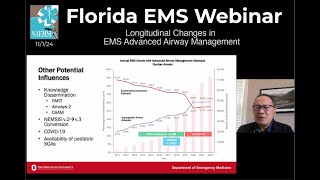
Our study shows the current patterns of advanced airway use in this large US Cohort of EMS encounters and this affirms national shifts in clinical practice. There are many plausible explanations for the changes that we saw in this series, so first of all, the composition of the data set and changed over time with increases in the number of contributing EMS agencies, the number of EMS events and the number of cardiac arrests. We note that the characteristics of the overall 911 population were relatively stable over time, so so that hopefully reassures us that these secular or longitudinal changes in the population probably were not driving many of the changes we observed in the airway management practices. However, here's some other potential influences so all of you who follow prehospital research will remember that back in 2017, there were three very important clinical trials in airway management that were published. The part trial, the Airways 2 trial, and the CAM trial.
And we know that findings from those trials influence practice in many pockets of the country. NEMSIS converted from version 2 to version 3 during this time, so there could have been differences in how some of the procedures were recorded. And finally, the COVID 19 crisis hit. And we all know that COVID 19 markedly changed airway management practices in EMS throughout the country. Lastly, pediatric supraglottic airways have been increasingly available over the last 10 years and that has certainly influenced these numbers. So there's a similar study that you might find in the journal Resuscitation, written by my younger colleague Christopher Gage. And this is just worth commenting on. Chris used 10 years of data from NEMSIS to examine a very similar question. And you'll note that when you put our graph side by side, the changes that Chris saw in his study were not as dramatic as the ones that we saw in this ESO based analysis. Now, we emphasize that these are two very different papers. The definition of cardiac arrest was very different between the NEMSIS and the RESO based observations. And that alone could explain why he saw less narrowing in his study and why we saw the crisscross pattern observing using our ESO dataset.
Limitations of the study. Because of a limited number, we excluded bag valve mass ventilation from the analysis. The ESO data represent a convenient sample of national scale, but we yet are unclear whether this is truly nationally representative.
And while we commented on many of the potential reasons for variations in airway management, the causal influence of these factors is unknown. Our goal was. My goal was to illustrate the current state of airway practice, not to make claims about what is causing these changes. So in conclusion, this study finds that prehospital airway advanced airway practices in the US have shifted with prominent increases in supraglottic airway use and decreases in intubation. These findings have extremely important implications for our prehospital airway practices, training and system planning.
Okay, happy to take questions.
Wow, that was great. Henry, would you mind just, you know, we have time. Would you mind just doing a quick segue before we kind of ask questions globally? I know that now you're leading, you and others are leading a very large study in pediatrics to actually assess this question further. Would you mind giving us a little bit of that before we go into the general discussion with everybody?
I'm working with Partners across the country in carrying out a randomized trial called the Pediatric Prehospital Airway Resuscitation Trial or PDF. And I'm happy to come return here and give you provide for you a more detailed presentation on the trial. The trial is funded by the National Institutes of health. There's about $14 million of funding behind this research trial. It is being run by the University of Utah Data Coordination center and it's supported by the PCAR Network, which is our main pediatric emergency care research network. The PDPAR trial is a landmark research trial. It will determine once and for all what is the best airway management technique to use in critically ill children. This is a multi center trial that involves 65 EMS agencies from 10 cities. We just started enrollment this past summer. We expect to have some early results in about two years. The full study will go on four and a half years. Like I said, I'm happy to come back and provide more information and insights about that study. But as Peter mentioned, you should all pay attention to the word PD part because this is going to be a major source of influence on our airway practices in the next 10 years.
Okay, great. So this paper and again you actually we have Marv. Marv Wayne raising his hand. Marv, go ahead, take it away and then we'll come in afterwards.
First of all, Henry, hi, how are you? We have shared airway ideas for many years. I can assure you one of the things that really has changed the trend and the volumes has been the use of a SupraGlassic Airway by BLS Basic Life Support personnel. So all of our BLS personnel are trained in supraglottic airways and we put them in even in children. And when the arrival of the als. Now instead of somebody rushing to mess with an airway, they rush to do good cpr, defibrillation and whatever else is necessary. So that alone has, I think really move, move the needle and I think that fits with exactly what you have shown. So thank you, this is great work. I don't know if I'll still be alive when you get the PD done, but if I am, I look forward to that also. It is, it's been a trend of time to go from everybody gets to suck plastic to everybody gets to have plastic rest on them.
So thank you.
Mark, thank you so much for the comments. The use of superglotic airways by basic life support providers is a very important innovation and should continue to evolve. Caught my attention as we're starting the PDPAR trial is remembering that SUPRAGLOTTIC airways, even though it's easier than intubation, it's still not a perfect silver bullet. There are still some complexities.
All the super.
Care ways.
So as medical directors, trainers, educators, clinicians.
To be.
Careful, this sounds like a good idea. But we might simply be exchanging sets of problems and we should be particularly attuned to that when we're training our basic life support providers.
I don't know if it's, if it's my. Is Henry's audio coming in good for everybody or a little chopped?
No, it chopped up Peter.
Okay.
Sorry.
Corollary of what you said, Henry, you are correct. We're tracking over five years now our supergloudic airways by bls and some point maybe at NMSP we can discuss where that trend seems to be going and results.
So thank you, Paul. What were you going to say? Paul?
I was just going to tell what he did already, which is turn off his video and he'll have a better, you know.
Okay.
I'm back.
Internet burps hey marv1 a question had come up to me and this is a whole separate issue recently and you may. I want to see what you're doing. Your practices is, is the use of paralytics actually, you know, for, for the, you know, for innovation, obviously we've known that. But how about for superglottics? That to me sounds like this really should work but. Or shouldn't be appropriate. But have you been doing that or you know of anyone who is doing that?
We, we do not use paralytics for basic life support and at this point Henry probably would agree with me on that one till we have at least some more supportive data. We do have end tidal CO2 for all the BLS IGEL people and we obviously continue to use paralytics where appropriate for the als. But the answer is can BLS use paralytics? The answer.
I'm not asking that. I wasn't asking about them. I'm just saying just in general, even though people.
Yeah, I see what you're saying. Other than as a rescue airway, are we routine routinely using paralytics and then using just the Igel? And the answer is it's very much variable and we're looking at. There is something that will be presented in EMSP that I think might completely change the dynamics of a supragotic intracolla airway in evolution.
Thank you.
Okay, so I want to pull back a little bit and make a comment. I want to bring Tanner in and then others. But Henry, my comment is the following is that we're looking strictly at airway device, right? And I think what's missing in the literature and in general is what happens after that device is installed, right. Whether it be ventilation rate, ventilation volume. Then you complicate it even more by the fact that there's a bundle of care happening here. You complicate it even more with those patients who are not being resuscitated well before they're being given an advanced airway. And so there's a lot of things besides just the what are you using that impacts the outcome? Which is really the question that we're trying to answer. I would love your comments on that. And then I'm going to bring in Tanner for his comments.
Airway is the first step with A, B and C. And you are absolutely right, Peter, that A helps us to get to the breathing and the circulation part. But like many things we've learned in resuscitation, how you do the airway could very much set the stage for how you carry out B and C. We absolutely have to pay attention to the airway part. The breathing and ventilation part is incredibly interesting if you think about it. We have virtually no data in the prehospital setting about how ventilation is delivered. My younger colleague Michelle Nassal just got an NIH grant last year and we are digging through 6,000 cardiac monitor and capnography files to unpack some of the secrets of ventilation. Some of her work has been featured in JAMA Open earlier this year. So she has a paper describing the slope of end tidal capnography and how it's associated with cardiac arrest, ROSC and outcomes. I will put that in the chat box for everyone to look at. It's a very important paper and I bet as Michelle progresses in her machine learning work, we'll have all these new insights and ventilation within the next five to 10 years.
Awesome. That, that'd be great if you can add that to the chat, that'd be wonderful. Let, let me bring in Tanner. Paul, come to you after. Let's get to Tanner and then we'll come to you. Back to you, Paul. Go ahead, Tanner.
Dr. Wank, thank you very much for the presentation. Just kind of to pull back and talk a little bit more about this paper. One of the reasons I really love this work is that I think it's really unique in terms of its design. I think most of the papers that we read about EMS and airway management, they're focused on the interventions, the procedures and a really agnostic to time. And so I Think just this paper really shows the power of data sets like ESO to look at changes in clinical practice over more than a decade on a nationwide scale. I'm definitely looking forward to more work exploring practice variation over time and maybe even looking at trends and outcomes over time and maybe how those can be linked to changes in nationwide practice. Just a couple questions. Reading through the paper, I was surprised to find that among patients with orotracheal innovation, only 8.8% of those were specifically described as being performed video laryngoscopy. So I was wondering, just as you were looking at the data set, you know, are we seeing increasing trend in the use of video laryngoscopy for innovation in the pre hospital setting? And then also, you know, our group has done a little bit of work looking at different types of supraglottic airways, so Igels and King laryngeal tubes. And so, you know, now that I have you here, I'd like to ask, so what's your feeling on the different types of supraglottic airways? And you know, again, kind of in line with this paper, do you see, what kind of trends do you see between the different types of airways across time in this dataset?
We didn't try to separate out the different types of airway superglottic airways in this particular analysis because it was getting really sloppy and messy. We do know that IGEL use has increased dramatically across the nation over time. But again, I bet that in a few years we're going to look backwards and reflect upon all the lessons we learned from the PEPAR trial about supraglottic airway use. And it might prompt us to take a second look. And I bet we'll have a fourth generation superaglottic airway that comes out in the next few years that again will change the landscape a little bit. As I mentioned before, superaglottic airway doesn't equal easy. We should all pause as educators and medical directors to think through some of the complexities. Video laryngoscopy. 20 years ago I was a skeptic, but the technology has radically changed. And now, now it's portable, it's lightweight, the cost has come way down. This is potentially a game changer. And those who think that this could make intubation safer across the board and perhaps reduce some of our hesitations and concerns about intubation, I think the video laryngoscopy can really contribute to that. So I encourage all of us to continue studying video laryngoscopy and how it plays out in the field and how it influences our practice.
Great comments, great question, great answer, Dr. Pepe.
And I apologize. I was just reacting because Henry was using the word ventilation and people interchange that for respiratory support when it really is how much CO2 you're moving and the issue of the tidal volume versus the rate. And a lot of people just try to lower the tidal volume, which of course makes things worse because you can't get blood across the lungs. So I think respiratory support is what I really like to sort of use that because it means oxygenation, you know, when you have good enough lung inflation and transport across the lung as well as ventilation, which is, you know, removal of CO2, et cetera. And you don't need to remove much CO2 during a.
You know, during an arrest situation or shock state. I thought your point though, Peter, was just exactly on target. There's so many factors that are involved like the system design, which means skills will be different depending on how you do your system design and then on making sure they're trained well. And I could go on and on. There's like seven factors that make it so important, but you know that those are going to be hard to tease out in the database.
That's the problem.
Yeah, you're exactly right. Yeah. So great, great comment. Let me bring in Tom DiBernardo. So for those who don't know, you know, the state of Florida, we're very fortunate that the deputy secretary of health is an EMS physician, Ken Shepky, he's on today, our state medical director, EMS medical director Zangas Jamison from Pinellas, he's on today. And then we also have at the state level, Steve McCoy and we have very blessed to have this guy called Tom DiBernardo, former fire chief here at Sunrise. He's the one who set cares across the state of Florida and now is very involved in biospatial and all the data involved in that. So Tom, you had mentioned something about the Fair Airway can measure and just biospatial in general. Let us know what you're thinking.
Well, we have all the fare airways, the nationally approved embedded airway measures are now available to all customers in Florida and biospatial customers. Fair Airway 7 has three categories which is advanced, which is a grouping of endotracheal innovation and superglottic innovation with the use of end Tidal CO2. Fair Airway which focuses on the pulse ox niperi innovation pre and post 19 as well. And 19 is more of their resuscitate before you innovate. And that's checking all the base vital signs and pulse ox prior to the innovation period. So those five airway measures are available to you now and I encourage all Florida customers to use them. And if you need help, you could reach out to Sam or I'll put our emails in and we can send you a link to set up your dashboard to look at like ours on your data.
And so thanks, Tom. For those of you who don't have the username and password, please get your username and password. And then also make sure that the data that you're showing on your dashboard appears to be correct. Right. So if, if there's some connection errors, then you have to fix those. Tom, can you, can you just talk about that real quick? That you have to make sure your, your EPCR is talking to Biospatial correctly.
Correct. So when you first get, when you first log in and you're using such complex benchmarks, we advise you just to look at it from a data quality point. Make sure the data's quality is correct, matches what your PCR is saying. And we can, and Sam and I can work with you to ensure that your data quality is good. Once your data quality is good, then you can move on to using the, I call the benchmarks for my clinical view.
Okay, great. All right, excellent. Anybody else?
Welcome back, by the way. Right.
You understand what I'm saying, Right? So, Debo.
Right, thank you.
All right, go ahead.
Great.
And then, and then, and then Claude. So, so Claude, for those who don't, who don't know Claude. Claude is involved with a device called Eolife. We've had eel life here on the web on, on the webinar and it actually looks at the volume.
That'S going into the patient with every single breath. I know Seattle is doing a study on that Claude. Is that the comment you wanted to make? I'm presuming.
No.
Actually Seattle is one of the system doing a study with the your life device, but thanks a lot, Peter for mentioning it. There are some other folks in Europe as well. And right now the ERC conference is going on in Athens and there is one paper actually being.
Presented by the French Paris Brigade Les Parfums Paris, that actually used the device. Not to compare the efficiency of supraglottic airway devices versus bvm, but the first phase was really to assess the manual ventilation skills of the top fire first responders in France. And I think you're going to be very interested. I think the presentation will take place tomorrow. They have a whole chapter on manual ventilation. It seems to be the new thing actually at the erc.
I know that Paul is a big. Paul Pepe is also very keen on, on the subject because he has been studying it a lot in the past.
The past what, sorry?
In your past century.
I knew he was saying no.
Yeah, so. So, Claude, I know we're running up against time and I want to get Dr. Shepke in, but when you have, when you have data, peer review, published data on that, we welcome you back to the webinar. So thank you so much and you always join us every week. We appreciate you, Ken. Dr. Shepke, Deputy Secretary of Health of the State, any comments?
Fantastic presentation. Thanks so much for that, Henry. This has been a great discussion. I remember when I first started EMS many decades ago, there was a badge of honor to get the endotracheal tube in. So much so that they're going to get this tube even if it kills the patient. That's one of the things that was there. The fact that we're looking at different ways of managing the airway is wonderful. And really it's not what device you use, whether it's sga, whether it's endotracheal tube, whether it's bvm, it's whether you had delivered an alive airway stabilized patient with good oxygenation and appropriate ventilation to the hospital so that they can have ongoing resuscitation. Because we all know that these skills all require repetition to be good at it, regardless of which skill you pick. And that's really where the focus is. It's been a great discussion.
Thanks.
Good to see you. Ken's point.
Thanks, Ken. Reminder to all and to help me with messaging that I am not the enemy of paramedic intubation, rather an advocate that we think very carefully and critically about how we perform airway management and all the other parts of resuscitation. That's the most important take home message. I want everyone to be very smart students and respect the data and help to think critically about how it alters our practice.
Absolutely.
I said use the tool that you're best at. That's going to give you the highest chance of delivering a stabilized airway.
Right. But to your point, Henry and Ken, you know this concept of DSI over rsi. It's been shown by Jeff Jarvis and others, Scott Weingart, that, you know, using that three minute period after ketamine administration to hyperoxygenate to nitrogen, watch out to get the blood pressure up to avoid peri, intubation arrest is a very important thing to do, but many people still haven't converted to that. So again, it's not the device, it's what you do with that device. And it still boggles my mind today that people still use RSI over DSI for those people who actually use advanced airway techniques. So I guess just a little rant.
So.
Lou Steinberg. Go ahead. Lou.
Hi.
So I just wanted to point out 30 years ago in Florida, 40 years ago in another world, I might have been the only medic on a call. So we've increased now to in our area, we have seen six medics fighting for that one rare opportunity to manage an airway. So we've diluted the gene pool substantially. You mentioned Seattle. There's a system with very few medics and a lot of EMTs. They're much better, I'm sure, because they get more opportunity. We've gone to supragliotic airways for most cardiac arrest initially, and CPAP has prevented many other intubations. So the opportunities are fewer, the number of providers are greater, and the skill level has gone down because of less opportunity to be doing it.
So.
What are your thoughts on that, Henry?
One other quick. I'm sorry, I'm sorry. Just the other quick thing is when we deal with the averages we're averaging in our area with Seattle, with others, so it may come out somewhere in the middle. But some systems, and I've always said this, you have to look at your system, how are your people doing in your area with your calls? Because it may be very different from someone else who is offsetting the average there.
Thank you for articulating a point. You might remember when my first graph shows that the incidence of airway management calls is actually remaining stable over time, it's not increasing. So that's further compounding this problem. Understanding the best airway management technique requires looking at the epidemiology, understanding their total patient population. If this is the reality of our landscape, then that behooves us as medical directors to deploy strategies that best reflect that. If we can't train everyone to be experts at endotracheal intubation, then that may be a reality of our practice in the next decade. But also that varies with different communities. So it's definitely not a one size fits all proposition.
Awesome. Tanner, any last comment?
Beyond saying it's an excellent study and really appreciated the presentation, I don't have.
Anything else at this point.
Okay, so how about. How about we end it this way? Henry, I'm going to make you a. You are now the medical director of a new fire department. You have 180 employees. You cover a population of 200,000 people.
What is your airway management strategy for cardiac arrest?
Depends upon the acuity of the patients and our opportunities to perform airway management and the education and training I have in the background. If I have access to an operating room and lots of very intense training sessions. If my agency wants to perform intubation on all cases, that is a possibility. If we have limited training resources and a limited pool of patients and we're concerned about our intubation skills, then maybe the more liberal use of supraglottic airways would make more sense.
Well said.
Well said. And then the last thing I'm going to mention, and again, I don't have the actual documentation, but there has been, I think I've heard some of the supraglottic airways are being taken off the market. So people really need to be kept up to speed because these things are being posted and you still have people that are using devices that have apparently been pulled off the market. So just word of caution, just be aware of what the FDA and so forth is putting out there regarding these devices. Use them well. And as Dr. Wang mentioned, they're not also easy to use. You have to know the nuances. You have to, you have to treat, you have to train appropriately and you have to have a QA and a QI program. Unfortunately, all of us are not David Miramontez, who has many things to his discretion, to his disposal there in San Antonio. So, Dr. Wayne, we're going to give you the last word. Take us away and give us any advice you may have going into the future. And as we roll down 2024, thank.
You so much for giving me the spotlight today and allowing my group to spotlight some of its work. Again, airway management and our knowledge and scientific and understanding of science is a journey. We've learned so much in the last 20 years, but we're just hitting our stride into science. So stay tuned, fasten your seatbelts. There's going to be so much more coming out over the next 10 years to inform how we perform airway management and resuscitation.
That's a great way to end it. Thank you, sir. Appreciate you coming on. Have a great rest of the year and we'll see you in January in San Diego. For everyone who's still on the call, reminder, Florida Chapter, we're having a big dinner and it's being sponsored by our great friends at Zol. Thank you Zol. I see Terry's on. Thank you Terry and Pam for coming on January 10th. We're going to move it to 7:30 only because our Florida meeting will be at 6:30. So join us. We only have a few spots left, so if you're going to be in San Diego, please fill out the form that we've we've dispersed to you. Thanks everyone. Please join the Dr. Peppy webinar going on in progress right now. You'll see the link in the chat for myself, for Tanner. Thank you so much. And we'll see you guys next week. We'll do it all over again. Thanks Henry. Appreciate you.
More from Peter




Melissa Olen MSN, FPN-C, CCRN: Sudden Cardiac Arrest Training in Schools (Project ADAM) 4/25/25



Pediatric Hospital Readiness: How Teamwork & CPR Metrics Drive Better Outcomes



Chelsea Kadish, MD & Kyle Goodknight, EMT-P, RT: Pediatric CPAP in EMS (3/14/25)