This is a spoken YouTube demonstration (creator: Peter Antevy) of the Hyphen Chest Seal from North American Rescue, a self-adhesive occlusive dressing for managing penetrating (sucking) chest wounds. The video explains the medical problem (open pneumothorax and the risk of progression to tension pneumothorax), states that the product meets Committee on Tactical Combat Casualty Care guidelines, and provides a five-step application procedure plus positioning and monitoring guidance for casualty care.
Questions this video answers
Peter Antevy (uploaded/created September 8, 2023).
Committee on Tactical Combat Casualty Care (current guidelines for managing open/sucking chest wounds).
Step 1: Wipe dirt/fluids from skin with sterile gauze. Step 2: Grip large white flap and peel clear liner. Step 3: Place dressing adhesive side down, centered over wound. Step 4: Peel and remove small white flap. Step 5: Firmly press dressing to skin to form effective seal.
Chapters
Introducing the Hyphen Chest Seal from North American Rescue. The Hyphen Chest Seal is a self adhesive occlusive dressing designed specifically for use in the management of casualties with penetrating chest wounds. The Hyphen utilizes the latest specialized adhesive technology in order to achieve and maintain a superior seal under the most adverse conditions. The hyphen is supplied in a rugged, easy to open foil package that allows for quick and effective application in extreme environments. After action, reviews from numerous healthcare professionals identified the recurrent requirement for an occlusive dressing that effectively adheres to a casualty's chest wall. The Hyphen Chest Seal was developed, tested and validated through an extensive collaborative effort with these providers to achieve this requirement. The Hyphen Chest Seal meets the Committee on Tactical Combat Casualty Care's current guidelines for managing all open and or sucking chest wounds. A penetrating chest wound creates an opening in the chest wall through which air may enter the chest cavity during the normal respiration cycle. Commonly referred to as a sucking chest wound, this injury results in a condition known as an open pneumothorax. An open pneumothorax occurs when there is a persistent communication between the internal thoracic cavity and the environment through a defect in the chest wall. Though this interferes with normal physiological ventilation, it should not create a tension pneumothorax as the intrathoracic pressure and the atmospheric pressure equalize across the open wound. A tension pneumothorax can develop with a sucking chest wound when the chest wall defect creates a one way valve in which air can be drawn into the pleural space but cannot exit. Since the air cannot escape, the intrathoracic pressure increases and a life threatening tension pneumothorax can develop. The initial management of an open and or sucking chest wound is to immediately apply an occlusive dressing to cover the defect and secure it in place. Traditionally, an occlusive dressing secured only on three sides has been used to seal penetrating chest wounds to help in preventing a tension pneumothorax from developing. Other types of chest dressings, some which contain pressure relief valves, are also in use, but there is little clinical evidence to show that any of these or even the traditional three sided dressings are superior to a completely occlusive dressing placed over the wound to cover the defect. Bleeding from the wound site, continued sweating, body hair and other environmental contaminants may significantly limit the effectiveness of adhesive devices not designed to overcome these adverse conditions. The hyphen chest seal was designed with superior adhesion capabilities to conquer these challenges.
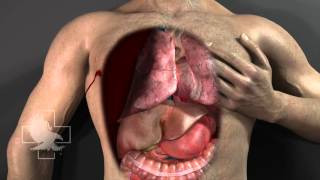
This casualty has sustained a penetrating chest wound to his anterior chest with no exit wound. His lung has collapsed and it is interfering with his ability to breathe. He requires the immediate application of a hyphen chest seal. These wounds are rapidly treated by applying a hyphen chest seal during expiration, placing the casualty in an upright position or in the recovery position, and monitoring his respirations for the possible development of a tension pneumothorax.
Step 1 Wipe any dirt and or fluid from skin with sterile gauze pad.
Step 2 Grip large white flap and peel clear liner from dressing.
Step three Place dressing on patient adhesive side down, centered over the wound.
Step 4 Peel and remove small white flap. Step 5 Firmly press dressing to skin, forming an effective seal.
Position the casualty in either a sitting position or the lateral recumbent recovery position. Because air may still enter the chest cavity through the damaged lung tissue during the normal respiratory cycle, the attending medical provider continuously observes and monitors the casualty for signs of progressive breathing difficulty that may indicate the development of a tension pneumothorax. If the provider becomes concerned for a developing tension pneumothorax, they should follow their training and established protocols to treat this condition. Supporting tactical and prehospital healthcare professionals worldwide and enhancing casualty survival by providing superior products designed specifically for austere environments is our mission and our privilege.