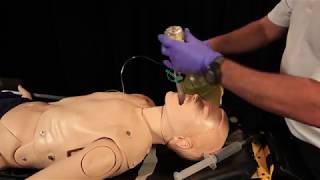
Instructional video on the IGEL supraglottic airway after Battalion 10 trial showed 90% preference over King airways. Covers sizing, insertion technique aiming at the hard palate, confirmation via ETCO2 and auscultation, and ventilation rates for cardiac arrest: 8 breaths per minute for no-pulse adults after 6 minutes, 10 per minute for those with a pulse.
Questions this video answers
Over 49 cases.
90%.
Size 4.
Place the tip over the xiphoid process, run the tube up around the patient's ear to the center of the mouth and note the depth.
8 liters per minute (anything greater may cause the O2 line to pop off).
Chapters
Hello. We wanted to take the opportunity to update you on our Igel trial that was performed in Battalion 10. We had enrolled over 49 cases, and 90% of the cases preferred the eye gel over the King airway. So the department has made the decision to move forward with purchasing all sizes of the IGEL. The 2018 protocols will reflect this change. We will no longer be using the OPAs with the MPAs for the primary cardiac arrest cases. Our cardiac arrest protocol will now state that you insert the IGEL immediately in all comers of cardiac arrest. We just wanted to say a quick thank you to Battalion 10 as well as all the EMS captains that gave us valued input during this evaluation period.
Based on manufacturer recommendation. Please review the following sizing chart to choose the appropriate size Igel for your patient. We're going to assume that Today's patient weighs 80 kilograms. We're going to utilize a size four in the kit that comes from Igel. It's known as the recess kit. That's going to include your eye gel, a securing strap, and a packet of lube. Through Support Services, we're actually going to make our own kit and include an NG OG tube the appropriate size, as well as a TUMI syringe to confirm placement.
We're going to utilize this both in the primary and secondary arrest immediately as your airway of choice. But this will also include your failed airway algorithm as opposed to the King Airway. We will now utilize the igel. So upon arrival, your crews are going to assume the normal pit crew positions, starting with compressions, early defibrillation if needed, and go ahead and confirming that the airway is clear. The number three position is going to come to the airway. They're going to give their two breaths, both to confirm no foreign body airway obstruction and to force the blood out of the lungs. Be sure and get a measurement of your gastric tube prior to insertion. The way you would appropriately size it is place the tip over the xiphoid process, run the tube up around the patient's ear to the center of the mouth. Be sure and take note of the depth where your gastric tube will be properly seated. Afterwards, we're going to go ahead and open our Igel recess pack.
We're going to make sure to keep the head strap close by.
Then we're going to open our lubrication packet. While prepping your IGEL for insertion, be sure and place a bolus of lubricant in the NG port.
Just lateral.
To the main ventilation port. Go ahead and insert your 12 French NG tube in and out several times to lubricate the channel, making sure to not allow your NG tube to pass out the distal end of the Igel prior to insertion.
After placing the NG tube, put the remaining lubricant on the holder.
And be sure and lubricate well across the back, the sides and the tip of the eye gel, making sure there's no excess gel.
Closing covering the opening.
We're going ahead and place the patient's head in the sniffing position.
And then we're going to go ahead and insert the eye gel, aiming towards the hard palate.
And making our way down the back of the throat. You will initially feel some resistance. You want to continue inserting until we feel a definitive resistance. The goal is to make the incisors reach the black line. However, as long as the teeth are within the bite block and you have felt your definitive resistance, you should be in now that you felt your definitive resistance. You have a couple of different options based on why the IGEL was inserted. You do want to connect with your BVM and end tidal CO2 filter and ventilate and get a positive capnographic waveform to confirm placement, simultaneously auscultating over your lung fields and negative epigastric area.
If the patient was given an eye gel due to a failed airway, this would be the extent of your connections.
If the patient was given an eye gel due to primary cardiac arrest, disconnect your BVM.
Remove the O2 line from the back of the BVM and place it on the passive oxygenation port at 8 liters per minute. Anything greater than that will cause the O2 line to pop off. We will not be using the rescue pod in the primary cardiac arrest until positive pressure ventilation begins.
If the patient was given an eye gel due to secondary cardiac arrest.
Then a rescue pod needs to be placed on first.
Followed by your end tidal CO2 filter line and BVM.
This is also going to be your setup for after six minutes of passive oxygenation, be sure and ventilate the adult patient with no pulse at 1 breath every 10 seconds. In an adult patient with a pulse at 1 breath every 6 seconds, never forgetting that if the patient has a pulse they do not get a rescue pod as well as under one year old or traumatic arrest.
Once you know that this is secure.
Prior to strapping down with the head strap, you want to make sure you advance your OGEE tube. We noticed during our trial that at times you would have trouble advancing the OG tube, whether due to anatomy or placement and you may need to adjust the eye gel at times to advance that Ogee tube. Once it is seated and you confirm it with air from your Tumi syringe auscultating over the epigastric region. Then we're going to go ahead.
And apply the strap that comes in the recess kit, maintaining.
A gentle inward pressure so that it seals against the laryngeal and perilaryngeal framework.
There are times that we noticed during the study you may hear some air escaping out of the mouth. There are two main reasons for this. One is sub optimal placement of the eye gel and two, the eye gel could actually be too small. Even utilizing the recommended size for your patient, you may need to actually remove the eye gel and insert a larger one.
Insertion techniques for the pediatric patient are the same as an adult. However, we were never provided a way to properly secure it. That solution was actually provided to us by one of our drivers, Ed Peek, who showed us that just using the adult strap out of the adult recess pack.
And pulling it over and actually.
Securing the 15 millimeter port with the side straps.
Provided a nice inward pressure that you needed to maintain that seal.