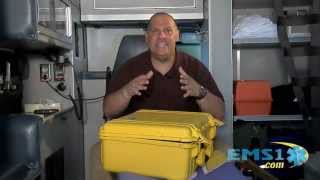
Chris Sabolaro demonstrates the Handtevy Pediatric Box, a customizable resuscitation kit with age-specific compartments for airway and IV supplies. Dr. Peter Antevy's hand-based mnemonic lets you calculate pediatric drug doses in seconds using weight and age, covering eight common emergency drugs. A 5-year-old weighing 20 kg gets 0.2 mL of epinephrine.
Questions this video answers
September 17, 2013.
Dr. Peter Antevy.
12 years.
1, 3, 5, 7, 9 years.
10, 15, 20, 25, 30 kilograms.
Chapters
As EMS providers, pediatric calls can be the most challenging. And one of the things that we think about as we go to this call is how we're going to do our job. We what if we have to do some drug dosing? What if we have to figure out what medications to give? When is it going to be that someone's going to come up with a system that allows us to do drug dosing as easy as possible? Well, today I'm going to show you that product. I'm Chris Sabolaro and this is the innovation zone.
You know, it seems that pediatric education is just one of those things we don't spend a lot of time on, but it's one of those things that we really need to know. Because when it comes to dealing with a pediatric arrest, when a mother hands you that three month old, that's not the time to figure out that you don't feel comfortable and confident with dealing with that situation. Well, today our product comes to us from Dr. Peter Antevi. It's the Hand Tevy pediatric box. And I gotta tell you, I'm really excited to bring this product to you. I've seen it for a couple of years now. And really to highlight some of the characteristics of this is really going to benefit our career field. And in my opinion, this is going to be one of the things that revolutionizes the way that we deal with pediatric arrests. The Hand Tevy system really comes with two components. Not only are we going to talk about the equipment that we have here in the box, but there's also a learning method as well. And what if I told you that I'm going to show you the eight common drugs that are used in pediatric arrest or pediatric medical treatment, and you're going to be able to calculate those in your head in a matter of seconds. So the pediatric resuscitation boxes, I'm really excited to show you this, and this is really the components of it. First off, up here you have all your disposable items, and these are items that you're going to be stocked from your own system. So once you purchase the system, you can just restock it with all your standard equipment and you have different cases that will allow you to treat the patient based on their age. So let's go ahead and show you some of the components. You have a tape and what you want to do is you want to take the tape and you want to lay it down against the patient from their head and you want to go to the bottom of their heel and that's going to tell you where you need to be. So you have your two year old patient, you want to go ahead and pull out the box that says two year old, you go ahead and open it and you're going to have everything you need in there that's going to allow you to handle that resuscitation. You've got your blades, you've got your LMAs. If you have, you've got your ET tubes, your Kings, and you also have your IV start equipment. Now one of the components of this that I think is really excellent is, is the fact that this is customizable to your system. Once you buy the system, a team of pediatric specialists is going to construct this box to your departmental specific needs. Once the pediatric specialty team builds your box, they also build a user manual for you as well. And what this does is based on your protocols will actually allow you to see what medication should be given in the proper dosages to your patient. And this is really an outstanding thing because how many times do you figure out that, that we're inside the home and we know that we need to give epinephrine, but we don't remember the dose. We're supposed to calculate weight base, we're supposed to utilize zero point, whatever it is and we really get kind of hung up on that. So instead we have all that listed out for us. And this is really a great benefit to deliver the appropriate dose and to reduce those common medication errors when it comes to dealing with our pediatric patients. You know, one of the components of dealing with a pediatric patient is that we have to give weight based medications. And, and there's really eight common medications that we're going to give to patients, whether it's pediatric arrest or whether it's medical emergencies. And we need to be able to figure out what those dosages are. So let me ask you a question. You have a 5 year old that needs some dextrose D25 and they have a blood glucose of 20. What dose are you going to give them of medication? Now we've got to sit there and we've got to figure out what dose we can give them. But what's really great about this system is Dr. Anteve spent 12 years coming up with the answer of how we can help this. And that's the pediatric badge, buddy. And what that does is it allows us to use our hand to figure out what dose we need to give. Let me go ahead and illustrate to you how that works. Using your left hand and starting with your thumb, what you want to do is the patient's age, 1, 3, 5, 7 and 9. The next thing you want to do is you want to be able to calculate the weight. So you start off with 10, 15, 20, 25 and 30 kilos. So knowing that you can calculate the eight most common drugs used in pediatric arrest as well as pediatric and medical situations. Well, let's look at epinephrine. 1, 1000 solution. Let's say we have to give this to a 5 year old who's now having an allergic reaction to a bee sting. So if we go back to our hand heavy System, we have 1, 3, 5, so we know that our patient is 5 years old. And if we go to the weight base, we have 10, 15, 20, so we know that our patient is 20 kilos. So basically the ease of this system is if I go ahead and take the decimal place and move it to the left two places, I'm going to give 0.2 milliliters of epinephrine to this patient. And that's how easy this system is. And it's really revolutionary to use and I'm so excited about it. Why didn't they teach us this in school? But again, it took Dr. Anteve 12 years to figure this out and we're excited that he did. The hand tevy pediatric box and learning method is really revolutionary. It's going to change the way that we deal with pediatric arrests. So when you think about it, you've got a resuscitation box which has all the tools that you need, that's built to the specifications of your department, as well as don't forget the hand heavy method of learning those eight common drug dosages that we need to deliver the highest quality of patient care. I'm Chris Subalero and thank you for joining us on the Innovation Zone.