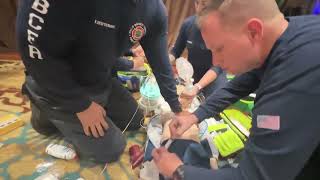
Peter Antevy leads a mock code demonstration for pediatric drowning response at the JDCH Conference 2023. The video walks through step-by-step EMS protocols and equipment use for emergency medical intervention in a drowning scenario.
Chapters
Responding to a six year old drowner. Six year old drowner. So I want you to hear what the pre game sounds like.
All right, team, we're going to get dispatched to a six year old. I'm going to be monitor. You're going to be airway. You're going to do compressions. Our first jewel setting is going to be 100 joules. We're going to be using a size 2 eye gel with a 12 French gastric tube. This is an adult combo pad. If we have to give EPI, it's going to be 2.2 MLS. And in the case that we need to get ammunitor on, it's also going to be 2.2 mls. It's a 25 millimeter IO.
Okay, so that's what it sounds like. Normal dispatching time for US is about 30 to 45 seconds to get in the truck. Our average Response time is 6 minutes and 43 seconds. So they do have that time to have that interaction. I will put you on the scene now so you'll see our primary providers come in. Our rescues and injuries contain three people. So you have three people. They do a quick and I'm going to narrate a few things for you. So number one, you'll see they waste no time with chest compressions. But I want you to focus specifically. Doc, can you zoom out for one second? If you back up where these bags are nice or strategic, there is no accident about this. They have the monitor down by the right foot. They have the compressor on the left side. They have the med bag down here. And all the airway equipment is landed at the head. This is practice. This is not an accident. This is not an accident. So the first 25 minutes ideally is going to look like this for us. Hands on the chest immediately. Combo pads, front and back, get off the chest.
Basically dumping backward compressions.
They never checked the rhythm yet. They'll stop. They pause. Monitor has the charge. If it's shockable, they shock. If it's not shockable, hands back on the chest, they keep going. It takes anywhere for 15, 20 seconds to charge monitor. Don't drop the chest that long.
At the airway. Two breaths go in. Face suction if needed. Chest compressions continue. He's counting in his head using a. Can you set me up a size two eye drop? Size two eye drop. Here's the metronome.
This is keeping him synchronized to make sure to make sure that his chest compression is around 110. They also have a ventilation light that's telling Maddie up at the airway when to squeeze the bag and I'll show you some case review where people think they can levitate patients off of the bed by squeezing the bag at their same heart rate. And I'm sure you've seen this before. So measuring the gastric tube, side sizing up the eye gel shock is performed. They already have an IO in the distal femur of the child and they're getting ready to administer their first dose of epinephrine. Now, understand, my mom's not screaming. Understand? We're in a nice lighted room here. We're not on the side of the pool. But everything that is happening right here is not by accident. If you're not practicing this at your hospital, please think about this. Please, please invite us. We will help. Now, another provider gets here. This is our EMS supervisor and I'm going to stop it right now and just switch it real quick for you. Imagine same 6 year old child that was stabbed in the abdomen. Imagine the same six year old child that was shot multiple times in the torso. Same concept, same theory. EMS kept his on scene. First thing he's going to do, you'll see right in his hand is the ultrasound. So he's going to be looking for hardwall motion immediately to figure out exactly what's going on. When the patient, after he determines whether or not hardwall motions present or not, his next step.
He looked at the heart of the ultrasound. He knows for a fact that kid is in a traumatic arrest. Now he's going to go ahead and set up a finger floor conference. The crew's switching their priorities. We're not chasing the epinephrine. We're starting off 2.2. Because the next thing after the bilateral cut is to administer whole blood. Obviously we use Dr. Antebe Zap. We have all of our drugs laid out for us. All of our whole blood is measured by age. There's no come around your side. There's no guessing here on exactly what they're going to give next.
200 charge the monitor. Got you.
Again. Remember, this is like 20, 25 minutes. Now, I will tell you this, and there's a caveat to this. If it's a child that's in traumatic arrest for an adult, this will be in the back of the truck. We will not be staying on scene for 25 minutes for a traumatic arrest. Medical patient, we're going to stay there longer. Traumatic arrest. This has to happen in the back of the truck on the way to the trauma center. We are not going to try and replace a trauma surgeon. Never could we do something like that. We all know this kid needs to be on bright lights and cold steel. That kid has to get to the hospital. But these steps have to occur. Bilateral cut, bilateral poke. Finger goes in all the way around. Air comes up seal with chest seal.
I know it's one of those things that you get to see the vendor tents and you get to talk to everyone. You get to see the things there. But sometimes when you see it in a practical setting, it makes a little more sense for you. Just for complete clarity, we do use the Warrior warning device, the killing flow. We also use the lights on every single patient that we know gets blood from us. It gets delivered to the water. And I can tell you that Dr. Peel's device and queuing flow has saved many lives in Palm Beach County. That 86%. There's not one blood case that we had at Palm beach county, we did not use that device. So thank you so much for protecting our community.
So now you'll see they've got the Y tubing and going to go ahead and set up the saline bag. And it's going to be followed with the blood. They're going to drain the line. Everyone here has seen this a million times in their ER or whatever they want.
Lines prime. Got it. Y. Go ahead. That. Put that DU on for the warmer.
You already drained it. You did a plug in. Go ahead, plug in. All right, we're in.