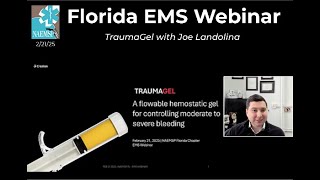
This content was created by Peter Antevy. This content was uploaded by Peter Antevy. This is a YouTube video titled "Joe Landolina: TraumaGel for hemorrhage control (2/21/25)" featuring a webinar recorded on February 21, 2025, where Peter Antevy introduces Joe Landolina, CEO and co-founder of Crestalon. The webinar discusses the development and application of TraumaGel, a hemostatic gel for hemorrhage control, including its origins, FDA clearance, and market introduction. Joe Landolina shares his background and the journey of Crestalon from a dorm room idea to a company with nearly 100 employees, highlighting the product's use in both veterinary and human medical fields.
Chapters
All right, so welcome, everybody. It is Friday, February 21st. Myself, Dr. Paul Pepe and Tanner Smeder welcome you to the Florida EMS webinar, where every week we bring in incredible speakers who are doing incredible things in EMS in the world of EMS. This is our second LinkedIn Live experience, so hopefully some people are joining us on LinkedIn as well as on the Zoom Call. This will be recorded and we will put it on our YouTube channel. Today we have the great pleasure of having Joe Landolina, who is the CEO and co founder of Crestalon, which is the creator of a product which, when you first hear about, may be too good to be true. But the more you read about it, the more you investigate it. And I've spoken to many people about it and actually had the ability to actually hold it in my hands at my agency in Coral Springs, which we're going to be trialing it and piloting it starting on March 3rd. You realize that this thing may be as transformational as something like having whole blood and emf. This is something that could potentially be on every shelf in Walmart and CVS and in every home of every person around the country. So I think this is big and really grateful to my good friend Nidal Khoury, who many of you know used to be with Teleflex, and now he's with Traumagel and Crestalon, working with Joe and running their entire team, their sales team. So without any further ado, Joe, if you want to make any further introductions. And again, thank you so much for joining us in the Florida EMS webinar. Take it away, my friend.
Of course. Thank you so much for having me this morning. It's great to be here. It's great to be able to speak about TraumaGel. And so I'm going to keep the presentation today relatively short to leave time for questions at the end. But before I dive in, let me talk first about my own background, because I had somewhat of a circuitous path into trauma gel or into discovering TraumaGel and bringing it to market, which is that I'm a chemical engineer by training. I was lucky that my grandfather was an ex pharmaceutical executive who decided that he liked the world of wine better than the world of pharmaceuticals. And so, in retirement, started a vineyard in upstate New York. That meant that I grew up on a vineyard with a grandfather who learned lab safety in the 60s, and so well before I probably should have been allowed into a lab. I was able to run experiments effectively, unsupervised. And that led to me at a relatively Young age, I was 16 or 17 years old, I discovered this extraction out of algae. So two polymers or two long chains of sugar that come from algae that would form a gel that when I put it on my skin, it would stick and it wouldn't let go until I wanted it to. And at that time, this was in 2010. So about 15 years ago, I had this idea of using a material like that to at least plug up a bullet wound so you can move a patient from point A to point B without them bleeding out. And that was the very beginning of Crestalon. But it allowed us to build the business that we have today. And when we entered that into a business plan competition at nyu, where I was then a student, we won, getting just enough capital to launch the concept that would become TraumaGyl.
So today, what we're going to discuss is TraumaGyl. TraumaGyl is a brand new product. It's a flowable hemostatic gel that's indicated for the control of moderate to severe hemorrhage. It was cleared by the FDA under a 510 in August of last year. Tramagel was also launched into the market in a pilot setting in October of last year. And so what we'll be discussing today is a little bit about the business, a little bit about traumagel, and quite a bit of highlighting some of the initial case studies that have come out of the early clinical use on this product product, and talk a little about why I'm excited to bring this technology to market. And so, like I mentioned in, in my introduction, we founded Crestalon in 2012. It was while I was an undergraduate at NYU. We were in 2012, just two guys in a dorm room. And Brooklyn was not known for being a hub of biotechnology or of medical devices. But, you know, we were Brooklyn born and raised and we wanted to keep it local to. And so over the last 15 years, we've turned Crestalon from what was an idea in a dorm room to now we have nearly 100 employees working out of our location in Brooklyn. We are the only biomanufacturer in the five boroughs of New York. And something that, as a native Brooklynite, I'm proud of because Pfizer was founded here and Bristol Meyer Squibb was founded here. But then as they got larger, they eventually left the city. And for me, living in Brooklyn, it's nice to be able to have a walking commute to the, to the office. And so we decided to build everything verticalized here. And so as a small med device company, we're unique in that our R and D, our production, our sales team, we're all located in the same place, allowing us to control our own destiny and work very closely with our customers. We began not in trauma care in the human space, but we started with a product by the name of Veto Gel, which is a veterinary biosurgical device. And so it's the exact same gel, just in a different size syringe. And the Vetigyl product is indicated for all types of surgical bleeding. And so that use cases range from trauma, as we'll discuss today, up to spine and neurosurgery, orthopedic surgery, soft tissue, cardiovascular. And so that product has been used in over 65,000 PET patients in 34 countries since its launch about five years ago. And so that. What's interesting about Vettagel is that it allowed us at a very large commercial scale to pilot these indications and understand that in canine units, dogs get stabbed and shot, too, unfortunately. And so we had very early data that came back from that market of the product's efficacy and those indications. And that only emboldened us as we looked to launch this product in the human space and.
As we brought traumagel to market. My initial goal when I started Crestalon was to be able to stop very large severe hemorrhage from gunshot wounds, stabbings, lacerations, amputations, motor vehicle accidents with our technology. And so that was the goal as we brought traumaville to market. And one side note is we also have two active CRADAs, which are collaborative research agreements with the US Department of Defense, one for hemorrhage control with USAISR, and the other with Walter Reed for penetrating ballistic brain injury, which is not trauma drills indication, but it's something that we're excited about for future indications. And.
It wouldn't be a presentation for me to just talk about what the product does. I want to show a few videos. Now, fair warning, these videos are in a preclinical model. And so it's. These are a demonstration of how the product works. So this is a model that was popularized by usaisr. This is a femoral arteriotomy in a pig. This is a model of severely lethal hemorrhage. And so what we have here is the traumatrol product being deployed. It creates a nearly instant mechanical barrier against bleeding. And so instead of needing to pack a wound with gauze or with powder and hope that you're getting in contact and getting control of vasculature, you can instead deploy this product as a flowable and it allows the patient to produce their own clot. And so one thing, just as we discuss where this product is used, this the traumatol product is indicated currently for external temporary control of moderate to severe hemorrhage. And so that means that this product isn't indicated for use inside the abdomen or in surgical use. And it should only be used in indications where the user of the product can more or less visualize the source of bleeding and where it can be ensured that the traumatic product can be removed after the fact. It's not indicated to be left in beyond the 24 hour point. But the idea here is that ideally.
If you can get this packed into a wound, it significantly reduces the time to pack. It comes as a pre filled syringe, and so it allows you to flow the product exactly where it needs to go. It starts bleeding rapidly of all sizes. And most importantly, which wasn't demonstrated in the video that I showed, it doesn't integrate with the clot. And so unlike a powder or a gauze that works by absorbing fluid, this works by creating a scaffold next to the bleed. And so when fibrin forms, when platelets aggregate, that fibrin and those platelets do not become incorporated within the structure of the gel itself. And so if you wash trauma gel away or you remove it from the wound, you're much less likely to have a rebleed. And so this is really important. And as we'll discuss through some of the cases where you need to remove the product for vascular repair, you're less likely going.