John B. Holcomb, MD: Plasma for TBI in EMS (9/16/24)
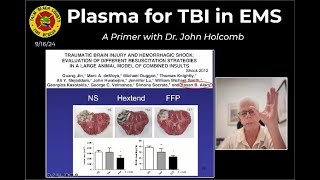
Dr. John B. Holcomb explains why giving plasma early in traumatic brain injury might save lives. Plasma repairs blood vessel damage, reduces swelling, and fixes clotting problems. The PAMPer trial tested prehospital plasma; typical dosing is 1-2 units plasma plus 2 grams of TXA.
Chapters
The topic of today and why we're here is traumatic brain injury. And as many of you know, it remains an important topic, especially in what we call God's waiting room here in South Florida with high morbidity, high mortality. And there have been several important studies on this topic, specifically with the use of plasma in tbi. And that's exactly what we're here to discuss today. The most recent of those studies was the Pamper trial many of you familiar with back in 2020. Those studies have shown that plasma not only improves survival, but it actually decreases the risk of secondary injuries. And I know Dr. Holcomb is going to talk about that today. So why does this matter? We as a department have connected with Dr. Holcomb to create a new protocol specifically incorporating plasma for TBI in the pre hospital setting. And so without any further ado, we're very privileged to have Dr. John Holcomb. Many of you know him, he's a renowned trauma surgeon, one of the world's leading trauma experts in trauma care and pre hospital resuscitation. He obviously has an extensive research background and he is helping us along the way. So without any further ado, Dr. Holcomb, thank you for joining us. I know you're sharing your slides. Take it away, my friend. Thanks for joining.
Yeah, Peter, thank you very much. And Charlie, thank you as well. I would encourage anybody to kind of just chime in and ask questions as we go through. We're going to cover a lot of ground, probably too much ground, but really this is just to throw some ideas out, some background and some data and then some generate some questions and discussion and a way ahead. I do have some conflicts. None of them have anything to do with plasma and tbi. You know, this is kind of everybody has this little quote when they give a talk and they want to do something different. But it really is true. I've been taking care of brain injured patients now since 1985 and we're better, but we really don't have a new intervention that's really made a big difference. And so what we're really going to talk about today is not preventing the injury. That's obviously very important. That mitigating coagulopathy expansion and decreasing edema, those are the things that really I think we can do something about. I don't need to tell this group TBI is a big deal. You can document it many different ways, but it is, it's a big problem both on the military and the civilian side. Now when you say tbi, it's Kind of like saying we're going to cure cancer. There's a lot of different kinds of cancer. There's a lot of different kinds of TBI all the way from subdural hemorrhage, enter parenchymal contusion, you know, and then, and then epicource epidurals and then you have combined which is very common. So I'm not really going to get into this too much. We're going to leave it at TBI for right now. The the Brain Trauma foundation and the National Academies have focused on tbi as you might expect over the last couple years. This National Academy report from 2022 kind of does a very high level roadmap. They talk about changing some names but really it says as a nation we should focus on traumatic brain injury because it's a big problem.
And maybe have a different framework and understanding. Again, not going into this but but worthwhile. Read the I don't need to tell this group the the visit Biggest and most successful interventions do not occur in the hospital and I'm at For the last 10 years, 15 years have largely been a hospital based guy prior to that spent 10 years in special operations in the army and was pre hospital, carried a ruck, slid down ropes of helicopters and evacuated patients back to the operating room. But.
Question, somebody have a question? Nope. But the biggest, the most successful interventions have been pre hospital taking things that kind of work sort of in the hospital and moving them pre hospital because they are time dependent. And I think the same is going to be true for tbi. I I've reviewed all the current guidelines that I can find.
And I would say they're pretty light on the pre hospital and ED resuscitation of TBI patients. We'll go through some of those guidelines and some of the interventions. The Brain Trauma foundation has looked at many of these interventions and I'm just going to go through a couple of these. They're redoing their recommendations as we speak and I've been in touch with them as well and they've seen some of this information that I'm showing you today. Hyperosmolotherapy, hypertonic saline, that sort of thing does lower intracranial pressure but none of them have been proven to improve outcome. The Penetrating Trauma Brain Trauma foundation guidelines are undergoing a review as well by the BTF and it's interesting that many of the things that we did on the battlefield in Iraq and Afghanistan have have made their way into the civilian Penetrating Brain Trauma foundation guidelines and the main one is that not all these patients end up dead. Certainly if you have transcranial both side to side or front to back, that's really bad. But many of the tangential injuries that we had a kind of a nihilistic attitude on previously have been shown to improve outcomes and the principles of damage control surgery and damage control resuscitation have made their way into the civilian Penetrating Brain Trauma foundation guidelines. We'll talk about that in a second as well. The Greg has, has really is taking the lead on the pre hospital Brain Trauma foundation guidelines. And if you have a chance this is, this webinar is worth reviewing. It came out In June of 25, just a couple months ago. It's pretty good. And I took some screenshots as I went through here. Rocco Mondo was, is a, was an army neurosurgeon. We were deployed together in Iraq. He has remained extremely involved with the Penetrating Brain Trauma foundation guidelines. Has been to Ukraine probably 10 times in the last two years. And you know there's the obligatory pictures but really talks about the influence of resuscitation and he talks about one to one to one whole blood improving the ability of the neurosurgeons to successfully operate on these penetrating brain injuries both in Iraq, Afghanistan and Ukraine. Again the neurosurgery guidelines talk about resuscitation, avoiding hypotension, hypoxia. They don't really talk about. This paper from 23 a year ago doesn't talk about how to do the improved resuscitation. We'll speak to that in just a second. They do talk about the EPIC study that you guys are familiar with. And the EPIC study is first authored By Daniel Speight 2019 doesn't have a specific new recommendation but says compliance with guidelines in the moderately or severely injured TBI patient dramatically improves the outcome. Dramatically improves the outcome and really talks about these four interventions. Prevention of hypoxia and airway intervention to optimize oxygenation and ventilation, not, not hyperventilation and avoidance of hypertension by infusing isotonic fluids and we'll spend some time on those as well. This, you know this, this slide is, is, is indicative of most physiologic parameters and almost everything in the brain area that we're going to talk about has this U shaped curve where you kind of keep the blood pressure relatively normal. You avoid hypotension and you also avoid hypertension. These are the probabilities of increase of death and you can see a U shaped curve. Most physiologic Parameters end up this way. This is not what we were taught when I was a resident and what I've done in the icu we were only taught the hypotension part. But if you really pay attention and let the data speak to you, you also avoid hypertension and the same thing goes with temperature. Avoiding hypothermia and hyperthermia for the traumatically brain injured patient is really important. Now if you look at the standard TBI care and this starts both pre hospital and works all the way through the I.C.U. all you know, avoiding hypotension, hypoxia, all the way through working on nutrition keep and serial CAT scans, operative intervention. You know, this is what the EPIC study shows is keeping the patient and paying attention to these guidelines really does improve outcome. We talked earlier about the primary and secondary injury. You know we're not going to do talk too much today about prevention. Obviously it's always better to wear body armor, your helmet, avoid getting your head injured, wear your seatbelt, et cetera. Don't get in a crash, avoid it. But once you do, let's we can't avoid that brain injury and I will show some pictures of in a second. But we can prevent the progression of hematoma, we can diagnose the progression earlier and we can prevent the progression of edema. I think this is our opportunity and this is what we'll speak about today.
Now just briefly, progression of hematomas is not rare. It's unusual, but it's not rare. What does that mean? We'll talk about that in a second. Most intracranial hematomas don't progress. When they do, mortality quadruples. So how do we diagnose this earlier? Well right now once you guys deliver these patients to the hospital, we wait for herniation and then get a CAT scan. It's kind of crazy actually. We wait for lateralizing physical exam signs but then we get a CAT scan. We do get serial CAT scans are expensive, transport's difficult and dangerous or not at all and just wait for physical exam signs which is really late. There are some studies out there right now using predictive analytics. There are non invasive point of care intracranial handheld hourly diagnostics that can be used and are used in austere settings. These are FDA clear devices. We'll talk about one of them.
This predictive analytics thing is pretty interesting. It comes from Marty Shriver and Susan Raul's group that published the recombinant factor, the TXA trial. And as opposed to some of the things we normally talk about with age, sex, admission, GCs, presence of inline shift. It's was really the different scoring systems that are out there that were associated with progression and also some of the biomarkers and mean arterial pressures. So there are some it kind of data analytics, AI things that are coming down the pike. But in, in the meantime what we can do today is, is to focus on this little device which is FDA cleared civilian and it's being used both in the civilian world and in Ukraine with a DoD funded study. There's a multicen prospective randomized DoD study on and going right now. Jan Yansen is the P.I. about six different centers in the U.S. this could be something that we could use to diagnose the presence of hematoma. And if the hematoma is expanding, something to think about, we'll talk about that much more. Avoiding heat edema. You know this is what we really focused on the last couple years. 20 years in the civilian world is using less crystalloid and earlier rub products. What's happened in is that we've ARDS has not gone away but its incidence is dramatically different. Open abdomens, you know, the big swelling of bowel, it's kind of gone away. Extremities are less edema, less edematous. We've seen this by not giving crystalloid and giving earlier blood balance bread products we've really changed some of these iatrogenic complications. And I, I think that a demon the brain can undergo the same revolution. We'll go through the data that would support that statement. This is the outline of this talk. We'll talk about endothelial dysfunction, coagulopathy, all the clear stuff. It's given drugs and we'll end up with blood. And I'm going to use bowel and lung as examples throughout here. I'll also throw in some of the brain data but you know, the neurosurgeons don't like it when I say it. But the brain is just another organ. Now it's special, right? It's a special organ but it's, it is different from the lung and the bowel and the liver etc, but it's just another organ and responds remarkably in some, in a very similar way as many of these other organs that are out there. It is instructed for just a second to go back to physiology. Physiology rules. Guyton is the best physiology book out there. And, and this picture comes from Guyton and talks about the different compartments. You have the intravascular part of the interstitial fluid, intracellular fluid and how Fluid moves back and forth between those different compartments. This is an extremely instructive figure from chapter 24 in Guyton. These are arterial pressures in dogs.
After different degrees of acute hemorrhage. These are without resuscitation. And I'm going to go over this for just a second because it gets to the. You know why I think that plasma may have been beneficial in the brain. This is the slide that talks about autoresusitation. I spent some time with some whole animal physiologists a number of years ago and they taught me about this slide, then went and read about it. If you, if you take out a lot of blood, the animal doesn't live for very long, couple hours with no resuscitation. If you take out less blood, they live longer. And if you take about even less.
30 to 50 mils per kilo, 30 mils per kilo and or less, the animals drop their pressure, but they also then live and they bounce back. They auto resuscitate. They take fluid from those different compartments, intracellular, interstitial, and translocate it into the intravascular and that's how they raise the blood pressure back up. Pretty interesting physiology on translocation of fluid from those different compartments that we all learned in school. And without resuscitation, how that applies to patients, we take care today. If you believe in evolution, which I think most of us do, how does that fluid happen? That fluid comes from the extravascular, interstitial, intracellular and gets back into the vessels because of permeability. This is a preserved physiologic response of autoresuscitation that is preserved across all mammals. And it's occurred over. It's been preserved over millennia. It is an evolution. It's a fact of evolutionary biology. Only in the last 150 years have we shown up as medics and doctors and nurses and, and put IVs or IO catheters and drift fluid the other and. And push fluid the other way out of the vessel and into the tissue. There is no edema. If you don't show up with an IV or IO catheter. What we're doing is we're working against evolution. We're working against that permeability. And what we need to do is work with it. So Bill Air publishes this book called the endothelium, published in 2007. And what he showed was that the endothelium is very different in different parts of the body. The brain endothelium is different than the lung and the bowel. Now they obviously have some similarities, but there are differences. Shabani pati is a PhD that I worked with for a long time, coined the phrase endotheliopathy a trauma. Published this paper now, was that 13, 14 years ago, and kind of goes through this for a second. If you look at those spaces that I talked about, the interstitial and intracellular space, the glycocalyx, when you go into shock or has an injury sheds, the endothelial cells become permeable. If you show up with an IV of crystalloid, then you drive fluid out of the blood vessel and into the tissue. But if you show up and give plasma or whole blood, then you restore the glycocalyx, you cause that, those endothelial cells to reverse the permeability, and you keep the fluid in the vessel and you don't get edema. That was published in 2010. It really is the basis, the molecular basis of everything we've done, and I think it applies to the brain as well. Shabani has continued this work and has really led the country, I think, in articulating clearly how this happens. This is a picture in the brain now. You have even tighter junctions in the brain than you do in other places. But the same thing happens.
Differently than in the lung to a different degree. But this hyperpermeability really occurs at the microvascular level and occurs in all of the vascular beds of the body. The secondary injury discussion in the brain now has been articulated by again, the neurosurgeons and the neurologists around the world and the Brain Trauma Foundation. This is right out of their paper, blood brain barrier, which is another word for the endothelium. Right. The. The brain guys change the words, but it's exactly the same thing. Leads to excessive interstitial water, vasogenic edema. That's if you give chrysaloid. Right. Contributive brain swelling, brain shift and herniation. Right here is blood brain barrier permeability. Right there. As they talk about this, and what they don't talk is about avoiding that or repairing it. And I'll show you how that could work now. Jill Sundin, Mike Dubic, Charlie Wade, whole animal physiologist, started teaching me this stuff a long time ago. We paid attention, others got on board. Bijan Karabadi and. And then down here, you see other physiologists have continued this work over many years and, and really have focused on permeability and started talking about the glycocalyx and start talking about biomarkers again. You put all this stuff together and now we'll switch over to lungs. Shobani Pati and I and Rosemary Kozar worked together and pretty clearly showed that if you change from lactator ringers to plasma in the lungs, which have the loosest tight junctions and endothelial permeability aspects, that you can repair that glycocalyx, you can reverse that permeability, and the lungs come back looking almost normal with, without getting fluid in the alveoli, otherwise known as ards, pulmonary edema with plasma resuscitation. Erica, who was visiting with us in Houston from Copenhagen, published this paper in the Scandinavian Journal of Trauma, which I'm sure you guys all read every month and looked at our patients with TBI and looked and see if this endotheliopathy of trauma occurs in brain, brain predominantly brain injured patients. And it does. It provides that we measured syndican one, which is one of the components of the glycocalyx and supports the notions and observational studies. So you can't be definitive that the glycocalyx contributes to that physiologic derangement after tbi. Now, for the folks who've seen in the operating room, this is in, in the early 2000s, this is what the bowel looked like on edema, right? We don't see this anymore because we used to give 20 liters of crystalloid. We don't give crystalloid anymore. And so we don't see this huge bowel exploding out of the abdomen. This is a picture I took as my patient in 2006. We don't see that. We just, I mean, people don't get bowel wall edema anymore, but we still see lots of edema and take out the skull so that the brain can herniate out. We see that cerebral edema today. I, I think that if you put these two slides side by side and go, why is this brain getting edematous? I think it's for the same reason that that bowel was edematous, you know, almost 20 years ago, because it was an iatrogenic resuscitation injury and we can avoid that. All right, Coagulopathy. So lots of discussion about tags and rotems and, and PT and ptts and inrs. The bottom line is we can fix all those laboratory abnormalities, but did we really see a benefit in the outcome? It's a really good question, and it's one that is still floating around out there. This paper out of Ron Chang and out of our group in Houston Looked at a thousand high risk patients and a clinical coagulopathy was only seen 4% of the time. Where a laboratory abnormality was recorded, almost 40%. A clinical coagulopathy was rare, but was associated with very high mortality. The laboratory coagulopathy, on the other hand, very common, but not associated with mortality. And so I think the laboratory coagulopathy is kind of a marker, if you will, a potentially poor outcome. I also feel very comfortable in saying that we created a lot of this clinical cholapathy back in the old days. This, this paper was published in 2017 data. We were still giving a fair amount of crystalloid then. And you know, the patients who had this oozing clinical coagulopathy received more crystalloid.
The group out of Europe did a prospective randomized study and they tried to correct all of the TAG and rotem data abnormalities, but in fact there was no difference in outcome than if they just did ratio based transfusion. So it's a little unclear yet if correcting that laboratory based coagulopathy will dramatically improve outcome. All right, let's talk about the clear stuff now. I kind of lump all of this together. Non blood albumin, hypertonic saline, dextran hyperlox saline, mannitol hypertroxings on there twice. Sorry about that. Because it's so important. Normal saline and lactated ringers. You know, we've done all these for the last 40 years. There's been no improvement outcome in clinical outcome with any of these. The you talk about balanced crystalloid versus saline, but normal saline, by the way, there's nothing normal about normal saline. But the, they both contribute to cerebral cerebral edema. This is what the data say. Lactated ringers probably contributes more because it's more hypotonic tonic than normal saline. Hypertonic saline and hypertonic saline dextran have been studied in prospective randomized studies funded by the NIH and DOD. This is published now, what, 14 years ago, pre hospital prospective randomized study, no benefit in outcome. No compelling reason to adopt a practice of hypertonic saline or out of hospital setting for tbi. That was pretty definitive study. And then albumin been around for a long time. Pretty expensive.
Not biologically active. Right? So it doesn't repair the endothelium like plasma does. Also not associated with improved outcome. And in patients with severe tbi, because it's not biologically active, goes through that paracellular permeability we discussed earlier actually increases edema and increase mortality.
Now, one of the questions that people say, well, you guys are promoting plasma Isn't that Pro inflammatory? Peter Re, over 20 years ago published that crystalloid is more pro inflammatory than plasma and other studies have shown exactly the same thing. Peter followed that up 10 years later with this study as a sole author. But you know, these, these inflammatory markers, we were just not taught correctly. There was lots of opinions out there, but crystalloid is more pro inflammatory than plasma according to the biomarkers that look directly at this.
Now Chobani, as I said earlier, has really demonstrated that FFP and Kcentra, which is a four factor PCC approved for reversing the coagulopathy of a prescribed Coumadin, does decrease that in that permeability inhibits vascular permeability but not albumin. And these are the data that say this. So FFP and K Centra are about the same.
Whereas HSA which is the albumin, human serum albumin and K Centra show don't shows no effect. So K Centra, ffp, Kintra here both reverse permeability, but the albumin does not. That's important because the major protein in plasma is albumin. Albumin is made from plasma, so you might think it would, but it's not been so processed and heat sterilized that it's not biologically active.
The just the risk factors for.
ARDs for increasing permeability and lungs fluid, which is known as ARDS in the lungs. From a secondary analysis of the prospective study, every 500 milliliters of crystalloid infused in the first six hours was associated with a 9% increase of ARDS. ARDS comes from that permeability issue. Blood, any blood given within 24 hours is not a risk injury for lung injury. So when you look at crystalloid and blood together, the risk factor was every 500 milliliters of crystalloid, which of course you guys know is not that much and it's pretty easy to get that much in pretty quickly.
Hypertonic saline we talked about already, does it cause a hyperchloremic metabolic acidosis? It does. Does that cause a clinical coagulopathy? So far it can't find anything that says it does do that. But remember that that study on hypertonic saline from Eileen Bulger showed no improvement at outcome.
And so because of this the the guidelines that came out this year from the European Society, based on available evidence, they conditional recommendations for using isotonic saline, normal saline rather than balanced crystalloid for volume expansion. The use of hypertonic saline is not recommended. Right. Hypertonic settings. So normal saline is what they come down to.
The let's talk about electrolytes for a second, I was taught. And for many years in the icu. Drove sodium up, right? We drove sodium up to, quote, dry out the brain and prevent that edema. These things can because of the different fluids we give all the times. Remember that U shaped curve. You can talk about hyponatremia, hypomagnesium. I can't even say the word. But low, low magnesium associated with worse outcomes. Hypernatremia associated with increased mortality in icu. Length of stay. That's what I did in the ICU for many years. And of course, hypokalemia and hypocalcemia associated with increased mortality. The bottom line is you kind of want to keep electrolytes normal. It's that U shaped curve again. This is a pretty nice review of all the electrolytes in the traumatic brain injury population. Now, I just put up this little slide for a second. You guys know there was hurricanes in Puerto rico back in 2017. And my slide didn't. My animation didn't come through. But what's supposed to pop up here is that the gods have spoken. They. The hurricane disrupted the crystalloid bag supply during that time. I'm going to stop there. Anybody have any questions about anything?
Dr. Holcomb. So it's Peter here, so I'm going to. Let me remove the spotlight. Hold one second. So we have a great audience here. I see some friendly names. I know we have many of the folks in the hospital, trauma surgeons, neurosurgeons, et cetera. I would invite any of them to unmute their microphone, introduce yourself and please comment on these concepts.
I have a question. This is Dr. Hus. There used to be medication that is off the market for different reasons. I was just wondering if you had any experience and if you can link it to what you were talking about called Zigris. Do you remember that by any chance?
Oh, yeah.
Oh, yeah, I do.
So it's a protein C inhibitor, if I remember right. I was just wondering how would that fit kind of like into this? I forget what it was for initially, which was for sepsis.
Yeah, yeah. The Zygos story, I think, is very interesting. You know, I. I only prescribe Zagress once or twice in my life in the icu.
And I think it. I think it is a drug that was given without completely understanding the mechanism of action.
You know, if you give Zygos at the right dose, at the right time, it appeared to have some benefit. If you gave it too late or too high a dose, it. It actually caused a profound Coagulopathy. The. When you get into the basic sciences, Zigrus, there was two parts of that molecule, the protein C molecule. And subsequent studies have shown if you take an aptamer, in other words, you break the molecule apart and have its two parts, there's probably one part that's anticoagulant and pro coagulant and you can use them separately. The bottom line is it got taken off the market because it caused more complications than benefit.
If I may, Dr. Farsi here. Dr. Alcohol, you're completely right. I was part of the surviving sepsis campaign. And near. It was only for severe sepsis and septic shock. I don't remember. I think it was Lilly. That was the pharmaceutical company that was behind Zygris. And there's kind of really. Was not statistically significant. And the rate of complication of bleeding and renal failure was very severe. Significant, severe. And I think the Prowess shock trial in 2008 is the one that was rate limiting and determining that zyrs was. Was causing more mortality in the 28 days. And I remember when the 28 guideline, the 2008 guideline for surviving sepsis, we were, I think in Spain and we all voted to ban the drug. I mean, to remove the drug from the guideline.
Yeah, yeah, I think that's right. I. The. The bleeding complications were. You have to balance. Right?
So.
I kind of touched on this. This evolutionary biology and the preserved response. And why do. Why does the endothelium and the brain. Blood. Brain become permeable? I mean, that's a preserved response. How does the repair of that thing happen? It happens because plasma repairs it. This thing that's circulating around in us all the time. You know, we got two and a half liters of plasma and. And it repairs the blood brain barrier and plasma repairs, reverses that permeability. I think there's a lot of. We should pay attention to evolutionary biology, honestly.
So I have a question, Dr. Holcomb, real quick. So based on the EPIC trial, which we. We did take a deep dive in here at Palm Beach County Fire, we really educated on. On epic. And as far as pushing up the systolic blood pressure, and our protocols now do reflect that, but the problem is that in order to push that blood pressure up, you know, we. We don't really have that many choices. Right. It's either the clear stuff or we can choose a presser. And so what I'm hearing from you then is that we would instead use plasma and let's say a volume of. Let's say either. I mean, I guess small aloquato taste 250 or 500 or more. To both increase the blood pressure and to repair that endothelial. Is that the concept here?
It is. You know, I think that's exactly right, Peter. And it's a good way of saying it. The.
That U shaped curve again shows up in. Whenever you look at biology, that U shaped curve shows up over and over and over again. Right. And if pressors will make the blood pressure look better in the blood vessel that we measure it, but at the mitochondrial level, it actually decreases perfusion to the mitochondria. Right. And we got to start. We all know this, right? We all know this. That oxygen delivery ultimately delivers oxygen to the mitochondria. So it can do its. Its metabolic thing, but you. The pressers decrease perfusion. Most of them decrease perfusion to the mitochondria, although it makes the large vessel artery look better, makes our chart look better, but not at the mitochondrial level. Again, I, I try to keep things simple.
We'll talk about the drugs in a second. We'll talk about TXA and you know, anything, anything you can use. When I used to carry a rut. Ruck. If I could use it, use something twice or three times. Right. For different. Different.
That would be a good thing.
Excellent. Any other questions?
Yeah, Dr. Alcohol. Dr. Farce, another comment on Peter, I think what. Based on that you said curve, right. Pre hospitally, you really want to try to avoid both extreme. Right. So the hypotension is the one you want to correct. And I think the plasma is probably one of the great option, right?
Yeah, I think you're right. David. I. You know.
I tell you what. I. I've told Peter this. If I live in Houston and I do my clinical work in Alabama, boy, if I get. If I get, I ride my bike. I rode my bike yesterday. Right. So if I get a head injury, you better give me plasma.
That's what I want.
Yeah, well, we're gonna try to make that happen.
That's awesome. This is Robert Borrego at St. Mary's I got to the lecture a little late, but I didn't. I missed when you described the mechanism in which plasma is repairing this endothelial dysfunction. What's the mechanism?
The mechanism is I can. Happy to share with you again. Like I said at the very beginning, this is a recorded and you guys can look at the slides and I try to put the papers in there. The mechanism of the plasma is very interesting. It reverses that Permeability of injury. And it reverses the permeability by repairing the glycocalyx, which is a mechanotransducer, through the cell membrane into the cytoskeleton.
The glycocalyx sheds. It's a mechanotransducer, causes contraction of the cytoskeleton and causes paracellular permeability. So that's all been worked out very nicely. Plasma reverses that by reconstituting the glycocalyx, causes that side skeleton to relax and reverses the contraction of the endothelial cell.
Actually has nothing to do with the 12 or 13 coagulation proteins that we were all taught in medical school. Nothing to do with that?
No. I was just wondering if it had anything to do with, you know, NDA channels or any other gated channels that are open in the brain and any of the.
Subsequent oxidative damage that's done by free radicals and all those things. Sounds like it may be related to that.
Yeah, I don't disagree. There's one of the papers that talk specifically about this, and you'll see the reference when you look at the slides and happy to send those to you, Dr. Hogan.
Doesn't the plasma also have, like, antithromy 3 protein C that also can mitigate some of the inflammatory response and that you see after traumatic injury? I mean, you're also providing that as well in the plasma?
Yeah, it's multi. I would. You know, it's interesting. I know it sounds. It almost sounds too good to be true, right? That it solves all problems. It clearly is not true. But Jessica Cardenas is another PhD who worked in our lab who just left Houston, went up to. Went up to Denver, but she has a paper in shock. I don't think it's in this deck. Slide deck. I'm happy to send that. If you're hypercoagulable or hyper inflammatory, it brings. If you're hypercoagulable, hyperinflam brings all those functions back down to normal. If you're hypo brings you back up again. It's this evolutionary biology concept that we should work with rather than against.
Yeah, I'm gonna.
I'm gonna.
For the sake of time, keep going here. I appreciate the questions. Love them, actually, because every time I do this makes them better. And I'm happy to answer them all. We're going to keep going if that's okay.
All right, drugs. You guys are all familiar with the crash 2 and 3 trials, so TXA for brain injury right for brain injury TXA for brain injury decreased mortality. Right Decreased mortality risk of death after 24 hours was the same. Was the same. And and because that kind of got washed out the risk of death over the whole 28 days was the same. But the kind of the bottom line here was that it reduced death in 24 hours in the in the non moribund TBI patients. Kind of interesting results. The this paper in JAMA by Susan Rao And Marty Schreiber 2020 also talks about TXA and TBI. Now they used the the previous study used the 11 gram 1 gram dosing. This study used 2 grams in 1 and then had a had a 0 and 0 arm as well. There were no safety issues identified. No difference in LY30 on admission tags after receiving pre hospital TXA and anti fibrinolytic and there was no difference in the primary outcome a functional outcome at six months. That's the FDA's endpoint for phase for TBI trials in the United States in that group that had a positive CAT scan so only about half the patients when you do a pre hospital TBI trial only about half will have a subsequently have a positive first CAT scan in the hospital because it's really hard to determine. There's many reasons to have altered gcs. Doesn't mean you have an intracranial bleeding in those patients who got 2 grams pre hospital very significant difference in 28 day mortality very beneficial, no difference in GOAC. But the DRs was significantly improved. So in one of the scorings function in that group who had a positive CAT scan and this is the results right? So in the group of the positive cat scan 18%.
Mortality in the 2 followed by 1 gram 26 in the 1 in 1 and 27 in the 0. So no difference. The 1 in 1 TXA had no effect on mortality in TBI patients and a big difference in the in the group that got 22 grams free hospital pretty significant and there was no again I would say there was no no increased complications in this prospective randomized study of over a thousand patients.
Now last year this patch trial comes out in the journal 15 EMS agencies.
Almost all of them outside of Houston I think was the only US based group but a first world country did not result in a greater number of patients surviving with a greater functional outcome. Both 53% the they used the one in one dosing that the crash three trial used.
The.
Yeah, let me just, I'm moving around the length. The patch also showed the same thing that the that the Crash 3 trial showed that early mortality was improved but by six months there was no difference. So you know what, what are you going to do with these patients? What are you going to do with drugs? Well we, we took the Susan Rao study, the Susan Rao Marty Shriver study and we're giving 2 grams of TXA pre hospital. So that's what we do. That's kind of how we put this together. No increased complications may be a benefit early on in the patients who have intracranial bleeding. All right, now we're going to talk about blood, which is everything we've kind of led up to and talked about already. Just to repeat this endotheliopia trauma you can look at the different organs, the, the mechanism, the pathophysiology is all remarkably similar that the brain is different. It has the tightest tight junctions of any place in the body. The I just want to go over this one more time because it's so important. What we were taught about Cryst and blood is so wrong. We were just taught wrong that TROLLEY was related to blood and that crystalloid was innocuous. It's just not true. So when you look at this study published in 2013 by Bryce Robinson, 0 patients in this large study had trolley and 505 had what we call Crawley crystalloid related acute lung injury. So 505 patients had lung injury associated with crystalloid and none had classically described TRALI or ards. This is the paper that we talked about earlier with Jessica Cardenas. It's really a good paper. Jessica's really smart PhD and has spent her entire career looking at thrombosis. So looking at the hypercoagulable part of this where it's very interesting, the plasma actually brings things back down to normal with its anti inflammatory response. Now Hassan Alam over the years has done a whole series of studies that starting in the early 2000s, these are pig brains that have been injured and then resuscitated with normal saline with hex, den, artificial colloid and ffp. And you can see the different size here, that ischemic penumbra, that brain at risk that converts. And you can put objective data next to this but you can just see it as well the effect of FFP on that ischemic brain at risk. This is Sanalam's paper from just this year, 2024. Talks about the blood brain barrier, talks about the cytosky and scorm. Peter, to your point about the pro inflammatory nature endothelial immune function and these of course all about the Plasma decreasing all of these the now clinical data. Clinical data. So if you look at this paper, this is Peter Rees group when he was in Phoenix, Arizona and talks about a balance resuscitation. This is the first paper I can find where it talks about resuscitation for traumatic brain injury. Is there an effect similar to what we've seen in the hemorrhagic shock patients? And there appears to be. In this retrospective study, single center appears to be an improvement in outcome with a balanced resuscitation.
A year later when I was in Houston with Ron Chang and the group, we published our results as well with 633 patients in the patients who received early plasma with that multifocal intracranial hemorrhage appeared to have an improvement in outcome. And we suggested that maybe there was repair of the blood brain barriers in 2017 for patients collected from over four years. And then the group out of Mayo, another single center studies much smaller pre hospital talked about improvement in outcome in their TBI patients with plasma compared to red cells alone. So three single center studies suggestive of improved outcome, albeit retrospective and single center probably one. In my opinion. One of the most important papers in the trauma world is the Pamper study now published a while ago in the new journal of Medicine. 501 patients, you know, randomized to plasma and standard of care groups showed a 10% absolute reduction, 30% relative improvement in 30 day mortality. You know, you guys, nothing, nothing we do in the hospital has this effect. And so this paper in my mind really drove a lot of what's happening across the country for hemorrhagic shock patients. Now there was a group that also had brain injury.
166 or 32% had CT proven brain injury. About a third of patients will almost always in these hemorrhagic shock pre hospital studies will have AIs 3 or greater brain injury. And you know the numbers get pretty small pretty quickly. 92 patients receive standard care, 74 received pre hospital plasma. But even with small numbers there was an improvement in outcome. In the group that got plasma prehospital there was no improvement. In the group that were transferred, they had about a third of the patients were transferred. And then the group that were transferred and got pre hospital plasma, there was no improvement in outcome. The improvement was all in the scene responses and pre hospital plasma. Again speaking to time timing of the intervention.
The.
You know one of the questions that's coming down the pike is this dried plasma. Everybody's all interested in that, not FDA clear can't give it today in the United States, you can't in other places in the world. And there appears to be no difference from a mechanism point of view, an outcome between dried plasma and the liquid plasma that we currently have available to us.
What happens if you give plasma or blood products to people who in hindsight don't need them? In hindsight, right, because we use, we use blood products both pre hospital and in the ED. And about 20% of the patients in hindsight, when the dust clears, all the studies are done, the labs are back, the equities are back in the hospital.
There was no difference in outcome when you give one to three units of blood products compared to the group that got more. So we looked specifically those patients that were over triaged if you will, with blood products and there was no difference in outcome. So what do we do in our clinical world right now we give 2 grams of TXA in the ED or pre hospital. We use balance resuscitation and we do that to heal the endothelium. Not really measuring coagulation proteins and talking about their INR, etc. We do that and the TAG in the later in the OR in the icu. But we do a lot of these things to prevent the ongoing secondary injury or edema. The there is Hassan Alam who did a decade's worth of work in pigs with plasma. There's a prospective randomized study of giving plasma in the hospital, not pre hospital. That study is going to start enrolling here any day that's funded by the DoD.
The common themes that we start wrapping up here minimize blood, brain barrier permeability, endothelial cell permeability, repair the endothelium. When I round the icu, I give plasma to hemodynamically stable patients who have normal coagulation function measured by INR or tegu and I do it to repair the endothelium. I gave plasma to an ARDS patient the other day.
And almost no clear fluids, almost no clear fluids do we give. I think there's really good mouse and rat data. I think there's really good pig data and there's highly suggestive human data. Single center retrospective and a secondary analysis of a prospective randomized multi center data. Conclusion. Let's don't make the injury worse. We did that for a long time. I did that for a long time in the hemorrhagic shock patients. Let's don't do that for these brain injured patients. We mitigate coagulopathy. We mitigate and avoid the expansion while decreasing edema repair the blood vein barrier. What would I do today? I'd give two units of plasma, both pre hospital EDO or icu. I give TN plasma as a drug to the TBI patients. Now teaser. This talk could go on forever and ever. Stem cells, very supportive data, sepsis, beautiful animal data, initial human data, burns. It's an ongoing DoD trial and of course the dried plasma stuff. All of this with plasma, all of it with a common mechanism of action and all of it to prevent edema. Thank you very much. Happy to answer any questions that you guys have. Fire away.
I do have a question. Dr. Holcomb, this is Robert Borrego again. Thank you. I mean, I really enjoyed the lecture very much and thanks for sharing that information with us. The only concern that I do have about one of the slides, it was on the TX day side to giving it to patients with suspected head injuries, brain injuries. But I'm concerned when it's a suspected head injury, like, you know, in a population here in Palm beach, which is a lot of elderly people that fall have a laceration or the scalp, but it turns out to be a stroke.
And you know, I don't know, I wonder if you, in your practice, if you use any type of exclusion criteria to try to exclude those patients that in fact it's a stroke and not a tbi.
Yeah, well, you know, stroke is a little bit like tbi, as you know. I mean, there's hemorrhagic and ischemic as well.
I need to look that up. We routinely, based on an altered GCS in our practice, give 2 grams of TXA. And I, I know we've given it to hemorrhagic stroke patients before and ischemic stroke patients with altered gz, you know, who fall down and bump their head. Right. And we see that in the ED quite often.
I'm unaware of any data suggesting any kind of negative outcomes. I actually would worry a little bit more about seizure because those strokes will lower the seizure threshold. And if you give 5 grams of TXA, you do increase seizures. If you give 2 grams of TXA, you don't. So I think that I'd be less concerned about the hemorrhagic part. It does. I mean, TXA does stabilize endothelium to some degree, it has anti inflammatory effects and I'd be a little concerned about the seizure threshold. Peter, any thoughts on that?
I think that's a great question. My understanding is that there was a study that did show that DXA did not increase that threshold. However, in patients who already have an ischemic stroke. I think. I think it's an excellent question. The difficult part on our end, on the EMS side of the house, is that oftentimes, I mean, not often, every time, those are impossible to tell.
Yeah.
Without some imaging of some sort.
Yeah, I think so. I. I don't know that question. It's a great question.
Yeah.
So, no.
The reason why I bring it. Yeah, the reason for the questions. We had a couple of anecdotal cases.
Like Peter suggested, you know, we didn't know. We suspected it was a tbi and we treated them with the txa, but it turned out it was an ischemic stroke. And of course, if the patient progresses, particularly the neurologists are going to blame the txa. So my question, it is even for us, is if we should have some exclusion criteria that we suspect the patient is at high risk for skin stroke to withhold the TX data. And that's that population of people. You think that's.
It's a great question.
I'm not a stroke guy.
It's really not. This. Not the subject of the discussion today, but it's a great question. We, as a trauma surgeon, I get routinely asked to see people in the DED who have fallen a little bit, who have an abnormal CAT scan, you know, lateralizing signs, and we try to sort out strokes versus versus brain injury. I don't know. I don't know the answer to the question. It's a great one.
Yeah. I think that we ought to reach out. Dr. Borrego, I'm going to reach out to some people that I trust and see if we can come up with something. What you're saying is there's obvious signs of lvo, some sort of hemiplegia, where it's obvious at the moment that they are having a large vessel occlusion in those cases. That's what you're saying, right? Yes. Yeah, great question. Okay.
You know, clearly if the patient woke up in bed like many of the awake in bed, or developed it without a history of trauma, that's a whole different story. It's the guy who falls, bumps her head after. Right after the stroke, symptoms start. Ischemic stroke symptom start. That's your question, correct? Yes. I do not know that.
Right.
Anybody else?
Only one ground of TXA. Right.
We've actually moved to 2 grams based on the study that Dr. Holcomb. So we take 2 grams, we put in a 50cc bag, 50 drop set, we run it wide open so that it's not really a push. But it's going in over three to five minutes.
And that's from, I think, the Marty schreiber study that Dr. Holcomb talked about earlier, which showed the benefit, significant benefit, when they parsed out the CT positive.
TBI patient and no benefit to the 1 in 1. Really interesting that they picked that. So no benefit to the one in one, which may explain the patch results and the. And the crash three.
Yeah. Right. But the problem is that with txa, the benefit on these large studies is only a couple of percentage points. Right. So you need tens of thousands of patients, maybe more, to find that small number. So it's very unlikely that these studies are ever going to be repeated again.
That was my main problem, even with the crash. True. You had to have 20,000 patients to see a zero point. And a 0.8% difference in 20,000 patients was significant. You kind of go, well, I don't know. Typically our studies, your big studies are a thousand patients, you know, that wouldn't have been significant.
Right, Exactly.
The key thing is in the trauma patient, just to go back in the trauma patients, Prospective randomized data in the trauma patient have seen no increased complications from VTE or seizures.
Right.
And Peter, if I may, David Farsi from a comprehensive stroke center. We're not a trauma center. If a patient has some significant bleed. Sorry, my child's. If a patient has a significant bleed and we feel that we have, we need to use TXA to reduce it. Neurology has never had a problem. And.
So they say the patient sees. Is it coming from txo, Is it coming from the. Their injury? So.
So just. I'm not saying that that's evidence based medicine, but just letting you know, like.
Yeah, thanks, Dave.
Yeah. Yeah. So I, I think, you know, it's. It's perhaps a good time to open it up now for everyone to discuss. At least let your feelings come out. Because we are now at Palm Beach County. We have connected with Dr. Holcomb. I have to give great credit to my team who's on here today. I saw Dr. Sheppy just joined us. But our team has developed a protocol that will start to allow the provision of plasma for TBI severe TBI patients. As everyone knows, the Palm Beach county, since July 2022, we have been carrying whole blood. We are now, we are able to get other blood products, plasma at a tenth of the price Dr. Holcomb mentioned. It's about 60 bucks instead of 600 bucks. And Dr. Holcomb, I'm hearing you're saying one to two units? That's what you're saying to these patients?
Yeah, I think so. That's what was done in the Pamper study? It is. When I talked to Hassan Alam, you know, he's a good friend, I said, what's the dose that you're projecting for your study in hospital? He said, one to two units. Why? Because that's what was successful and gave good outcomes in the Pamper study.
Awesome. So having heard that and now everyone knowing that we are going to be moving towards this protocol. Anyone on the hospital side, of course. Dr. Shepke, please, if you want to make comments, would be a great time for that now as well. Or Chief Coyle.
Dr. Anton Borrego. I'm a huge proponent of plasma. In fact, even before listening to Dr. Holcomb give this lecture in the, you know, in my 33 years of working in the ICU and to my patients, many, many, many times I've used plasma in lieu of.
Normal selling to resuscitate a patient in the icu just because I believe in the plasma issue wholeheartedly. And I think that if we're going to use plasma, in fact, I know there are papers out there that have compared giving nano blood but Paxils to patients versus plasma and the outcome has been better with plasma. I don't know why the reason that is, but I do know that those papers are out there. So for me, as far as the protocol of using plasma in the pre hospital setting, in my opinion that's a great idea and you would definitely have our support for that.
Well, that's fantastic. I appreciate hearing that. And I'll say that there's been a lot of protocol changes we've done that involve trauma. And I'm going to write today down because this may be the fastest we've ever come to agreement on something. So Dr. Holcomb, thank you. I mean, I've heard your rationale for this before and I'm totally sold on it. I think it's a great idea. Not to mention the issue. I mean, I think there's a lot of uses for plasma, including when, you know, Peter with his outreach with everybody getting everybody else in the world on whole blood. Once we get into the area where we have whole blood shortages, I think plasma has a lot of other roles other than what you're talking about. So I'm a huge fan of getting it out for this. But I always keep in mind is what other things can we use it for? And certainly we can start using it in our areas where we have a Whole blood shortage or we have other potential uses like you mentioned. I'm looking forward to hearing more. More for some of those other potential uses as well. So everything we put on the truck, we try to have multiple uses. I think this is a great first step and I'm really excited to partner with you, Dr. Oklahoma, saying it's gonna be a wonderful, wonderful rollout.
Yeah. Okay.
The only thing I can just say.
That I have to add a patient with profound ARDS sepsis the other day and you know, N of 1. Okay. But he had a PDF ratio of 80 and two days later had a PDF ratio of 300.
Yeah, that's amazing. I'm sold on the whole glycocalyx mechanism, actually. I think you're absolutely correct.
Yeah.
My only concern.
I still have the one concern, though, about patients with ischemic stroke. And the reason why I keep harping on that is because, as you know, we have a lot of elderly people that fall. They have laceration to the scalp, and it turns out that it's an ischemic stroke and not a bleed. That's my only little concern, that I think some exclusion criteria may be warranted for those people.
Yeah, Bob, you're absolutely right. I mean, it's a big unknown. So I think, number one, we're going to have to all go back and sort of research and see if there's any other data to help guide us on that. And then we're going to have to get a little creative on the exclusion criteria. So a lot of it can be sorted out clinically, you know, what the scenario is. But there's going to be cases. You know as well as I do, there are cases that you just can't tell without mj.
And guys, I think that there's two things we can do. So I know that Charlie has worked with both St. Mary's and Del Rey to get some data back on the elderly patients who have had a fall TXA and non txa. So we already have a nice population of patients. We're now going to then look, look forward or, you know, it'll still be a retrospective study, but after the plasma comes in. So perhaps we'll have to look at our own data moving forward. However, I'm not sure what that sample size has to be to see a difference. I did get a response back from my. From my good friend who I trust very well, and he says that theoretically, yes, the TXA and an ischemic stroke could. Could make things a little worse.
Charlie, Chief Coyle, do you have so.
Peter, it is a relative contraindication to give TXA in an ischemic stroke.
Right.
But what I tell my staff is if the patient's dying from a bleed somewhere and you have to use TXA to stop it or do something, then what are we treating? So I think we need to devise what patient. If the patient, like Dr. Okun mentioned and the way when we were at shock trauma patient fell from a wheelchair, did he, did he had a stroke and then had hit his head, or did he, or did he actually fail trying to get up and hit his head? Right, right. And, and that's I think, the problem. And I think that's where, as in a pre hospital phase, we need to also address carefully.
Right.
If there's a relative contraindication, we have to be kind of using it with.
Right, right. So I think the only patients that will qualify in my mind are those who have an obvious large vessel, who have like, you know, who have hemiplegia as an example, who have a gaze preference. And I'll give you a story that hits home for me, that my wife's grandmother was on blood thinner, she fell on her butt. Okay. She didn't even hit her head. She ended up with a big hemorrhagic stroke. She ended up with a bleed, let's say. And you know, it was, it was not diagnosed, not in ems, and it wasn't diagnosed even in the emergency department because they didn't think that a lady who fell on her bottom would ever have a bleed. So I just want to make sure that we're picking out the right patients and we're not excluding the wrong ones. And I think that I don't want to, I don't want to overreach here, but I do agree that, you know, we'll have to talk about it, but to see whether or not just those patients with like a dense hemiplegia or gaze preference, those who really have signs of ischemic stroke, perhaps those patients. We avoid the txa, but we'll have to talk to the team and see how every feels about that.
There's a iStat which we have and some people do have in their trauma bay that can measure levels of GFAP and ubiquitin. Carboxylic. It's a terminal hydrolase that are both markers that are elevated in tbi. It's a five minute test that basically they're using it for, to say whether a person needs a CT scan of the brain or not in the face of tbi. So Maybe there is a role there to kind of guess whether this is for ischemic stroke more likely, or a TBI more likely. It can be done even in an ambulance if you guys have access to an iSTAT.
The only problem with the Istatinnir is that it's not a CLIA wave test.
I'm actually doing a non clia wave test, so you have to get a full CLIA lab certification, and it's not an easy task, unfortunately.
Are there other things I know John had mentioned in his presentation, the scans. I know there are other devices that are coming out that are able to tell LVO versus non lvo, hemorrhagic versus non hemorrhagic, and maybe that's a technology that will come forward that will enable EMS without a CT to be able to detect a hemorrhage versus ischemia. I don't know.
Yeah, it's. I. I put that infrascan in there just as a little bit of a teaser as well. It. It is pretty good. It is operator dependent. It's like an ultra. You know, it's a near infrared, but kind of like ultrasound is pre hospital. I mean, it's. It's operator dependent, but it's very trainable. And, you know, I don't. I. I put that in there just to kind of raise the question. I need to add a slide on the biomarkers there. It's a. It's a great point. I'll add a slide on biomarkers. You know, pre hot. They cost about 300 bucks. The little. The little. The little cartridge is not cheap, and I don't know what those biomarkers do with ischemic stroke versus traumatic brain injury or hemorrhagic stroke. I don't know the difference between them. I need to.
Right.
They're cleared for TBI in general, not necessarily for ischemic, so.
I don't know.
I didn't.
Yeah, I know that. Believe me, that DOD funded all that stuff last 20 years. I don't know if those biomarkers are elevated in ischemic stroke as well. I don't know that it's a great question.
Excellent.
Hey, guys. Robert Borrego. I got to leave. I've enjoyed the election, the discussion. Thanks very much, but I got to get going.
Okay. Thanks, Dr. Borrego.
Thank you.
Thank you.
Thank you, Dr. Halse.
Yeah, thank you.
Chief Coyle, before we. Before we drop, are you able to just very rapidly discuss what the protocol looks like as far as inclusion criteria, or is that for another time?
No, it's very simple. And I'll send it to the group here. Right. So basically what the purpose of today was, number one, just to bring this new concept up, you know, directly from Dr. Holcomb and all the research and time he spent looking at this. And then the second part was, you know, asking the hospital for the data. We have St. Mary's and Del Rey's data, which I'm going to share with this group here and then basically go back to the drawing board with the protocol from whatever came out of the meeting today, make sure our team feels good about it, and then share with this team basically, the, the protocol that, that you're going to see for our TBI is the same protocol as what we had before. GCS of 12 or less that would have gotten the TXA is just going to be getting the plasma with the txa. So we basically kept the TBI protocol the same, but we've added the plasma portion into it, so it won't be significantly different. Our overview for this is we have nine EMS supervisors that are out on the road every day. All nine of those supervisors carry txa. Only six of those supervisors carry whole blood. All nine of our EMS supervisors will carry the plasma if we're able to. You know, obviously, if it's in stock, if we can get it. So basically, TBI less than 12 on the GCS, you know, hypotension, et cetera, would be treated now with saline. We would be giving this to plasma whether it was normotensive or hypotensive. Plasma would be the go to for us.
And Dr. Holcomb, based on what Chief Coyle just said, how many patients would we need? Ultimately, based on the data you, you had shown before, how many patients would we need to actually see a difference to see if this is working or not, in your opinion?
Yeah, Peter, I, I would go back to that secondary analysis of Pamper.
Yep.
And, and do a power analysis, but I, I don't. I mean, I think this is a one year retrospective study.
Okay, good. That, that, that's really, that was really my question. And I think that's here.
I think that's what, I think that's what we agreed on with Dr. Zidik. Right. And Dr. Occam. Last time I was unable to be on a meeting, but I think that's what we said. One year. Yeah, we won't, we won't get. I mean, we won't get to the statistical significance and getting an N number until we know, like, we know where we at right.
And we have to see our volumes to Charlie, do you have just a like a big round number on how many types of these types of PBI patients we would see in a given year?
So we had a little bit over a hundred patients between the St. Mary group and the Delray group. And the St. Mary group and the Delray group got the same spreadsheets. We had a group of patients that qualified by their GCS score for TXA but didn't get txa. And the only reason that would have happened is our EMS captain wasn't on that call. So that's group number one. Group number two is same criteria but got the TXA because the supervisor made it to the call. So essentially by looking at a year's worth of data between both hospitals, we had over 100 patients that would have qualified to receive the plasma therapy. If the EMS supervisor arrives on the call.
Okay, great. And then Dr. Holcomb is putting up the total number of patients was less than 300. It looks like 166. That's about. What is that?
258 is the total number of patients they had there. And they showed.
I think it was 32 versus 22% difference. So.
Have there been any other folks pre hospital, Dr. Holcomb that you know who have, who have done this or are doing this?
No, no, I.
We want to be first.
Yeah. The Mayo guys do a little bit very small study that's in the, you know, the three. There's three papers that talk about plasma and tbi. The Mayo guys did a very small study. I don't know if they're still doing it, but in the progression of this, you know, the progression of studies, the way this works, it kind of gets there. The pre clinical data is better for this effort than anything I've seen. The pre clinical data. The clinical data is highly suggestive to include a secondary analysis of that of the Pamper study. It's. We have better data for this question than anything in resuscitation and blood that I've done in the last 20 years. Well.
So.
I. You guys are poised to do this. Somebody will do a prospective randomized multi center study. This is the next.
More from Peter




Melissa Olen MSN, FPN-C, CCRN: Sudden Cardiac Arrest Training in Schools (Project ADAM) 4/25/25



Pediatric Hospital Readiness: How Teamwork & CPR Metrics Drive Better Outcomes



Chelsea Kadish, MD & Kyle Goodknight, EMT-P, RT: Pediatric CPAP in EMS (3/14/25)