Josh Kimbrell & Judah Kreinbrook: False Electrical Capture in TCP (4/19/24)
Webinar (April 19, 2024) presenting a small retrospective case series investigating "false electrical capture" during transcutaneous pacing (TCP) in an urban EMS system. The presenters reviewed 23 ALS patients who received TCP between March 2021–March 2023, defined true electrical capture by visible wide QRS with T-wave and sustained change, and found only 4/23 (17.4%) had true electrical capture while 19/23 (82.6%) had false electrical capture despite crews reporting a palpable pulse in all cases. Authors highlight patient-safety concerns, waveform artifacts that mimic capture, limited prior literature, and call for further study.
Questions this video answers
April 19, 2024.
March 2021 to March 2023.
23 patients.
4 patients (17.4%).
19 patients (82.6%).
Chapters
All right.
Good afternoon or good morning, everybody. It's April 19th. It is Friday at 11:00am Eastern Time. We have another Florida EMS webinar. I am actually dialing in from Indianapolis, just finishing up FDIC and gems and going to be heading out on a plane shortly thereafter. We have a very exciting guest today. If you haven't read his paper yet, this is going to fascinate you. For all of us who do transcutaneous pacing where we think everything is working out just fine, it turns out it may not be. And Joshua and I have known each other for quite some time on the circuit. He's one of these guys who's just everywhere and loves ems. He loves the research, he's contributing to the evidence base. Him and his co author who just joined us, Judah Kreinbrook. Welcome, Judah. So I'm going to pass it over to you and Paul. We do have the codes up in the, in the, in the chat.
I'll put them up again here in a second and let me pass it over to you, Joshua. You can make some further introductions of yourself and Judah and then you can share your screen. Take it away, my friend. Thanks for joining us.
Okay, sounds great. So my name is Josh. I'm a paramedic quality manager in New York City. I also work in peds and neonatal critical care transport. I'm really excited about resuscitation science and excited to be here. And Judah, if you'd like to provide a little introduction yourself.
Sure. So my name is Judah Kreinbrook. I was an EMT for two years, paramedic for four in Sumter County, Florida. So happy to be here. I am interested in resuscitation science and moved on to medical school. I'm in current second year at Duke University School of Medicine. Actually taking a break from my radiology rotation right now. So excited to present this work.
Yeah.
So let's get carried away. So this all started with the case review, my.
My role as a quality manager. In my role as a quality manager, we found some cases where we saw the transcutaneous pacing wasn't done correctly. So this kind of started with an email back and forth in like fall of 2022 with medical director, where I said, hey there, there's false electrical capture in this tracing. Let me show you. This guy, Tom Bootheley has been talking about this in his blogs for the years, but I'm not sure if you've heard of it. And so we discussed that a lot and we ended up looking into the literature and we just didn't find very much. I did a PubMed review, looked for all these different things. Hey, where is false electrical capture at? I know that EMS clinicians know it's a problem, but where is it in the literature? And it just wasn't there. And so I actually sent a Twitter DM back before it was called X to Tom Boothelet. And I was like, hey, you don't know me, but I've been following your work for a while, and this false electrical capture thing hasn't been mentioned in the literature. This idea that, you know, you think you have capture, but the artifact from the monitor is actually causing an issue. And so he was like, you're totally right. That's why we started the blog. But it's still not in the literature. So I got a group of our paramedics that work on a quality team, and we got excited. We said we needed to do our own research project here. And on social media, I started continuing to look for this research and I kind of put out to the ether like, hey, guys, we do not have evidence for this intervention that we do for our critical symptomatic bradycardia patients. And funny enough, two of the co authors started here in a Twitter reply where we said, hey, maybe we can figure this out.
Didia, Judah and myself are both paramedics. Are all paramedics. And those two are in medical school. And I'm starting next year. So we're both really interested in resuscitation science. So we kind of looked at how we were going to move forward with that.
Yeah, so I'm really interested in history and philosophy of science. And so it fascinates me how this therapy got started. So back in 1952, Paul Zoell starts pioneering this work. He was originally using it in ventricular standstill. And so for anybody who's had these patients really scary, you essentially get, you know, complete blockade. You get no qrs, and you'll probably just have P waves with these patients. And these were the patients he was originally reporting the device in. They had a lot of comorbidities. Recommend anybody read that basic paper to start.
And then here we have a timeline of really how the research progressed in transcutaneous pacing. I think it's important to understand that ventricular standstill patients are kind of a subtype of bradycardia, but really they're going into what's a sort of asystole. And so TCP was thought to be a cardiac arrest treatment in the early 50s through the kind of like 80s 90s in Brady asystolic cardiac arrest. So these were cohorts. They took symptomatic brady patients and ventricular standstill patients, and they combined them with what we would think of today as pulses electrical activity. If you look there, kind of in our second blurb, you'll see that there are all these authors that are publishing, they're running trials on transcutaneous pacing. And I think there needs to be a lot more return to exactly what that evidence showed. But to kind of sum it all up, these were pacing trials in Brady asystolic cardiac arrest, that in the subgroup analyses of those with symptomatic bradycardia, they showed a survival advantage, but they actually had no survival advantage in the entire cohort. You go into the early 2000s and you start to see the ED literature open up about false electrical capture, which by the way, had been discussed intermittently, but not in one sole paper, except for really the work of Rosenthal was the only paper I've really found historically that talked about this. And the ED authors are talking about these patients they have where they aren't getting capture and they're having to use pocus to verify capture. And they found, okay, well, you know, we couldn't just read this from the EKG alone. It was really difficult, or there was kind of electromechanical disassociation. So, you know, in the pre hospital side, Charmino et al, Jonathan Scherbino's prominent resuscitation science, publishes this landmark Systematic Review in 2006 to the American Heart association and CIRC, showing that there's rampant uncertainty in whether it works in symptomatic bradycardia. And there's absolutely no high quality evidence that it works in, you know, Brady asystolic cardiac arrest cohorts. So this is really where the tide starts shifting. I think the EMS community moves away from using transcutaneous pacing and cardiac arrest, and we move on from there. ACLS changes. Morrison had published a feasibility trial of TCP and symptomatic bradycardia versus chronotropic agents in 2008. But it lacked power. It was really just a feasibility trial to show that with a particular amount of funding and background rate of these patients, you could run that trial. And then you fast forward to Today, Tom Boothlay's EMS12 lead blog. He covered this in multiple areas. There's a study out of the University of Maryland by Moiety who directly compared AP and AL positioning with capture. Importantly, there is a difference between failing to capture. That is, you reckon you recognize that the patient doesn't have Capture and false electrical capture. That's when you're confused and you believe you have electrical capture. When we're arguing, you don't. And then I think a really important development in this, and this is something any budding, you know, resuscitation scientist I think needs to see, is when you get multiple disciplines involved, there's a lot of. There's a lot of stuff here. Zagliki is a Greek group of electrophysiology authors who have directly compared TCP and TVP electrophysiological characteristics for the first time, proving that there's no extra potential of V fib with TCP and that the characteristics of capture are quite unique to both TCP and tvp.
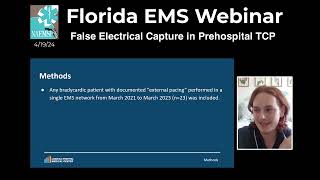
All right, so let's get into the methods, what we did. So, basically we looked at any bradycardic patient with documented pacing performed in a single EMS network. So it's an urban EMS network, Medicis Health Network in Queens, New York. Urban environment that works in a pretty complicated M1 system. And so we looked at ALS patients with transcutaneous pacing from March 2021 to March 2023. So this was totally based on feasibility and convenience. March 2021 is when we started recording all of our ECG cases retrospectively in our physio control CodeStat software, which was how we did this study. We had 23 included. And we got some basic info first from the epcr. We got demographics, we got some pacing characteristics. So what was the current set at? What was the max current? What was the systolic blood pressure before and after? Did they get medications? Did they get compressions? If they did, when did they get those? And then we got some things from the Electronic Health Record. So we use EPIC for 18 of these 23 patients they were transported to in network hospitals. And so we were able to get some things that we thought were valuable. So potassium values survival to admission, CPC status at discharge, and our primary outcome was, did the patient have false electrical capture? Right. So the way we found this is we did a retrospective review of the entire ECGs of the case. We took two paramedics from our quality improvement team and trained them on what true electrical capture looks like using other cases and a lot of Tom Bootheley's work on the EMS 12 week website. So, as you can see, and this is a piece from Tom's blog where you actually can see this kind of arcing artifact that's not a qrs, there's no T wave, and it gets larger with these currents. So we really trained our abstractors here, our paramedics to look for the change going slowly back in time, looking at that change from this artifact that gets bigger with each current to a change into a QRS with a bigger T wave. So visible wide QRS and T wave was what we defined as true electrical capture. And we need that to be sustained.
We did some statistical analysis, there's some brief descriptive statistics. We did a Mann Whitney U test, which is kind of designed for these smaller sample sizes to try to get.
Kind of a basic analysis. And then we did an inter rater reliability with Cohen's cap. But basically we wanted to see how often the paramedics agreed.
So as far as our integrator reliability goes, the benefit here was that it showed the validity and feasibility of paramedic training. So we had our two paramedics disagreed four times of the 23, which is actually the opposite of our primary results for when our paramedics were facing in the actual patient scenarios. And so we also use the systolic blood pressure change just to kind of show some validity for true electrical capture.
Yeah. So going through our results Here, our Table 1, like any good Table 1, just showing the patient characteristics, we had 4 in our true electrical capture group, 19 in our false electrical capture group. Looking at the distribution, the median age difference, false electrical capture tended to be younger. But if you look at the interquartile range, you can see that it's relatively comparable because they're overlapping. And the kind of high side there is 89. Looking at just our distribution of sex, you can see that most of the true electrical capture patients were male. I think a lot of this is limited by the fact that there were just so few patients that got true electrical capture in this group. And then looking at some common comorbidities, you can see that, you know, they're all over the place here. And we didn't really feel like comparing these with any sort of statistical analysis was warranted, especially because, again, you know, like, our idea was to describe a problem here and less to, you know, our primary analysis was not survival or, you know, any of this other stuff. Looking at table three, which is where I think the rubber meets the road. Electrical capture, you know, like we Talked about before, 4 of 23 had true electrical capture for a rate of 17.4%. Meaning our false electrical capture is over 80, sitting right around 82.6. You can see that our systolic blood pressure changed to show the validity of this measurement. Our median change was positive 40 versus negative 1 in the false electrical capture group. Comparing this with Mannu Whitney, you get a p value of 0.03 showing validity there, the current applied. While there is an absolute difference in the medians. 95 in the true electrical capture group versus 70 in the false electrocapture group. This didn't reach statistical significance at 0.17. Looking at our survival and CPC1 2 at discharge, as well as potassium values, we didn't compare these with statistical analysis because we only had two patients in the true electrical capture group that had outcomes. But you can see that one out of the two with true electrical capture actually made it neurologically attacked on discharge with CPC 1 or 2 scores. But 0 of 14 in the false electrical capture group were discharged with good neurologic with a neurologically intact survival. I think this is important, right? We don't want to shut our brains off to the fact that we can't use statistics in this group. Zero. Nobody in this false electrical capture group survived neurologically intact on discharge. These are very sick patients. They're in frank shock. And we think this is a really important finding of our, of our study. Even though that's limited the potassium value, which was kind of our way of saying, hey, like, maybe these patients are hyperkalemic, can't compare it statistically. It appears like there is maybe a slightly higher potassium value first recorded in the pulse electrode capture group. But I think this needs to be looked at in further studies.
And I think, importantly, one thing to add. Even though less than 20% had true electrical capture in our review, all 100%, all 23 had a palpated pulse. So the crew says that, said that they confirmed mechanical capture here.
Yeah. Looking at our systolic blood pressure change here, false capture group, you can see that the, the range is wide. The median was obviously less. It was negative one, the negative hundreds. These are patients who went into cardiac arrest shortly after TCP is initiated or down the road during the initiation during false electrical capture. And so this obviously, like, pulls the median down. But I think that it's important that we see that, you know, these patients are going into arrest after a therapy that's supposed to be keeping them out of arrest. And that should never be the case.
So the reason we frame this study as a case series rather than a retrospective cohort is because we wanted to show you guys ECGs, ECG waveforms and actually talk about the cases. So in this first case here, you can see the pacers turned on. And before they start to set the current, you can see triangles designating this underlying beat, this junctional rhythm. And once the pacer starts, you see a pacer spike, and then you see this kind of arcing artifact, right. And it gets bigger. You can see they're increasing the current. This artifact that we call phantom complex is interspersed with these native beats. So in addition to this, like, artifact that really confuses the clinicians, you also have a native beat. So I'm not really surprised that the crew said, oh, I felt a pulse here, because they probably did with each underlying rhythm here. And I apologize for the quality of the image here, but I'm happy to get anybody the original PDF if they'd like it. You can see this kind of artifact can be blended with the native beat, what Thomas called a pseudo fusion in some of his blocks. And so you end up having this kind of bizarre, wide looking possible QRS with the T wave. And when crews lock in on that, they say, okay, that's good, and they move on. Similarly, here we had this bradycardic rhythm. They start the pacer, and you can see in that first, first pacer spike, we have this electrical artifact. And as soon as they increase the current just to probably the positioning of the pads, the voltage is starting to spike off the page, which makes it really difficult. And in this true electrical capture case that we included, we offered the pleth wave with hqrs, which is a really nice ability to help try to confirm the mechanical capture behind electrical capture.
Yeah, Judah, if you want to take some.
Yeah. So I think there's some unmentioned findings here. Anytime you write a paper, there's sometimes things you want to go back and really look at. We reported this data so that everyone could see it with full transparency. But we think this is really important. Talking about these patients in pulse electrical capture, 11 of them were post ROSC. So we wonder, could there be any sort of interaction between the acidosis, the myocardial injury that's probable in these patients? And obviously those patients would have a lower likelihood of surviving a discharge with neurologically intact survival, which is why our study is really not able to comment on that fully. So I think this is a great topic for future research as well. To rearrested during or after tcp. We think this is an immediate patient safety concern. You cannot have a therapist.
More from Peter




Melissa Olen MSN, FPN-C, CCRN: Sudden Cardiac Arrest Training in Schools (Project ADAM) 4/25/25



Pediatric Hospital Readiness: How Teamwork & CPR Metrics Drive Better Outcomes



Chelsea Kadish, MD & Kyle Goodknight, EMT-P, RT: Pediatric CPAP in EMS (3/14/25)