Joshua Brown, MD, MSc: Hemorrhagic Trauma Resuscitation Paper (8/8/23)
Dr. Joshua Brown presents a secondary analysis of two prehospital trauma trials showing that each one-minute delay in starting resuscitative interventions (blood products or TXA) after EMS arrival is associated with roughly 2% higher odds of death in hemorrhagic-shock patients. The effect held across different interventions and patient subgroups.
Questions this video answers
Secondary analysis of the PAMPER (prehospital plasma) and STAMP (TXA) randomized trials.
Packed red blood cells (PRBCs), plasma, and tranexamic acid (TXA).
Time EMS arrived on scene (clock started at EMS arrival).
First 90 minutes after trauma center arrival.
About 1,100 eligible patients (combined from both trials).
Chapters
We'll get started once up.
We did. Okay, good. Thank you, Angus. I appreciate that. Alrighty, so as far as just some housekeeping items, the CME is in the chat. For those of you who also don't know, all the recordings go on our YouTube channel. So you can search up YouTube for Florida Naemspo. This is I think will be the 126th webinar EMS and you know, emergency physician leadership coming to make presentations to us here in the state. We've gotten a good group from around the country joining us as well. So welcome back everybody. I've been away on vacation, but I'm happily back. And Paul, Dr. Pepe, thank you so much for emceeing the last couple of weeks. I appreciate that.
And so let's get started. So today we have a great speaker. You know, back in 2002 I was in Pittsburgh for my fellowship and made some great, really lifelong friends. And when I saw this paper come up on the, on the Twitter feed per se, I looked through the names and I saw a couple of friendly names. But then I reached out to the, to the main author which is Dr. Joshua Brown, who is a trauma surgeon. He's on call tonight. He starts up in about an hour. And this paper is really pertinent to what we're doing because many of us are using whole blood in the field. Thanks to Dr. Pepe and many others, we're now full force with TXA. And this paper really talks about the time to early resuscitative management and I think it goes exactly to what we're doing. It couldn't be more timely. So without any further ado, we're honored to have Dr. Josh Brown. So Josh, if you want to give a further intro and take it away, thanks for joining us.
Sure.
No, happy to be here. As Hugh said, I'm one of the trauma surgeons at Pitt, but I spent a decade working as a medic up.
In Buffalo, New York for the old rural Metro.
And so now all of my research.
Is pre hospital oriented, looking at pre hospital trauma systems resuscitation. And I do spend a lot of time working with Frank and Chris Martin Gill. So happy to be here and think they've tapped me. I'm working with them to write the prehospital blood position statement for naemsp. So that's coming out down the road.
So you know, just in the way of disclosures, you. The data we use came from the Pampered Stamp trials that I'll talk about a little bit for this paper.
So that was funded by Department of Defense. And certainly the standard disclaimer that the views expressed here do not reflect those of the Department of Defense. But this was a secondary analysis, so no further funding for this particular study.
But, you know, the reason we're really interested in looking at this was because we know that hemorrhage is the primary.
Cause of preventable trauma deaths. When you look at both the civilian and the military side, and what really.
We started to learn is that the coagulopathy and the inflammation that we talk so much about really starts very early.
Within minutes of injury. And so once you get into that lethal triad of acidosis and coagulopathy and hypothermia, it's very difficult to reverse.
And so with the advent of damage.
Control resuscitation using blood products and adjuncts, we've seen mortality from those entities decrease significantly.
There's also data that shows, you know, delaying activation of massive transfusion protocols and even how long it takes for them to get a blood cooler from the.
Blood bank to the trauma bay is associated with mortality.
Most of the studies out there looking at txa, both even the in hospital.
And the pre hospital ones, show that giving it earlier is better.
And with the prehospital plasma trials, Pamper and Combat showed that mortality was reduced.
Largely when transport times were longer for that pre hospital intervention.
And so we think that the balance of evidence really shows that reducing the.
Time to getting resuscitation started for these patients in hemorrhagic shock is an important facet.
So what we wanted to do is to see if the time to availability.
Of these resuscitative interventions impacts mortality for patients who are in hemorrhagic shock after injury.
And so what we did, we started off with our pre hospital plasma trial, the Pamper trial, We took that combination.
Of patients with our stage, which was the TXA trial that we did for pre hospital and in hospital dosing.
So in Pamper, not to belabor how these studies themselves are designed, but to show patients who are enrolled in PAMPER could get either plasma if we were.
On a plasma month and we randomized at the helicopter base level.
But also about half of the agencies.
In Pamper trial also had blood as part of their standard of care. And so patients in the Pamper trial.
Could get plasma or blood.
In some cases, patients got both of those before arrival at the trauma center.
And then similarly with our stamp trial.
Patients who got enrolled got a gram of TXA in the pre hospital setting.
And then those patients could also get.
Blood transfusion as part of standard of care for those agencies that were carrying blood already before the trial started.
So for this particular study, we focus on the scene patients, especially since we're so interested in timing the transfer patients.
The timing is really going to be a little bit nebulous and they can get things at the outside hospital. So we really focus on patients coming from the scene.
For pamper patients that got enrolled either.
Had severe hypotension with a systolic less.
Than 70 or they had hypotension plus tachycardia.
And that's sort of based on some of the older ROC criteria for enrollment.
For the STAMP trial, we tried to.
Mirror this really based on the crash.
Enrollment, so patients who are hypertensive or.
Tachycardic could get enrolled.
We exclude the extremes of age and.
Then ground level falls, spinal cord injuries, penetrating TBIs, a host of exclusion criteria.
To really drill down on patients that.
We thought had hemorrhagic shock or were at risk for that.
Now the intervention that we're interested in is really access to these resuscitative interventions. And so what we were looking at.
Was patients getting packed blood cells, plasma or txa.
And then we looked at the time.
To initiate any one of those interventions.
And this is a schematic of how we calculated the main sort of intervention in the trial, what we called the.
Time to early resuscitative intervention or the terry.
And so there's really were kind of.
Three groups of patients that we looked at.
The first is somebody that got the.
Intervention in the pre hospital phase as part of the trial, or pec cells as part of standard of care in those agencies carrying them.
And we started the clock at the.
Time that EMS arrived at the scene.
Because that would really be the first.
Opportunity that a patient could get an intervention and stop the clock at the time that they started the infusion of the intervention.
So there's patients that got that in.
The pre hospital setting.
We also looked at the first 90.
Minutes post trauma center arrival to really capture a group of patients who are, you're in bleeding in hemorrhagic shock and are getting very early transfusion.
Again, because some of the evidence, even in the in hospital damage control literature.
Shows that you delayed activation of massive.
Transfusion or massive hemorrhage protocols and even delays in getting the blood from the.
Blood bank to the trauma bay are associated with worse outcomes.
And then finally there was a group.
Of patients in these trials that didn't.
Get either a pre hospital intervention or.
Any of these interventions in the first 90 minutes.
And so you have to calculate this time interval. We cut it off when they arrived.
At the trauma center as the first opportunity that they would potentially get one of these interventions.
And so you can see different intervals.
Calculated based on the type, timing of the intervention these patients could get.
Now, we recognize that that last group.
Of patients who didn't end up getting any one of our resuscitative interventions within 90 minutes of arriving at the trauma center probably represents a different set of patients.
And so to mitigate that, we did.
Propensity score matching and we looked at.
Some of the demographics, their mechanism of injury, they're presenting vital signs, total pre hospital time and some of the pre.
Hospital interventions, and also what trial they.
Came from to match patients for the.
Likelihood of receiving one of these early interventions.
And we matched patients with a weighted replacement so that we were making sure the treatment group who was getting one.
Of these early interventions was being matched to a control patient that looked very much like them.
And outcomes that largely came from the trials were 30 day mortality, which we had with high fidelity because of the trial infrastructure as well, is looking at an earlier time point to see really what the impact of some of these.
Early interventions are on early mortality, as.
A lot of things happen to these.
Patients in the hospital and can be.
Hard to disentangle the hospital course and.
Complications and other things that may come up while they're in the hospital from the early interventions and their impact on outcomes.
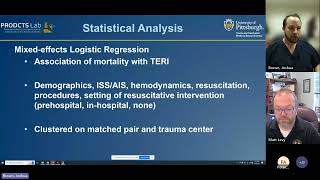
So we use mixed effects logistic regression to really look at association of those mortality time points with the time to early resuscitative intervention, really looking at a per minute effect. And we adjusted for a number of potential, potential confounders after the propensity matching.
And we'll look at some of those in some of the tables.
And also clustered based on the pairing.
As well as what trauma center you showed up at to account for, you know, clustering of patients within those centers.
The other thing we wanted to do is try to look at some subgroups. So certainly we looked at patients that received the early resuscitative intervention.
So we got rid of those patients that didn't get end up getting anything in the first 90 minutes of arrival.
And then we also wanted to make sure that any one of those components.
Wasn'T driving an effect that we saw. So we actually looked at PAC cells, plasma and TXA separately.
And the last thing we wanted to do is see if there were other variables out there that might modify the.
Effect of the resuscitation time on mortality. And so we tested the interaction with pre hospital time as well as the presence of traumatic brain injury.
So this is kind of the breakdown of the patients as they flowed into the study. You see, we got rid of the transfer patients and ended up from both.
Of the studies with just over 1100 eligible patients.
About 800 of those had one of those early resuscitative interventions, most actually in.
The pre hospital phase, given the transition trials that we drew these patients from.
And another handful who got their first.
Intervention within the first 90 minutes at the trauma center.
And when we matched those, we ended.
Up with 1500 propensity matches.
And again, we allowed you control patients.
To be matched more than once. So that we really had a good apples to apples comparison.
This really just kind of looks at the variables that we matched. People on the open circles, you can see, were very different between the groups.
Before and after matching, before matching and then after matching in the solid circle shows that we really had tight grouping around these different variables between patients that got an early resuscitative intervention and those that did not.
And again, this is sort of our table one, looking at those that did and didn't get the resuscitative interventions after matching.
And I'll show you the pre hospital characteristics that we matched on. You were very similar. There's a few things that were still a little bit different between those patients after admission. And so blood pressure, some of the.
Iss and in hospital resuscitation requirements. So we also adjusted for these in regression analysis to make sure that we weren't seeing the effects of confounders.
And then if you break it down, when people were getting these receptivity of interventions, remember, starting at the time the EMS arrives in the scene to the start of the intervention, we're seeing most people getting it in the sort of.
20, 30, 40 minute range.
But sort of the punchline was that when we looked at 30 day mortality as well that you see on the left, as well as the 24 hour mortality, for every one minute that there was a delay from EMS arrival in starting the intervention, there's about a 2%.
Increase in the odds of mortality.
And then when we looked at just those patients that did actually receive one of these outside of our propensity mass cohort, we saw pretty similar effects again, 2% here for 30 day mortality, 2.3%.
For the 24 hour mortality. When looking at just those 800 patients, they received one of the three early resuscitative interventions.
And then on this, you know, we really wanted to make sure again that we weren't seeing one of the interventions driving effect.
We were a little suspicious that plasma, given the trial effects that we saw with Pamper, might be driving the mortality that we saw.
But it actually turns out, you know, any one of these components, you know.
For every minute that you delay starting PAC cells, that you delay starting plasma and even delay in starting TXA in these patients with hemorrhagic shock is associated.
With increased 30 day and 24 hour mortality.
Now when we started to look at the interactions, what we see here is that there wasn't a significant interaction between total pre hospital time and the time.
To the early resuscitative intervention.
And so what that really says is that your pre hospital time didn't necessarily.
Modify the impact of the resuscitative intervention time frame on mortality.
But when we looked at the 30 day, we saw that, you know, total.
Pre hospital time was not associated with 30 day mortality. Well, our time to resuscitate intervention still was. And then both were associated with greater mortality for longer time periods.
And so it sort of the impact of pre hospital time falls off when.
You get to 30 day mortality. But the impact of starting resuscitation in these patients persists out to 30 days.
And then we didn't see any significant.
Interactions between severe TBI and the time to resuscitate intervention.
Essentially both longer time to starting one.
Of these resuscitations and severe TBI were associated with worse outcomes at 30 days and 24 hours.
So certainly, you know, there are a number of limitations. Again, this is secondary analysis of these trial data sets. So we combine these two trials. There's slightly different inclusion criteria, but both.
Were trying to capture patients that were at risk for hemorrhagic shock after injury.
Again, this is that sort of population of patients. We had primarily blunt mechanisms of injury just given the centers that were enrolling in these trials.
And we also tended to have longer pre hospital times.
So what we took away from this paper was that increasing time to one of these resuscitative interventions is associated with.
Both early and late mortality that persists out to 30 days for those who are in hemorrhagic shock.
And we think this may actually be more important than the total pre hospital.
Time, especially when you start to look at long term outcomes in this population.
So this is really a critical interval.
And we need to start the resuscitation as early as possible.
And when you think about what that kind of means in terms of implications for systems and how we you would apply these findings, you know, Certainly there are systems out there that have very rapid transport with short free hospital times and getting early access to these resuscitated.
Interventions at a trauma center is key.
But when you look at systems that either have longer pre hospital times overall serving more rural or suburban areas, or you have a patient who's entrapped and.
Is going to have prolonged pre hospital.
Time because of that, starting this in.
The field is really critical for these patients.
And then it comes down to looking at what the cost and logistics and.
The options are to add a resuscitative intervention. And you know, I think, and perhaps we'll discuss this.
You know, one of the things that we thought was important, you, you, the whole blood and, and the blood products.
Have really been a cornerstone of our pre hospital, you know, air medical and critical care transport agency.
But you know that that's a heavy lift for a lot of agencies. But if you look at something like txa, you know, it's much more feasible.
In a ground transport agency. CH are much easier and shows a benefit in these patients.
The other thing we were really interested in doing, we just didn't have enough patience, but it would be on our radar to do is really see is.
There some threshold effect?
We didn't have enough patients to really say at five minutes it really becomes the main issue.
Is it 10 minutes? Where is that potential threshold effect of saying okay, after 20 minutes, after five minutes, you know, you start to see that mortality go up significantly. And so I think that that's on our to do list.
So that's what I have for the short sort of intro to the paper and certainly happy to chat and discuss.
With, with folks now.
Awesome. That was, that's incredible. And it's just a nice, I think, demonstration of these new interventions. And I'm saying new, I'll say here in South Florida, there was a hesitation for many years to go with TXA. And then finally, you know, we have Dr. Pepe who looks like he's about to make a comment coming out in a minute. But we had a big resistance from the surgeons, our trauma surgeons and then our folks here in Broward, one of the medical directors just had screw it and started it.
And then since then, and Dr. Pepe has shown us this in some of the papers, that going with a higher dose of txa, giving it quicker rather than the one plus one is really making an impact. So it sounds to me like TXA is like table stakes. Everyone should be doing that early at a two gram dose. And you agree with that aspect. The two Grammar rapid.
Yeah.
Over five minutes.
Yeah. In fact, you know, clearly the Portland data certainly supported that.
And then, you know, the patients that had the biggest benefit in the Stamp trial actually ended up getting three grams because they would get one in the.
Field and then we'd slam in a.
Second gram in as soon as they arrived and then they got the overlong sort of the eight hour infusion. So certainly the higher dose has, is panned out as the one that benefits patients the most.
I think for the tsa. The other interesting thing, and certainly admittedly, I think.
Our community, the trauma surgeons.
In general, and even before we did Stamp, I think we admittedly, I was sort of skeptical about what the benefit.
Might be, but we started to see it certainly in subgroups. And then I think the other thing.
That'S been important is across all the.
Trials, you know, there's always the concern.
Of increased VT EL events from some of the observational data, but that hasn't panned out. And we started to look at combining, you know, the other randomized trials with our SNAP data and also seeing that it's very safe and that we're not seeing increased complications. And so I think the barrier to entry is lower because there's nothing a downside and it's easy to give and it certainly can benefit patients that are.
Hemorrhaging and getting it early.
Awesome. Let me bring in Dr. Pepe Paul. I know you must have some comments here. We'd love to hear your thoughts.
Yeah.
And just to extend on think. Great talk by the way. And I'm going to make a couple comments for everybody else's purposes, but like for example, in your own studies that you showed that Francis ran the, you know, it was like the. But you're saying subgroups just so everybody else knows. I think, but I mentioned this before to the group is that it was the ones that had lower blood pressure if they got onboard faster. And I've even advised our people, if it's going more than an hour, don't even bother because that's where you'll see the complications. It's not that TXA is good or bad, it could actually be bad for you, it's just when you use it, et cetera. But the earlier the intervention, the better results. Is what I wanted to hear from you. Here's the reason why is that people who have challenged this have basically said, oh, we're right here, they could get to us in 10 minutes or something like that. And so I want to show that's like saying, well, we'll just do CPR till we get them to the hospital. Then we'll try the defibrillator out at that point in time. So I make an analogy there. Couple pieces of advice. I was going to say, first of all, the propensity score approach. I was just talking about this this morning. I'm here in Seattle saying that's the way to go. There's just so many confounding variables now, not only in trauma but in cardiac arrest. And we know a lot of the things that really go along pretty well with. So I want to congratulate you on using that tactic because I think it's the wave of the Future. I was Mr. Controlled trial. I was introducing the first controlled trial, especially for trauma in the pre hospital setting. Help start the rock with Max Harry Wild for this purpose. But it turned out this is the way to go. So thank you for doing that and showing another good example why it's important. All right, so here's the deal. This is on more of a political end, is that when you're talking to us, you'll say that the longer you delay, okay, the intervention, the more mortality.
You'Re going to have.
On the other hand, if we're talking also to the public or just add on to that or another way to say it is that the sooner you get this on better, the better the survival chances. And I just think that has to be emphasized that, you know, it's because different people think different ways. Glass half full, class empty. So I think I would add both of those in that order, by the way. In other words, you know, that kind of thing. So those are a couple three or four comments. But this is fantastic. So thank you so much and give my best to everybody. Was Andy Peitzman involved with this one, by the way, or just Jason and Francis?
Yeah, it was Frank and Jason and.
You know, and Chris Margaret, if he's also one that you guys know. But, you know, it's been great, but.
Andy's definitely involved in a lot of.
The stuff we do and continues to. So the system trump system guy in Western Pennsylvania.
Yeah, just, just out of curiosity, but listen, thank you so much then for say hi everybody for me and I'll just shut up because I have to go over to my own talk meeting in a couple. But you're welcome to join, by the way. I wouldn't mind you if we have some time if you want to plug him in, Peter, maybe we can even have him presented over on the eagle side too. Okay, well, get to the point though.
He's on call at 4. So that's the thing.
Paul runs a more of an international webinar starting in about four minutes from now. But I'm not sure if you can, if you can stick around and present it to the larger national international group.
Well, some other time. And then I have maybe or maybe.
Another week maybe we'll.
Yeah, I'm always, you know, happy we can find a time. I'm always happy to chat. Like, you know, like I said, I, I spent 10 years with medic I.
Is, are my people and this group.
Of people really where I think we.
Can make a big difference is in the field and taking care of these patients.
That's a great idea. I like that.
This is great. So thank you. And then I'll contact in the meantime because while have you used, you have to probably tighten it up more to five or 10 minutes. And I think just get to the point with us because most of these guys are pretty sophisticated about the background.
So what I'll do, Paul, I'll connect you and Josh via email.
Great job, Josh.
Thanks a lot. All right.
As Paul peels away, is there anybody else? I see Matt Levy from Hopkins on I see Joseph Zalkin. Oh, let's see who's. Who's Dr. Angus Jameson. Go ahead, Angus from Pinellas.
Hey, how's it going? First of all, your picture of Presby and talk of Andy Peitzman makes me send shivers down my spine of being an intern on the trauma service there. So thank you so much for that. Just makes me feel so good.
But how would you line this up with the recent study out of Australia and sort of compare and contrast what you think the takeaways are from both of those?
Yeah, I think, you know, the patch study is interesting and they had taken a long time to get that off.
The ground and we've been sort of weighted bated breath.
You know, I think you, you thinking about, you know, those types of studies and also you even we were looking at this study and thinking about the refill, you know, study came out that was also sort of unexpected and not, not what we thought. You know, I think a lot of it has to do with the infrastructure.
And the systems that we're working in and the type of pre hospital.
System that we're in.
And so some of those things you have to do, I think with the infrastructure because if you look at to like our subgroups in the stamp trial, you know, it was the low blood pressure, but it was the time and.
The dose and so it was Sort.
Of the systematic things that really made a difference rather than you.
The native patient population.
So I think probably you see some of those factors, you have more influence.
Over the trial results from different, very different systems and approaches.
And Josh and Angus, if I could insert one thing, when they didn't even have to tell me the results, I asked them the design. I knew this about a year ago, just so you know the answer. And they said they went to one gram and then one gram or eight hours, like the old cardiac OB GYN surgery cases in the 60s. And I said, oh, then I already know your outcome's not going to be showing anything of benefit. It may actually be they didn't stratify according to the earlier intervention versus last. So I could even just have predicted it. So it's kind of what you're alluding to. They didn't give it and they broke it up into two things, like the old timey things like the CRASH studies. It was. So they were doomed to not.
Yeah, exactly, because they were playing the trial at the same time we were playing Stamp and everyone at that time, because it really was not. You know, everyone's trying to recreate Stamp in a, you know, what we call.
A more resource trauma system.
Although, you know, I think fortunately for us, we.
You did this dose testing.
You know, we had one, two or.
Three gram doses, and clearly the higher doses fell out.
And so, you know, everyone was trying to recreate Crash 2 in different settings.
And, you know, it's. That effect gets washed out if you just aren't using a high enough dose.
And then, Josh, also with. With refill, our policy on the other side, with refill, it took 53 minutes for them to get the first. Yeah, I mean, which here, you know, in New Orleans are getting it in nine minutes. We're doing the same thing here in Broward in Palm Beach County. So huge differences in time of initiation of resuscitation.
Yeah, yeah. If it takes you 30 minutes to get to the patient and then minutes to start the intervention, clearly, you know, you've added up quite a bit of.
Mortality based on our data here.
Angus, did you want to follow up before I go back to Joseph?
No, I just wanted to say thank you because I think there's. There's an ongoing discussion there about exactly that, the systems and the strategies and how to interpret this data. I will tell you over here in west Central Florida, I still can't get my trauma surgeons to be happy with it without a tag. So say hi to. Say hi to Frank and CMG for me and thanks for being on.
Awesome. And then let's bring in Joseph Zalkin from Wake ems. Joseph, hey.
Thank you very much. Thanks, Joshua. Great presentation. Sacred Cow for EMS is extending that scene time on a trauma patient. So I think the evidence will be clear as the studies collectively come about. It takes too long in the facility to start this process that the bang for the buck will be in the back of the truck.
Yeah, yeah.
And I think that's what we really want to show here, is it. It's the time. It doesn't matter. You. The setting per se, doesn't matter, but it's the time. But EMS is getting there first. And so you. If you can get it started, started before you can drive to the hospital.
Then you should start it in the field.
Well said. Well said. Matt, go ahead from Hopkins. Dr. Levy.
Matt, we cannot hear you yet for some reason or see you.
Looks like he froze.
Oh, man. Let's just give another second or two here. All right, well, we'll wait till it comes back on, but we're going to bump off and I know you got to go onto a shift, but.
Matt, go ahead, Matt. Yeah.
Hey, can you guys hear me now?
Yes.
All right, I'll be brief. Thank you.
Actually, Josh, your last point took the words out of my mouth about what we need to do on scene and on time. So this is one of those things where getting it started before we get the ambulance and gear probably makes some sense. But thank you very much. Great job and my best, everybody in Pittsburgh.
So thank you.
Yeah.
So, Josh, I'm going to give you the last word. You have people on this call who, you know, only a few of us have blood, some people using txa. What. What would you tell everyone listening, everyone who'll be listening on YouTube afterwards where this is an EMS crowd. What. What are your final thoughts to leave us with?
Yeah, yeah. I think this is, you know, another nail in the coffin to show that our biggest bang for patients is going.
To be pre hospital interventions.
And I think pushing the stuff that we think is so important in the hospital out into the field is where we're going to see. Pamper is the biggest mortality reduction ever.
Published in Toronto trial and was pre hospital plasma.
And having done this for a long time and now sort of being on the hospital based side, I think we. Well, not this community, but I think in general we're not giving you, the EMS clinicians enough credit that they can.
Do these more advanced interventions and that it just makes sense to be putting this out into the field and getting it started as soon as possible so.
That I have a lot of patient.
To operate on when they get to the hospital.
Well said. And listen, we have great respect as someone who you rode the back of the truck for, it sounds like many years, and now you're at the top of the heap in the academic center. We appreciate you joining our webinar today and educating us. And thanks for contributing to the evidence base. We really appreciate your time today and have a good rest of your shift today at Pittsburgh there.
All right. Thank you.
I appreciate it. Always happy to chat with you guys. And always we'll look forward to other webinars.
And always we'll keep pushing forward the pre hospital evidence.
I'll definitely connect you with Paul so that you can get onto the big show. All right. Awesome.
All right.
Thank you so much.
More from Peter




Melissa Olen MSN, FPN-C, CCRN: Sudden Cardiac Arrest Training in Schools (Project ADAM) 4/25/25



Pediatric Hospital Readiness: How Teamwork & CPR Metrics Drive Better Outcomes



Chelsea Kadish, MD & Kyle Goodknight, EMT-P, RT: Pediatric CPAP in EMS (3/14/25)