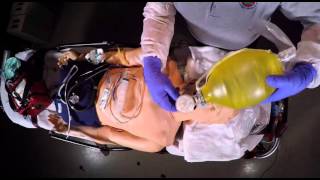
Jeff Mealer demonstrates the King LTS-D supraglottic airway for cardiac arrest when intubation fails twice. Insert at the external auditory meatus aligned with sternal notch, inflate the cuff to 60 mL, and use the gastric suction port with a measured gastric tube at 50 cm depth.
Questions this video answers
Secondary cardiac arrest and as a bridge airway after two failed endotracheal intubation attempts.
Ingestion of caustic substances, known esophageal disease, or esophageal varices.
King LTS-D size 4, designed for patients 5 to 6 foot in height.
Device states 60–80 mL; department recommends starting at 60 mL and assessing for leak.
Measure from xiphoid process to angle of the jaw or from corner of the ear to corner of the mouth; the demonstrated patient measured 50 cm.
Chapters
Hi, Jeff Mealer here. Today we're going to talk about the King airway, its use and its placement. Our department currently uses the KING LTD S airway. And the dash S component in this airway means that we can provide gastric suctioning with this type airway. It is our advanced airway for secondary cardiac arrest. Its indications are secondary cardiac arrest as well as it's our bridge airway. After two failed endotracheal tube intubation attempts, the contraindications for the King airway are patients who may have ingested caustic substances, patients who have known esophageal disease and or esophageal varices. And what we want to do here is anytime we are operating with an airway, we want to be in full body substance isolation to include.
Full facial protection.
Now, for the purposes of this video, with the full facial protection, I'm going to remove the full facial protection so that you can still hear me with talking during the video. What we want to do here is we want to establish and make sure that the airway is patent so that we want to deliver two breaths via the Ambu bag using good airway management technique. Understanding that patient positioning is of utmost importance in managing this patient's airway. What we want to do is make sure that external auditory meatus, the ear hole is in front of the sternal notch. We want to do that whether we're just using a bag valve mask device, if we're using OPAs, NPAs or if we're using Kings or endotracheal tubes. We want to optimize this patient's positioning. So you can see that we have towels underneath the head and we have the airway in an appropriate position. We want to deliver two breaths to make sure that the airway is patent. And notice that we do have our capnography attached to the Ambu bag during our resuscitation attempts. This is the King Ltds or LTS D number 4 King Airway. It's designed to be used in a patient that is 5 to 6 foot in height and here directly on the tube, it tells you that you should use 60-80 ML of air. Once you insert the King airway to fill the pharyngeal balloon.
Our department recommends that you use the minimal amount of air. If the device recommends 60-80 ML, we recommend that you start at 60 ML and then assess for an air leak. You can always add as necessary. The other thing that we want to do is we Want to secure. We want to properly lubricate this airway. We want to lubricate this King device back here and on the sides. But we want to pay particular attention not to get a large amount of lubricant at the ventilatory hole here on the king airway. So we would use a lubricant and lubricate the backside and the tip of the king airway, taking care not to get a bunch of lubricant around the ventilatory port after that, then your airway is ready for your insertion. Go ahead and remove the oral airway. And with our dominant hand, we want to hold the king airway with our dominant hand. With our non dominant hand, we want to go ahead and do a.
Chin lift with our airway. And we want to go ahead and insert the king airway midline and rotate it as we put it in. Now, this airway is a size four, so this patient is five to six foot in height. And we want to administer as the minimal amount of minimal amount of air to the pharyngeal cuff here. So we go ahead and insert this down to the hub.
Inflate it with 60cc's of air, and we're going to notice that the endotracheal or the king airway may migrate out of that airway. We would go ahead then connect our ambu bag with our capnography to our king airway device and administer a breath. We would listen to gastric sounds first and then we would listen to breath sounds after that. If we do meet resistance while attempting to ventilate this patient, what we can do is withdraw on the king airway slightly and see if that assists the air in going in through the device. We also want to then therefore secure the King device. Our department currently uses Thomas endolocks. We have two types of Thomas endolocks. We have a dark blue type and this color. This is an older type Thomas Endo lock. This Thomas Endo lock will not work on a king airway device. So you have to use this type of Thomas Endo lock. We go ahead and place this onto the king airway device, making sure this.
The bite block went between the patient's teeth. We want to secure the.
Thomas endolock to the patient.
Continue to continually ventilate the patient, retract the king airway as required to have adequate chest rise, and then go ahead and secure the Thomas endolock. Want to ventilate at a rate as provided per our protocol. And we want to monitor.
Capnography and capnometry on our patient as we utilize the King airway. As I mentioned earlier, our King LTD s airway has a suction port.
It has the ability to introduce a gastric tube into the esophagus to relieve gastric distension. What we want to do is we want to measure this gastric tube. We want to measure it from the xiphoid process to the angle of the jaw or the corner of the ear to the corner of the mouth. We want to.
Set this the measurement will mark out in centimeters. This patient measures at 50 centimeters. And the one thing we can do here, you have to vigorously aggressively lubricate this.
Gastric tube. Back here on the backside of the King LTD s airway is the gastric port and you can go ahead and insert the gastric tube right in here into the King airway and you want to advance it to your pre measured distance. This patient measured at 50cm and then now you have gastric suctioning available to you to relieve gastric distension should that be required.