Lt. Holly O'Byrne: The DC Fire and EMS Whole Blood program (12/13/24)
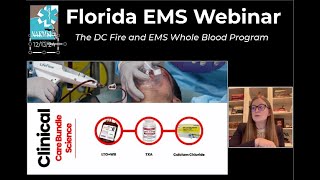
Lt. Holly O'Byrne describes DC Fire & EMS's whole blood program for paramedics, launched after a 161% rise in homicides. Since April, 186 units have gone to 174 patients, with dispatch-to-blood time averaging 25 minutes and shock index dropping 0.43 points per transfusion.
Questions this video answers
April 10 (year implied 2024 from context).
186 units used since program start.
174 patients transfused; 11 patients received more than one unit.
25 minutes and 41 seconds (includes special-ops/staging delays).
Approximately 13 minutes (central trauma).
Chapters
Welcome Everybody. It is December 13th, it's Friday, and this is the Florida EMS webinar, part of the Florida chapter of the NMSP. And as mentioned, we hope to see everybody at the meeting, whether you're a physician or professional member. I just learned the other day that 30% of the NMSP membership are professional members and we need more professional members, especially people like Lieutenant Talia Byrne, who's joining us today. I've been waiting for this presentation for quite a while now. Many, many people have emailed me and the hype about this talk is beyond, I think, any that we've ever had. Many of us, there's about 200 programs in the country today who are doing whole blood. But we could all agree that the one program that seems to be doing it at a very high level is DC Fire and ems. And a big, big part of that is Lieutenant Holly o'. Burn. So she graciously accepted our offer to come and present and she will present that and then I hope you have lots of questions afterwards. So without any further ado, Senate Holly o', Byrne, thank you for joining us and take it away.
No, thank you. This is an absolute honor to be able to sit and talk with you. My name is Holly O'. Byrne. I am a lieutenant paramedic with DC Fire and EMS and I am currently assigned to the 3rd Battalion which covers part of Ward 7 and Ward 8. And we're going to get into what that means and how it is it plays a really large deal with blood in the city. Just a little bit on my background. I have a master's degree in emergency management and disaster management and I am a doctoral student for emergency management currently and I have previous flight experience with MedStar that's also based in Washington D.C.
So one of the things is this is going to be a 10,000 foot overview. We have a limited time and kind of a lot of information to cover, but that doesn't mean that we won't take any questions and please feel free to stop me if there's anything you want me to go into more detail on.
So our whole blood project came out of need.
Within the last decade. There is 161% rise in homicides within the district. I have spent my entire career pretty much east of the Anacostia river where there are known health equity issues. There is no trauma center there. D.C. general closed about 20 years ago and our closest trauma centers are about a six mile drive to Seven Mile Drive, which might not seem like a lot, but in traffic you're looking upwards of 30 minute transport times if a helicopter is unavailable. So we needed to look at and say we need to do something to help. What's more, what can more be? And we started seeing whole blood pop up and we looked at New Orleans data and said, hey, this makes a big difference, so let's look at Strax data. But then we knew it made a difference, but how could we apply it to us? We looked at all of our 2023 data and began to map it out and started looking at what supervisors it could benefit. We had an idea, but we still didn't know. And for those of you who have talked to me previously or reached out by email or zoom, you know, the first question I'm going to ask you is, well, what do you know? Do you know you need blood? So we spent a fair amount of time looking at data.
We mapped out from January 1 to 61 of 2023 for all of our information on our trauma cases. Our medical cases are a lot harder to pull out of our previous software, but we knew we could track trauma. We also could track it by battalion. We broke it down into central versus non central. We looked at our transport times, our on scene times, what hospitals we were going to, and we also looked at what was our TXA rate. Okay, with every system across the country, we know that we have providers who do good medicine, but we don't necessarily always do good documentation. So we knew one of the things we had to put in was a coverall of saying if we give blood, TXA and calcium are mandatory and they have to be put into the bundle and we have to document them. So we put that as a standard as well and a standard in our training when we look at our trauma cases.
Our EMS 5 is located in upper northwest at Bridges, Maryland, the upper side of Maryland, and has very, very limited trauma cases on the opposite end. EMS 2 and 3 are east of the Anacostia. They cover some of Capitol Hill extended and have the highest number of central and non Central Trauma. EMS4 is located pretty much dead smack center of the district. And there's one supervisor that you don't see on here and that's our EMS7. And you're going to see them pop up when we talk about our dashboard. And that's our special operations unit. This is a citywide supervisor and they respond on all of our critical incidents that potentially have some type of extrication involved. We knew that this supervisor handles many of our critical calls, but also works in conjunction with our surgical strike team for Extrication out of GW hospital.
We do. And I think this is one of the biggest things is our dashboard and monitor. So this is not today's current dashboard and that's just for safety reasons for our personnel. But this is one from the other day which actually shows you all of our color coding. So if you've talked to me at all or have figured out I have a high level of OCD and organization. So we color code all of our bags. We make sure that if we have an extended expiration period, those bags are green. Our ones that hit between 11 and five days are going to be in yellow and those that are under five days are in red. We do a cycle rotation to move our short date units, so dates that are in red over to our highest use supervisors. So for example, if you see the one that's at the top left, EMS4's fridge that day got rotated down to EMS3. Okay. That way we kept them in areas that we have highest use. Our program is different. We do not return blood to a hospital.
That's something that was agreed upon in the MOA with George Washington University Hospital. Blood bank is currently with this. Because of our use rates, they did not want to recycle back. Okay. And I know that causes a fair amount of consternation with other programs because they don't want to either incur the cost for a bag that expires or they're worried about expiration percentage. Our expiration percentage is very, very low.
Because of how much effort we put into the dashboard. We do 24 hour temperature monitoring through the sensor push devices in the sensor push dashboard that give us temperature readings every 15 to 30 seconds that auto populate on the dashboard. The one thing this also does is it links to our supervisor vehicle. So if any of you know about the technology for what three words, it's 100 by 100 mapping grid. That same technology is used with how we map our vehicles. So we can show you where that unit of blood is in the supervisor vehicle within 100ft. So if at any point in time you wanted to know where that unit was in the city, we could directly pinpoint it to you.
This also captures all of our incident data that you see at the bottom. And this is from this morning. We've utilized 186 units since the first one was administered on April 10th. We've had some ebbs and flows in rate usage. We know that we are moving into our slower trauma season, but our medical usage is picking up a lot.
So not only do we track call types but we also track the hospitals we're going to. So you can see that 62% of our usage is going to be on shootings and then another 15% is going to be on stabbings. We have a lot of penetrating and penetrating central trauma.
The one thing our dashboard does is also map the usage in the city. This is actually a big part of how we are going to do thoughtful implementation. If we were to add another supervisor in the city to get whole blood, it would be through the use of data and GIS mapping.
By mapping the incidents, we can actually do a hot map across the city where the yellow shows you the highest usage and we can show you all of the coverage areas. Now this flows back to our other map and shows you again how much we're using. And actually we did a validation study and off of our current data at 170units and it validated where we put every unit with every supervisor. Because we are really, really committed to making sure we have a zero to no waste program. We are hot mapping all of our usage and can tell you exactly when we have the highest rates. So Saturday at 12am and Tuesday at 1am happen to be our highest usage. Why it's Tuesday I don't know, but it's Tuesday.
But we can map this across and as you go from light to dark you can see it pick up. So Sunday at 8pm especially after football games, after sports games, Basketball is another one where we see a fair amount of usage.
ArcGIS is a great program. It allows you to use multi server information to pull data in. And I'm going to go back one slide if that's okay.
So when we look at our initial dashboard we highlight what our supervisor is is doing that day. So which one's in the position? Are they qualified? Are they unqualified? We track the unit, we track our temperatures and all of those are through different API backends. So we use Telestaff for our staffing software. We're pulling out of the sensor push dashboard. We're pulling off of our survey 123 app which is also part of ArcGIS for our chain of custody. Every 24 hours we have to do an exchange between the ongoing and offgoing supervisor just like many systems do with their controlled medication programs. We want to make sure that someone is signing on and verifying that unit of blood whenever there's a shift exchange. For example, today I have a WDO or an overtime supervisor working. That overtime supervisor at 7pm will do a change of custody with the other WDO low blood supervisor this evening. And these are continuously held. We have no limitations on the data for this program. So we can go back to day one. I know some systems when I've talked to People have an ArcGIS data limitation of a year and some places even have it as 180 days. So that data pull information is really going to be dependent on what your government has signed up for because this is a government sponsored program that can be used for everything.
I want to say thank you to New Orleans and for Tom for the ARC bundle. We are, we are big proponents of this. When we package all of our, all of our medications and everything like that, we wanted to make sure we stood by this. The data behind it, the science behind it is amazing. So much so that we're implementing it with other projects that we're doing. So our regimen for giving whole blood is taxa then blood, then 1 gram of calcium. Okay. We are currently at 1 gram of calcium until our protocol update where we will be going to 2 grams of of TXA and 1 gram of calcium.
So I want to preface this with I am not going to tell people what to buy. I'm going to tell you what works for our system and why. But there are a lot of products out there. But we have developed a great partnership with life flow and Q and flow. And I will also tell you why we work with the CREDO cooler. So we put all of our supplies into one bag. We used a stat pack. It's the teardrop shape, it's the three compartments, and over here is the list of everything that we carry.
We've had a lot of questions about why we don't have IV supplies in this. There is one thing that is standard in all of our medic units and that's where IV supplies are. They are readily accessible, they're easy to get to. The IO supplies are not as accessible. We are looking at about a 6040 split between IV and IO administration right now. Okay. We also have a fair amount of patients who suffer from multiple medical sequelae. So extensive medical conditions that prohibit starting an IV but meet the qualifications for blood administration where an IO is warranted. In our large pouch is where we carry all of our administration and monitoring and medications.
We bundled this a little bit differently. So when we pull out the life flow, you can actually reach in and pull out another bag to hand to the other paramedic on scene to put together all of the TXA and the calcium for you right next to that is also End title. As we move forward and are looking at our demographic information and looking at the patients that we are seeing, we're noticing that shock index is not necessarily the trigger to pull for whole blood, literally. So we are starting to look a lot at end title. And our teaching our transfusion is the difference between hypoperfusion and hypotension. Okay. We are seeing a trend where we're seeing a lot of very young African American males suffering from penetrating trauma who are compensating very well but are showing early signs of hypoperfusion where their blood pressure is 108 systolic. Their heart rate is holding at 120, 130, but their end title is sitting at 23, 25. We know this is a patient who is compensating and is going to.
Rapidly decompensate while en route to the hospital. And we're teaching our transfusionist to get more aggressive in the care that they're providing.
This program has taught us a lot of trips and tricks. I can tell you that our policy is extensive, but you can't out policy everything.
We have empowered our BLS providers to make sure they get manual blood pressure. I'm sorry. Go ahead.
Sir, how was the visit?
I'm sorry, sir, I can't hear you.
I probably an error. I just muted him. So.
Okay.
If everyone can save their questions for the end. Thank you.
Okay. So we have really, really, really empowered our BLS providers to first in vital signs, set them up on end title, be really involved in the care and airway management.
And we want to make sure that throughout the care we have someone who is obtaining manual blood pressures. You can place a patient on the monitor and we've always heard that continual recycle of attempting to get a blood pressure that wastes critical time when we can get a manual pressure a lot faster. We've implemented some different safety measures and this came out of a couple of special operations call where we needed to attach the Q and flow or the warming device to a patient.
At the advice of the manufacturer, we switch to a strap that can be either attached to the stretcher and IV pole or to the patient themselves. We make sure all of our blood that is administered is warm. We are developing a charging schedule for the units.
But after every use, currently we have it that the device gets recharged. We went with the credo cooler. Okay. We have an aging fleet of vehicles where we could not do a plug in system due to electrical demands. We are in the process of replacing all the Vehicles in the system. Okay. But it was not feasible to ensure temperature monitoring was maintained in the whole cold chain. Storage principles. If we use something like the Delta cooler, if that makes sense. Our Credo cooler, we carry three inserts per cooler and we rotate those every 24 hours. We maintain a temperature of 1.5 to 5.5 for all of our low tide or blood across the city. Anytime there is a temperature deviation outside of that range, Even if it's 0.1 Celsius, alerts are sent out to our fire operations center, which is a monitoring brain trust in the city. The EMS battalion chief, all of the EMS supervisors, the whole blood coordinator, the deputy fire chief of ems, the medical director, everybody gets notified that that box is out of range. Either it was open for a transfer, it was open for use, or it needs to be rotated and then instantaneously we can call the supervisor and have them rotate it or see if they're on an incident. On an incident. And it will plug us in that that has been utilized and to start the exchange process.
It may seem like common sense that if you transfuse, you transport, okay.
Things happen. And we've made this really, really clear as a pillar of. Hey, we're not perfect, okay? By no means is is any system perfect. It's designed to get the results that, that you intend for it. We didn't intend on this one, but it is now, now written in policy that if you transfuse a unit of blood, you will transport to the hospital and then our bundle of care. We work diligently to make sure this is given on every single patient, absolutely diligently. You're going to see our numbers here in a second. In a couple of slides that show you we went from 26% to 86% just by bundling and ensuring that everything is documented correctly.
I can tell you the biggest sticking point in the program is standardization. Okay. We were fortunate enough through connections through Tom and Randy and Dr. Spinella to be able to understand the pre hospital AABB guidelines before they came out. We have standardized our blood transfusion record that goes to the hospital. Are there's. It's a triplicate form. The yellow and the pink copies of the triplicate form stay at the hospital. One gets sent to the blood bag blood bank with the unit that we've administered. The other one stays in the patient's chart and then the white one is the receipt that the supervisor brings back to get another unit of blood. This is our physical record that shows again, just a written copy of what occurred on that incident. We also standardized our procedure through dropdowns in our documentation system through, through literal, really, really good, thoughtful consideration. There's a gentleman named Game Gabe Gann, who works with us, who is very involved in triptychs and is just very, very logical in how to put things together. Our documentation system wouldn't be as robust as it is without him.
When a EMS supervisor transfuses, they are responsible for documenting that transfusion and it pulls up all the required criteria for that. We also standardized our narrative. Okay. Because we are collecting so many data points, we had to make sure we were capturing all the associated data correctly. So everything that you see in bold actually shows up in red when the patient is doing or when the provider is doing the patient care report.
These will auto populate for your heart rate, your blood pressure, all of that information. But this means that we can capture everything very, very quickly. The one thing about our program is we're capturing about 141 data points at last count. And it can become very time consuming to gather information if you're having to look at multiple pieces of multiple reports. Our system currently does not combine the EHR on the patient into one report. So if five units are on scene, five units have reports.
This, this helps immensely in the time for this project.
When we look at all of our information.
This is a table that you've seen used by Dr. Peel. Dr. Spinella has used it. I know Randy Shaffer here has used this as well. This really is just a quick overview that we can send out about our program. We know that right now we have a 93.7% survival rate. Outside of patients found in cardiac arrest, our total mortality rate is sitting right around 64 point. I'm sorry, 74.3.
And that's overall, including our traumatic cardiac arrest, Our current dispatch to blood admin time is 25 minutes and 41 seconds. And this is the time the 911 call is placed. Okay. To the time blood is administered. Now, the caveat with this, and I'm going to say this is partially my fault, is I have had not had time to parse out the information.
For scene times and dispatch the blood admin. These numbers include all of our special operations, all of our incidents that require staging because of safety concerns, waiting for police to clear it, and any rendezvous that has to happen with an EMS supervisor. So when we are able to remove those, I expect those times to go down immensely.
Our average transport time has not changed from our initial information. We are still right at the 13 minute mark for central trauma. On average.
We'Ve transfused 174 patients, 186 units. We've had 11 patients get more than one unit. And right now we're doing a unit of blood every 31 hours. Okay. That number's gone up a little bit since the summer. Our lowest was we were giving a unit of blood every 24.2 hours.
TXA and calcium administration numbers have skyrocketed. We're at 86.9% and 85.3%.
And our Delta variables, our biggest one, our shock index is dropping by 0.43, which is huge. We are taking patients who have been very, very critical and are now getting them in back into a normal range. So we are very, very lucky with that.
I know one of the highlights was our newsletter, and I know that you wanted to talk about that, Dr. Antebe.
I did. I did. Mainly because it's. I think what it's brought to the table is this level of transparency and data, and it allows us to all look at each particular case. And if you could just talk about that with respect to what has that done for your. For your community as far as. Because I even see that the mayor has had some posts about it, et cetera. If you can describe what it takes to get this done and then what it's done for your program within the community. If you can give a couple comments there.
Okay. Are you able to see that document? I'm sorry, I had to flip screens.
Yeah.
Yes. Thank you so much. I really appreciate it. So every 150 patients, we publish a newsletter. This one was a little bit later. We published at 160.
One of the things about the blood program is it wasn't just increasing the clinical competence of our supervisors.
It has been a big goal across the department to increase the clinical acumen for all providers, which is why it was really important to me to make sure we pulled images where we could describe what was going on. We can show you. This is what happened to our patient. This is what's going on. This is an end result. These are the things that occurred. It's actually opened up a dialogue with a lot of our providers to be able to say, holly, what does an orph mean? What. What happens with that? I. And I can direct them to a YouTube video. I can just talk to them and say, hey, this is what this means and why it's important. He. A patient was shot in their femur, and it's a commuted fracture. This is what they're Doing for it. Let's pull up that image and look at it.
We also wanted to make sure we were transparent in what we were doing with our previous cases. There is a.
We wanted to make sure that at 30 days, how many patients are being readmitted? What are we looking at for trauma care follow ups? Are our patients compliant? Are they a victim of another serious injury or medical complaint within the next 30 days that required readmission, which is why we put this in there. I think if you only just focus on that case at that time, it gives you just a very little snapshot of what that entire care community is doing for that patient. For those of you who are following the grant funding right now, there are a couple of grants that are opening for patients who are victims of trauma to work with trauma services. I know we have talked about doing this a lot for care counseling after a traumatic event. And this is something that we're starting to notice in the community, that it bridges a gap to create a continuum of care.
As for the pictures, I got a bunch of emails saying, hey, can we get bigger images? We're using these to teach. Not a problem. Asked and answered. I will make sure that you have bigger images, which is why on this one, you're going to see a big format change from our previous newsletters to give you better pictures, a better description. So when you go to teach this case or you go to use this as a reference, you have, you have a solid image on this one. We did have a big case that was a one pager. If you don't mind, I'm going to scroll pretty quickly.
Case 121, and we're going to be, as a department, we will be doing something for this. Case 121 was found in traumatic cardiac arrest, was resuscitated with whole blood, came to the hospital with a pulse. Ross was sustained for more than 15 minutes, left the hospital neurologically intact and has just completed their rehab care.
This is a. This is big. I know Dr. Ansavy and I have talked about whether to give blood in traumatic cardiac arrest cases, whether it's witnessed or unwitnessed, and what does the data look like? And this is a case where this made the difference. They. They had a great outcome because of the aggressive care that was provided on scene.
One of the other things that we do is we are incredibly transparent in data.
For those of you who have talked with me before, I don't hold anything back. I will tell you exactly what we're doing, how we're doing it. The why, what any fail points are, and this is another part of that is making sure when we look at our data, we have very, very clear information that's being processed.
We're very, very into time management right now, which is why you see a lot of stopwatches, you see how things are requested, why they're requested. That way we get into all of our destinations, demographics, all of our administration and all of the changes that we're seeing with our shock index and our rest of our vital signs.
This program is a lot and I can tell you that when you look at doing this, please make this a position for someone. Okay?
I'm not saying that our program is the best. There are still things we're learning every single day. Okay? I learned a lot this week already.
But this, to, to do this.
It is, it is really, really time consuming, especially when you're talking about looking at your QA. QI. Every EPCR is reviewed within 72 hours, feedback is given, hospital follow ups, data entry.
Can be, it can be a lot.
And Holly, this is an amazing presentation and a lot of great tactical information. Part of, part of what I think I've gathered from what you guys have done is, you know, the entire country is wondering what to do here. You have, you have chiefs, you have, you have commissioners, you have people at the highest level who are, who are watching this play out. There are some people looking for an RCT, there's some people looking for more data, etc. I think what you guys have done is show a full on documentation of every single case, what you've done right, what you've done wrong, et cetera. And I think it's really empowered many, many of us to either continue what we're doing or those who are still waiting to actually move forward. We have some folks on here from many different levels. I know Dr. Kramer and his team have been working at the highest levels with people like Randy Schaefer and you know, Tom Dransfield, you mentioned Phil Spinella and Don Jenkins and many other people. Where do you think this is going? And do you. And the other question before I'm going to move to Tanner also is if someone's watching this today and they're saying, oh my goodness, that takes a lot of effort, a lot of time. Do people have to come out of the gate doing what you're doing or do you think that what you're doing is something kind of over and beyond what's required from an agency who's just wanting to go ahead and get blood to their community? What are your thoughts on that?
So I think there is a lot that we are doing because we knew the volume we were giving or could give. When we're talking about giving 300 to 400 units in a year. We needed to build a robust system and we needed to build a data system that allowed us to justify our current placement and any expansion that we have. The one thing I would say moving forward is I would recommend. This is a recommendation, okay, please don't come for me. That we have tiers of blood programs, right? So you have the New Orleans and the Strack and us and other agencies that are doing a large volume. Grady health care being another one, and saying, okay, those are tier one programs. These are the data matrix for that program. And then you have tier two programs who are like, hey, we're giving, but we're only giving maybe three units a month and saying, okay, that's great. Here's your data metrics, here's how you can do that. Because the one thing we're also missing right now is a national standardized data platform where everybody has a repository, right? We have a repository that says, this is the standard.
I completely agree with that. And I think that there are people who are working towards that. And you know, now we have 200 programs. I think once we start to get to 300, 500,000 programs that here, that tiering, if you will, need to be well established. The data points need to be well established. And at the same time, all of these outcomes need to be published because again, there's still people on the other side of the fence thinking that whole blood and EMS doesn't work. So because we're getting a little late on time, let me bring in my co host and research phenom, Tanner Smita. Tanner, what are your thoughts?
So I love this. I think you're a shining light and an example of kind of data driven practice in ems. You can't improve what you don't.
Oh, we lost Tanner. Tanner, you there?
Looks like he.
Are you guys hearing me still? Holly, you there?
Yes, sir.
Oh, you are? Okay. All right, let me. Until Tanner gets on, I. I can't move on without bringing in Randy Schaefer. So, Randy, you've seen a whole lot of blood programs, you've done a whole lot for many cities and many agencies around the country. I'd love to hear your comments on what you're seeing here from Lt. O' Byrne and D.C. fire and EMS.
I'm in proud mama bear mode.
Holly, think about like when we talked, was it A couple years ago. And when, when you were trying to figure it all out, and you've absolutely set the standards, and I get every chance I can to brag on your program, including to the Italians, when, When you' provided me that data, you, you, you were spot on on everything.
Well done. Thank you, proud mama bear. Thank you. And I saw a question in the chat. Yes, we are transfusing peds nob. We actually have. It's not just trauma, it's medical as well. And that's shown in our, in our data poll. That's in our newsletters.
Okay, excellent. And I, I know Tanner is back on. Tanner. Okay, hold on. Mary, there you are. Danner, go ahead. The only thing we heard was you're shining light.
You continue from there.
All right, all right.
So, so yeah, starting from the shining light, you're a shining light in, in terms of data driven EMS practice, you know, you cannot improve what you do not measure. Right. Whether that's, that's implementing a whole blood program, whether that's improving cardiac arrest survival and associated metrics. And so I think what you're doing in terms of kind of critically looking at previous patients that you treated to determine that the need for blood is something that so many agencies do not do when they're trying to kind of head down this road for any new initiative and then building the dashboard so you can kind of monitor how you're doing in real time collecting that data. Absolutely phenomenal. So, you know, and I'm kind of looking at this from, from a research lens and trying to figure out, you know, from observational data, how can we best, you know, kind of prove with the data that we have, or at least suggest with the data that we have, that kind of giving whole blood to these patients provides a mortality benefit.
Right.
And I think there's evidence growing that that is the case. One thing that I, that I just kind of came to mind, you talked about inclusion criteria and specifically looking at end tidal CO2 in isolation and, you know, maybe people being kind of pushed over the, the edge to administer blood based on low end tidal CO2 values. You know, just kind of think about that. I know there's a lot of things that could influence end tidal CO2, especially when it's monitored via the kind of nasal cannula adapters. You know, obviously the respiratory rate, there's, there's blood flow across the, the kind of pulmonary vasculature. There's also, you know, some other factors, especially when we're using nasal entitlement, including whether or not there's oxygen flowing through those cannula which can lead to dilution of the CO2 as well as whether those that the sensor is kind of properly positioned on a person's face. And I think a lot of the evidence that's out there about end tidal CO2 or low end tidal CO2 values predicting hemorrhagic shock and comes from innovated trauma patients. And so, you know, one thing I'd be concerned about from a research perspective is if we have programs that are using end tidal CO2 values as inclusion criteria for administering whole blood, we're going to be, you know, enrolling a bunch of people who may not necessarily be hypotensive, maybe don't meet that shock index or heart rate threshold, have these low entitled values because they're hyperventilating, maybe because they're in pain. And those patients are going to do really well. So it's going to artificially inflate survival and make, you know, these programs look like they have wonderful outcomes when you know the real things that predict outcome or at least have been shown rigorously and repeatedly to predict outcome like systolic blood pressure and shock index. You know, that's just kind of, kind of one thought I had about that. But, but otherwise, you know, again, excellent job. I have no criticism of the practice of it maybe administering whole blood to those patients if hyperperfusion or occult hyperfusion is, is suspected. But from a research perspective, that's one thought I had as well as I noticed right at the end, at the end of the newsletter and I've been an avid fan of these newsletters. I've been, I've been reading them as they've been coming out. I've noticed that only I think it's like 40% of patients actually need any further hemorrhage control. So like a procedure angiography once they actually get to the trauma center. And so I think the question is, are these patients that we're kind of over triaging who may not need blood or is it the hemostatic properties of whole blood that is actually kind of leading to these patients not needing surgery or actually needing any intervention once they get to a trauma center? So if you want to comment.
So that's one thing that we're looking at with our research study right now is whether or not these patients actually needed blood in the first place. We're measuring that basically on trauma right now, looking at the AIs and ISIS scoring from patients who were previous or what we're going to call control measures before the institution of the whole blood program.
So we are looking at that. What we're going to what I'm going to say is there is a significant lab lag in our trauma registry data. And right now you are only looking at a small cohort of about 30% of all of our patients. Those numbers have exponentially changed and will be reflected in the next newsletter for how many patients actually require one or two different interventions. As for the end title part of it, we're not saying that this is the artificial trigger, but if you have someone who suffers multiple GSWS and the pressure is sitting at 108 and you notice there's abdominal distention and they're still sitting at 108systolic, but now you have a really bad end title. It's better to transfuse than to wait because a lot of our patients actually wind up on MTP. Okay. We're looking at over 40% of our patients right now.
Great. And after Dr. Kramer, I'm going to ask Chief Coyle to comment because he also continues to make great points about the end tidal issue at our own department. So let's go on to Dr. Kramer, who has done some amazing work at the national level. So Dr. Kramer, love to hear your comments.
For Holly, I'm sitting in an airport and hopefully the background noise won't be too bad. Probably three comments overall. And Holly, your OCD is really to be complimented. I know you've got great support staff and wonderful medical directors that you're working with, but the OCD that you have is what has resulted in the premier system that you are operating under. Two things, one, on documentation. No question we need to improve the documentation across the board. We've noticed as we've looked at the national level at blood transfusion documentation, that most of the documentation is in the narrative because we haven't done a good job of.
Coalescing things in data collectible elements. NEMSIS is working on that very aggressively.
The problem is with all other EMS EPCRs, there's a lot of customization that occurs. NEMSIS will hopefully be releasing in very early January, some very general guidelines on how we should appropriately be documenting transfusion activities. It will take another year and a half to do all of the mapping to get everything consistent. So that is coming. It still needs to be an issue that you very importantly pointed out. The other thing, having to do a registry. We are having discussions about that. The challenge that we have is there are trauma registries, there are cardiac registries, there are other medical registries. Trying to get them all to map together is a challenge. So it's in the works, but it's going to take some time.
Amazing comment. Thank you. Thank you, sir. And appreciate all the work you have done at the national level, including with cms, with many people on this call, let me bring in Chief Charlie Coral, who is. Well, he used to be my EMSC for Palm Beach County Fire Rescue until they promoted him. Damn it. But obviously, he. He started this thing in Palm beach. We're just over 150 units. But, Chief Coyle, if you can just comment on what Tanner and both Holly both mentioned about end title and your comments on how you've seen that title go down upon me.
Yeah. So first, I want to compliment Holly and her team. I mean, I. I say team, and a lot of times it's one person that's doing all the work. There's a lot of people that contribute the concept and ideas, and then there's usually one person that stands in front of the group that's doing the work. And I'm not assuming that's what's going on here. But, Holly, it seems like you're very aware of what's going on in D.C. so congratulations to your success. I'm sure you've impacted many of lives and saved lots of people and put them back into the community. So being able to display that the way that you're doing right now is absolutely amazing, Doctor. And Tevi said it very eloquently correct at the beginning. We are jealous. We're extremely jealous of what you're doing over there. And we're extremely open for hiring new employees. I'll just throw that out there. But second of all, I will tell you that one of the things, I do agree with what Tanner's saying here, and I do agree with what Holly's saying. The part that I'm agreeing with, Holly, is if you have someone that's teetering on that line of 110, 108, you know, their belly's distended, that patient's bleeding. There's no doubt how they're compensating. You know, that's. Sometimes people are better and more resilient than others. I agree that patient needs blood. The concern that I have with the entitled CO2 is when we started our program, we looked at all potential causes that would have got blood. We, you know, really, we didn't look at medical. We just looked at trauma. And by mere vital signs, including entitled CO2 and mechanism of injury, we had a potential of 336 patients, we took those patients and compared them, every single one of them in the trauma registry. And when we compared them in the trauma registry, a large amount of patients that had an entitled CO2 of right at 25 or less didn't really get transfused at the hospital and didn't meet the hospital criteria for blood. So for us at that time, it was just, you know, this is strictly through nasal cannula. I felt like it was a little sensitive of an indicator at that time. There was a little bit of scrutiny around our program at the beginning. So to make sure that we didn't over triage patients, we didn't include it. However, now retrospectively looking back, there's plenty of patients that we have transfused that did have entitled CO2 of less than 25, but also had another qualifying vital sign too. So, you know, I. I think it's a great conversational piece. I think it could be studied both ways, and I think you'd be able to provide benefit with doing it with it and without it. Just for us, it was a little bit too sensitive of a marker at the very beginning.
Right. Great comment. Thank you so much. I want to bring in a few more people here. I know we're going a little over time, if that's okay for everybody. You feel free to join the. The. The Eagles webinar, which is in progress right now. But let me bring in Mark. So, Mark, I know you've had a chance to go visit D.C. and I know at that time, I think Holly had to. He was running an arrest. If you couldn't meet. He was telling me. But from. From someone who, you know, you're an ICU doctor, an emac medical director, you've been to dc. What's different about them?
Well, yeah, I didn't get to see Holly the other day.
Sorry.
She was out on a. I think you had a stabbing or something you had to respond to. But I got to meet with the rest of our team, and actually, first of all, I love.
What they're doing. I love your program. It's well run. You're saving lives. It was just encouraging to me to be there and meet the players and see the fruit of the work you've done as you presented here, the data speak for themselves. I am a fan of entitled CO2. I'd love to address that. And Tanner maybe pushed back a tiny bit. Although I agree that we need more data. In my own trauma center, we've mandated that every patient coming in gets an end title. Immediately as they are placed on the bed, which, whether they had one on the EMS or not. And I've found it anecdotally in my own practice to be something that does tip me over the edge. I know this patient is sick. They're a little tachycardic. The blood pressure may be okay. There's a bullet hole somewhere. But the end title is 20. That patient's gonna need blood. And I can't tell you where the magic number is. But I think, as I think Charlie Ingram just mentioned, it's another tool not to be used in isolation, but as part of the package of evaluation of how sick that patient is and whether they're in shock or not. So I would encourage its use and study. I noticed in your data, Holly, that it's your average end title, starts out at 22 and by a hospital arrival is 28. I'm fascinated to watch that as a marker of improvement in shock. That mirrors the shock index and the pressure. So I think there's more to be learned about how we use it. But I would encourage its use nasal cannula or otherwise. And tenor. I do think there's value in the. In the inaccuracy in the nasal cannula end tidal. Even with a little bit of oxygen flowing. I know with secretions and other things, it can be inaccurate, but I'm a fan. Two, do these patients. Did these patients need blood or not? And I think, one, that it's a question that remains studyable, and we don't know for sure. But if you look at Holly's average systolic. So mostly penetrating trauma with a systolic pressure of 80, that may predict up to 50% mortality. Penetrating trauma with hypotension is a big deal, and yet your mortality for those who don't were not already in arrest is 90 some percent. So I think it's hard to argue that most of those patients didn't need blood. The fact that they didn't need surgery, maybe the value of the hemostatic potential of the whole blood, the early reversal of shock, all that. I think that still needs to be studied, but I think probably patients are maybe even being saved to surgery by the early resuscitation would be my theory. And then lastly, back to Peter. Your question about DC Fire. It's so fun to see how the culture of that agency.
Has come together. And they love this program that they have created. Together. They're making a difference in the district. They're saving lives. And I think it's probably been an enhancer of the quality of all the care that Holly's agency provides, in that they've done this well. And I'd love to hear Holly's comment on that. But I have a theory that as people begin to roll out whole blood programs, the assessment skills, the reverence for this, for this precious resource that they need to be giving in the field and making sure they're doing it right enhances the clinical skills, the teamwork, the quality of the overall care that the agency provides. And I would love to hear thoughts on that, Holly, from your end.
So we did not do this in a silo. In my worst fear, and I'm hoping maybe Randy can hit on this as well, is that agencies are going to do this in a silo where they don't work or they don't reach out to other people. And then they're building this comprehensive program that may work this for us. We reached out to every trauma center, we reached out to every hospital that might have received one of our patients. We reached out to the blood bank. We worked very, very closely with Dr. Fernandez. We reached out to the American Red Cross. We talked to them on a weekly basis.
If there isn't, I want to say this is. This is like a family tree. If you don't have tons of branches and tons of contact and a lot of interagency collaboration, it will not be as successful as it could be. You'll be administering blood, but that doesn't mean you're administering blood successfully, right, Randy?
Absolutely. Absolutely.
It.
You know, pre hospital blood is a team sport. I think many of you have heard that endlessly from me. And it's interesting that as the programs are gaining more popularity and more folks are selling the equipment that I've had two or three agencies in the last month send panic phone calls, texts, emails. Oh my God, we bought all of our equipment. Nobody explained to us that we had to go partner with the blood bank, that we had to talk with our hospitals. So I would strongly encourage you, if you're even considering setting up a program, talk with me. I'll give you just a quick lay.
Of the land and then that will.
Tee you up nicely to go talk to Holly and Tom and really kind of, excuse me, dig into their programs. So please don't go buy your equipment without doing a little bit of homework.
And Holly, I'm getting a text on the side. You guys are basically, you're firing ems. You're not hospital based at all, right? You're not really attached to any hospital. You're kind of like us down here in South Florida.
Yes, sir. You're not attached to the hospital.
Municipal 911. Gotcha. Okay.
Yes, sir.
Okay. Excellent. All right. And I know that we're getting a little late on time, but is there anybody else? I see some other people on this call. Okay, Lou, go ahead.
Yeah. Just a couple of things to back up with. Dr. Thiel said sometimes with the vitals, the trends are more important than the numbers. So if the patient's improving, if they're white as a ghost and have color back, if their end tidal rises, we're going in the right direction. But two questions for Holly. Do your non supervisory units carry TXA.
And are they able to give it.
Prior to arrival of the blood?
Yes, sir, they do. They carry TXA and they also carry calcium as well.
Okay, so they can start the process while they're waiting.
Yes, sir. And the second one I saw you.
Have for elderly patients, shock index over 1. What about the ones on beta blockers? Does that fall into the discretionary criteria?
Yes, sir, it does. We are actually, I have about 12 patients that I'm mapping right now who had systolic blood pressures under 80, but had multiple comorbidities, were on beta blockers or a calcium channel blocker, and their heart rates were sitting under 100 that were transfused.
Okay, great. Thanks.
And. And I know, and maybe it's not a question for Holly Since Washington, D.C. it's its own, like, thing, right? But I see people like, you know, Marcolino on the call, I see Joseph Dalkin on the call. I see other people who have John Johnathan alphabam from Colorado, who. There are these statewide coalitions.
And so I would recommend to everybody that even if you're doing something, you know, on your own, at your own agency, connect with people within your state, talk to the people at your state, and then try to connect with other people doing it nationally. Holly, any comment on that?
Reach out and connect. To get this into the standard practice, we. We collectively all have to work together as a team, especially if we're looking at doing a national database.
The more you talk to people, the more you learn. Sometimes you're going to learn amazing things that you instantaneously want to put into practice. And other times, there are things you're going to learn where you have to sit back and say, can this be applied to us? How do we apply to us? And I think the more that we start collaborating, the more that we're able to work together. This. This is going to be a big movement and change in both medical and trauma care.
I and I think we should end on that because I do agree. I think that our kids and our kids kids will look back on the 2020s and say, I can't believe that you guys waited that this long to do this in the pre hospital setting. This is a game changer, you and your team. You know, I have to give congratulations to Dr. Vitberg and prior to that, Dr. Holman, but you are really setting the bar. Tanner said it earlier. I'll say it again. You really are the shining light. Thank you for all you're doing. Thanks for inspiring the people who are waiting and looking and wondering and also inspiring those who are doing but feel like we can do better. Thank you so much for all you do and continue to inspire others. So thank you so much, Holly. I appreciate you.
Thank you, sir.
And with that, thank you all very much. I did put the link in for the webinar for Dr. Pepe. It's going on right now. They're actually calling me because they're about to present a study. So I have to, I'm going to pop over there and I'm sorry we didn't get to you. Mike, Mike Humphrey from Canada, who I should have mentioned there's some great work with the case review. They use Zoll out there and Holly. But before I go, are you guys using any of your case review or code stat data.
On these blood cases? I know they're not cardiac arrest per se, but are you looking at the vital signs through that mechanism just before we go?
Yes, sir, we are.
Okay. And Mike, hopefully you'll come down to Florida and present at their first care conference and maybe we'll continue this on another time. But thank you all. I appreciate you. Have a great weekend and good to see everybody.
Bye, Holly. Thank you so much.
Thank you again.
Thank you. Got it. Thank you. Mark, good to see you. Thanks for your comments.
More from Peter




Melissa Olen MSN, FPN-C, CCRN: Sudden Cardiac Arrest Training in Schools (Project ADAM) 4/25/25



Pediatric Hospital Readiness: How Teamwork & CPR Metrics Drive Better Outcomes



Chelsea Kadish, MD & Kyle Goodknight, EMT-P, RT: Pediatric CPAP in EMS (3/14/25)