Mark Piehl, MD: Unraveling the Fluid Confusion in Sepsis (6/27/23)
Mark Piehl argues for early fluid resuscitation in septic shock, giving 250-500 ml boluses in the first hours before ICU arrival. He says trials showing harm from fluids enrolled patients hours into care, missing the window when earlier fluids reduce mortality and intubation rates.
Questions this video answers
June 27, 2023.
Presenter: Mark Piehl, MD; Host/moderator: Peter Antevy.
FEAST (pediatric, sub-Saharan Africa), CLOVERS (early restrictive vs liberal fluids), European ICU restrictive vs liberal trial (often referred to as CLASSIC/ICU trials).
Reported as a 20% absolute reduction in 30-day mortality across ~125,000 Medicare patients (speaker statement).
Chapters
Awesome. All right, so without any further ado, welcome everybody. It is Tuesday, June 27th. The codes for today's meeting are in the chat. And today we have a very, very special guest who is a friend of the webinar. He's a friend of ours in general. He's a fellow EMS medical director. He happens also to be a pediatric ICU doc up in WakeMed in Raleigh, North Carolina. But Mark has had some life experiences that kind of pushed him into this realm of resuscitation, specifically with fluids and the speed of giving fluids. I don't have any conflicts, unfortunately, but we use Mark's advice, you guys, many of you know it as a life flow, but I asked Mark to come on today to unravel the fluid confusion. All the data out there that originated from the FEAST trial, the sub Saharan African trial of children with malaria and dengue, which was not a sepsis trial, which changed the guidelines in 2015 to consider fluids for patients who are in shock, which makes no sense. Mark. Since then, he and I email each other with all these articles that just kind of keep making no sense. And so I asked him to come on the webinar today to unravel all of that. So, Mark, thank you for joining us. Great to see you again. Take it away.
Thanks for having me. And just to be clear, I'm going to focus on adult septic shock, not pediatrics in this. Pete, I think was your request. And that's where a lot of the controversy.
They're just little adults.
It's fine.
Yep.
So you introduced me. This is part of my team up at WakeMed. I get to work with. I do have disclosures, as Peter mentioned. I'm a founder of a company that has to do with administration of fluid and blood. So keep that in mind. I have a bunch of DoD grants related to trauma resuscitation and kind of like Peter gives in many of his talks. I love patient care, resuscitation teaching and particularly teaching prehospital providers. And it was some challenges that we felt as a team that led to some of my innovations. I've had an opportunity to get involved in EMS and hospital sepsis resuscitation and have become fascinated with the literature and the controversies there. So I thought I'd present those just the quick basics. What we're talking about in sepsis and septic shock in particular is inadequate delivery of red blood cells and their oxygen carrying capacity to tissues. Simply shock is the problem we're addressing. It was first best defined by a guy named Carl Wiggers. Who did a lot of the original hemodynamic descriptions of how the heart and the blood vessels work. And Paul, I think some of your previous research, you probably referenced him a lot back in the day. And note that his definition, which is still applicable today, is that shock is essentially the reduction of the effective circulating volume and blood pressure and that if we don't reverse it quickly, we result in a state of irreversible circulatory failure. So our job as clinicians is to recognize and treat shock early. And my bias is that we often don't do that well in the early stages, because if we don't, we reach what's called the shock threshold, beyond which irreversible tissue damage is done and.
Mortality rises exponentially after we reach that shock threshold. And if we can implement reversal of shock antibiotics blood in the case of traumatic hemorrhagic shock, we can save lives and improve outcomes. Our shock protocols up in Wake county.
Validate this. In our hypotension shock protocols and in the post Ross protocols. The treatment initially for hypotension and shock is small. 500 mil boluses of fluid until the patient's systolic is over 90. Always being attentive to looking at patient response and paying attention to any signs of heart failure. ASEP validates this as well. I don't know how often this is actually adhered to, but shock and hypotension in particular are thought to be important targets for our therapy with fluids and AC. Again, 500 mil boluses up to about 2000 with frequent reassessment is the recommendation of this ASEP task force. Hypotension. I think we sometimes underrate the importance of it. It's been described that a single episode of hypotension under 100, defined as 100, increases your risk of sepsis mortality by threefold. In the ED, every minute of map under 65 in sepsis increases mortality, and in all comers in the OR in particular, maps under 55 progressively increase organ injury, sepsis or not. We know that every minute and every point of hypotension under about 120 increases TBI mortality. And in our in our patients with respiratory failure or hypotension predicts and probably is the biggest predictor of peri intubation cardiac arrest. So correcting that ahead of time is vital. Another article here on the shock threshold. Basically, the longer the hypotension exists, the higher the mortality. So I'm going to present you two cases they're real cases. One from our system and one from a system in Virginia. This is a 70 year old lady. Not her real picture, but I have permission to use this picture. Who has a history of hypertension, diabetes, coronary disease and chronic renal disease, who was picked up by the paramedics for altered mental status, a facial droop, aphasia, hypotension and fever. She was described en route as having a GCS of 3. Her pressure prior to arrival was in the 60s, higher heart rate and tidal of 23. And a code stroke because of the facial droop was activated in the emergency department.
She immediately ran to CT. There was no bleed noted. She got 2 liters of fluid in 1 liter boluses for her initial hypotension, the full volume given over 10 minutes. Subsequent bless. Her pressure was 83 and she, according to the doctor's notes in EPIC and I've talked to him personally, said she immediately became more alert, talking, following commands and the facial droop went away.
She was started on norepinephrine as she'd almost had an entire 30 per kilo in that 2 liters. Blood pressure now 90s, lactate was 4.6, which equates with that low end tidal CO2. She was started on antibiotics after her fluid bolus within 45 minutes, went to the ICU for a short period of time and was discharged in baseline condition a couple days later. The lesson here is that the fluid challenge was both therapeutic and diagnostic. It treated her shock, it reversed it and it revealed that she wasn't actually having a thromboembolic event. She just didn't have enough brain perfusion, given her carotid artery disease to perfuse the brain and therefore had what looked like a stroke initially. And that was reversed with adequate resuscitation. Second case crew in Virginia dispatched to a nursing home for a male that had altered mental status and fever. His initial pressure was 100, which may not sound low, but his shock index was high. Heart rate of 150, shock index is high. His end tidal is 22, probably correlates with a lactate of around 4. Their EMS protocols were to give 30 per kilo for shock and suspected sepsis. He got 2 liters of LR, arrived awake, talking now with the shock index completely reversed to 0.7, didn't have to go to the ICU and was discharged a couple days later. So early recognition and early treatment with adequate fluid resuscitation result resulted in good outcomes for these patients. This was recognized in the controversial 2018 Surviving Sepsis Hour 1 bundle which.
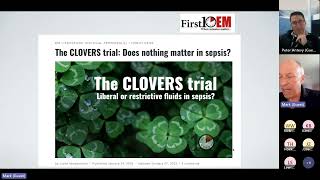
Promoted all interventions being started and even completed within one hour of patient arrival to the ed. That's antibiotics, lactate fluids, vasopressors if necessary. And now I'm going to get into the controversy because this resulted in a lot of pushback, equating the surviving sepsis guidelines and the CMS regulations with the Death Star as coming after physicians and telling the government telling them what to do. And I don't disagree with some of the criticism, but the idea that the 30 per kilo itself was harmful is something we'll challenge here in a minute. It gets even worse. On the EMCRIT podcast and website there was a sub site by Paul Merrick called the ISEPSIS Project that equated fluid with harm and in fact with death. So his article published a couple years ago, this is in 2020 called fluid resuscitation the great 30 mils per kilo hoax. As if fluids given in that volume were resulting in excess death. Actually a whole conspiracy theory developed. This is the Pulmcrit related to MCRIT website. Josh Farkas and ICU Doc put out this post on pushing back on the idea that we should be giving any volume of dedicated volume of fluid in septic shock resuscitation. And again, I don't advocate that 30 is what everyone needs, but adequate fluid resuscitation is what many patients in shock need. And he predicted something that called the Clovers trial, which is now out, but back then on this post said this is going to be a very important study. The authors are who's who of prominent researchers at big important universities like Stanford and Duke and upmc. And this study is promising and will ideally show us that we don't need to give fluids or much fluids for septic shock. So here it is. Here's the Clovers trial just came out a few months ago and the title interestingly is called Early Restrictive or Liberal Fluid Management for Sepsis Induced Hypotension. That's fascinating because you look at it and you think what does early mean? What does restrictive mean? What does liberal mean? And it implies that we mean the first minutes of care. But that's not at all what this or the next study actually looked at. So they called.
The study of liberal crystalloid versus vasopressors and septic shock, meaning fluids only or starting right away with vasopressors, which is an interesting and reasonable strategy. And they took hypotensive patients, patients with systolics under 90 who were unresponsive in the emergency department to up to 3 liters of crystalloid over their first four hours. Okay, keep that number in mind. Both arms end up getting 2 liters of fluid for their initial resuscitation, again over that four hours. And then they were randomized to up to 5 liters of fluid before the docs could start vasopressors or vasopressors alone, plus subsequent 500mil boluses for hypotension, which actually seems like a reasonable strategy. And this study was actually ended for futility, meaning no difference was shown at an interim analysis. And the study was stopped after 1600 patients. So a couple points here to keep in mind is this has essentially nothing to do with the early, meaning the first minutes of care of septic shock, whether in the ambulance or on arrival to the ed. It was all patients enrolled four hours later after they were determined to be fluid unresponsive, which seems to me like a long time.
A lot written about this. Here's a blog called the first 10em and the conclusion was really maybe nothing matters in sepsis. Liberal, restrictive, who cares? Nothing matters. There's no difference made. But again, I think it sends the wrong message because this is talking about way down the line for patients management in the ed, not the early minutes of care. This is a post after the CCTMC conference recently.
On another study which I'll present to you, which again says, hey, we can restrict fluids, it's safe. All that fluid we give doesn't matter, probably doesn't help. Fluid restriction is safe. Interesting post and interesting headline, but let's look at the study. This is the classic trial done in Europe, similar to Clover's, and they interestingly looked at adults in the ICU with septic shock. So this is way, way down the line. Once they've been admitted to the ICU, they have a lactate over 2 and they're already on vasopressors. And then they randomized them to a restrictive versus a liberal group.
The patients in the liberal group could get fluids per the physician's direction, and the restrictive group could get vasopressors plus 250mil boluses. Both groups interestingly got 3 liters. So about the process, promise and arise level of fluids, if you remember those trials and it's not given, no info is given to us on how many patients presented hypotensive or how many received their initial resuscitation and then got better enough that they didn't need to be enrolled. That's not included in this study. Patients got 800 versus 1600 in the restrictive versus the little group and there was no difference in outcome. So the conclusion in that tweet was it's fine to be restrictive, and it probably is. As an intensive care doc, I like to restrict fluids. Once we have given that initial resuscitation, we have the patients on vasopressors. And I recognize the harms of dumping continued fluids in over days time in the icu. In fact, I did this just last night with a patient in shock where we gave a few boluses of fluid, got our vasopressin and epinephrine going and stopped giving fluid boluses. That's the right way to practice. But neither of these studies have anything to do with the early minutes an hour of care. Yet they're used to justify.
A mentality that says, yeah, fluids don't really help and maybe they harm our patients. So let's look at the EMS data quickly. I have three or four studies to present to you quickly. This one's about 10 years old or more, just 10 years old. Seymour out of King County, Washington. And they noted in this study that very few patients with severe sepsis or septic shock got any fluid pre hospital. But among those who did, the more fluid they received, the less mortality they had. And that effect was most pronounced in patients with shock with hypotension. So if you look at the patients in the left hand bar, that was patients who got no iv, no fluid pre hospital and had severe sepsis, they had a 30% mortality. Interestingly, placing a catheter alone cut their mortality almost in half, presumably because that patient was prepped to begin their fluid resuscitation and antibiotics the minute they hit the door. And then the patients who got fluids in the pre hospital environment had a far lower mortality. This is similar to the more recent study by Lane et Al In JAMA Open 2018, they showed that 50% of patients, but double the previous one got prehospital fluid. And that was an average of 400mls across for all comers. And any fluid resuscitation was associated with improved mortality in patients with a systolic under 100. And where you define hypotension, I think remains an open question. You'll know that some of these studies call it 90 and some 100. But the sweet spot there was patients under 100 who got fluid resuscitation had reduced mortality. Also repeated in a French trial where they looked at the fluids in terms of ML kilo. Those who got less than 10 mils per kilo had a far greater mortality than those who got greater than 20. And this was based on actual body weight, fascinatingly, because that's another fear. If we base our fluids on.
Actual body weight in obese patients, we might overdo it. And I may agree with that. But in this study it didn't bear out and the patients who got their 20 per kilo pre hospital did better. So what about that 30 per kilo number? Again, I'm not advocating a number that everyone needs, but there are actually data now that the SEP1 bundle improves 30 day mortality. This is across almost 125,000 Medicare patients. The SEP1 bundle, which includes, as you all know, antibiotics, fluids, lactate, repeat lactate, vasopressors if necessary, had 20% absolute reduction in mortality and reduced length of stay, therefore reduced cost. All elements, including fluid administration were associated with this improved survival, except one, which was vasopressors. I wonder if that's because our vasopressors got started too late. If people had started them earlier in patients who were fluid refractory, maybe that would have shown a difference. But that did not bear out in this study. Then lastly, fascinating study on the 30 per kilo dose by Kodab et al. This was at, I believe this is in Wisconsin. And they looked at who got and who didn't get 30 per kilo in the first three hours. So pretty low bar, 30 per kilo in three hours. And they wanted to focus particularly on folks that we think may be at risk for volume overload. And those were said to be the elderly, patients with obesity, patients with heart failure and with renal disease. And they showed that failure to get 30 per kilo in in three hours increased mortality, increased ICU stay and interestingly increased the risk of intubation in the ed. So you can see here, the red arrow showed that the sweet spot, interestingly, of fluid resuscitation in the early phase of care was 30 per kilo. And those patients had the least risk of needing advanced airway management in the ed, fascinatingly. So too little fluid, they got intubated quicker. Too much on the 60 per kilo end, which we would probably all agree seems like too much. They had a higher risk of intubation. But just like the lady with the stroke, if she had not gotten resuscitated quickly and had remained with a low GCS and hypotensive, she might have gotten intubated earlier and had a much longer ICU stay. Then lastly, there's a fascinating meta analysis that just came out. Peter this is one I was telling you about yesterday. Michael Ward from Wisconsin put together many of these studies in a single meta analysis and said, well, let's look at timing, not necessarily volume, but look at timing of fluid on sepsis mortality. And looked at five studies, two conducted in ems, which I've shown you already, and three emergency department studies and, and showed that the odds of mortality were half or cut in half for earlier fluid resuscitation in patients with hypotension. Not statistically significant for sepsis patients who didn't have hypotension. But the septic shock cohort with hypotension had a much lower risk if they got their fluids earlier. So the blue bars here indicate a lower odds of mortality for earlier.
Administration, less than 30 minutes in one study, if they got their fluid resuscitation given, then they had a much lower mortality. So all this I believe, points to.
What seems intuitive, is that if we reverse shock with a modest amount of fluid and we do it quickly, we can reduce mortality and improve outcomes. And there's not harm shown in any of these. In fact there's mortality and length of stay benefit keep. Can we give too much fluid? Absolutely, 100%. We in the ICU probably do it all the time, inadvertently. This is one of my actual patients, appendicitis patient, ruptured API, septic shock. And you can see over her four day course we gave 15 liters of fluid. That was our fault. Too many drugs, too many fluid bolses, too many drips without being attentive to the volume that was being put in. That patient needed extra oxygen and needed BiPAP and potentially suffered harm from excess fluid resuscitation. But rarely does that occur, rarely does that occur in the early minutes of care, particularly in the pre hospital space. So I like to think about the concept of the slope of resuscitation, the black line being how we commonly practice we may approach the patient with shock, slowly dribble some fluid in, maybe get things fixed by the third to the sixth hour and they end up taking a lot longer to recover and may need more interventions. Whereas if we follow the blue line and elevate that slope, reverse shock early with an adequate amount of fluid in the early minutes of care, get vasopressor started early and then de resuscitate for us in the icu, begin to draw that fluid off with Lasix or other methods, we can improve care and reduce interventions. And then lastly in, if you want to shift that concept to the prehospital Space, which these studies all validate. If we can make time zero happen at the time we pick the patient up at the nursing home or at home or elsewhere at a referring hospital, then maybe we can improve outcomes by earlier resuscitation in the field. So, Peter, I think I'm going to stop. There's seven minutes left. I have other data I could share with you, but why don't I stop there and see if there's questions or controversies that people want to raise?
Wow, Mark, let me tell you.
This data is so important to see in the whole. And so many years have gone by with. Actually, can you stop sharing? So I don't see myself. Yep.
So many years of data have gone by with these individual studies, and then they're being evaluated. It was funny that the first 10em website, I mean, the irony that the guy who's the first 10 em didn't recognize that the study he was evaluating was somewhere many hours later in the United States.
It was in the first four hour.
Right, right. So.
You know, why is it that when you present the data like this, that they just don't get it?
Number one.
And that's my question, number one. But it goes back to the current guidelines, American Heart association guidelines, which are done by ICU doctors, and then we in ems, a subspecialty of our own, are kind of looking at their data. So what do you say to us about, you know, the lens by which you look at the data needs to be the specialty in which you practice and the moment that you see the patient. So can you address why you think this is happening and how could be 2023 with a lot of smart people who just are getting it wrong?
I wish I knew the answer. I'd love. I'd love input from Paul or anyone else on the line on that. I think that the studies, like you mentioned, the Feast trial, and there was another Africa adult septic shock trial, in which the populations and the illnesses that those patients were suffering from were vastly different than what we encounter. And they showed some harm. Children with malaria and anemia who were given fluid boluses empirically didn't do as well. And we would agree that we wouldn't want to do that here. Why that translates into how we treat adult and pediatric septic shock in the US I still have not fully recognized. I do believe that CMS guidelines that seem to mandate a treatment protocol are an irritant, understandably making us think we're told how to practice. But they're actually fairly reasonable guidelines. And there are Many exit ramps from them if you don't feel like the patient applies specifically. But Peter, I wish I had the answer to that, but I think we all need to dig down into the studies and understand the data and understand that the headlines don't always apply to the patient population we're most commonly encountering.
100% agree. And people have a question, just raise your hand. But when I was in la, a resident in LA Children's, the head of the department, a man by the name of Alan Nagor, great guy, he came up with an idea that he wanted to give, right? He wanted to give 50 per kilo fast. And I mean it was almost like he was, he was murdering people. And actually the results were quite good. I was there, I was the one giving the 50 per kilo. But it kind of fell off the radar because it wasn't like the thing to do. You have done amazing things and you have the data to back it. I'm curious, the folks who are using lifeload to get fluids fast in the field, what does the data show? Do you have any early data you can at least tell us here on the webinar from Wake and other places that are using a device to get fluids early?
We do. We have two studies which have been presented a couple meetings, ASEP and NAEMSP and will hopefully be published if we can get them published. Where we looked at pre and post implementation of giving adequate amount of fluid pre hospital, one in Florida, one in Wake county and both show the same trend that if we one it's possible to resuscitate better prehospital, it's possible to recognize sepsis adequately for our pre hospital teams and the patients who do get resuscitated earlier with more fluid. And this is anywhere from 1 to 1.5 liters. Typically the typical amount of fluid across all studies given an EMS for septic shock is between 250 and 400 mils. That's about what happens and that's what we validated in these two studies. That's about what people got in prehospital for septic shock. Those in the post groups who got more showed improvement in their vitals. Interestingly, reduced need for oxygen, not more. Similar to what I showed you in the cut up study. They needed less airway interventions and had trends towards neither were bigger enough but had trends towards lower mortality. So less ICU stay, less mortality and better vitals upon presentation to the ed. So they're small studies, hard to do big randomized trials, but validate much of the Data that I showed you. And in fact, in our own center, we looked at patients coming in by EMS who got more or less fluid. This is nothing to do with any device, just how much they got. And patients who did not get adequately fluid resuscitated pre hospital didn't get their 30 per kilo, then within the ED time and had higher mortality, there's a fairly clear signal. And the hypotensive patients are most at risk. So I think those are the ones that we should be paying attention to and trying to adequately resuscitate according to the protocol that I showed you at the beginning. 250 to 500 boluses until we get that pressure over 90 and then stop.
Beautiful. Is there anyone on the call who has a conflicting opinion or is there any data that, as I wait for that. Is there any data that is showing the opposite? Is there any study out there today that shows that pre hospital or early fluid resuscitation is harmful? Like something that is relevant to the EMS world that we should know about, that we should read today that says what you just heard was wrong? Is there anything out there that you know of to the contract?
Peter, would you just read. You said what we just heard. Oh, sorry about that. So, yeah, I was just asking, are.
There any EMS studies that show.
You asked the question what we heard. So what did you just hear? That's what I wanted to know.
We just heard that all of the studies that are done that we're looking at are done in the icu. And those are the studies that show that are trying to show that.
Limiting fluids may be beneficial. Mark is showing us that there's proof that there's early fluid resuscitation is beneficial, that giving fluids early works. Are there any studies that show the opposite? EMS studies that show that early, early fluid is harmful is my question.
And we're talking about sepsis, not trauma, Peter, Because.
Correct. Sepsis, yes, sepsis, yeah, there are some, but this is more at a micro circulatory level. Studies that can show some differences here, but I don't think it's worth getting into here. I just want to make sure it's clear that. Because what happens often later on is a totally different situation as far as correct than in the early situation.
All that.
One of the things that I'd like to always emphasize under these circumstances, if it took you a long time to get cold, you warm them up slowly. If they are cold really quickly, you warm them up quickly. So there's all sorts of physiological. Let's Say, reflexes that kick in and change things a lot. So it kind of. Some of it just depends. Okay. But again, what you're also doing is you're saying you're taking your best guess for the group of people that you're dealing with, that that's what you're trying to do. So, anyways, I got to get on the call, but I don't know if I helped or not by answering it. But I want to make sure it was clear. I wanted to bring out to everybody because we heard a lot of information. I wanted to make sure, what are you distilling out of this? And that's the important thing. And then I think ultimately you're right. There's a bunch of people in an ICU telling us what. What to. What to do here, and we have a whole different specialty area here in resuscitation medicine, so. All right.
Yeah, thanks, Paul. We're going to pass over in just a second, but, yeah, I mean, just to kind of make my point more clear, that as I know it today, there are no studies in EMS that show that early fluids are harmful. Correct, Mark? Correct.
And the not that I'm aware of, and in fact, those that are published in the last 10 years show the earlier, the better, the better the mortality. And the studies that are comparing the liberal quote to the conservative fluids are much later in the course, hours into the ED course or in the icu. So they're not really applicable to our world. So I'll stop there. Peter, thanks for inviting me.
Yeah, you got it. Let's go to Dr. Landry, Panhandle, Florida. Go ahead, Kim.
Does ultrasound have any play or any say in this in terms of the safety of how fast we give these fluids to the patients with respect to volume? We can measure their volume with ultrasound or cardiac activity or lung overload.
Peter, you muted.
Mark, did you hear the question?
Sorry, I accidentally cut myself off. Can you repeat it?
Yeah, Kim, go ahead.
Yeah, I was just wondering if ultrasound would have any role in EMS to kind of gauge and guide us in terms of how fast we can give fluid, how much we can give before we need to start backing off or monitoring.
I believe 100%, and I wish we could make better use of. Tends to be more expensive and hard to train, but I think it's coming to ems. I know some agencies are beginning to use it, and I believe, yes. My protocol in my own hands is simply to look at the IVC in a patient who's in shock and spontaneously breathing. If it's collapsible if it's readily collapsible, and our medics can see this, they will tolerate fluid. So a hyperdynamic heart and a collapsible ivc. If the IVC has a very minimal collapse, then it's a patient that we would probably want to be cautious with the fluids in. And that's going to be the minority of patients. Patients with severe heart failure, a PE tamponade, even though in those cases they may need a little fluid. It's really the patient with heart failure and minimal IVC collapse and depressed heart function on ultrasound, in whom we should be cautious. So I think it can guide fluid resuscitation and the IVC collapsibility index, which is a fairly simple thing to learn, could be a great tool to do it. I don't know if anyone on the call has experience with that with their own teams. I try to teach folks that. I come across that every day, although we have not implemented it in the prehospital space yet.
Awesome. Great, great question, great answers to. Mark, we're going to end and I'm going to give you the last word. So you have a lot of folks on this call and we're going to watch this call and they're. We're all EMS people. Right. What do you say to us as far as, you know, your, your last words or advice to us moving forward this year?
I mean, I'd say read the literature carefully. The headlines are not always what's actually beneath. There's a lot of, there's, there's a lot more data beneath the headlines that we need to understand. And I think in this space in particular, as you named the webinar, Peter, there's a lot of confusion about fluids. I think a modest amount of fluid given earlier with attention to reversing hypotension will improve our patients outcomes. And I think most patients will benefit, few will have adverse consequences from that. And to Dr. Landry's point, if we could implement ultrasound. Wow. We could really even tailor that better. But I think the data show even in the absence of ultrasound, that earlier fluid resuscitation and septic shock improves our patients outcomes.
Awesome. Great, great ending, wonderful talk, a beautiful overview. I love your slides and thanks again for updating us on that.
And Peter, I can send references if it would be helpful for you to pass around to folks. I can send all those references to you, please.
That would be wonderful. Yes, that'd be great. Okay. All right.
Thanks for the invite.
Appreciate it. All right, so Angus, if you could take us over to the big show. Mark, thank you so much again. I'm gonna Post this on YouTube as soon as I get it. Thank you.
Hey Peter, you don't happen to be in a position to do the restream today, do you? I could, yeah, Because I'm just juggling a bunch of stuff so I can. If you can, it's great. If not, I can set it up but won't be able to participate.
You know what? Maybe I'll give it to Joseph. Jay Z, can you do this? Only because I'm going to be in and out more than likely as well. You have the link, Joseph. Are you available to do that? If not, we'll figure it out.
If you'll send me the link, I'll try.
Okay.
Okay. It's in your inbox here in a second.
Okay, I'll work the magic on my side.
More from Peter




Melissa Olen MSN, FPN-C, CCRN: Sudden Cardiac Arrest Training in Schools (Project ADAM) 4/25/25



Pediatric Hospital Readiness: How Teamwork & CPR Metrics Drive Better Outcomes



Chelsea Kadish, MD & Kyle Goodknight, EMT-P, RT: Pediatric CPAP in EMS (3/14/25)